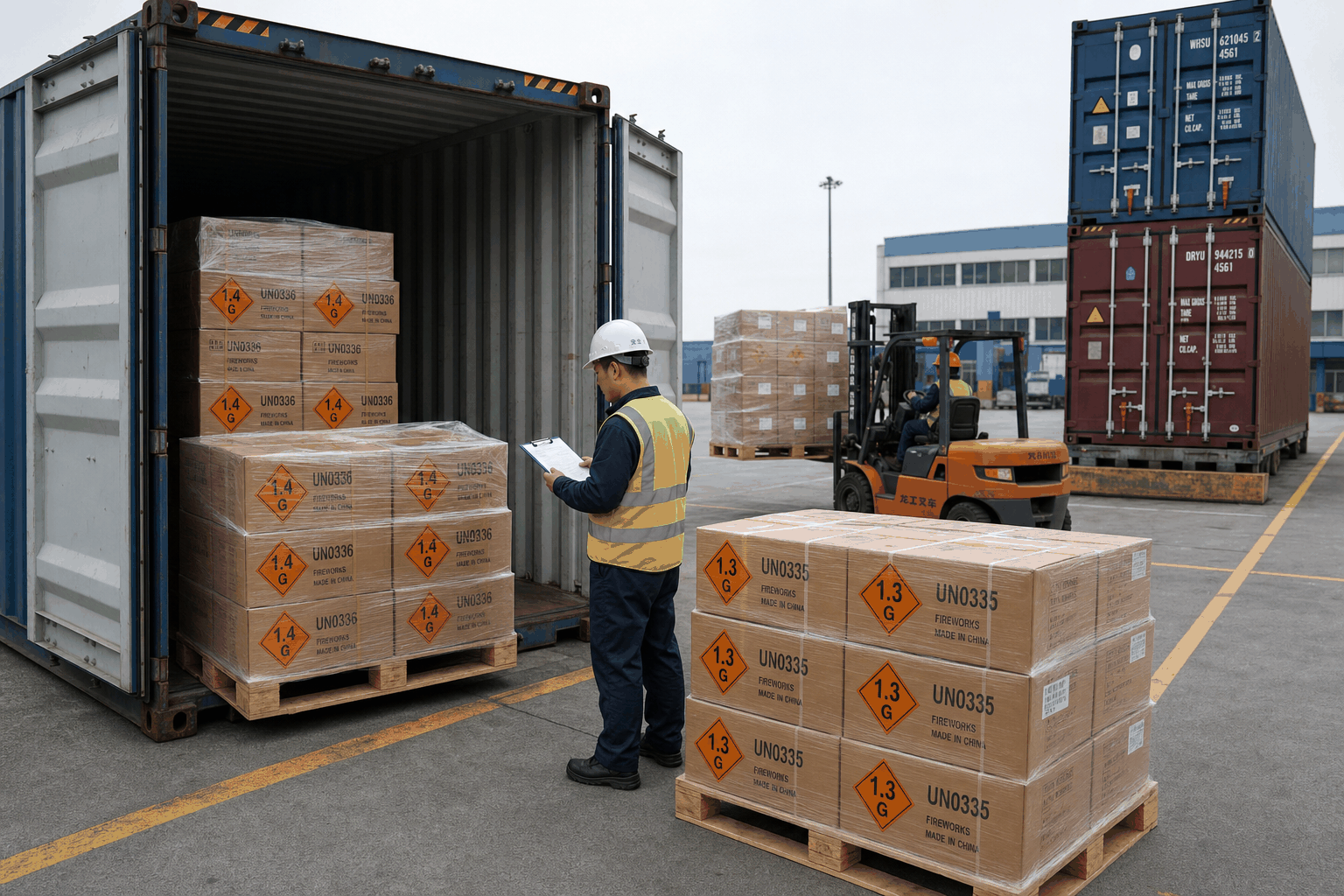
Jebel Ali is the working default GCC entry for Class 1 fireworks, and most weeks of the year it is the easiest one to plan against. DP World’s flagship port is one of the few Persian Gulf calls where four things line up in the same booking: a Class 1-rated berth, a segregated dangerous-goods yard, on-site UAE Civil Defence presence, and a transhipment network into Saudi inland, Oman, Bahrain and Kuwait with fewer hand-offs before the cargo reaches the destination market. For a Liuyang factory loading UN0336 1.4G family-assortment cartons in November or UN0335 1.3G display product in October, the practical question is rarely whether to use Jebel Ali — it is whether the document set will keep up with the vessel.
This guide sits alongside our GCC fireworks logistics hub and walks step by step through what a clean Jebel Ali clearance actually looks like: why DP World became the default, the five-document chain that has to land before the box does, what UAE Civil Defence checks on-site, how a Jebel Ali container is transhipped onward, where dwell time and demurrage typically bite, and how the five GCC Class 1 ports really compare once Strait of Hormuz exposure and 2026 Red Sea routing risk are on the same table.
Why Jebel Ali Has Become the Default GCC Entry for Class 1 Fireworks
From a factory-side view, the GCC has roughly five live Class 1 fireworks ports: Jebel Ali (UAE), Jeddah Islamic Port (Saudi Red Sea), Dammam (Saudi Persian Gulf), Hamad (Qatar) and Sohar (Oman), with Salalah serving Dhofar in the south. All five clear Class 1 cargo. Only one of them clears it on a consistent weekly schedule at the volume the GCC market actually moves.
Jebel Ali handles the largest share of GCC Class 1 fireworks volume because three operating conditions line up in one port that rarely line up elsewhere: a segregated dangerous-goods yard with Class 1-rated berths, a continuous UAE Civil Defence (DCD) presence that can inspect cargo on-site rather than after a road move, and a deep transhipment network into Saudi, Oman, Bahrain and Kuwait. On top of those three, Jebel Ali sits on the Persian Gulf and is approached via the Strait of Hormuz, which keeps it outside the 2026 Red Sea routing risk that sits on Jeddah and King Abdullah Port.
From our seat in Liuyang, a typical 1x40' HC of UN0336 1.4G consumer fireworks heading to a UAE importer with a clean magazine licence usually clears the Jebel Ali DG yard in two to four working days. The same factory loading the same SKUs into a Jeddah lane currently has to plan for 14–21 extra days of Cape-of-Good-Hope routing on top of the clearance itself. That gap is structural, not a one-off operating accident.
A note on the numbers: the two to four working days in this guide refers to DG yard release — UAE Civil Defence on-site review plus Mirsal 2 customs acceptance on a clean document set. The 5–10 working days window quoted in our parent GCC logistics hub is the wider full import-side clearance figure that adds carrier free-time variability, customs workload and any random DG inspection on top. Both ranges describe the same lane; they just measure different points on it.
DG-Friendly Port Infrastructure — DG Yard, Class 1 Berth and On-Site DCD
The reason Class 1 cargo clears Jebel Ali quickly is not goodwill. It is infrastructure that was engineered for dangerous goods from the start, then layered with a Civil Defence workflow that other GCC ports replicate only partially.
Segregated Dangerous-Goods Yard
A dedicated DG yard with separation distances and segregation rules for IMDG Class 1, so a 1.3G display container does not have to share a stack with reefer or general cargo while it waits for inspection.
Class 1-Rated Berth
Specific berths are pre-cleared for Class 1 discharge with the quantity-distance and DG-handling rules built into the call schedule, which removes the “named-vessel only” bottleneck that hits some other GCC ports.
On-Site UAE Civil Defence
UAE Civil Defence (DCD) reviews the cargo and the importer’s magazine licence at port, with Ministry of Interior sign-off where the SKUs require it, rather than waiting for a road-move to an inland licensed magazine for inspection.
Multi-Modal Onward
Road-bridge to Saudi via Al Ghuwaifat / Al Batha, feeder vessels to Bahrain (Khalifa Bin Salman), Sohar and Hamad, and a free zone that lets a transhipment buyer bond the cargo without an in-country import declaration first.
None of these four are unique to Jebel Ali in isolation. What is unusual is that all four sit inside one port call. From the planning side, that means a single booking decision unlocks both a clean inspection path and a clean onward path.
The China-to-Jebel Ali Document Chain — DGD, Shipper's Declaration, IMO Form, Booking, B/L
Almost every Jebel Ali delay we see at the factory traces back to one of five documents being late, mismatched, or filed against the wrong UN classification. The chain is not long. It just has to land in the right order.
Booking Confirmation & Vessel Slot D-45 from arrival
The forwarder confirms the Class 1 DG slot on a named vessel out of a southern Chinese DG-certified port (typically Huangpu, Shenzhen, Shanghai or Ningbo) and verifies the vessel actually calls at Jebel Ali. A booking that calls only at Salalah for transhipment is not the same booking.
Dangerous Goods Declaration (DGD) & Shipper's Declaration D-21 to D-14
The DGD is drafted against the actual carton-level SKU list and the IMDG class of each lot (UN0336 1.4G for consumer, UN0335 1.3G for display, UN0337 for very small theatrical effects where applicable). The shipper's signed declaration matches it exactly. A DGD that lists “1.4G” when one carton is actually 1.3G is one of the most common clearance rejects we see.
IMO Dangerous Goods Form D-14 to D-10
The IMO DG Form is prepared for the named vessel and lodged with the carrier’s DG desk. Net explosive quantity (NEQ) per carton, segregation group, packing group and emergency response codes have to match the DGD verbatim; even a 1-unit numeric mismatch can hold the booking.
Bill of Lading + CIPL D-7 to D-3
The Bill of Lading and the Commercial Invoice / Packing List (CIPL) reference the same UN numbers and the same total NEQ per carton. The importer’s name and address on the B/L match the magazine licence on file with UAE Civil Defence; otherwise the DCD review will not start.
Mirsal 2 Customs Declaration on arrival
A UAE-licensed customs broker files the Mirsal 2 declaration against the Dubai Customs portal, with the DG documents and the DCD pre-approval attached. Once Mirsal 2 is accepted and DCD signs off on the magazine licence reference, the container is released from the DG yard for road or feeder onward movement.
Most Jebel Ali clearance delays we trace at the factory are not about missing documents, they are about a mismatch between two of them. The cheapest insurance is a single carton-level SKU list reviewed by the forwarder, the factory and the importer in the same week before D-21 — not three separate versions in three separate inboxes. We are happy to do that review from the Liuyang side.
DCD Inspection at Jebel Ali — What UAE Civil Defence Actually Checks
The UAE Civil Defence on-site review at Jebel Ali is not a deep technical re-test of the product. The testing has already happened — it is referenced in the importer’s DCD pre-approval. The on-site review is a compliance handshake that the container in front of the inspector is the same container that the pre-approval covers, and that the receiving magazine is ready to take it.
Which means the approvals behind that pre-approval have to be in place long before the ship arrives, and under UAE law they come in two layers rather than one — the importer’s standing licence and a permit for the consignment itself. It is worth naming the parties, because those upstream layers are not all Civil Defence’s to give: the federal permit to import explosives is issued by the Ministry of Interior, and for a Dubai entry the shipment clearance NOC comes from SIRA. Civil Defence is the body reviewing the cargo and the receiving magazine here at the port. Who is allowed to hold each, why a free-zone entity is not exempt, and how the emirates differ are covered in our UAE fireworks import approval guide.
In our experience the DCD inspection covers five things, in roughly this order:
- Document match. Does the DGD, the Shipper's Declaration, the IMO DG Form, the B/L and the importer’s DCD pre-approval reference the same UN classes, the same NEQ totals, and the same importer name and address?
- Importer magazine licence in date. Is the importer’s magazine licence still valid through the planned road-move date, and is the licensed magazine capacity sufficient for the inbound carton count?
- Carton labelling integrity. Are the UN0336 1.4G or UN0335 1.3G orange-diamond hazard labels intact on the outer cartons, are Arabic + English compliance markings present, and is the moisture barrier visibly undamaged?
- Container seal integrity. Is the original DG-supervised seal applied at the Chinese loading port still intact, and does the seal number match the DGD?
- Onward movement plan. Is the road-mover (or feeder vessel) DG-certified for Class 1 and booked against the right window, so that the cargo does not sit in the DG yard waiting for transport after clearance?
Containers that pass all five typically clear on the same working day the inspection takes place. Containers that fail one of them — most often the document match — sit in the DG yard while the importer’s broker resolves the gap, and demurrage starts to accumulate from the carrier’s free-time cut-off.
Transhipment from Jebel Ali to Saudi, Oman, Bahrain and Kuwait
A meaningful share of the cargo that lands at Jebel Ali never sits on a UAE retail shelf. It is transhipped onward, by road bridge or feeder vessel, into one of the other GCC markets. From a planning point of view the four onward routes look like this:
Road bridge via Al Ghuwaifat / Al Batha
DG-certified road carrier moves the container over the UAE–Saudi border with the full SABER file attached (in-hand product certificate, SABER shipment certificate, importer CR and ZATCA tax registration). Without the shipment certificate the box does not move.
Feeder vessel to Khalifa Bin Salman, or road via KSA
Smaller Eid and National Day lots usually move by feeder to Khalifa Bin Salman Port; larger consolidated loads sometimes road-move through Saudi via the King Fahd Causeway. Bahrain importer is Ministry of Interior with Civil Defence approval.
Feeder to Sohar, or road via UAE–Oman border
Oman cargo typically feeders to Sohar (Gulf of Oman, just outside the Strait of Hormuz); Salalah is rarely the onward node from Jebel Ali because it sits on the Arabian Sea distant from Hormuz. Permits come from the Royal Oman Police, and Oman’s transit permit for explosives must be in place before the cargo arrives — see the Oman import guide.
Feeder to Shuwaikh / Shuaiba
Kuwait-bound cargo typically feeders to Shuwaikh or Shuaiba (both Persian Gulf side via the Strait of Hormuz). Importer is the Ministry of Interior, Explosives Section. Q4 feeder availability tightens when UAE National Day and Eid windows overlap.
The most common transhipment failure mode is documentation that was correct for the Jebel Ali leg but incomplete for the onward market. A clean Jebel Ali DCD review does not by itself satisfy SABER for Saudi, Royal Oman Police for Oman, or Bahrain MOI; each onward market has its own file and its own approval path. Plan the onward documentation in parallel with the Jebel Ali documentation, not after it.
Dwell Time, Demurrage and the Q4 Slot Crunch
Dwell time at Jebel Ali for a Class 1 fireworks container depends on three things: how clean the document set is, whether the carrier’s free-time has been negotiated up-front, and which week of the year the box lands in. The pattern we see at the factory looks like the table below.
| Scenario | Typical Dwell | Demurrage Exposure | Notes |
|---|---|---|---|
| Clean document set, UAE retail | 2–4 working days | None within standard free time | The base case. Mirsal 2 and DCD on-site review complete in the same week as arrival. |
| Clean document set, Saudi transhipment | 4–7 working days | Usually inside free time | SABER shipment certificate must be in hand before the road-bridge move; absence here resets the clock. |
| DGD vs CIPL UN number mismatch | 5–10 working days | Starts at day 6–7 | Reissue of the DGD and corrected B/L typically take a working week from the loading port. |
| Importer magazine licence expired | 10–20 working days | Significant | The most expensive single failure mode we see. Renewal can take two to four weeks; the box sits in the DG yard meanwhile. |
| SABER missing for Saudi onward leg | 15–30 working days | Significant | Opening or re-opening the SABER conformity route from Jebel Ali side adds two to six weeks; demurrage accumulates throughout. |
| Q4 + Eid + UAE National Day window | +1 to +3 working days on any of the above | Add 10–20% | Late-November through mid-December has the highest combined GCC inbound DG volume; plan the document set tighter, not looser. |
The economic point in this table is the gap between rows two and four. The difference between a clean Saudi-transhipment plan and a magazine licence that quietly lapsed during Q3 is rarely a difference of preparation effort. It is almost always a difference of which week the licence renewal was put in the calendar — and that gap shows up in 1.4G consumer cartons sitting in the DG yard while the Eid retail window slips away in Riyadh.
Jebel Ali vs Jeddah vs Dammam vs Hamad vs Sohar — How the Five GCC Class 1 Ports Compare
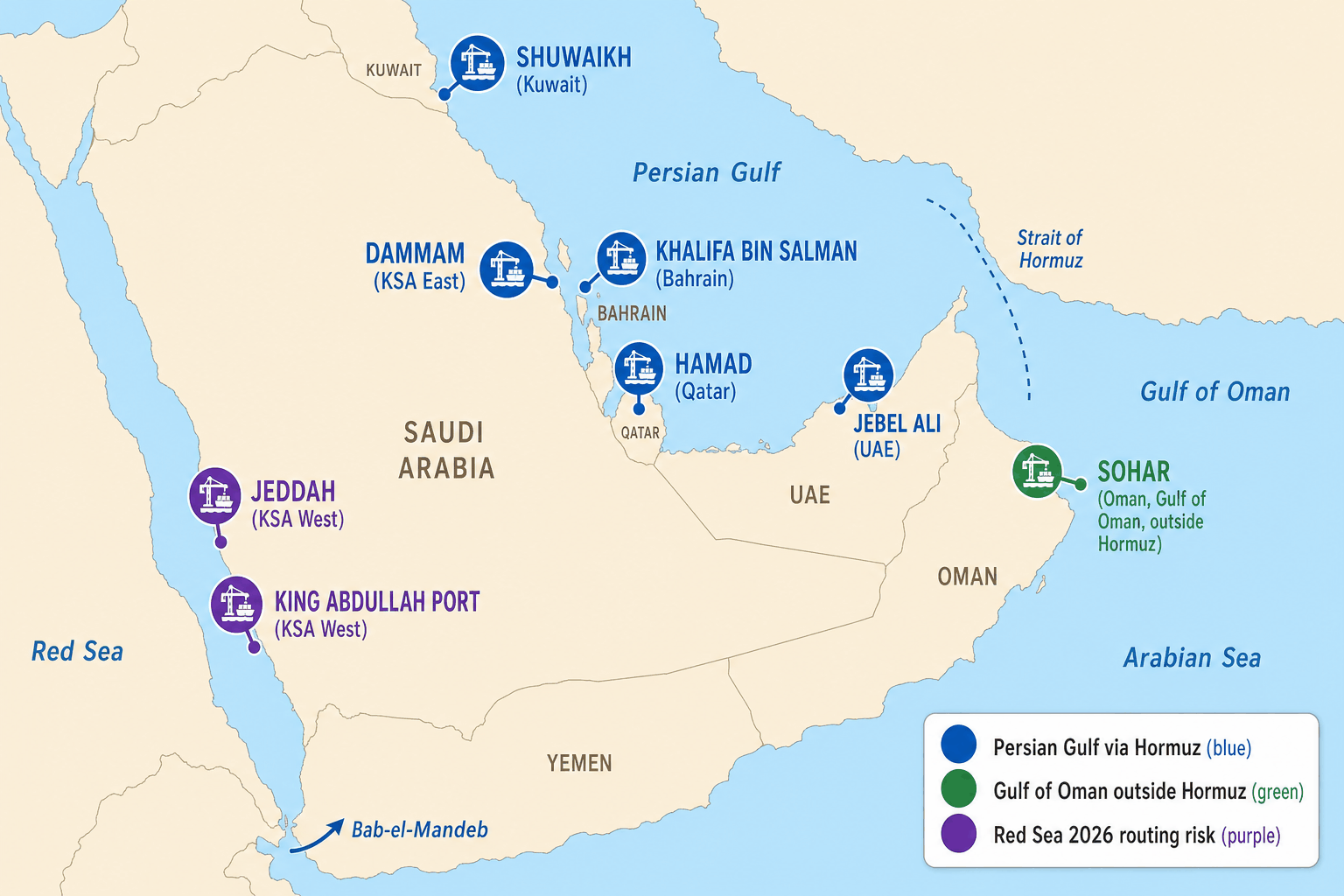
The five live GCC Class 1 fireworks ports do not sit on the same map for routing risk. The colour-coding below follows the geography honestly rather than the marketing brochure: ports approached via the Strait of Hormuz are one group, ports outside Hormuz in the Gulf of Oman are a second group, and Red Sea ports are a third group with their own 2026 routing exposure.
Jebel Ali (UAE)
The default GCC Class 1 entry. DG yard, Class 1 berth, on-site UAE Civil Defence, deep transhipment network. No Red Sea routing risk. Q4 + Eid + UAE National Day extend dwell by 1–3 days.
Dammam (Saudi East)
Primary Saudi Persian Gulf entry for eastern Saudi and Bahrain transhipment. SABER and ZATCA file at full Saudi standard. No Red Sea routing risk. Lighter DG slot pressure than Jebel Ali; fewer alternative vessels.
Hamad Port (Qatar)
Default Qatar entry for Class 1 cargo bound for Doha and Lusail. Ministry of Interior with Civil Defence approval; importer magazine licence required. No Red Sea routing risk. Lower weekly volume than Jebel Ali.
Sohar (Oman)
Sits on the Gulf of Oman just outside the Strait of Hormuz, so it neither requires a Hormuz transit nor carries Red Sea routing risk. The Royal Oman Police license the importer’s store and issue the import permit, which must be in place before the ship sails. Useful as a Hormuz-bypass option when geopolitical headlines tighten.
Jeddah Islamic Port (Saudi West)
The historical Saudi western entry. Most exposed of the five to 2026 Red Sea routing disruption; Cape of Good Hope routing adds 14–21 days versus the pre-2023 Suez calendar, plus a war-risk premium of roughly 0.05%–0.5% of cargo value on Suez-routed alternatives.
King Abdullah Port / KAP (Saudi West)
The newer Red Sea alternative to Jeddah, often used by forwarders looking to spread Red Sea exposure across two western Saudi calls. Same 2026 routing risk profile as Jeddah; SABER file at full Saudi standard.
Four of the five ports above sit close together operationally once Hormuz transit is on the table; the fifth (and the King Abdullah Port alternative) carries a Red Sea routing exposure that has been stable for long enough now to plan around rather than wait out. For the full port-by-port view with war-risk pricing and the FOB / CIF / DDP decision, our GCC logistics hub is the next read.
Why 2026 Red Sea Routing Risk Is Indirect for Jebel Ali
One of the most common misreads we hear from new GCC buyers in 2026 is that “the Red Sea problem” affects every Middle East port. It does not. Jebel Ali is on the Persian Gulf, and the relevant approach is the Strait of Hormuz, not Bab-el-Mandeb. The picture below is the operational reality from a Class 1 routing point of view.
Jebel Ali — via Strait of Hormuz
Persian Gulf approach. Operationally stable in 2026 against current Red Sea disruption.
- For China-origin Class 1 cargo, the practical Jebel Ali lane is Indian Ocean → Strait of Hormuz; it does not require a Red Sea or Bab-el-Mandeb call at all.
- Carriers that have rerouted their Red Sea services via the Cape of Good Hope still reach Jebel Ali on the same Persian Gulf call — the only meaningful change is extra sailing days.
- No structural Red Sea war-risk premium attaches to the Jebel Ali leg itself, even when Suez-routed alternatives carry one.
- Transhipment from Jebel Ali to Dammam, Hamad, Sohar, Khalifa Bin Salman, Shuwaikh and Shuaiba all stays on Persian Gulf or Gulf of Oman lanes.
Jeddah / KAP — via Bab-el-Mandeb
Red Sea approach. 14–21 days added on Cape of Good Hope reroute since late 2023.
- Cape routing adds 14–21 days to a China–Jeddah / KAP sailing versus the pre-2023 Suez calendar.
- War-risk premium on Suez-routed alternatives runs roughly 0.05%–0.5% of cargo value, with the higher end on specific Jeddah calls.
- Many Saudi-bound forwarders now route via Jebel Ali transhipment to Dammam, or accept the Cape sail into Jeddah directly with the longer planning buffer.
- The Hormuz-side ports (Jebel Ali, Dammam, Hamad, Khalifa Bin Salman, Shuwaikh, Shuaiba) and the Gulf-of-Oman port (Sohar) do not share this risk profile.
Practically: if a buyer’s calendar still assumes pre-2023 Suez sailing times, the Jebel Ali plan still works as-is; it is the Jeddah / KAP plan that needs a Cape buffer added. That is the part most worth re-checking before locking the next Q4 booking.
Eight Common Jebel Ali Clearance Mistakes We See at the Factory
Across years of Class 1 fireworks containers shipped from Liuyang into Jebel Ali, eight failure patterns account for most of the dwell time and demurrage we see. None of them are exotic.
- Wrong UN number on the DGD. A 1.3G display SKU bundled into a container declared as “1.4G consumer only” is the single most common reject. The carrier’s DG desk catches it before the vessel sails, and the booking moves to the next available slot.
- DGD net-explosive-content mismatch with the CIPL. Even a small numeric drift between the DGD totals and the commercial invoice totals will hold Mirsal 2 acceptance.
- Importer name on the B/L does not match the magazine licence. A trading-company name on the B/L and an operating-company name on the licence look minor on paper; UAE Civil Defence will not start the inspection until they match.
- Magazine licence quietly expired during Q3. Renewal is not difficult, but it takes two to four weeks. A container landing in November against a licence that expired in October is the most expensive single mistake on this list.
- SABER missing for a Saudi transhipment leg. The Jebel Ali DCD review can be clean and the container still cannot leave the transhipment yard. The SABER shipment certificate has to be in hand for the road bridge, not promised for next week.
- Booked vessel does not actually call at Jebel Ali. Some Class 1 sailings out of southern Chinese DG ports transit only Salalah for onward feeder. A buyer expecting a direct Jebel Ali call discovers the difference only when the container lands two weeks late.
- DG seal integrity broken on arrival. A reseal during a transhipment leg without a corresponding amended DGD will fail the seal-number match check on-site at Jebel Ali.
- No DG-certified road-mover booked for the onward leg. Class 1 cargo cannot leave the DG yard on a general-freight truck. Booking the road-mover after clearance, instead of before, is a clean two-day delay every time.
Q4 + Eid + UAE National Day — Where the Dwell Time Spikes
Jebel Ali is operationally stable through most of the calendar, but three windows compress it every year: UAE National Day (December 2), Eid al-Fitr lead time (variable, walking 10–12 days earlier each Hijri year), and the global Q4 pre-Christmas / pre-Spring-Festival DG vessel squeeze. Two of the three are inevitable; the third moves into the same window for years on end before it walks back out.
Practically, that means buyers planning UAE National Day cargo for early December and Eid al-Fitr 1.4G consumer cartons for late February or March (depending on the year) hit the same Jebel Ali DG yard at the same time. The dwell-time penalty during this window is rarely dramatic per container — usually one to three additional working days — but the demurrage exposure compounds because the carrier’s free-time cut-off is the same. The realistic discipline is to plan Q4 GCC containers with the document chain a week earlier than the rest of the year, not a week later.
For the full Hijri walk and the Eid al-Fitr backward plan that determines the most pressured Q4 windows year over year, see our Eid al-Fitr 90-day sourcing timeline companion. For the UAE-side magazine licence work that has to be in date before any of the above runs cleanly, the GCC storage and hospitality hub covers the licence and 6-country comparison in detail.
Frequently Asked Questions
Why is Jebel Ali the default GCC entry for Class 1 fireworks?
Three things line up at Jebel Ali (DP World) that rarely line up at other GCC ports: a Class 1-rated berth with a segregated DG yard, on-site UAE Civil Defence (DCD) clearance instead of a post-arrival road move, and a transhipment network into Saudi inland, Oman, Bahrain and Kuwait. Persian Gulf approach via the Strait of Hormuz also keeps Jebel Ali off the 2026 Red Sea routing exposure that sits on Jeddah and King Abdullah Port.
What documents does the importer need before the container arrives at Jebel Ali?
Six items in the importer’s hand before arrival: a current UAE DCD pre-approval covering the UN classes on the booking; an importer magazine licence valid through the planned arrival date; a DGD and signed Shipper's Declaration that match the carton-level packing list; an IMO Dangerous Goods Form for the named vessel; the B/L and CIPL referencing UN0335, UN0336 or UN0337 as applicable; and a Mirsal 2 declaration prepared by a UAE-licensed customs broker. Missing any one is the most common reason a container parks in the DG yard at the importer’s cost.
Can Jebel Ali handle 1.3G display product, or only 1.4G consumer?
Both. UN0335 1.3G display and UN0337 theatrical effects move through Jebel Ali alongside the higher UN0336 1.4G consumer volume. The practical difference is documentation and slot pressure: 1.3G display travels under a tighter DG surcharge band, a smaller pool of carriers, and a tighter UAE DCD review. From the factory side we book 1.3G containers earlier in the planning window than 1.4G consumer to hold the Class 1 vessel slot.
How long does a typical Jebel Ali clearance take for a Class 1 container?
With a clean document set in the importer’s hand before arrival, a Class 1 container typically clears the DG yard in two to four working days, including the UAE DCD on-site review and Mirsal 2 customs processing. Paperwork mismatches (wrong UN number on the DGD, missing magazine licence reference, SABER absent for a Saudi transhipment) routinely add a week or more, with demurrage from day five. Q4 windows around UAE National Day and Eid al-Fitr extend these numbers.
What happens to a Jebel Ali container if SABER paperwork is missing for a Saudi transhipment?
A Class 1 container transhipped from Jebel Ali into Saudi by road or feeder needs a complete SABER file: an in-hand product certificate per SKU, a SABER shipment certificate, plus the Saudi importer’s CR (commercial registration) and ZATCA tax registration. If the shipment certificate is missing or issued against the wrong SKU list, the container does not move past the Jebel Ali transhipment yard. Opening or re-opening the SABER conformity file from Jebel Ali side typically adds two to six weeks while demurrage accumulates.
Does 2026 Red Sea routing risk affect a Jebel Ali sailing?
Only indirectly. Jebel Ali sits on the Persian Gulf and is approached via the Strait of Hormuz, not the Red Sea. For China-origin cargo the practical lane is Indian Ocean → Strait of Hormuz, which does not require a Red Sea or Bab-el-Mandeb call. Carriers rerouting their Red Sea services via the Cape of Good Hope still reach Jebel Ali on the same Persian Gulf call — only sailing time changes. The 14–21-day Cape detour and 2026 war-risk premium mainly sit on Jeddah and King Abdullah Port, and on Suez-routed services into Dammam or Hamad.
Continue Reading by Market
- Parent logistics guide → Shipping Fireworks to the Middle East: Ports, DG Process & 2026 Red Sea Routing
- GCC compliance overview → Importing Fireworks to the Middle East (Saudi, UAE, Qatar, Kuwait, Bahrain, Oman)
- Saudi onward leg deep dive → Saudi SABER & SASO Step-by-Step (2026 Guide)
- Eid al-Fitr 90-day plan → Eid al-Fitr Fireworks: 90-Day Sourcing Timeline for GCC Buyers
- UAE magazine & storage rules → GCC Storage & Hospitality: Magazines, Weddings & Hotel Pyro
Planning a Jebel Ali Class 1 Container from Liuyang?
Send us your destination GCC market, target arrival week and SKU mix. We'll line up the DG document set and SABER / DCD references against a named Class 1 vessel, so the container has the best chance of clearing the Jebel Ali DG yard inside its first free-time window.
WhatsApp Email