A fireworks container bound for the Gulf is not a normal box of cargo. It is IMO Class 1 dangerous goods, it can only sail on a carrier that accepts UN0335 / UN0336 / UN0337 in that exact lane, and it has to clear a destination Civil Defence regulator that does not treat fireworks the way it treats general freight.
This page is the GCC logistics hub. It covers where the container actually leaves China, the working entry ports across the six GCC markets, the 2026 Red Sea routing reality, the war-risk and DG cost stack, and the FOB / CIF / DDP decision that decides who carries the risk when a Class 1 box gets held at a transhipment hub.
China-to-GCC Sea Freight: How a Class 1 Container Actually Moves
Fireworks made in Liuyang do not leave from Liuyang. The Hunan factories truck the sealed Class 1 container under DG-permit road transport to a coastal Class 1-licensed dangerous goods berth, and only there can it be loaded onto a container vessel that accepts pyrotechnic cargo on the GCC lane.
- Loading port — Liuyang fireworks bound for the GCC typically leave through a Class 1 DG window in southern China. The working options are Huangpu Old Port (Guangzhou), Shenzhen, Shanghai and Ningbo; which port is used for a given booking depends on which carrier accepts UN0335 / UN0336 / UN0337 on the buyer's lane that month. Liuyang factories arrange the inland trucking under DG permit; the buyer's forwarder books the vessel slot.
- Carrier — only carriers that have published a Class 1 acceptance for the destination port can take the booking. Forwarders without a DG desk simply cannot file the DGD/IMO form and the UN classification documents the shipping line requires before issuing the Bill of Lading.
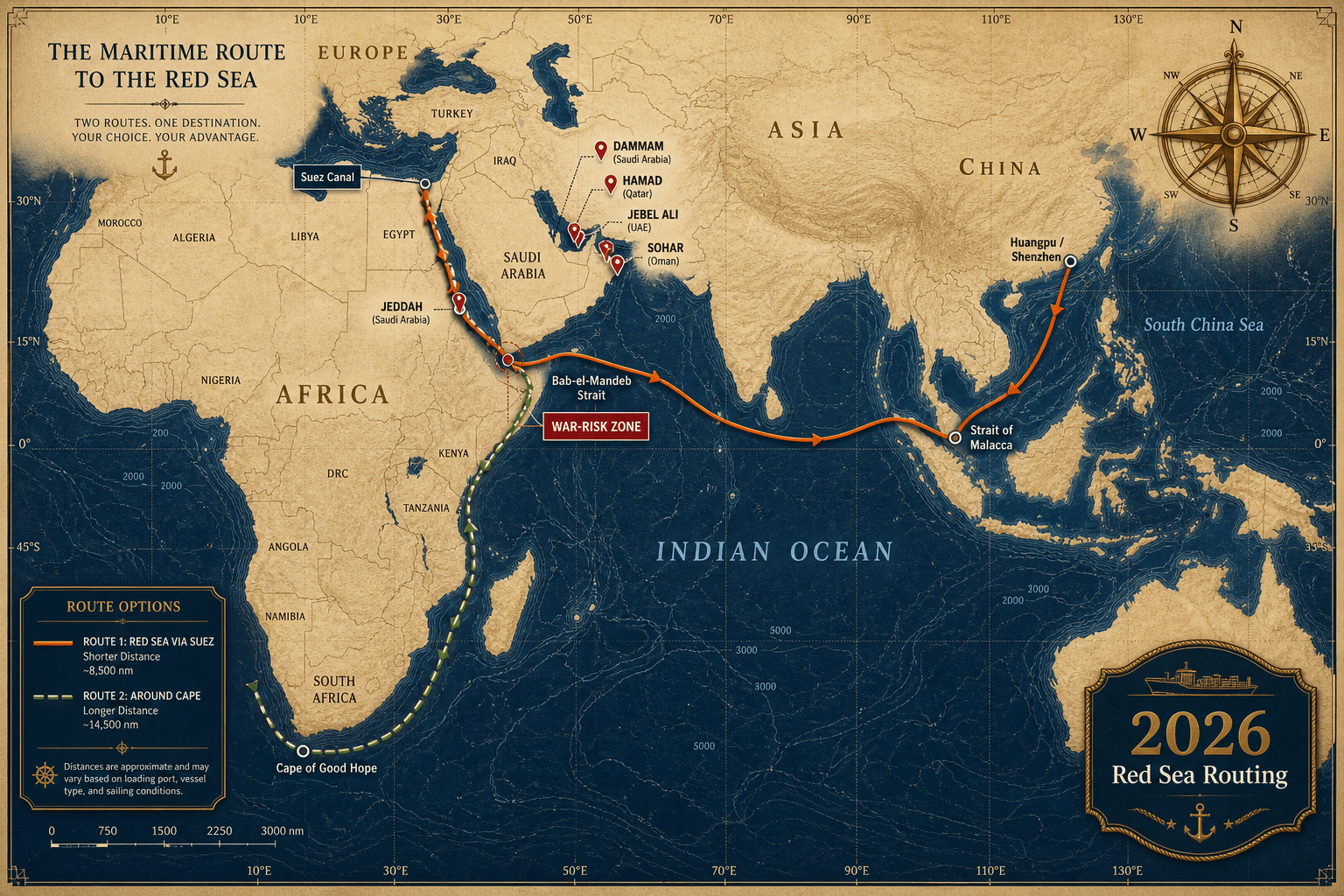
- Routing — from southern China the vessel transits the Strait of Malacca into the Indian Ocean. Persian Gulf calls (Jebel Ali, Hamad, Dammam) then route through the Strait of Hormuz; Sohar sits on the Gulf of Oman just outside Hormuz and is reached without making the strait transit; Salalah is an Arabian Sea transhipment hub west of Hormuz, often used as a relay onward to the upper Gulf. Jeddah on the Red Sea is the only GCC port that requires either a Suez transit or a Cape of Good Hope detour.
- Discharge and clearance — at the destination port the container is gated into a DG yard or moved straight to the Civil Defence inspection bay, and the local clearing agent files the per-shipment permit, customs entry and DG release.
Jebel Ali (DP World) — The Default GCC Entry Point
Jebel Ali is the default destination for a large share of China-origin fireworks containers into the GCC. DP World runs a dedicated DG handling regime, and the port is served by frequent direct-call services from the southern China loading ports, with a clearing-agent ecosystem that handles DCD (Dubai Civil Defence) and MOI fireworks documentation routinely. Sailing frequency and which carriers currently accept Class 1 on the lane change with the schedule season, so confirm both when you book rather than assuming last year's rotation.
- Lane stability — served by both Suez-routed and Cape-routed services, so spot capacity for Class 1 containers is usually available even when other GCC lanes tighten.
- Typical clearance — with complete documentation and a DG-experienced clearing agent, Jebel Ali normally clears a fireworks container in roughly 5–10 working days, subject to customs workload and any random DG inspection.
- Transhipment role — many Saudi-bound shipments now route via Jebel Ali transhipment to Dammam (or by inland truck through the UAE) during active Red Sea disruption windows, because the lane and the paperwork are more predictable.
For full UAE compliance — DCD, ECAS and MOI — see the GCC Compliance Hub; this page focuses on the logistics layer.
Jeddah Islamic Port — Saudi Red Sea Gateway
Jeddah Islamic Port is the largest Saudi gateway for cargo from China and the natural entry for the Western Region (Mecca, Medina, Jeddah, Taif). It is also the GCC port most exposed to Red Sea disruption.
- Sailing time — Suez routing typically runs 22–28 days from southern China when the carrier accepts the war-risk profile; Cape of Good Hope re-routing pushes the same lane to 38–50 days end-to-end.
- Documentation — needs a valid SABER Certificate of Conformity, GDCD per-shipment explosives permit and full DG document set before the carrier will load the container in China. ZATCA clearance at Jeddah is normally 5–10 working days with a clean document set.
- Routing alternatives — some forwarders now route Saudi-bound cargo via Jebel Ali transhipment to Dammam on the Persian Gulf side, then truck inland to Jeddah or Riyadh, to step around the Bab-el-Mandeb risk profile entirely. King Abdullah Port (KAP), also on the Red Sea but ~90 km north of Jeddah, is a separate alternative when the constraint is Jeddah-specific congestion rather than Red Sea routing risk.
For the full SABER / SASO / GDCD / ZATCA workflow see the Saudi SABER & SASO Step-by-Step companion.
Dammam & King Abdullah Port — Two Saudi Alternatives to Jeddah Congestion
Dammam (King Abdulaziz Port) on the Persian Gulf and King Abdullah Port (KAP) on the Red Sea but ~90 km north of Jeddah have both grown in fireworks volume since 2024 as buyers have looked for Jeddah alternatives. They share the same SABER + GDCD compliance requirements, but the routing risk profiles are different: Dammam removes the Red Sea exposure entirely; KAP is still a Red Sea call, just away from the most congested berth windows at Jeddah Islamic Port.
- Dammam — reached via the Strait of Hormuz, so Cape re-routing does not apply; sailing time from southern China is typically 20–26 days. Strong inland connectivity to Riyadh (~400 km) by rail and road. Best fit for Eastern Region demand and for Riyadh-served retailers.
- King Abdullah Port (KAP) — sits on the Red Sea coast roughly 90 km north of Jeddah; transit times are similar to Jeddah on Suez routing but without the Jeddah-specific congestion. KAP is positioning itself as a modern transhipment alternative; carrier acceptance for Class 1 cargo is improving but still narrower than Jeddah or Jebel Ali.
- Use case — Dammam is the simpler choice for first-time Saudi importers serving Riyadh and the Eastern Province; KAP is worth tracking for Western Region buyers who want to step around Jeddah congestion.
Hamad Port (Doha) — Qatar's DG-Friendly Modern Hub
Hamad Port is the commercial DG gateway for fireworks containers into Qatar. Built out heavily after 2017, it is digital-paperwork friendly and has invested in DG handling capacity to support large national-day, hospitality and event programming volumes.
- Sailing time — via the Strait of Hormuz, typically 19–25 days from southern China; comparable to Jebel Ali, occasionally one transhipment leg longer depending on carrier rotation.
- Documentation — standard GCC document set: invoice, packing list, BL with DG marks, DGD/IMO form, MSDS, classification certificate, plus the joint Qatar MOI + Civil Defence per-shipment approval. Customs duty is the standard 5% GCC rate on HS 3604.10.
- Typical clearance — 7–12 working days, slightly longer than Jebel Ali because each fireworks shipment is treated as an individual case rather than a routine flow.
- Dangerous-goods handling — Class 1 cargo is accepted only after pre-coordination and approval by Mwani Qatar, and carries extra DG handling and storage charges on top of standard fees; confirm current rates with your forwarder. The full permit-and-port workflow is in the Qatar MOI & Hamad Port import playbook.
Sohar, Salalah & Other Smaller GCC DG Ports
Beyond the four headline ports, several smaller GCC entry points handle fireworks containers and are worth knowing about — either as the natural choice for the local market or as a hedge when the headline lane tightens.
- Sohar (Oman) — the usual entry when the importer’s licensed store is in Muscat or the north. Sohar sits on the Gulf of Oman just outside the Strait of Hormuz, so vessels do not have to make the Hormuz transit to call there — useful when upper-Gulf congestion or transit risk is a concern. Approximately 18–25 days from southern China. Royal Oman Police (ROP) issues the explosives import permit; the licence chain and the Sohar–Salalah choice are in the Oman import guide.
- Salalah (Oman) — major transhipment hub on the Arabian Sea side, reached directly from southern China without a Hormuz transit. Direct Salalah calls are typically 1–3 days shorter than Jebel Ali for the same lane; Salalah-relayed cargo onward to Sohar or the upper Gulf typically adds 1–2 days over a direct call. The natural entry for a licensed store in Dhofar. Class 1 at Salalah needs port approval before loading, carries a 100% surcharge on handling, and allows no other cargo work, bunkering or passengers during the operation; a relay there is an Omani Class 1 call in its own right, and not every carrier will tranship explosives at a hub.
- Khalifa Bin Salman Port (Bahrain) — the main DG entry for Bahrain. Process is similar in spirit to UAE but lower volume, so each shipment takes longer; expect 7–12 working days clearance with the joint MOI + Civil Defence approval.
- Shuwaikh / Shuaiba (Kuwait) — Kuwait Customs handles fireworks at both ports with MOI Explosives Directorate approval. Class 1.4G is the practical ceiling; 1.3G display is rarely approved outside government events.
- Khalifa Port (Abu Dhabi) — occasionally used by Abu Dhabi-based importers as an alternative to Jebel Ali; slot frequency for Class 1 is narrower, so most volume still routes through Jebel Ali.
2026 Red Sea Routing Reality — What Actually Changed
Houthi-related disruption in the Bab-el-Mandeb strait has pushed many container vessels onto the Cape of Good Hope route since late 2023. The situation continues to evolve, and the transit windows and premiums below reflect the position as reviewed in May 2026 — re-check them with your forwarder before committing to a sail date, because routing decisions on this corridor have changed within weeks before now. What is stable enough to plan around is the shape of the problem rather than any particular number.
- Cape routing adds 14–21 days to a China–GCC sailing compared to the Suez route — almost entirely affecting Jeddah and other Red Sea calls.
- Persian Gulf, Gulf of Oman and Arabian Sea calls are not directly affected — Jebel Ali, Hamad and Dammam reach the Persian Gulf via the Strait of Hormuz; Sohar sits on the Gulf of Oman just outside Hormuz; Salalah is on the Arabian Sea, west of Hormuz. All three approaches sit on the opposite side of the Arabian Peninsula from the Bab-el-Mandeb chokepoint, so none of these lanes carry the Red Sea routing risk. Carriers may reshuffle vessel rotations, but the lanes themselves are intact.
- War-risk premium for Suez/Red Sea-routed vessels typically runs 0.05% to 0.5% of cargo value, sometimes higher on specific calls into Jeddah, plus a per-TEU surcharge of around USD 50–300 on some lines.
- Saudi mitigation — many forwarders now route Saudi-bound cargo via Jebel Ali transhipment to Dammam or by truck inland to avoid Jeddah's Red Sea risk profile entirely.
- Booking lead time — for any GCC lane, book DG vessel space 6–8 weeks ahead during peak Eid or National Day windows; for Jeddah-bound sailings add a further 2–3 weeks of routing buffer.
For the broader transit-time and cost detail across all China-export lanes see the fireworks shipping time guide and the cost breakdown.
War-Risk Surcharge & the DG Cost Stack for MENA-Bound Fireworks
The all-in cost of a fireworks container into the GCC is not just the base ocean rate. Class 1 cargo carries a stack of dangerous-goods surcharges, and Red Sea-routed sailings add a war-risk layer on top. Knowing the components stops the "why is the freight quote double what I expected" conversation late in the booking cycle.
How to read the figures below. Every number on this page is an indicative planning range compiled from bookings and carrier quotations, last reviewed May 2026. Ocean rates, DG surcharges and war-risk terms are repriced by carriers continuously and can move sharply within a single quarter; war-risk in particular is tied to an active security situation. Use the structure of the cost stack — which layers exist, which are conditional, what drives each one — because that is what stays stable. Do not budget from the specific figures without a current written quotation for your lane, cargo division and sail window.
Where the USD per a 20ft fireworks container actually goes, by layer. Brown bars are the unavoidable base on every GCC shipment. Orange and red bars are conditional — they only fire when the cargo is 1.3G display, when the lane is Red Sea, or when you fall through one of the GCC's smaller DG ports. The war-risk %-of-value layer can't share an axis with USD bars, so it sits below in its own box.
Suez / Red Sea sailings carry an additional 0.05%–0.5% premium on declared cargo value, with Jeddah-bound voyages seeing the highest exposure. On a USD 500,000 container declaration that's roughly USD 250–2,500 on top of the bars above — which is why a 1.3G Jeddah container lands materially higher than the same cargo into Jebel Ali, even before Cape re-routing extends transit by 14–21 days.
View as table (full Notes column)
| Cost Layer | Typical Range (per 20ft) | Applies To | Notes |
|---|---|---|---|
| Base ocean freight | USD 800–2,500 | All lanes | Higher in Q3–Q4 peak season |
| Class 1 DG surcharge (1.4G) | USD 300–600 | UN0336 / UN0337 | Carrier-dependent; consumer fireworks |
| Class 1 DG surcharge (1.3G) | USD 800–1,500 | UN0335 | Display fireworks; fewer carriers |
| War-risk premium | 0.05%–0.5% of cargo value | Suez / Red Sea sailings | Jeddah-bound highest exposure |
| War-risk per-TEU surcharge | USD 50–300 | Some lines, Red Sea | In addition to the % premium |
| Inland trucking (Liuyang → port) | USD 600–1,200 | All shipments | DG-permit road transport |
| Origin DG documentation | USD 150–400 | All shipments | DGD / IMO form, classification |
| Destination DG handling | USD 200–600 | All GCC ports | Higher at smaller DG ports |
Practical rule: Always ask the forwarder for the freight quote broken out by line item. A flat "USD 4,200 all-in to Jebel Ali" tells you nothing useful; the same quote split into base + DG + war-risk + handling lets you compare carriers, lanes and Incoterms apples-to-apples and lets the factory reconcile against the SABER / DCD / MOI document set.
FOB / CIF / DDP / EXW for GCC Fireworks — Which Incoterm Wins
The Incoterm decides who controls the carrier choice, who pays the war-risk surcharge, and who carries the risk if a Class 1 container gets held at a transhipment hub. For fireworks this is not an academic question.
- FOB Chinese DG port — the most common Incoterm for first-time and mid-volume GCC importers. Buyer's freight forwarder books the vessel, controls routing, war-risk exposure and destination clearance. This is exactly where Class 1 cargo can go wrong, so the buyer wants to control it.
- CIF GCC port — the factory arranges the ocean leg and basic insurance; cargo discharges at Jebel Ali / Jeddah / Hamad and the buyer takes from there. Simpler booking but less leverage on routing and surcharge. The buyer still needs the destination Civil Defence permit before the vessel arrives.
- DDP destination warehouse — rarely practical for fireworks. The consignee at the magazine must hold a local explosives storage licence; very few Chinese forwarders can deliver Class 1 cargo door-to-door without a partner license at destination.
- EXW Liuyang factory — uncommon for the same reason. DG inland trucking from Hunan to a southern China port is itself a permitted operation, and few foreign forwarders will accept the inland leg of Class 1 cargo inside China.
Common GCC Fireworks Logistics Mistakes
The pattern of avoidable mistakes is remarkably consistent across markets. A factory-side checklist done before the container is sealed prevents the majority of demurrage and detention exposure on Class 1 cargo.
- Using a general-cargo forwarder — the single most common cause of failed bookings. Class 1 needs a DG desk that can file the DGD/IMO form and submit the UN classification documents.
- Late DG vessel booking — leaving it until 4 weeks before sailing in peak Eid or National Day windows. Class 1 slot capacity is finite; book 6–8 weeks ahead.
- Mismatched NEQ values — net explosive quantity figures on the invoice that do not match the DGD/IMO form. Customs and Civil Defence inspectors compare these line by line.
- Wrong UN number — UN0335 vs UN0336 vs UN0337 mixed across the same container without a per-pallet split. Each UN number has its own DG handling profile.
- Choosing CIF without the destination permit — the vessel arrives with cargo that the consignee cannot legally receive. Storage at the port runs at full DG day-rate.
- Underestimating Cape re-routing — quoting a Jeddah customer a 25-day transit that turns into 45 days on Cape routing, then explaining the slip to the buyer's retail planning team.
- No war-risk line in the quote — not flagging the war-risk premium up-front and absorbing it as a margin loss when the invoice arrives.
Frequently Asked Questions
Which Chinese port do fireworks containers actually leave from when shipping to the GCC?
Liuyang fireworks containers bound for the GCC typically leave through a Class 1-licensed dangerous goods berth in southern China. The working options are Huangpu Old Port in Guangzhou, Shenzhen, Shanghai or Ningbo, and which port is used for a given booking depends on which carrier accepts UN0335/UN0336/UN0337 on the buyer's lane that month. Liuyang factories truck the sealed Class 1 container under DG-permit road transport from Hunan to the loading port; only DG-licensed forwarders can book the slot, file the DGD/IMO form and submit the UN classification documentation to the carrier.
How long does it take to ship fireworks from China to Jebel Ali, Jeddah, Dammam, Hamad and Sohar in 2026?
Persian Gulf ports (Jebel Ali, Hamad, Dammam) are reached via the Strait of Hormuz; Sohar sits on the Gulf of Oman just outside Hormuz; Salalah is an Arabian Sea transhipment hub reached directly from southern China without the Hormuz leg. None of these lanes are directly affected by Red Sea disruption — typical port-to-port transit from a southern China DG port is 18 to 25 days for the Persian Gulf calls and Sohar; direct Salalah calls are typically 1–3 days shorter, while Salalah-relayed cargo onward to Sohar or the upper Gulf adds 1–2 days over a direct call. Jeddah on the Red Sea is the exception: Suez routing is around 22–28 days when carriers accept the war-risk profile, while Cape of Good Hope re-routing adds 14–21 days, pushing total transit to 38–50 days. These are sailing windows only; add 4 to 6 weeks for inland trucking from Liuyang, DG vessel booking and customs clearance at the destination.
How much does the war-risk surcharge add for fireworks containers routed via the Red Sea?
As reviewed in May 2026, carriers typically applied a war-risk premium of 0.05% to 0.5% of cargo value on Suez / Red Sea-routed sailings, with Jeddah-bound voyages occasionally seeing higher add-ons during active disruption windows, and some lines publishing a flat surcharge of around USD 50 to 300 per TEU. That sits on top of the Class 1 DG surcharge — indicatively USD 300–600 per 20ft for 1.4G (UN0336/UN0337) and USD 800–1,500 for 1.3G (UN0335). Treat these as planning ranges, not quotations: war-risk tracks an active security situation and is repriced continuously. The durable point is structural — a 1.3G container into Jeddah stacks materially higher than the same container into Jebel Ali.
Should a GCC fireworks importer buy FOB China, CIF GCC port, or DDP destination warehouse?
FOB at the Chinese DG port is the most common Incoterm for first-time and mid-volume GCC fireworks importers — the buyer's freight forwarder controls the carrier choice, the DG booking, the war-risk exposure and the destination clearance, which is exactly where Class 1 cargo can go wrong. CIF GCC port shifts the ocean leg to the factory, which simplifies booking but limits the importer's leverage on routing and surcharge negotiation. DDP to a GCC warehouse is rarely practical for fireworks because the consignee at the magazine must hold a local explosives storage licence; very few Chinese forwarders can deliver Class 1 cargo door-to-door without a partner license at destination. EXW Liuyang factory is uncommon for the same reason — DG inland trucking from Hunan to a southern China port is itself a permitted operation.
Why is Jebel Ali the default GCC entry point for China-origin fireworks containers?
Jebel Ali handles Class 1 cargo as a routine flow: DP World runs a dedicated DG handling regime, the port is served by frequent direct calls from southern China DG ports, and clearing agents there are familiar with DCD and MOI fireworks documentation. Sailing frequency and which carriers accept Class 1 on the lane vary by schedule season, so confirm both at booking. It is also served by both Suez-routed and Cape-routed services, so spot capacity for Class 1 containers is usually available even when other GCC lanes tighten. For first-time GCC fireworks importers, Jebel Ali is often the lowest-variance entry point — and many Saudi-bound shipments are now routed via Jebel Ali transhipment to Dammam or by inland truck from the UAE during active Red Sea disruption.
What are the most common GCC fireworks logistics mistakes a Liuyang factory sees buyers make?
The recurring logistics-side mistakes are using a general-cargo forwarder that cannot file Class 1 documentation, leaving DG vessel booking until 4 weeks before sailing in peak Eid or National Day windows, choosing CIF without realising the importer still needs the destination Civil Defence permit before the vessel arrives, underestimating Cape of Good Hope re-routing time on Jeddah-bound sailings, and not flagging the war-risk premium up-front in the freight quote. Document-level errors such as mismatched NEQ figures or wrong UN number are covered separately in the GCC Compliance Hub. A factory-side checklist done before the container is sealed prevents most of the demurrage and detention exposure on Class 1 cargo.
Continue Reading by Market
- Middle East buyers → GCC Import & Compliance Hub
- Saudi deep dive → Saudi SABER & SASO Step-by-Step for Fireworks Importers
- Middle East festival calendar → Eid, National Days & Royal Wedding Sourcing Calendar
- GCC logistics hub → Shipping Fireworks to the Middle East (this page)
- Jebel Ali clearance deep dive → Jebel Ali Fireworks Clearance: DG, DCD & Transhipment Step-by-Step
- GCC storage & hospitality → Gulf Fireworks Without the Drama: 50°C Magazines & Hotel Pyro
- Distributor playbook → Distributor's Guide for ME & LATAM
- DG process → Dangerous Goods Shipping Process
- Shipping costs → Fireworks Shipping Cost Breakdown
- Transit times → China–GCC Shipping Time & Delays
- Classification → UN Numbers & Shipping Classifications
- Labels & carton marks → Arabic Fireworks Labels & DG Carton Marks for the GCC
Shipping Fireworks to the GCC?
If you need a Class 1-ready document set for Jebel Ali, Jeddah, Dammam, Hamad or Sohar — with DGD/IMO form, UN0335/UN0336/UN0337 classification, your destination import permit reference and a freight quote broken out by DG and war-risk line items — our Liuyang team can assemble it before the container leaves the loading port. We ship to all six GCC markets every season.
WhatsApp Email