The Middle East fireworks calendar is one of the most concentrated and time-sensitive in the world. Two Eids, six national days, a steady year-round royal-wedding and hospitality cycle — when these windows hit, factories in Liuyang need to be booked months ahead, or the container simply does not arrive in time.
This page is the sourcing calendar: who buys when, what to book by which deadline, and how Red Sea routing has reshaped the lead time map in 2026.
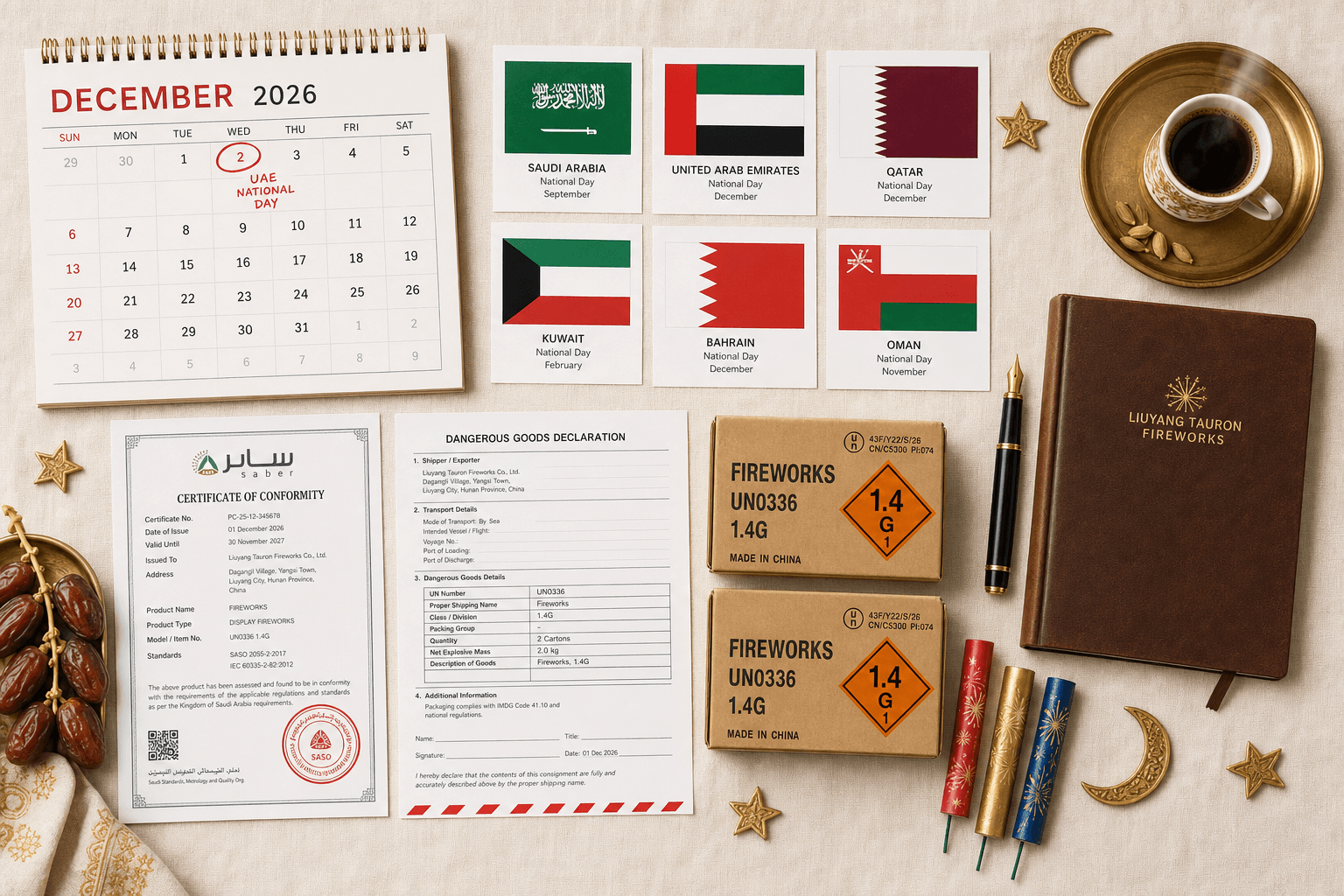
The Middle East Demand Cycle at a Glance
For a Liuyang factory shipping to the GCC, every calendar year contains four distinct demand peaks plus a year-round baseline.
- Eid al-Fitr — 1.4G consumer fireworks (UN0336) for retail. Cakes, fountains, sparklers, family-pack assortments. Driven by households, small public squares and shopping centres.
- Eid al-Adha — hospitality and licensed display. Hajj-season Riyadh, Jeddah, Mecca-Medina region (restricted), Dubai and Doha programmes. More 1.3G display (UN0335) and indoor effects than retail-grade product.
- UAE National Day (December 2) and Saudi National Day (September 23) — the two biggest concentrated display windows in the Gulf. 1.3G shells, large multi-shot cakes and ground display.
- Other GCC national days — Qatar (Dec 18), Bahrain (Dec 16–17), Oman (Nov 20), Kuwait (Feb 25–26). Smaller volume but very predictable.
- Royal weddings and hospitality — year-round; smaller per-order but adds up to a meaningful share of GCC volume, especially indoor cold fountains for five-star hotels.
Backward-planned from the retail or show date, lock SKUs about 120 days out — 120–140 on the dedicated Eid plan. A March Eid al-Fitr floor date means talking to the factory by late November of the previous year, earlier for 1.3G display.
Eid al-Fitr — Lock-to-Floor Countdown
Eid al-Fitr marks the end of Ramadan and is one of the biggest 1.4G consumer fireworks windows in the GCC. Because the Hijri calendar is 10–12 days shorter than the Gregorian calendar, Eid moves earlier each year: expect roughly March 20–21, 2026 and March 9–10, 2027 (subject to moon sighting confirmation by the relevant national authorities).
Working backward from a March retail date (same countdown as the dedicated Eid plan):
- T−120 days (mid-November) — SKU selection locked. Saudi importer initiates GDCD per-shipment permit; UAE importer applies for DCD or ACD approval. SABER PCoC route confirmed for Saudi shipments.
- T−90 days (mid-December) — production starts on cakes, fountains, sparklers, family assortments. Arabic / English retail labelling artwork signed off.
- T−60 days (late January) — production complete. SABER SCoC submitted for Saudi shipments. Final NEQ per carton confirmed against the Dangerous Goods Declaration.
- T−45 days (mid-February) — container loaded, BL issued with DG marks. UN0336 1.4G consumer load typical; UN0337 1.4S for sparklers / novelty items where applicable.
- T−30 days (late February) — vessel sails. Confirm the lane at booking — the Cape add-on is Red Sea ports only.
- T−14 to T−7 days — arrival at Jebel Ali, Jeddah, Dammam or Hamad. Customs clearance with a full document set typically runs 5–10 working days at Jebel Ali, and around 7–12 at Hamad, where each fireworks shipment is treated as an individual case.
- T−0 — on retail shelves in time for Eid prayers, family gatherings and the evening fireworks window.
Eid al-Adha — Hajj-Season Hospitality and Display Cycle
Eid al-Adha (the “Festival of Sacrifice”) falls roughly two months after Eid al-Fitr and aligns with the close of the Hajj pilgrimage. Expect approximately May 26–27, 2026 and May 16–17, 2027 (subject to moon sighting confirmation; the relevant national authorities may shift the date by one day in either direction).
From a Liuyang factory’s perspective Eid al-Adha is not primarily a retail consumer window. Large-scale civilian pyrotechnics around the Hajj-season public gatherings in Mecca and Medina are restricted on safety and crowd-management grounds. Demand concentrates instead on:
- Hospitality programming — Riyadh hotels, Jeddah Corniche resorts, Dubai marina district, Doha West Bay. Indoor cold fountains for ballrooms and outdoor multi-shot cakes for terrace and beach programmes.
- Government and royal displays — smaller in scale than UAE National Day or Saudi National Day but still requiring licensed display contractors and 1.3G product.
- GCC-wide hotel and HoReCa demand — ground spinners, fountains, indoor stage fireworks (one of the 12 categories in our wholesale catalogue) for restaurants and entertainment venues.
Booking window: lock SKUs by November or early December of the previous year for a late-May Eid, ship by late February or March. The mix is heavier on 1.3G display than Eid al-Fitr and lighter on consumer assortments. SABER, DCD and Civil Defence paperwork takes longer for 1.3G because of the contractor-licence layer; do not assume Eid al-Fitr timings transfer to Eid al-Adha.
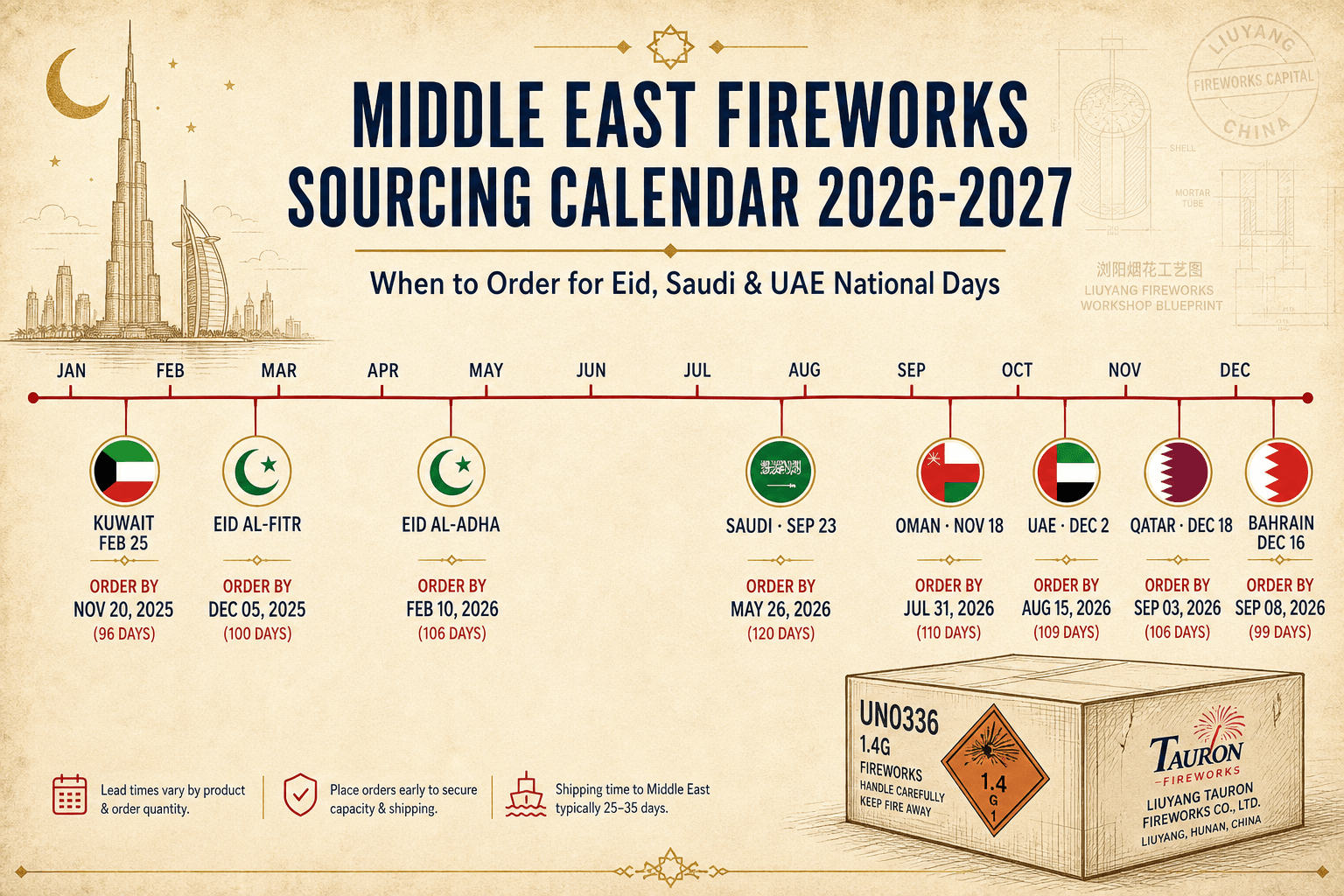
UAE National Day (December 2) — One of the Biggest Gulf Display Windows
UAE National Day is one of the largest concentrated 1.3G display fireworks windows in the Gulf. The Burj Khalifa-area programme alone runs a major synchronised sequence; the Abu Dhabi Corniche, Sharjah, Ras Al Khaimah and Fujairah waterfronts each programme their own major synchronised display. Hospitality groups add private rooftop shows on top.
Buyer profile: licensed UAE display contractors operating under DCD (Dubai), ACD (Abu Dhabi), and emirate-level Civil Defence permits. The MOI explosives import approval and DCD / ACD per-shipment review run in parallel and typically take 4–6 weeks for 1.3G product.
Timeline: SKU lock by April or May; production complete by August; BL issued by early September; arrival at Jebel Ali by mid-October to give 6–8 weeks for clearance, magazine staging and show choreography. Khalifa Port is occasionally used by Abu Dhabi-based importers but Jebel Ali handles almost all China-origin fireworks containers for UAE National Day.
Product mix: 4″–8″ display shells, large multi-shot cakes (200–500 shot), ground display, indoor and stage effects for the formal evening receptions. The deeper UAE compliance workflow is covered in the GCC Compliance Hub — the UAE section walks through MOI, Civil Defence and ECAS in detail.
Saudi National Day (September 23) — From Riyadh to the Red Sea
Saudi National Day is broader in geography than UAE National Day. Riyadh, Jeddah, Dammam, AlUla, Diriyah Gate and a long list of regional capitals all run synchronised programmes. Because the show footprint is national, the volume is higher in absolute terms and the SKU mix is more diverse: more 1.4G consumer product for civic and family celebrations alongside the headline 1.3G display.
Three Regions, Three Different Logistics Stories
One reason Saudi National Day frustrates first-time importers is that the country splits into three different logistics geographies on this date, each with its own port, routing risk and inland trucking distance:
- Western Region — Jeddah, King Abdullah Port (KAP), Hajj-adjacent cities. Where the largest single waterfront shows take place, but also where Red Sea routing risk is highest. KAP increasingly absorbs Jeddah overflow for large National Day loads.
- Eastern Province — Dammam. Approached via the Strait of Hormuz, so the more stable Persian Gulf option in 2026. A growing share of Saudi National Day cargo now arrives here, often as a Jebel Ali transhipment, then trucks inland.
- Riyadh, AlUla and Diriyah Gate — inland. Pull from whichever entry port the importer of record selected, then ground-truck to the venue. Picking the right port before SKU lock is what saves 2–3 weeks on the calendar.
Buyer profile and paperwork: licensed Saudi importers operating under a GDCD fireworks importer licence, with per-shipment GDCD explosives permits issued for the specific load. SABER PCoC + SCoC is required for retail-grade product; SASO bilingual retail labelling is mandatory.
Backward-planned timeline: SKU lock by March or April, production complete by August, ship by August to clear and stage by mid-September. The deeper Saudi workflow — SABER PCoC and SCoC, GDCD per-shipment permits, ZATCA clearance at Jeddah, Dammam and King Abdullah Port — is covered in the dedicated companion guide: Saudi SABER & SASO Step-by-Step for Fireworks Importers.
Other GCC National Days — Qatar, Kuwait, Bahrain, Oman
The four smaller GCC national days are predictable but lower volume. Each follows the same backward-planning logic: lock 4–6 months before the date, ship 6–8 weeks before, and allow 1–2 weeks for clearance (Hamad often 7–12 working days).
- Qatar National Day (December 18) — Doha Corniche, Lusail, West Bay. MOI + Qatar Civil Defence joint approval. Hamad Port is the commercial DG gateway. Display-heavy mix; 1.3G dominant. See the full Qatar MOI & Hamad Port import playbook.
- Bahrain National Day (December 16–17) — Manama Corniche and Riffa programmes. MOI + Bahrain Civil Defence joint approval. Khalifa Bin Salman Port. Mostly 1.4G consumer with a small display component.
- Oman National Day (November 20) — Royal Decree 15/2025 sets it on 20 and 21 November, moved from 18 November. The 2026 public-holiday list approved by the Council of Ministers gives 25 and 26 November. In 2025 the displays ran at Al Khoudh Dam in Seeb and the Ateen Plain in Salalah on the same evening, then Qurum and Khasab. Royal Oman Police (ROP) issues import permits. Display-led rather than retail; the port follows the importer’s licensed store, Sohar for the north and Salalah for Dhofar. See the Oman import guide.
- Kuwait National Day & Liberation Day (February 25–26) — Kuwait City Towers, Marina Crescent. MOI Explosives Directorate. Shuwaikh and Shuaiba ports. Class 1.4G is the practical ceiling; 1.3G is rare outside government events. Note that Kuwait’s National Day falls in February of the following calendar year, so SKU lock has to start in the previous September.
Royal Wedding & Hospitality Demand Cycle
Outside the four festival windows the GCC carries a steady year-round demand for wedding and hospitality pyrotechnics. There is no fixed calendar, but the patterns are consistent.
- Indoor cold fountain fireworks and stage pyrotechnics — depending on testing regime usually classified as UN0431 (articles, pyrotechnic, for technical purposes, 1.4G) or UN0337 (fireworks, 1.4S). Used for ballrooms at Atlantis, Burj Al Arab, Address Downtown, Marsa Malaz Kempinski and the Four Seasons / Mandarin Oriental properties. Stage fireworks (one of the 12 product categories in our catalogue) are the workhorse SKU.
- Outdoor private beach and rooftop sequences — 1.4G consumer multi-shot cakes (50–100 shot), small Roman candles, mines and fountains. Used by wedding planners working with licensed local pyrotechnicians.
- Royal and headline displays — only at the largest royal weddings, where a licensed display contractor builds a full 1.3G display programme around the venue.
Booking window: 12–16 weeks for a planned wedding sequence; 8–10 weeks for “catalogue” orders pulled from stock that the local importer already has cleared. The hospitality demand is what gives GCC importers their steady mid-year cashflow between Eid al-Adha and Saudi National Day.
2026–2027 Middle East Master Calendar
One-page reference grid for procurement managers planning across both years. All Hijri-driven dates are indicative and subject to official moon sighting confirmation.
Eid al-Fitr
- SKU Lock ByNov / early Dec
- Vessel Sails ByLate Jan / Feb
Eid al-Adha
- SKU Lock ByNov / early Dec (prev yr)
- Vessel Sails ByLate Feb / Mar
Saudi National Day
- SKU Lock ByMar / Apr
- Vessel Sails ByAug
Oman National Day
- SKU Lock ByMay
- Vessel Sails ByAug
UAE National Day
- SKU Lock ByMay / Jun
- Vessel Sails ByAug / early Sep
Bahrain National Day
- SKU Lock ByJun
- Vessel Sails BySep
Qatar National Day
- SKU Lock ByJun
- Vessel Sails BySep
Kuwait National Day
- SKU Lock BySep (prev yr)
- Vessel Sails ByNov / Dec (prev yr)
Royal Weddings & Hospitality
- SKU Lock By12–16 wk lead
- Vessel Sails By8–10 wk lead
Practical rule: Add a 2–3 week routing buffer only to Jeddah / King Abdullah (Red Sea) sailings. Do not add those weeks to Jebel Ali, Dammam or Hamad — those boxes never used Suez. Their Red Sea exposure is tighter Class 1 slots, not a longer voyage.
Red Sea Routing — How It Reshapes Booking Windows in 2026
Houthi-related disruption in the Bab-el-Mandeb strait has pushed many container vessels onto the Cape of Good Hope route since late 2023. For Middle East fireworks importers the practical effects in 2026 are now stable enough to plan around — but the adjustment is by lane, not a blanket add-on to every GCC window.
- Cape routing adds 14–21 days on Suez-linked lanes. For GCC fireworks that is mainly Jeddah and King Abdullah Port. Jebel Ali, Dammam and Hamad still sail Indian Ocean → Hormuz; they do not gain three weeks of sea time.
- War-risk premium on Suez-routed vessels typically runs 0.05%–0.5% of cargo value, sometimes higher on specific calls into Jeddah.
- Jeddah is the most affected GCC port; many forwarders now route Saudi-bound cargo via Jebel Ali transhipment to Dammam, or accept Cape sailings directly into Jeddah.
- Jebel Ali, Dammam and Hamad approach via the Strait of Hormuz; Sohar sits on the Gulf of Oman just outside Hormuz. None of these lanes carry the Red Sea routing risk, so all remain stable. Jebel Ali is the default first-time-buyer choice: Hormuz arrival and the widest Class 1 service coverage.
For the GCC port-by-port logistics view — Jebel Ali, Jeddah, Dammam, Hamad and Sohar — including the war-risk surcharge and the FOB / CIF / DDP decision for Class 1 cargo, see our GCC fireworks logistics hub. For lane-by-lane transit detail and the latest 2026 port-by-port reference, see our fireworks shipping time guide and the cost breakdown.
Sourcing Mistakes Specific to Middle East Festival Buying
Five recurring mistakes account for most of the late shipments, demurrage bills and over-stock writedowns we see across GCC accounts.
- Treating Eid al-Adha like Eid al-Fitr. The first is retail-driven; the second is hospitality- and display-driven. Buying the wrong SKU mix is the most expensive mistake on the Eid axis.
- Forgetting the Hijri shift. Both Eids move 10–12 days earlier every Gregorian year. A team that locked SKUs in mid-December last year must lock by early December this year for the same lock-to-floor window.
- Mismatching 1.4G consumer with 1.3G display channels. 1.3G product in a retail SKU mix means a contractor licence requirement at destination and a SABER / DCD permit path that retail importers rarely have.
- Underestimating warehouse and magazine readiness. Eid stock stored at 50°C+ in a non-air-conditioned warehouse is a real quality risk. The destination importer should have temperature-controlled magazine space ready before the container arrives.
- Leaving SABER, DCD or Civil Defence approval until the container is loaded. The single most common cause of Saudi clearance delay is starting SABER once the container is already on the water. Lock the conformity route at the SKU selection stage, not at the booking stage.
Frequently Asked Questions
Why does Eid al-Fitr shift earlier every year?
Both Eids follow the Hijri (Islamic lunar) calendar, which is about 10–12 days shorter than the Gregorian calendar each year. That means Eid moves earlier every Gregorian year. A buyer who locked SKUs in mid-December last year usually has to lock by early December the following year to keep the same lock-to-floor window.
Which is the larger fireworks buy: UAE National Day or Saudi National Day?
Both are very large display windows, but the shape is different. UAE National Day on December 2 is among the biggest concentrated 1.3G display windows in the Gulf, anchored on the Burj Khalifa area, the Abu Dhabi Corniche and emirate-level shows. Saudi National Day on September 23 is broader in geography — Riyadh, Jeddah, Dammam, AlUla, Diriyah Gate, regional capitals — and combines 1.3G display with a much larger share of 1.4G consumer SKUs.
What is the latest date a buyer can still lock Eid al-Fitr SKUs?
About 120 days before the Eid retail date for a typical 1.4G consumer load. Later than that, production, SABER or DCD approval and the Class 1 booking no longer all fit. Cape extra days apply only to Jeddah and King Abdullah Port. Buyers who miss this window sometimes redirect the same SKUs to the next Hijri-driven peak instead of forcing a late Eid shipment.
Do hotels use 1.4G consumer fireworks or 1.3G display fireworks for indoor weddings?
Indoor effects at hotels such as Atlantis, Burj Al Arab, Address Downtown and Marsa Malaz Kempinski are usually delivered with indoor cold fountain fireworks and stage pyrotechnics (typically UN0431 or UN0337 depending on the testing regime), not outdoor 1.3G display shells. Outdoor private beach or rooftop sequences often use a mix of 1.4G consumer cakes and small Roman candles. Truly large 1.3G display sequences only appear at headline royal or government weddings and require a licensed display contractor.
Should a GCC buyer source for Eid al-Fitr and UAE National Day from the same factory run?
It depends on the SKU overlap. Eid al-Fitr is heavily 1.4G consumer — cakes, fountains, sparklers, family assortments. UAE National Day is heavily 1.3G display — large shells, big multi-shot cakes, ground display. If both windows share a meaningful 1.4G consumer share, consolidating into one production run in early autumn can save factory setup cost and freight. If the SKU profiles are completely different, run them as separate productions — mixing 1.3G and 1.4G in the same container raises the DG surcharge and complicates SABER / DCD paperwork.
Does Cape routing also delay Eid al-Fitr in March?
Only if the box is going to a Red Sea port. A March Eid container into Jebel Ali, Dammam or Hamad does not add the Cape’s 14–21 days — that lane never used Suez. Jeddah and King Abdullah Port can. The more common March miss we see is a pre-2023 booking calendar that ignored Class 1 slot tightness, not a three-week ocean add-on on a Hormuz sailing.
Continue Reading by Market
- GCC compliance overview → GCC Import & Compliance Hub
- GCC logistics hub → Shipping Fireworks to the Middle East
- GCC storage & hospitality → Gulf Fireworks Without the Drama: 50°C Magazines & Hotel Pyro
- Saudi deep dive → Saudi SABER & SASO Step-by-Step for Fireworks Importers
- Eid al-Fitr deep dive → Eid al-Fitr Fireworks: 90-Day Sourcing Timeline for GCC Buyers
- What to put in the load → Building a 1.4G Fireworks Mixed Container for GCC Retail Seasons
- Distributor playbook → Distributor’s Guide for ME & LATAM
- Shipping time → China–GCC Shipping Time & Delays
- Shipping cost → Fireworks Shipping Cost Breakdown
- DG process → Dangerous Goods Shipping Process
- Classification → UN Numbers & Shipping Classifications
- Calendar alternate (US/EU) → US & EU Fireworks Sourcing Calendar
Plan Your GCC Festival Shipment
Send us your target Eid, National Day or wedding-season date. We'll work the production, conformity and Class 1 sailing timeline backward from it — Red Sea routing buffer included — so you can lock SKUs before the booking window closes.
WhatsApp Email