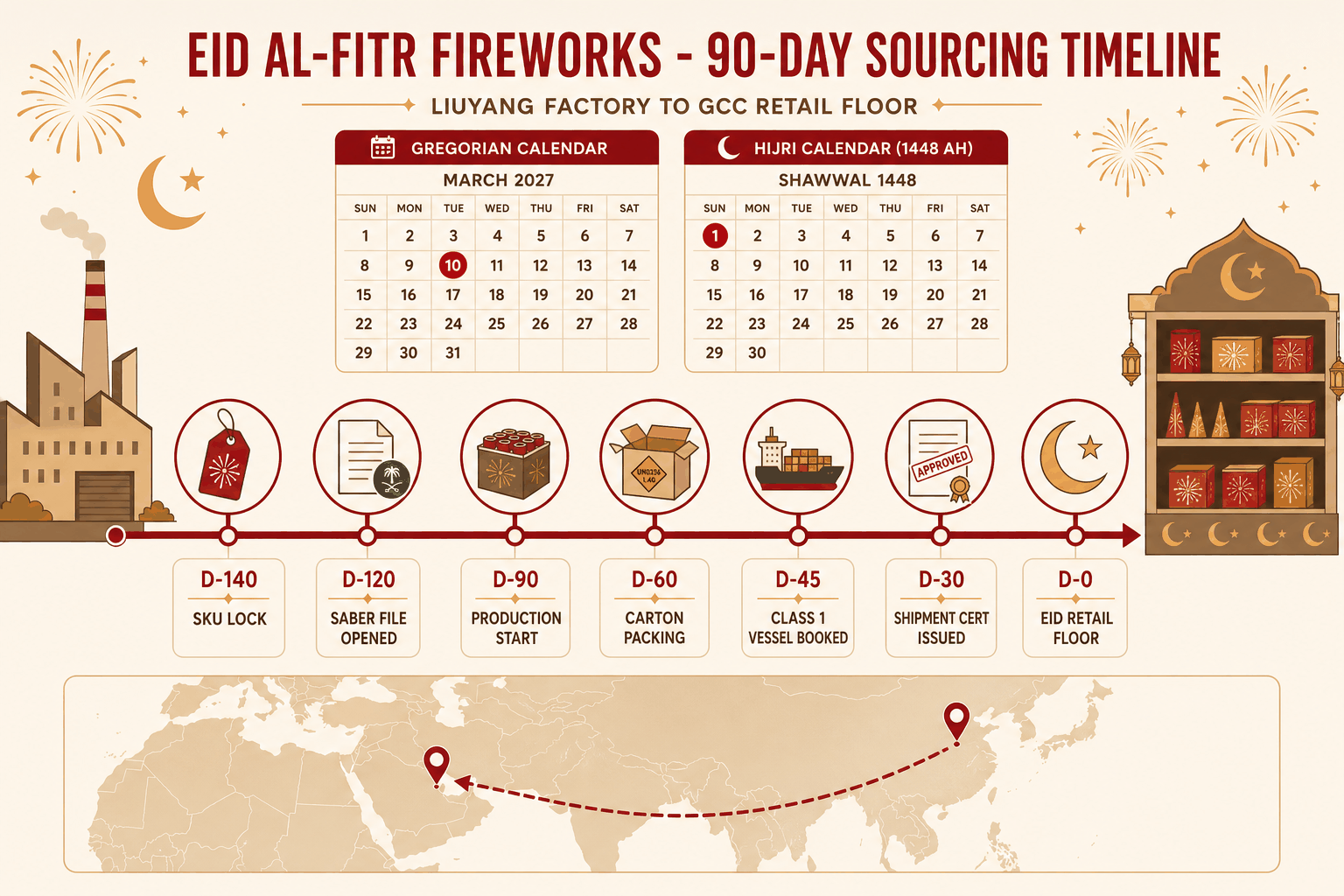
Eid al-Fitr is the single most time-sensitive 1.4G consumer fireworks window in the GCC year. The retail date is fixed by the Hijri lunar calendar, so it walks 10–12 days earlier every Gregorian year. The buyers who clear stock cleanly are the ones who set their lock dates against the Hijri calendar, not last year’s desk diary. The ones who chase the previous Gregorian date by habit tend to discover the same problem every February: there is no production slot left, the SABER file has not been opened, and the Class 1 vessel is already booked out by another season’s holiday cargo.
This guide sits alongside our Middle East Fireworks Sourcing Calendar and walks step by step through what a clean Eid al-Fitr plan actually looks like from the Liuyang side: how the Hijri shift bites, what a workable 90-day backward plan covers, which SKU families do the work, where the six GCC markets differ, and where the SABER, DCD and Civil Defence timing tends to slip.
Why Eid al-Fitr Sets the Tightest 1.4G Sourcing Window of the GCC Year
Most of the high-value GCC fireworks windows — UAE National Day on December 2, Saudi National Day on September 23, royal weddings — sit on the Gregorian calendar. They move at most a couple of days year to year because of weekday placement. Eid al-Fitr does not behave like that. It is anchored to the first day of Shawwal, declared after the sighting of the new moon at the end of Ramadan, and it walks 10–12 days earlier every Gregorian year. From a sourcing point of view that means:
- The retail floor date moves earlier each year. A buyer who sold Eid al-Fitr cartons on March 21 this year is selling them around March 10 the following year, and around February 27 the year after that.
- The SKU lock date and the vessel-sail date have to move with it. The 90-day production buffer does not care which Gregorian month it lands in.
- The lock date keeps drifting toward the Chinese factory shutdown. Within roughly six years the Eid lock date walks across the Lunar New Year period, when Liuyang capacity is at its annual low. That is the worst case for new SKU introduction.
- SABER, DCD and Civil Defence file times do not compress. If the file usually takes six to ten weeks, that does not change because Eid is earlier this year.
This is not a marketing observation. It is the most common reason we see GCC importers ship 1.4G consumer cartons that arrive at the magazine after the Eid retail floor has already closed.
The Hijri Shift — How Eid al-Fitr Walks Through the Gregorian Year
For backward planning, the practical question is “when does my SKU lock have to happen this year, given when Eid actually falls?” The table below uses the most widely cited civil dates for the next three Eid al-Fitr windows. All dates are subject to local moon sighting and can shift by one day in either direction between Saudi Arabia, the UAE, Qatar, Bahrain, Kuwait and Oman; we treat any printed calendar as a planning anchor, not a guarantee.
| Eid Year | Civil Date (Approx.) | SKU Lock By | Vessel Sails By | Notes |
|---|---|---|---|---|
| Eid al-Fitr 2026 | Mar 20–22, 2026 | — | — | Reference anchor only (window has passed); included for backward calibration. |
| Eid al-Fitr 2027 | Mar 9–11, 2027 | Mid-Nov 2026 | Late Jan 2027 | The current planning window. Sail date falls just before Chinese Spring Festival 2027. |
| Eid al-Fitr 2028 | Feb 26–28, 2028 | Early Nov 2027 | Mid-Jan 2028 | Lock date sits inside the Q4 2027 SABER / DCD high-traffic window. |
| Eid al-Fitr 2029 | Feb 14–16, 2029 | Late Oct 2028 | Late Dec 2028 / early Jan 2029 | Sail window runs into the pre-Spring-Festival capacity squeeze; advance lock recommended. |
The pattern in the right two columns is what matters. A buyer who once locked Eid SKUs in mid-December and sailed in early February is now locking in mid-November and sailing in late January. Six years from now, the same buyer will be locking in October and sailing before Christmas. The desk diary needs to follow the Hijri calendar, not the other way around.
The 90-Day Backward Plan — From Liuyang Production Line to Eid Retail Floor
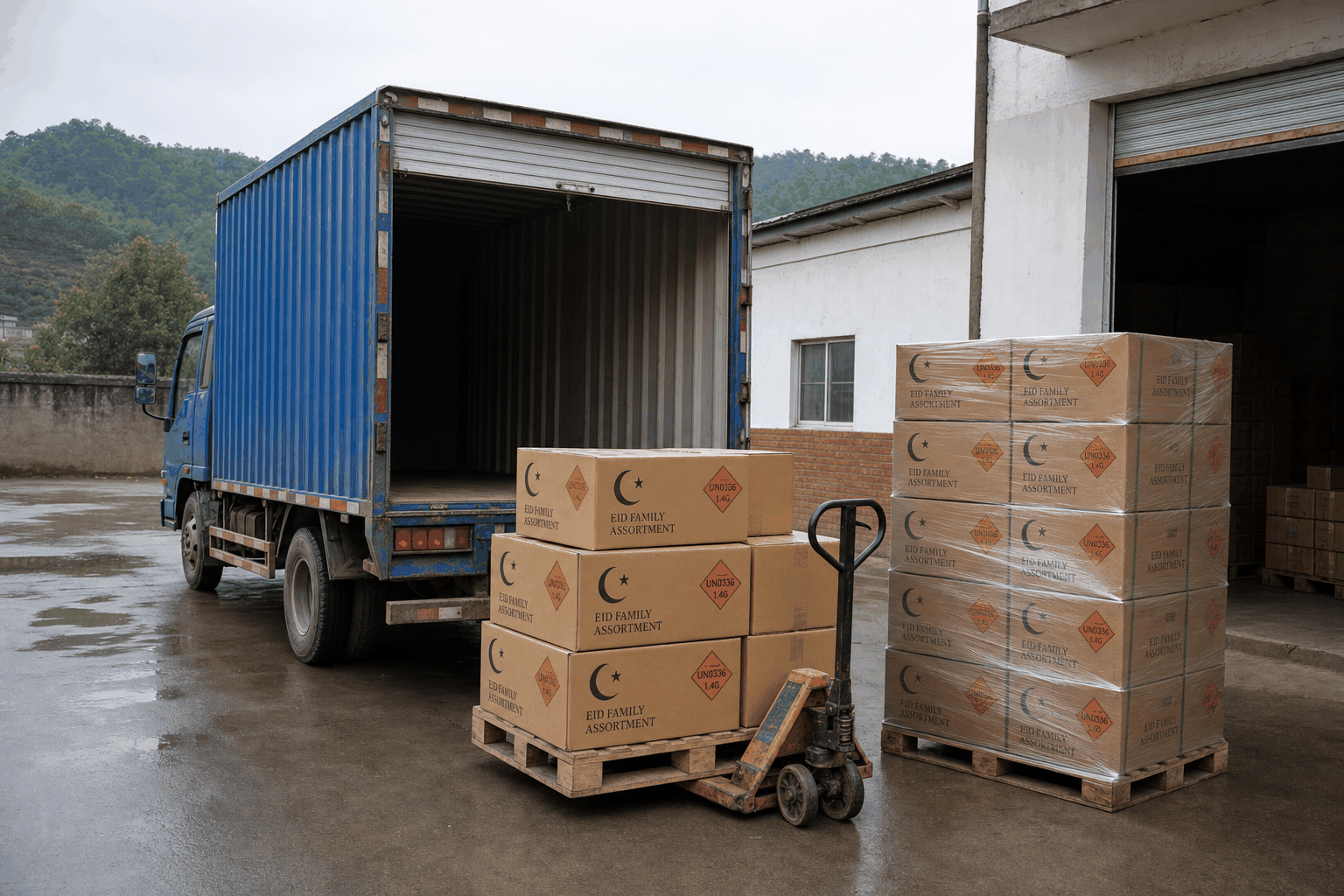
The number “90 days” in the title is the production-and-shipping core of the plan, but the realistic Eid timeline is closer to 120–140 days from SKU lock to retail floor once compliance, vessel booking and a Cape of Good Hope routing buffer are added. The seven steps below describe a workable plan for a single 1x40' HC container of 1.4G consumer fireworks — family assortments, cake fireworks, fountains and sparklers — landing at a GCC magazine ahead of Eid al-Fitr 2027.
SKU Selection & Artwork Lock ~20 weeks before Eid
Buyer finalises the carton-level SKU list (family assortments, cake counts, sparkler grades), confirms Arabic and English retail labelling artwork, and signs off custom-printed box design where applicable. Liuyang reserves a production slot against that SKU list.
SABER / DCD / Civil Defence File Opened ~17 weeks before
For Saudi-bound cargo, the SABER product certificate is initiated for each SKU before the production line is set up. For UAE-bound cargo, the DCD pre-approval and the importer’s magazine licence are confirmed in writing. Liuyang prepares the Certificate of Origin and Manufacturer Declaration drafts in parallel.
Production Line Setup & First-Batch QC ~13 weeks before
Production starts. First-batch samples are pulled for QC against the agreed specification (fuse burn, lift charge, comp consistency, packaging seal). Heat-aged fuse and primer batches are selected for buyers shipping into hot-climate GCC magazines.
Production Completion & Carton-Level Packing ~8–9 weeks before
Production wraps. Each carton is marked with batch and production-date stamps for clean FIFO at destination. Bilingual UN0336 1.4G labelling, moisture-barrier inner bags with desiccant, and UV-stable outer printing are applied. The carton-level packing list is matched to the importer’s magazine layout.
Class 1 Vessel Booking Confirmed ~6–7 weeks before
Forwarder confirms the Class 1 DG slot on a named vessel out of a southern Chinese DG-certified port. The DGD (Dangerous Goods Declaration) is drafted; the Shipper's Declaration is signed. If Saudi-bound and routing through Cape of Good Hope, the additional 14–21 day buffer is built into the sail plan.
SABER Shipment Certificate & Container Sealing ~4 weeks before
For Saudi-bound cargo, the SABER shipment certificate is issued against the in-hand product certificate. Container is sealed under DG supervision. Liuyang sends the importer the full document pack (CO, MD, DGD, CIPL, SABER docs, photos, batch list) for advance clearance prep.
Magazine Intake & Retail Floor Push Eid retail window
Container clears at the destination GCC port, transits to the importer’s licensed magazine, and is broken down against the carton list. Retail push starts on the agreed Eid retail date. A clean batch log makes the destination Civil Defence intake check fast.
Working backward from Eid al-Fitr 2027 (around March 10), the practical SKU lock date for most GCC importers is mid-November 2026. If your SKU list is not yet locked and your SABER or DCD file is not yet open, the safer plan is to talk to the factory in early autumn 2026 — not in January 2027.
SKU Mix for Eid al-Fitr — Why It Is a 1.4G Consumer Story
Eid al-Fitr is not a display-fireworks window in the way UAE National Day or a headline civic celebration is. The retail demand is dominated by 1.4G consumer SKUs bought in family-sized assortments through hypermarkets, seasonal pop-up stands and licensed retailers across the GCC. The 1.3G display tail exists — civic shows, hotel hospitality programmes, marina events — but it is a small share of the cartons that move per season.
Eid al-Fitr Core SKUs — 1.4G Consumer
Roughly 80–90% of Eid al-Fitr carton volume across the GCC, in our experience.
- Family assortment boxes (mixed cakes, fountains, sparklers, novelties)
- Small to mid-shot cake fireworks (12–36 shots, kid-friendly heights)
- Cone and tube fountains, including indoor cold-spark variants for hospitality
- Sparklers (gold, silver, colour-flame; 8″, 10″, 14″)
- Novelty cartons (ground spinners, snakes, tanks, party poppers, bang snaps)
- Small Roman candles and crackling balls
- Custom-printed retail boxes with Arabic + English brand artwork
Eid al-Fitr Tail SKUs — 1.3G Display
A meaningful tail at hotel events and civic shows; usually a separate buyer and a separate licence.
- 3″ and 4″ display shells for civic and hotel programmes
- Large multi-shot cakes (100+ shots) for hotel roof and marina displays
- Mid-size Roman candles for stage and hospitality use
- Comet and mine effects for choreographed sequences
- Stage pyrotechnics (UN0431 or UN0337 depending on testing route) for indoor wedding-style segments inside hotels
The most expensive mistake on the SKU axis is mixing 1.3G display product into a retail-channel container. It pushes the whole shipment into a contractor-licence regulatory path the retail importer rarely holds, increases the DG surcharge, and complicates SABER and DCD paperwork. If you genuinely need both, run them as two separate productions and two separate containers.
Country Patterns — the Six GCC Markets Do Not Buy Eid the Same Way
From a planning perspective, treat each of the six GCC markets as a separate Eid microclimate. The lock date is the same, but the SKU mix, the entry port and the compliance path are not.
Largest Eid 1.4G consumer volume in the GCC
Hypermarket and seasonal-stand retail across Riyadh, Jeddah, Dammam, Mecca region, Eastern Province. Heavy family-assortment skew. SABER product + shipment certificate required for every container. Entry split between Jeddah (Red Sea, most exposed to 2026 routing risk), Dammam (Persian Gulf, unaffected) and King Abdullah Port (Red Sea alternative).
Premium retail + Dubai hospitality circuit
Strong demand for higher-finish cakes, indoor cold-spark fountains for hotel restaurants, and well-printed retail boxes for premium grocery chains. DCD pre-approval plus MOI sign-off; importer must hold a magazine licence. Entry overwhelmingly Jebel Ali (DP World), Persian Gulf side via the Strait of Hormuz.
Smaller volume, premium SKUs
Eid retail is smaller than National Day for Qatar, but the SKU finish standard is high (premium cakes, indoor cold-spark, hotel sequences in Doha and Lusail). Ministry of Interior with Civil Defence approval; magazine licence required. Entry via Hamad Port, Persian Gulf side — see the Qatar import playbook.
Compact, household-led Eid retail
Family-assortment-led buying through national retailers. Magazine licence is significant relative to market size. Ministry of Interior with Civil Defence approval. Entry typically Khalifa Bin Salman Port (Persian Gulf) or transhipment via Jebel Ali for smaller lots.
Family retail with seasonal cooperative sales
Retail driven by household assortments through cooperative chains and licensed retailers; less indoor-hospitality tail than UAE / Qatar. Ministry of Interior, Explosives Section. Entry via Shuwaikh or Shuaiba, Persian Gulf side.
Smaller, calmer Eid window
Quieter retail demand than the upper GCC, with measured family assortments and a smaller cake share. Royal Oman Police with the Civil Defence and Ambulance Authority (CDAA, formerly PACDA). Entry via Sohar (Gulf of Oman, just outside the Strait of Hormuz, no Red Sea routing risk) or Salalah (Arabian Sea, distant from Hormuz; mainly a transhipment node).
Cape-of-Good-Hope Routing — Why the Pre-2023 Eid Calendar Now Runs Late
Houthi-related disruption in the Bab-el-Mandeb strait pushed many container vessels onto the Cape of Good Hope route from late 2023, and that pattern is stable enough in 2026 to plan against. For Eid al-Fitr, the practical consequence is straightforward:
- Cape routing adds 14–21 days to a China–GCC sailing compared with the Suez route. For Eid al-Fitr that means the container should leave the Chinese port roughly 2–3 weeks earlier than the pre-2023 calendar suggested.
- Jeddah is the most exposed GCC port because it is on the Red Sea. Many Saudi-bound forwarders now route via Jebel Ali transhipment to Dammam, or accept Cape sailings directly into Jeddah.
- Jebel Ali, Dammam, Hamad, Khalifa Bin Salman, Shuwaikh and Shuaiba all approach via the Strait of Hormuz; Sohar sits on the Gulf of Oman just outside Hormuz. None of these lanes carry the Red Sea routing risk, so the Eid timeline through them remains stable.
- War-risk premium on Suez-routed vessels typically runs 0.05%–0.5% of cargo value, with the higher end on specific calls into Jeddah. This is on top of the standard DG surcharge.
A recurring cause of a late Eid al-Fitr shipment we still see at the factory is a buyer running a pre-2023 mental calendar and discovering, in mid-February, that the Suez routing assumption no longer holds. For the full GCC port-by-port view including war-risk and the FOB / CIF / DDP decision, see our GCC fireworks logistics hub.
SABER, DCD and Civil Defence Timing — The Stage That Most Often Slips
Production is rarely the bottleneck in an Eid al-Fitr plan. Compliance is. The recurring pattern across SABER (Saudi), DCD (UAE) and the other Civil Defence files is the same: the file is started after production is already underway, the in-country reviewer queues build up through Q4 (the universal GCC sourcing crunch), and the shipment certificate is issued just late enough to miss the booked Class 1 vessel.
The realistic mental model is: open the conformity route at SKU lock, not at booking. For Saudi-bound cargo specifically, that means opening the SABER product certificate path the moment the SKU list is signed, well before the production line is set up. Our Saudi SABER & SASO step-by-step guide walks through the 10 stages of the Saudi conformity route, including where the file most often gets stuck and what the recovery path looks like.
For UAE-bound cargo, the parallel discipline is to confirm in writing that the buyer’s magazine licence is current and that the DCD pre-approval is in hand for the SKUs about to be produced — not for a SKU list from a previous season that has since changed.
Container Booking & Class 1 DG Vessel Reality — Q4 Slot Pressure
DG vessel availability out of southern Chinese ports tightens through Q4 every year. Three independent factors push on the same window: pre-Christmas European demand, pre-Spring-Festival East Asian demand, and the November–January Eid al-Fitr load itself. The result is that the Class 1 DG container slot for an Eid al-Fitr cargo is often the scarcest single resource in the plan, more so than the production line itself.
- Book the Class 1 vessel by D-45. A confirmed DG slot at six to seven weeks out is the cheapest insurance against a late Eid arrival.
- Avoid mixed 1.3G + 1.4G containers if you can. Mixed-class containers push the cargo into a higher DG surcharge bracket and tighten the choice of vessels willing to carry it.
- Confirm the named vessel calls at your destination port. Not every Class 1 sailing out of Huangpu, Shenzhen, Shanghai or Ningbo calls at every GCC port. A booked vessel that calls only at Jebel Ali is not useful to a buyer whose magazine is in Dammam without a transhipment plan.
- Build a Cape-routing buffer into the booking, not into the wishful thinking. If the lane runs via Cape of Good Hope, the sail date has to move earlier; the arrival date does not move later.
Destination Storage — Why an Eid Lot Cannot Sit at 50°C Through the Following Summer
Eid al-Fitr 2027 falls in March. The first GCC summer that any unsold cartons will see starts roughly three months later. Class 1 consumer fireworks left in a non-engineered warehouse through a 45–52°C Gulf summer tend to degrade quietly: composition caking, moisture from day-night condensation, fuse hardening, primer ageing. None of that is dramatic the day it happens, but it usually shows up as a measurable rise in dud-rate the following season and as customer complaints the season after that.
The practical implication for Eid sourcing is to size the container conservatively against the season’s actual sell-through and to plan a clean rotation. Anything left after the Eid retail window should either move into a properly engineered Civil Defence licensed magazine, be redirected to the next Hijri-driven peak (Eid al-Adha, Mawlid, National Day depending on SKU fit), or be cleared through a planned off-season discount — not parked in an air-conditioned office storage room and forgotten.
The chemistry, the magazine-engineering details and the FIFO rotation discipline that contain heat damage across a Gulf summer are the subject of our GCC magazine storage guide for 50°C+ climates. Buyers planning Eid al-Fitr should read it alongside this timeline.
Six Eid Sourcing Mistakes We See Most at the Factory
Across years of GCC Eid programmes shipped from Liuyang, the same six failure patterns account for most of the late shipments and missed retail dates. None of them are exotic.
- Treating Eid al-Fitr like a Gregorian holiday. Booking against last year’s desk date instead of this year’s Hijri date. The 10–12 day annual drift is one of the most common sources of late Eid containers we see.
- Locking SKUs after opening the SABER or DCD file, instead of before. Compliance reviewers cannot certify a SKU list that is still in motion. Settle the SKU list first, then open the file.
- Mixing 1.3G display product into a 1.4G consumer container. The DG surcharge, the SABER paperwork and the contractor-licence requirement all move against the buyer at the same time. Run them as separate productions.
- Assuming a pre-2023 Suez sailing time. The 14–21 day Cape routing buffer is structural, not seasonal. A vessel sailing for Eid al-Fitr 2027 needs to leave roughly 2–3 weeks earlier than the pre-2023 calendar suggested.
- Booking the Class 1 vessel too late. The DG slot out of southern Chinese ports is the scarcest single resource in Q4. A confirmed booking at D-45 is the cheapest piece of insurance in the whole plan.
- Planning the container size against last year’s sell-through and storing the rest through a Gulf summer. Eid al-Fitr stock that fails to clear in March is exposed to 45–52°C magazine conditions from June onward; size the container conservatively and plan the rotation in advance.
Frequently Asked Questions
When is Eid al-Fitr in 2026, 2027 and 2028?
The most widely cited civil dates are around March 20–22, 2026; around March 9–11, 2027; and around February 26–28, 2028. All three are subject to local moon sighting and can shift by one day in either direction between Saudi, the UAE, Qatar, Bahrain, Kuwait and Oman. For factory planning we work back from the earliest plausible retail date in the destination market and treat any printed calendar as a planning anchor, not a guarantee.
Can Liuyang ship a small Eid al-Fitr trial order inside six weeks?
For a small first-time 1.4G consumer container of stock SKUs — standard cakes, fountains, sparklers, novelty assortments — we can usually compress production, packaging and Class 1 vessel booking into about six to seven weeks if the buyer has an in-hand SABER, DCD or destination Civil Defence approval and accepts our existing artwork. What we cannot compress in that window is new SKU development, custom-printed retail boxes that still need artwork sign-off, or a SABER conformity route that has not yet been opened. A trial order is best placed twelve to sixteen weeks before the Eid retail date, not six.
What is the difference between sourcing for Eid al-Fitr and Eid al-Adha?
Eid al-Fitr is primarily a retail and family-celebration window, dominated by 1.4G consumer cakes, fountains, sparklers and assortments sold through hypermarkets and seasonal stands. Eid al-Adha overlaps with the Hajj season and weighs more heavily toward hospitality, hotel and city-display 1.3G product, with a smaller retail 1.4G tail. A buyer who treats the two Eids as one shared booking tends to over-stock display product for Fitr and under-stock retail assortments for Adha. The container economics, the SABER timeline and the magazine planning are very different.
Do we need SABER for every Eid al-Fitr container into Saudi Arabia?
Yes. Every regulated import shipment into Saudi Arabia requires a SABER product certificate and a shipment certificate, and consumer fireworks fall inside the regulated scope. The practical lesson on the Eid axis is to open the SABER conformity route at the SKU selection stage, well before production starts — not after the container is already on the water. A late SABER file is a frequent cause of a missed Eid al-Fitr shelf date we see from the factory side.
Which GCC port handles most Eid al-Fitr 1.4G volume?
Jebel Ali (DP World) handles the largest share of GCC Eid al-Fitr 1.4G consumer volume, both for UAE-bound cargo and as a transhipment node for Saudi inland and Bahraini buyers. Jeddah Islamic Port handles the western Saudi share and is the most exposed to 2026 Red Sea routing risk. Dammam serves the eastern Saudi and Bahraini Eid share via the Persian Gulf and is unaffected by Red Sea routing. Hamad (Doha) covers Qatar Eid, also Persian Gulf side. Sohar covers an Omani share and sits on the Gulf of Oman just outside the Strait of Hormuz, so it carries no Red Sea routing risk either.
What documents should be ready on the buyer side before booking the Class 1 vessel for Eid al-Fitr?
At least six items should be in hand on the buyer side before the Class 1 DG slot is confirmed: an in-hand SABER product certificate for Saudi-bound cargo; a current DCD pre-approval and importer magazine licence for UAE-bound cargo, or the equivalent Ministry of Interior or Civil Defence approval for Qatar, Bahrain, Kuwait and Oman; a frozen carton-level SKU list with Arabic and English artwork already signed off; UN0336 1.4G (or UN0335 1.3G) classification confirmed against the destination Civil Defence file; the importer’s preferred port of entry plus a backup transhipment plan if the primary lane is exposed to Red Sea routing; and the target Eid retail floor date in writing. Missing any one of these is a common reason we see a booked DG slot slip and the next available sailing land two to three weeks later than the original plan.
Continue Reading by Market
- Festival sourcing hub → Middle East Fireworks Sourcing Calendar: Eid & GCC National Days
- Main GCC guide → GCC Import & Compliance Hub (Saudi, UAE, Qatar, Kuwait, Bahrain, Oman)
- Logistics into the Gulf → Shipping Fireworks to the Middle East: Ports, DG Process & 2026 Red Sea Routing
- Saudi compliance deep dive → Saudi SABER & SASO Step-by-Step (2026 Guide)
- Storage & hospitality hub → GCC Storage & Hospitality: Magazines, Weddings & Hotel Pyro
- Magazine heat best practices → Storing Fireworks at 50°C+: GCC Warehouse Best Practices
- Classification → UN Numbers & Shipping Classifications for Fireworks
- Building the assortment → Building a 1.4G Fireworks Mixed Container for GCC Retail Seasons
Planning an Eid al-Fitr Container from Liuyang?
Send us your target Eid al-Fitr retail date and destination GCC market. We'll work the SKU lock, conformity file, production and Class 1 sailing backward from it — routing buffer included — so the container reaches the magazine before the Eid window opens, not after.
WhatsApp Email