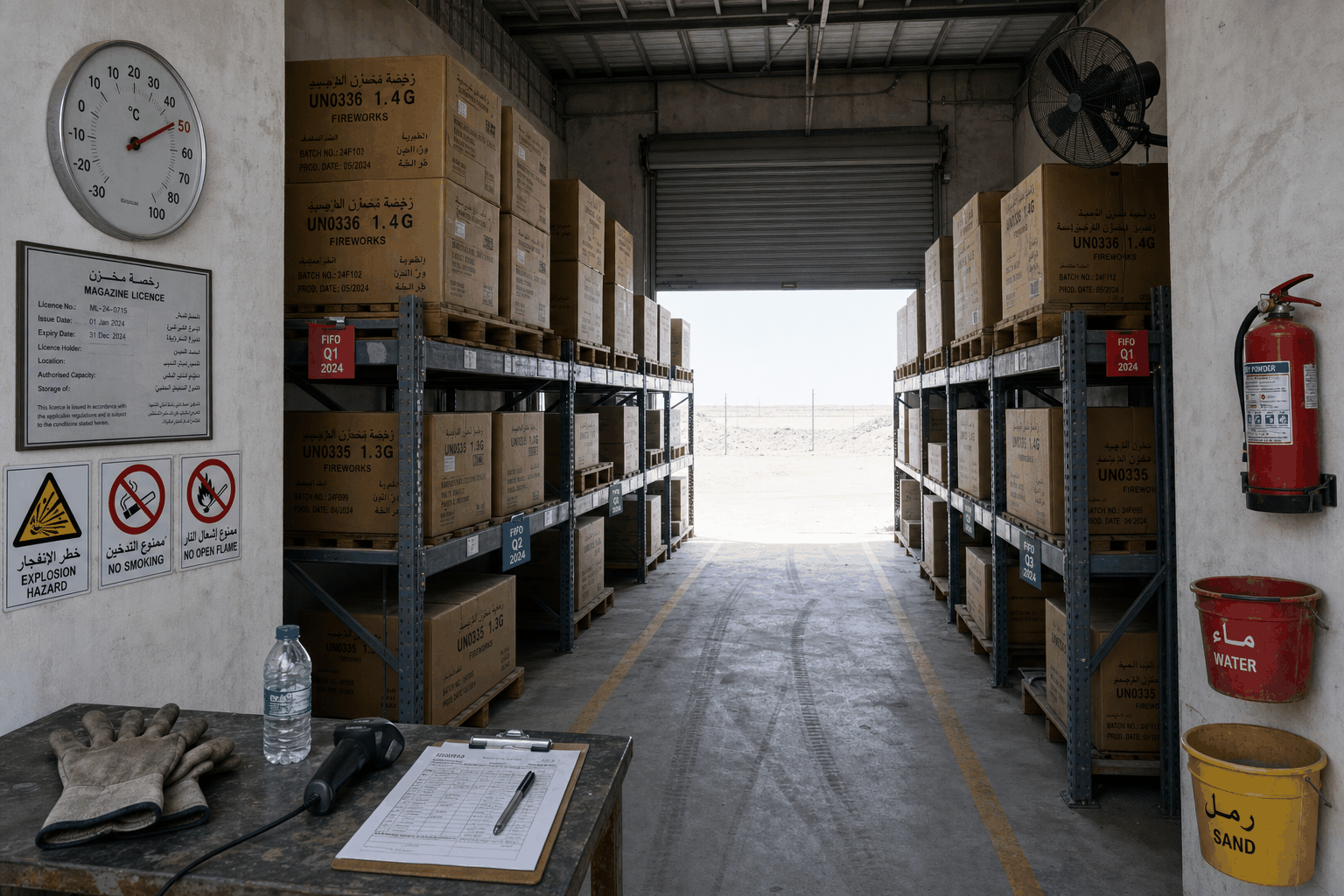
Ask a fireworks importer in Riyadh, Dubai or Doha what they actually worry about between two seasons, and the answer is almost never the show itself. It is the months of 45–52°C heat, salt-loaded coastal humidity and June sandstorms that the cargo has to sit through before it ever reaches a stage. Class 1 explosives are not bottled water; they age, and the way you store them decides whether that ageing stays invisible to the customer or surfaces as duds during a high-profile show.
This guide is the operational companion to our GCC Storage & Hospitality Hub. It is written from the factory side — the things a Liuyang export desk can pre-build into the container, and the things only the GCC buyer's magazine and Civil Defence team can manage on the ground. The aim is a shared baseline, not a marketing pitch.
Why 50°C Is the Number That Matters in the Gulf
Fifty degrees Celsius is not a magic threshold for fireworks chemistry. Properly packaged consumer fireworks do not auto-ignite at that temperature, and Civil Defence authorities across the GCC do not use 50°C as a single “trip-wire.” The reason 50°C is the working number is more practical: it is the realistic upper edge of what a well-built magazine sees on a hot June afternoon in Riyadh, Jeddah, Dammam, Dubai, Sharjah, Doha or Kuwait City, before any air-flow or shading measures.
Most fireworks technical files from Liuyang factories assume the cargo will be stored well below about 35°C with stable humidity for the bulk of its planning shelf life. The Gulf summer sits well above that for four to five months a year. The question is not whether the chemistry tolerates heat — it does, with margin — but whether the rate of slow degradation stays low enough that the customer notices nothing 18 months later. That margin is what magazine design, rotation discipline and packaging together protect.
The Gulf Year — Average Peak Daytime Temperature by Month
Indicative monthly peak air temperature, drawn from public meteorological averages for representative GCC cities. Magazine interior temperatures track outdoor highs closely without engineered shading and ventilation.
Figures are monthly averages of peak daytime air temperature in shade; individual July–August days can run 4–6°C above the monthly average, and container interiors in direct sun easily exceed outdoor air by another 5–10°C before any roof ventilation. Inland sites (Riyadh, Kuwait City) reach higher peaks than coastal Jeddah and Muscat.
What Heat Really Does to a Fireworks Composition
The slow ageing inside a Gulf magazine is not one mechanism but four working at once. Understanding which is happening helps explain why a batch that performs perfectly in October can drift into a noticeably higher dud-rate the following March if rotation slips.
Moisture migration
Day-night temperature swings drive condensation inside cartons. Hygroscopic salts in the composition pull in water vapour, then cake when temperature drops again. The cargo looks fine from the outside, but stars and lift charges lose consistency.
Oxidiser ageing
Common oxidisers used in cake compositions can slowly migrate or recrystallise under repeated heating, especially when packaging seals are imperfect. The visible symptom months later is uneven burn rate and the occasional “weak” shot in an otherwise normal pack.
UV-driven case fatigue
Direct sun on outer carton printing and on any cargo briefly staged outside a magazine bleaches inks and embrittles the cardboard. The composition is fine; the retail packaging looks tired, which matters for hotel and event-pyro sell-through.
Fuse and primer hardening
Time-fuse coatings and primer compositions are the most heat-sensitive layer of the system. They harden, lose elasticity and ignition consistency before the main composition shows any sign of trouble — which is why a magazine’s oldest stock often misfires first.
Two Magazines, Same Container, Different Lifespan
The clearest way to feel why magazine quality matters is to imagine the same 20′ container of Liuyang cargo arriving into two different sites the same week. One is a fenced industrial shed near a port; the other is a Civil Defence approved magazine compound on the edge of a city. Six months later the cargo tells very different stories.
Fenced shed near the port
Common improvised arrangement, often without a current Civil Defence magazine licence.
- Direct sun on metal roof, no ceiling insulation
- No earth berm or quantity-distance separation from neighbouring units
- Cartons stacked floor-to-ceiling against external walls
- 1.3G display and 1.4G consumer stock mixed on one rack
- No batch log; FIFO done by best guess
- One dry-powder extinguisher near the door
- No lightning protection on the roof
- Inspection-ready paperwork incomplete or out of date
Civil Defence approved magazine
Typical setup observed across Saudi, UAE, Qatar and Oman event-pyro operators.
- Earth berm on three sides, light-coloured roof, ventilated soffits
- Quantity-distance separation per Civil Defence approval
- Pallets on raised dunnage, 60–80 cm air gap to external walls
- 1.3G and 1.4G physically segregated by partition or separate bay
- Batch log updated on every in / out movement, audited monthly
- Water supply, sand buckets and Class A/B/C extinguishers per Civil Defence list
- Lightning rods bonded to grounded earth pit
- Bilingual signage, current Civil Defence licence visible at gate
Neither magazine is rare in the GCC. The difference is not money — the bermed magazine costs a fraction of the cargo it protects — it is whether the importer has decided that storage is a real operational discipline, not a place where pallets land until the next show.
Inventory Rotation: What “FIFO” Actually Means at 45–52°C
Every magazine SOP mentions FIFO (first-in, first-out). In a cool European warehouse, an honest FEFO (first-expire, first-out) approach by production date is enough. In a Gulf magazine the same words have to carry more weight: an item that looked fresh in February will not look the same after a June heat-wave, even if its calendar age has barely changed.
Receive against the carton-level packing list
Check carton counts, batch and production dates, UN0335 / UN0336 marking and bilingual labels at the gate, not after the truck has left. Photograph any damaged carton before signing.
Quarantine 24 hours for temperature normalisation
Cargo arriving off a reefer or after a long inland haul holds a temperature gradient. Letting it sit in the magazine vestibule for a day prevents condensation when it goes into the cooler interior storage area.
Stage by batch + production date, not by SKU
Two pallets of the same SKU shipped 3 months apart are different stock. Marking pallets with a coloured tag per production quarter makes FIFO a glance rather than a spreadsheet exercise.
Update the batch log on every movement
A simple in/out logbook (or its digital equivalent) shared with Civil Defence is the single piece of paperwork that turns an inspection from a 2-hour audit into a 20-minute formality.
Sample-test before each event window
Pull a few cartons from the oldest batch and test-fire under safe conditions 4–6 weeks before a wedding, hotel show or National Day program. Heat damage shows itself in burn time and report consistency, not in the carton appearance.
Plan to clear cargo within 12–18 months
Inside the Gulf belt, treat the planning shelf life as 12–18 months for 1.4G consumer items and one full season for 1.3G display product. Older stock should either be sold through promotional windows or be deliberately rolled into low-stakes shows.
Decommission with the same paperwork as intake
Any product that is judged unfit must leave the magazine through a documented decommissioning path coordinated with Civil Defence, not by quiet disposal. The audit trail is what keeps the licence intact for the next season.
Pre-Cooling, Reefers and the Eid Window
Most GCC importers do not run a refrigerated magazine — cold storage of bulk explosives is not how Civil Defence usually approves storage in any case. What works in practice is a smaller, targeted use of insulated or refrigerated containers for short windows around the year’s two highest-stakes seasons: the Eid al-Fitr consumer push in spring and the UAE / Saudi National Day display season in autumn.
| Window | Typical action | Why |
|---|---|---|
| T−60 days | Pull season SKUs forward in the magazine. Confirm sample-test plan with venue safety officer. | Heat damage to fuses appears first; 60 days gives time to swap any batch that shows variance. |
| T−30 days | Final batch log audit. Re-label any cartons whose printing has faded under UV. | Civil Defence pre-show inspections tend to concentrate in this window; clean labels avoid hold-ups. |
| T−7 days | Stage the event allocation in an insulated or refrigerated container near the venue at 18–25°C. | Indoor cold-spark and 1.4G consumer items perform more consistently when not pulled straight from a 48°C magazine. |
| T−24 hours | Move only the operating allocation to the firing zone; balance stays in the conditioned buffer. | Limits the quantity exposed to ambient conditions and matches Civil Defence quantity rules at venue. |
| T+24 hours | Unused stock returns to the licensed magazine on the same paperwork as intake. | Keeps the licence audit trail clean for the next inspection cycle. |
Importers who run this discipline tend to report that the “heat” conversation with hotel and event safety officers becomes a non-issue. The cargo has been treated as a perishable for the last 7 days, even though it is shelf-stable on paper.
Planning an Eid or National Day allocation? Send us your magazine address, the SKUs you hold on paper and the event window — our Liuyang desk can review carton dates, UN class, packing spec and lead time, and flag the operational questions worth confirming with your Civil Defence officer before a hot-season pull. Request a stock-rotation review →
Civil Defence Magazine Inspections — What They Actually Look At
Across Saudi GDCD, UAE DCD with MOI sign-off, Qatar MOI with Civil Defence, Bahrain MOI with Civil Defence, Kuwait’s MOI Explosives Section and Oman’s Royal Oman Police with CDAA (the latter formerly PACDA), the licensing language differs, but the practical inspection checklist a buyer should prepare against is surprisingly consistent. A well-run inspection is short because the paperwork is in order, not because the inspector was friendly.
- Quantity on site vs licence — the kilograms of net explosive quantity (NEQ) actually present, matched to the figure on the magazine licence. This is the single most common source of compliance findings.
- Segregation — 1.3G display and 1.4G consumer stored in separate bays or behind a fire-rated partition.
- Housekeeping — no broken cartons, no loose composition, aisles kept clear, dunnage off the floor, no other goods stored in the magazine.
- Fire-fighting equipment — serviced extinguishers, sand and water supply per the Civil Defence list, with maintenance tags in date.
- Lightning and earthing — visible rods, bonded earth, last test certificate available.
- Signage — bilingual Arabic and English hazard signs, the magazine licence and importer authority visible at the entrance.
- Batch log and manifest — up to date, with dates that match the most recent in/out movements.
- Perimeter and access — fence intact, gate locked outside operating hours, controlled access roster maintained.
Insurance, Demurrage and the Real Cost of a Heat-Damaged Lot
The economic case for spending money on magazine quality usually becomes clear the first time an importer has to write off stock that “looked fine” until the show. A useful way to frame the conversation with a finance team is to compare three downside scenarios across a single typical container.
- Quiet attrition — the most common case: a measurable rise in dud-rate after a hot summer, often masked by retail returns and never claimed. The cargo “works,” but the customer complaint rate grows, and the next reorder is smaller.
- Insured write-off — a documented batch failure on a tested sample triggers an insurance claim. Class 1 cargo insurance typically pays only when the storage conditions and Civil Defence licence are demonstrably in order, which is exactly what the batch log and magazine inspection certificate are for.
- Licence action — the worst case is not the cargo, it is the licence. A Civil Defence finding that the magazine was overcapacity, or that 1.3G and 1.4G were mixed, can suspend operations for the next season and is much harder to recover from than a single lost container.
Practical rule: the marginal cost of a properly bermed magazine, monthly inspection routine and a 7-day pre-show cooling buffer is small compared to one written-off display container. The buyers who quietly hold their margin year after year in the Gulf are almost always the ones who treat storage as a process discipline, not as a cost line.
What a Liuyang Factory Can Pre-Build Into the Container
Most of what decides whether cargo survives a Gulf summer happens after it leaves Chinese export. But several factory-side choices materially shift the curve, and most of them are easiest — and cheapest — to specify before the production run starts rather than after.
- Heat-aged fuse and primer batches selected for export to hot climates, rather than the same fuse used for European 1.4G consumer lines.
- Double-bagged moisture barriers with desiccant inside the export carton, sealed before palletisation, so the day-night condensation cycle in a GCC magazine acts on the outer carton, not the composition.
- UV-stable outer carton printing — pigments and varnishes that hold contrast for 12–18 months under indirect sun and warehouse light, so retail packaging still reads cleanly at sell-through.
- Bilingual Arabic and English labelling with UN0336 / UN0335, NEQ in grams per unit, and clearly printed batch and production dates — the inputs Civil Defence inspectors and the importer’s own FIFO process both need.
- Carton-level packing list matched to the magazine layout — a planning detail that turns intake-day from a 2-hour reconcile into a 20-minute count, and protects the audit trail.
- Container loading photography — seals, UN marks, NEQ totals and pallet pattern photographed before sailing, archived to the importer for use during any future insurance or Civil Defence enquiry.
None of this replaces a good magazine, a licensed importer or a current Civil Defence relationship. What it does is reduce the rate of early degradation — often by enough that scheduled events fall inside the cargo’s lower-risk window, rather than at the edge of it.
Frequently Asked Questions
What actually happens to Class 1 consumer fireworks stored at 45–52°C in a GCC magazine?
Properly packed consumer fireworks do not auto-ignite at common Gulf magazine temperatures. The real risk over a summer at 45–52°C is gradual chemical degradation: composition caking, dampness from day-night condensation, fuse hardening and primer ageing. Buyers usually see this as a quiet rise in dud-rate and inconsistent burn time several months later, not as a single dramatic event. A well-designed magazine and a disciplined FIFO rotation are what keep that degradation invisible to the end customer.
Do I need a separate Civil Defence magazine licence for fireworks in Saudi, the UAE and Qatar?
Yes. Across the GCC the magazine and the importer are licensed separately by the relevant Civil Defence authority — the General Directorate of Civil Defence (GDCD) in Saudi Arabia, Civil Defence (DCD) with a Ministry of Interior sign-off in the UAE, the Ministry of Interior with Civil Defence in Qatar and Bahrain, the Explosives Section of the Ministry of Interior in Kuwait, and the Royal Oman Police with the Civil Defence and Ambulance Authority (CDAA, formerly PACDA) in Oman. The licence covers a specific physical site, with quantity-distance separation, lightning protection, signage and approved fire-fighting equipment. A trader holding only an importer licence but no magazine licence is carrying a storage-compliance risk that should be resolved before shipment, and Liuyang factories shipping to that buyer typically ask to see the magazine document before sealing the container.
What is the realistic shelf life of fireworks in a GCC magazine?
Most consumer-grade Class 1 fireworks from Liuyang are designed around a planning shelf life of roughly two to three years from the production date if kept dry and below about 35°C. In a typical GCC magazine that sees 45–52°C in summer with humidity swings, importers should plan to rotate stock within 12 to 18 months. Display 1.3G items with larger compositions, lift charges and time fuses are more sensitive than 1.4G consumer pieces and should ideally clear within one full season.
Is a refrigerated container a sensible way to store fireworks through a Gulf summer?
It can be, with limits. Some hospitality and event-pyro operators in the UAE and Qatar park a reefer or insulated container at the venue marshalling area to hold a small allocation of cold-spark and indoor 1.4G items at 18–25°C for one or two days before a show. That is different from running a magazine on a reefer, which is generally not how Civil Defence approves storage. Long-term cold storage of explosives is not a substitute for a properly bermed magazine; it is a short-term buffer for the last mile.
What do Civil Defence inspectors actually check during a GCC magazine inspection?
Inspections in Saudi, the UAE and Qatar focus on a short list of practical items: the licensed quantity on site versus what is physically present, segregation of Hazard Division 1.3G from 1.4G, condition of fire-fighting equipment and water supply, lightning protection, signage in Arabic and English, the manifest and batch-log book, and the condition of the perimeter fence and access road. Documented FIFO rotation and clean labelling on every carton make those checks fast. Missing or out-of-date paperwork is what usually triggers a return visit, not the cargo itself.
What can a Liuyang factory pre-build into the container to help with GCC heat storage?
Factory-side measures that materially help include: heat-aged fuse and primer batches selected for export to hot climates, double-bagged moisture barriers with desiccant inside the export carton, UV-stable outer carton printing, bilingual Arabic and English UN0336 and UN0335 labelling that survives sun exposure, batch and production-date marking on every carton for clean FIFO, and a carton-level packing list matched to the magazine layout the importer plans to use. None of this replaces a good magazine, but it can help delay the first visible signs of degradation later into the season.
Continue Reading by Market
- Storage & hospitality hub → GCC Storage & Hospitality: Magazines, Weddings & Hotel Pyro
- Main GCC guide → GCC Import & Compliance Hub (Saudi, UAE, Qatar, Kuwait, Bahrain, Oman)
- Logistics into the Gulf → Shipping Fireworks to the Middle East: Ports, DG Process & 2026 Red Sea Routing
- Saudi compliance guide → Saudi SABER & SASO Step-by-Step (2026 Guide)
- Festival sourcing calendar → MENA Fireworks Sourcing Calendar: Eid & GCC National Days
- Classification → UN Numbers & Shipping Classifications for Fireworks
Building a Magazine-Ready Container for the Gulf?
Tell us your Gulf market and magazine conditions. Our Liuyang export desk can specify UN0336 / UN0335 cargo for a 45–52°C magazine — heat-aged fuses, sealed moisture barriers, UV-stable labelling — before the booking is confirmed.
WhatsApp Email