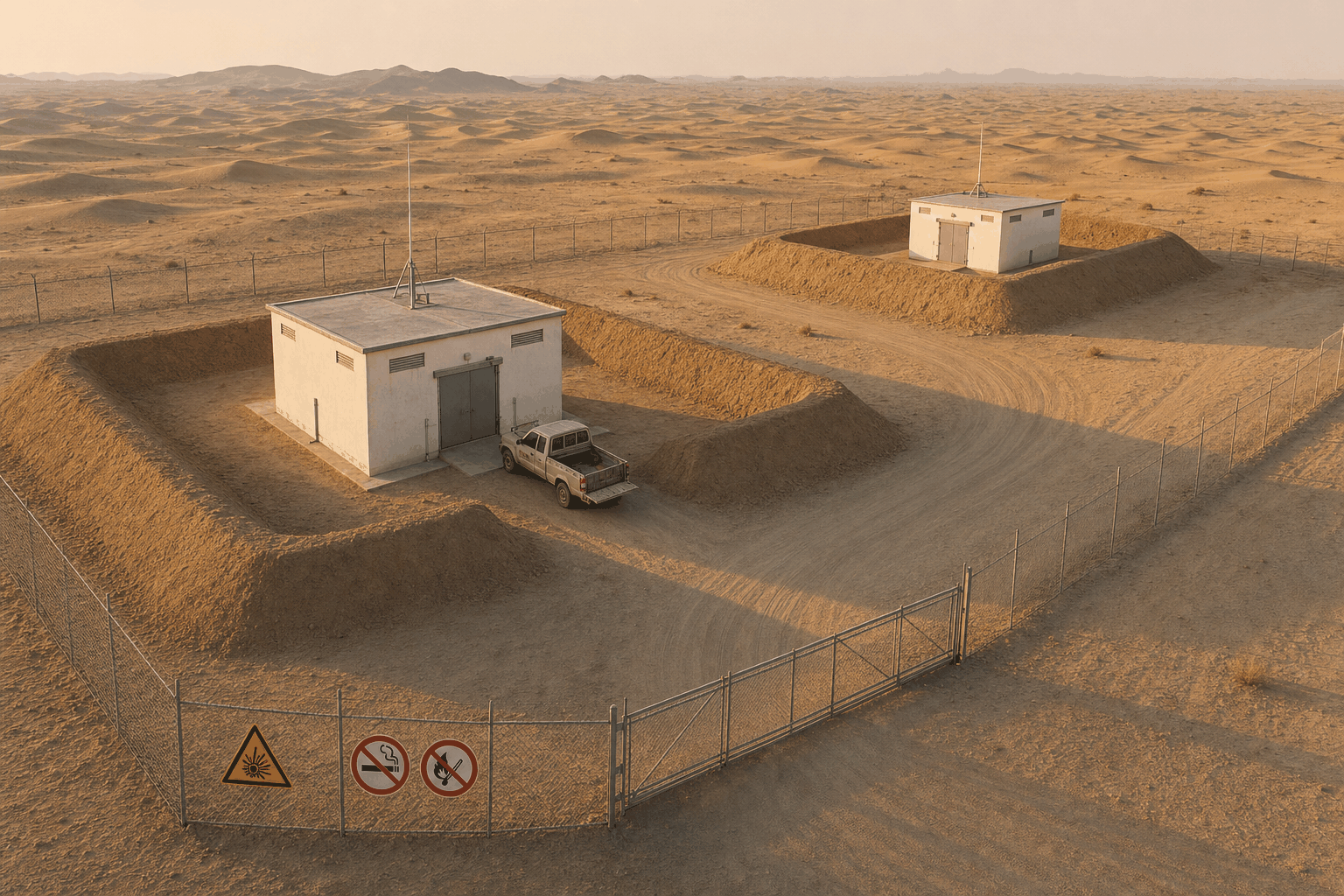
The Gulf does not punish bad pyrotechnics the way temperate Europe does. It bakes them at 50°C+ in the magazine, sandblasts them through a six-month shamal season, and then asks them to fire on a Dubai wedding rooftop with no margin for error.
This page is the GCC storage and stage hub. It covers what 50°C+ magazines actually do to Class 1 cargo, how sandstorm and UV degradation creep in across a single Gulf summer, who issues the magazine licence in Saudi Arabia, the UAE, Qatar, Bahrain, Kuwait and Oman, and how the Liuyang factory loading dock connects to the Atlantis ballroom, the NEOM event lawn and the Lusail boulevard without the wedding party noticing the supply chain. A hotel that fires every Saturday is a different commercial shape — cover on someone else’s magazine licence — and sits in our Gulf hotel and resort procurement guide.
50°C+ GCC Storage Reality — What Heat & Humidity Do to Fireworks
Fireworks are stable in normal warehouse conditions and they have plenty of margin for European or US summers. The Gulf is a different climate.
A non-climate-controlled fireworks magazine inside Riyadh, Doha or Dubai routinely sees 48–52°C on a July afternoon, with the steel-roof variant climbing higher under direct sun. Coastal magazines in Jebel Ali, Sohar or Bahrain run lower peak air temperature but pair the heat with 70–90% relative humidity overnight. Inland magazines in the Saudi Eastern Province or interior Qatar see large diurnal swings instead — 25°C day-to-night differences are normal in summer.
What this typically does to Class 1 cargo over a single Gulf storage cycle:
- Fuses and quickmatch absorb moisture during humid coastal nights and slowly lose burn-rate consistency. The article still fires; the timing tightens or loosens away from spec.
- Hygroscopic star compositions — particularly potassium nitrate-rich formulations — can lose performance reliability. Colours dim, durations shorten and a measurable share of stars in long-stored stock may fail to ignite cleanly.
- Cardboard tubes warp at the joints if stacked too tight on plastic-wrapped pallets that trap nighttime condensation.
- Chemical stability under sustained high temperature — long stretches above the manufacturer's recommended storage range accelerate decomposition of nitrate-based oxidisers and shorten useful shelf life. Outright auto-ignition of properly packaged consumer fireworks requires conditions well beyond ambient GCC magazine temperature, but Civil Defence authorities still set magazine alarm thresholds conservatively to protect against compounding factors — leaking compositions, contaminated stock, blocked ventilation — which gives a working safety margin even at peak summer temperature.
The practical implication is that GCC importers who turn stock within one season see very little of this; importers who hold a 12-month buffer in a non-conditioned magazine should expect a measurable share of the held stock to underperform by the second season. The factory checklist further down covers what we recommend on the packaging side; the magazine side is the importer's call. This page frames the storage scenario; the day-to-day operational detail — heat-composition chemistry, the two-magazine lifespan comparison, FIFO discipline at 45–52°C, pre-cooling and Civil Defence inspection points — lives in our operational companion, Storing Fireworks at 50°C+: GCC Warehouse Best Practices.
Sandstorms, UV & the Slow Degradation of Class 1 Cargo
Sandstorm (shamal) season in the GCC runs roughly March through September, with the strongest events in May and June. The risk to fireworks cargo is rarely the sand itself but the cumulative effects across a typical 12-month storage cycle.
- Fine dust ingress through ventilation louvers — GCC dust passes through standard magazine vents and settles on cartons, fuses and quickmatch ends. A magazine left open or under construction during a shamal can accumulate a thin abrasive layer on every horizontal surface inside two weeks.
- UV degradation of plastic wrapping — outer shrink wrap and PE corner protectors brittle within 6–12 months of direct or filtered sunlight. The carton beneath is usually fine; the visual presentation at delivery is what suffers, and retail buyers notice.
- Salt-laden coastal air — magazines within 5 km of the Gulf coast see corrosion on metal banding, staples and any exposed wire. Electronic firing systems and pre-wired display modules are particularly affected.
- Diurnal temperature swing — large day-night temperature differences in the inland Gulf drive condensation cycles inside sealed cartons. Importers who break cartons open inside the magazine for individual SKU picking accelerate moisture intake further.
None of these are catastrophic when fireworks turn within 6 months of arrival. They become real issues when stock sits 12–18 months in a non-conditioned magazine. The defence is partly packaging (we cover that further down) and partly inventory discipline at the importer end.
GCC Magazine Licensing — Who Issues What in Saudi, UAE, Qatar, Bahrain, Kuwait & Oman
A fireworks magazine in the GCC is licensed by the same authority that issues the per-shipment import permit, not by a general logistics regulator. The exact authority varies by country, and the quantity-distance rules vary with it.
| Country | Magazine licensing authority | Typical distance / capacity rules |
|---|---|---|
| Saudi Arabia | General Directorate of Civil Defence (GDCD) | Distances scaled to NEQ; rural magazine siting required above roughly 1 t NEQ; per-shipment permit references the magazine number. |
| UAE | Civil Defence (DCD in Dubai; equivalent authorities in other emirates) + MOI sign-off | Quantity-distance tables aligned with NFPA-style rules; magazine quotas applied to coastal and high-population zones. |
| Qatar | Ministry of Interior (MOI) + Civil Defence | Strict population-distance rules; capacity-limited magazines outside Doha; per-event movement permit on top of the storage licence. |
| Kuwait | Ministry of Interior, Explosives Section | Per-magazine NEQ ceilings; separate sign-off for festival stock versus commercial display stock. |
| Bahrain | Ministry of Interior + Civil Defence | Small-island geography limits magazine count; most stock turns within 6 months, so long-term storage is uncommon. |
| Oman | Royal Oman Police + Civil Defence and Ambulance Authority (CDAA; formerly PACDA, renamed by Royal Decree in 2021) | Quantity-distance rules broadly similar to UAE; magazines mostly outside Muscat and Salalah city limits. |
The practical rule across all six markets is the same: a fireworks importer cannot legally receive Class 1 cargo from China unless the importer-of-record holds a magazine licence at the destination address, and the per-shipment GDCD / DCD / MOI / ROP permit references that magazine number on the import paperwork. DDP and door-to-door delivery for fireworks are limited by exactly this constraint — even a Chinese forwarder with a destination DG agent partner cannot deliver into a warehouse that does not hold the local magazine licence.
For the full per-shipment compliance workflow — SABER, DCD, MOI and the document chain — see the GCC Compliance Hub. This page focuses on the storage and event end of the chain.
Indoor Cold Fountain & Wedding Pyro — UN0431 vs UN0337 in Practice
The GCC hospitality and wedding category is dominated by indoor cold fountains — short-duration, low-temperature spark fountains used for cake cutting, bride and groom entrance, ballroom centrepieces and stage cues. They look similar to consumer-grade sparklers but they are classified differently under IMDG, and the difference matters both at customs in China and at the venue safety officer in the GCC.
- UN0337 — Fireworks, 1.4S. The consumer and novelty classification. Tested under EN 16263 (the European standard for low-hazard pyrotechnic articles) and accepted by most carriers as 1.4S consumer cargo. A natural fit for small-format sparklers and short cake-topper fountains.
- UN0431 — Articles, pyrotechnic, for technical purposes, 1.4G. The classification most professional indoor cold fountains and stage pyro fall under once they pass the IMDG technical-purpose testing. Accepted by most hotel safety regimes in Dubai, Doha and Riyadh provided the operator holds the local stage pyrotechnician licence and the venue has approved the article datasheet in advance.
In our experience the same physical product can sit under either UN number depending on which test regime the factory ran. A reliable GCC hospitality supplier will declare the UN number on the article datasheet, hold the IMDG test report and be prepared to walk the hotel safety officer through both classifications. Bringing a UN0335 (1.3G display) article into a ballroom because the export paperwork was lazy is one of the more common reasons a Dubai wedding pyro show gets stopped at the door. The wider question of which class an occasion can carry at all, before storage or shipping enters the picture, is covered in our guide to sourcing fireworks by event type.
Dubai Hospitality Circuit — Atlantis, Burj Al Arab, Address Downtown & Marsa Malaz Kempinski
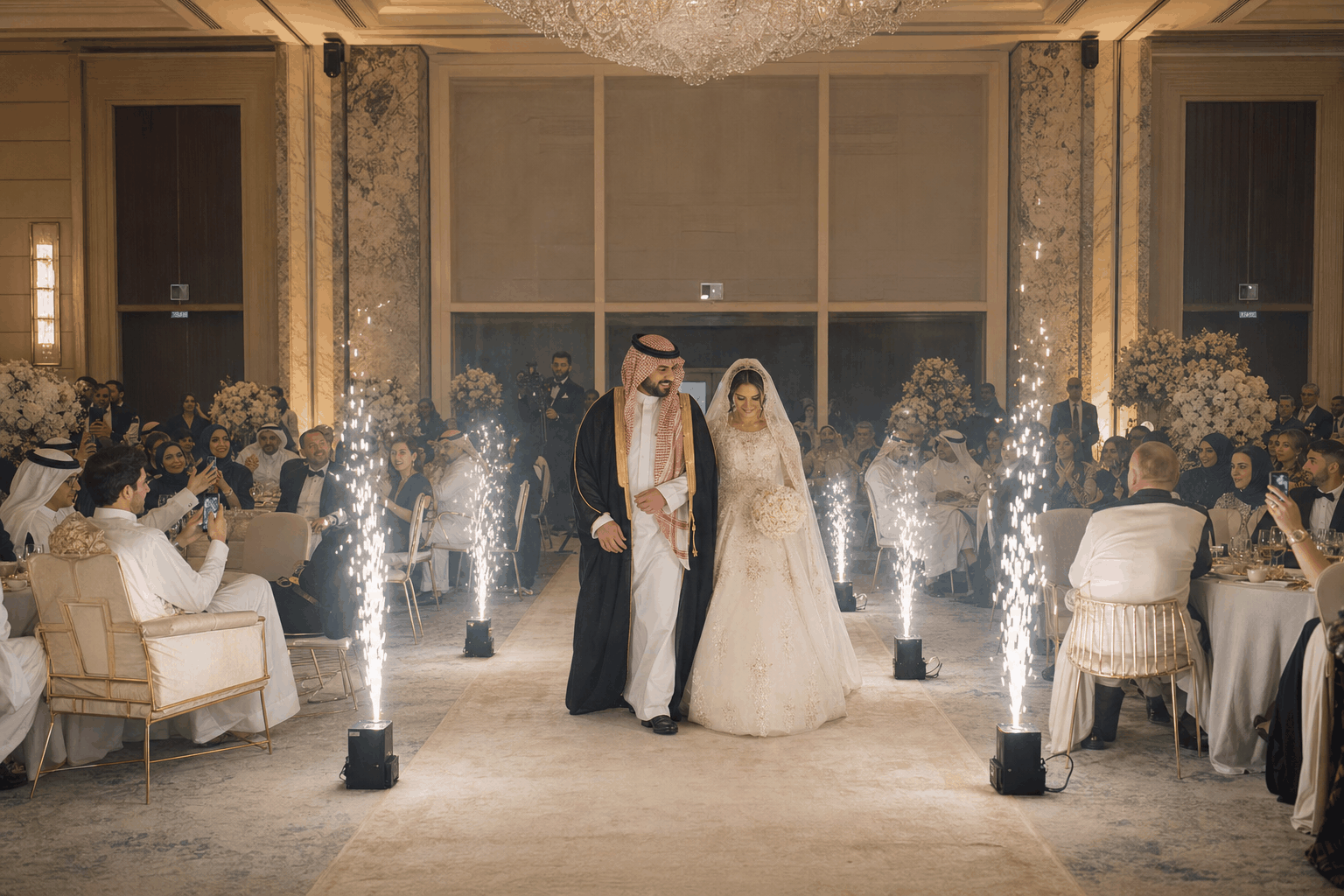
The Dubai-to-Doha hospitality circuit runs on a small number of flagship venues that anchor the high-end wedding, brand-launch and gala calendar. Each property has its own internal pyrotechnic policy on top of the Dubai Civil Defence (DCD) or Qatar Civil Defence rules, and those policies do change between seasons. The notes below describe commonly observed practice rather than a guaranteed booking position for any specific date — final sign-off always sits with the venue's safety officer and the local Civil Defence authority, and any importer should confirm directly before quoting a show.
- Atlantis The Palm and Atlantis The Royal (Dubai) — extensive outdoor terrace and beachfront positions; properties of this type can typically accommodate indoor cold fountains in the ballrooms and limited outdoor low-altitude effects, subject to DCD pre-approval and the in-house safety officer being present.
- Burj Al Arab (Dubai) — internal ballroom and helipad positions; indoor cold fountains are commonly used at this tier of property, while outdoor display work is rarer and typically requires extensive sign-off given the helipad and adjacent airspace.
- Address Downtown (Dubai) — Downtown / Burj Khalifa-area properties tend to run a tight indoor-only policy for in-house events because of proximity to public areas; outdoor work in this district is generally handled through the Downtown event programme rather than the hotel itself.
- Marsa Malaz Kempinski (Doha) — Qatar's flagship Pearl-Qatar hotel can typically support indoor cold fountains and limited outdoor effects on the resort grounds, subject to Qatar Civil Defence and Pearl Authority sign-off.
Hospitality buyers usually pre-position stock in a Dubai or Doha magazine and draw against it for wedding-season demand. Importing per-event is normally not feasible against the 60–90 day fireworks lead time from China, so the magazine licence and the inventory plan are upstream of any individual show.
Saudi Mega-Project Programming — NEOM, Diriyah & the Red Sea Project
Saudi Arabia's giga-project event calendar has become a meaningful source of professional pyrotechnic demand outside the traditional National Day and Founding Day windows. Three programmes account for most of the recurring volume.
- NEOM — the northwest Saudi development runs a regular brand-launch, hospitality and entertainment calendar; pyrotechnic work is coordinated with the NEOM events authority and the relevant GDCD regional office. Inland trucking from Dammam or Jeddah is typical for stock pre-positioned in Saudi.
- Diriyah — the historical Riyadh-area site runs a Founding Day, Formula E weekend and seasonal entertainment programme with significant outdoor display content. Stock is typically pre-positioned in a Riyadh-region magazine and trucked to the site for each event.
- The Red Sea Project — the western coast hospitality and resort development is moving into a regular event programme. Pyrotechnic work is coordinated with Red Sea Global (the developer formerly known as The Red Sea Development Company / TRSDC, rebranded in late 2022) and GDCD, with stock typically routed via Jeddah or King Abdullah Port and pre-positioned in Western Region magazines.
These programmes are not single events but rolling calendars. The practical implication for importers is that quarterly container volume into Saudi has grown meaningfully and the magazine licensing in Riyadh, the Eastern Province and the Western Region is what tends to limit scale, rather than factory capacity in Liuyang.
Qatar's Lusail Event Circuit — Hamad Port to Stage in 72 Hours
Qatar's professional event calendar centres on Lusail Boulevard, the Lusail waterfront and the Doha Corniche, with regular national day, F1, hospitality and brand programming. The supply chain advantage Qatar offers is short: Hamad Port to a Lusail stage is roughly 30–40 km, with no inland trucking complexity.
For pyrotechnic importers serving Qatar, this typically means:
- Stock pre-positioned in a Doha-area magazine can reach a Lusail or Corniche stage in 72 hours once the Qatar Civil Defence movement permit and operator approval are in place.
- Single-event volumes are usually smaller than Saudi National Day or UAE National Day, but the event frequency is high and the planning window per event is shorter.
- The Qatar MOI + Civil Defence sign-off for pyrotechnic articles is per-event in addition to the per-shipment import permit; the venue and the operator are named on each approval. The import side — the MOI licence, Hamad Port and the document chain — is covered in the Qatar MOI & Hamad Port import playbook.
The combination of short port-to-stage distance and dense event programming makes Doha one of the cleaner GCC operations to plan around — provided the importer holds the magazine licence and works with an MOI-registered operator partner.
Packaging & Inland Handling — What Survives a Gulf Summer
Packaging is the single variable on the supply side that genuinely changes the survival rate of fireworks across a Gulf summer. The spec below is what Liuyang factories typically use on GCC hospitality and storage-heavy orders; it is not free, but it pays back as soon as stock sits longer than one season.
- Inner liner — moisture-barrier foil-laminated PE bag inside each carton; sealed at the factory before the carton is closed.
- Carton material — 5-ply corrugated cartons with a higher burst-strength rating than the standard 3-ply used for short-cycle US and EU shipments; resists carton wall failure under stack loads in 50°C+ magazines.
- Pallet wrap — UV-stable PE shrink wrap rated for outdoor storage; standard food-grade wrap brittles within 6 months under Gulf conditions.
- Pallet height — pallets capped at 1.6 m to avoid top-layer crush under stack load when magazines run at peak summer temperature.
- Banding — plastic strap rather than metal; metal banding corrodes in coastal magazines and abrades carton walls during transit.
- Container loading — paper-faced dunnage rather than air bags on the topmost row, because air bags develop pressure variance across 25°C day-night swings inside a closed Class 1 container.
Factory-side packaging cannot fix a magazine that runs at 55°C with broken ventilation, but it can extend useful shelf life from one season to two for the GCC-spec carton compared with the standard short-cycle export carton.
The Storage-to-Stage Compliance Relay — Liuyang Factory to GCC Magazine
The compliance chain on a GCC hospitality or storage-heavy order is not a single document; it is a relay of approvals across the supply chain, and the handover points are where most Class 1 problems originate.
- Factory loading — the Liuyang factory loads the sealed Class 1 container under provincial DG permit; UN classification, NEQ and the DGD / IMO form are issued at this stage.
- Inland trucking to the coastal port — DG-permitted road transport to Huangpu, Shenzhen, Shanghai or Ningbo; the trucking company holds the inter-provincial DG transport licence.
- Loading port — Class 1-licensed DG berth at the southern China coastal port; the loading forwarder must hold the Class 1 booking desk and file the DGD / IMO form with the carrier.
- Ocean carriage — carrier acceptance for UN0335 / UN0336 / UN0337 / UN0431 on the destination lane; Class 1 cargo cannot transit on a general-cargo booking.
- Destination port clearance — Civil Defence per-shipment import permit (GDCD / DCD / MOI / Royal Oman Police, depending on country) referencing the destination magazine number.
- Inland trucking to the magazine — DG-permitted road transport from the destination port to the licensed magazine; in Saudi this often involves inland transport from Jeddah or Dammam to a Riyadh-region or Eastern Province magazine.
- Magazine storage — magazine held under GCC Civil Defence licence in the importer's name, with NEQ tracked against the magazine cap.
- Movement to venue or stage — separate per-event movement permit issued by Civil Defence; an operator licence is required at the venue.
Every handover requires the next party in the chain to hold the right licence in its own name. The factory cannot issue the magazine number; the importer cannot issue the loading-port DG permit; the operator cannot draw stock without the importer's magazine reference. Mapping out which permit covers which segment before the first purchase order is, in our experience, the single best predictor of whether a GCC hospitality programme ships smoothly.
Frequently Asked Questions
What is the safe storage temperature for fireworks in a GCC magazine?
Fireworks are stable in normal warehouse conditions, but a non-climate-controlled GCC magazine inside Riyadh, Doha or Dubai routinely sees 48–52°C on a July afternoon, with steel-roof variants climbing higher under direct sun. Outright auto-ignition of properly packaged consumer fireworks requires conditions well beyond ambient GCC magazine temperature, and GCC Civil Defence regulators still set magazine alarm thresholds conservatively against compounding factors — leaking compositions, contaminated stock, blocked ventilation — which gives a working safety margin even at peak summer temperature. Performance, however, is a separate question from safety: hygroscopic star compositions and fuses degrade measurably over a 12–18 month storage cycle in an uncontrolled magazine, so importers who turn stock within one season see very little of this while importers holding a long buffer should expect some performance drift in the second season.
Do indoor cold fountains used at GCC hotel weddings need a separate magazine licence?
Indoor cold fountains are still Class 1 pyrotechnic articles under IMDG — typically UN0337 (1.4S) or UN0431 (1.4G, articles for technical purposes) depending on which test regime the factory ran. They must be stored in the same licensed magazine as larger fireworks, under the importer's GCC magazine licence. What is separate is the per-event movement and use approval, which Dubai Civil Defence (DCD), Qatar MOI and Saudi GDCD issue against the specific venue, operator and event date. The magazine licence covers storage; the event permit covers use; neither replaces the other.
Which GCC port is best for hospitality-grade fireworks shipments under tight wedding deadlines?
For Dubai hospitality, Jebel Ali is usually the lowest-variance entry point — multiple weekly direct-call DG services from southern China, DP World's established Class 1 handling and a clearing-agent ecosystem that handles DCD and MOI fireworks documentation as routine workflow. For Qatar hospitality, Hamad Port to a Lusail stage is roughly 30–40 km with no inland trucking complexity, so the port-to-stage chain is short once the per-event permit is in place. For Saudi hospitality on the Western Region, Jeddah remains the closest entry but is the most exposed to Red Sea routing risk; some buyers now use Jebel Ali transhipment to Dammam plus inland trucking, or King Abdullah Port for Western Region demand. The full port-by-port logistics picture lives in the GCC Logistics Hub.
How do Saudi and UAE magazine licensing requirements differ for fireworks importers?
In Saudi Arabia the General Directorate of Civil Defence (GDCD) licenses the magazine and issues the per-shipment import permit, with quantity-distance rules scaled to NEQ and rural magazine siting required above roughly 1 tonne NEQ. In the UAE the Civil Defence authority (DCD in Dubai, equivalent authorities in the other emirates) licenses the magazine with a Ministry of Interior sign-off layer, and quantity-distance tables are aligned with NFPA-style rules. The practical difference is that Saudi magazines tend to be larger and further from population centres, while UAE magazines are smaller, more numerous and often closer to demand. In both jurisdictions the importer-of-record must hold the magazine licence in its own name; an overseas factory cannot deliver Class 1 cargo into a warehouse that does not hold the local magazine reference.
What is the typical lead time from a Liuyang factory order to a Dubai wedding stage?
Factory-to-stage on a fresh order is rarely faster than 90 to 120 days end-to-end. Liuyang production typically runs 30–45 days for hospitality SKUs (indoor cold fountains, stage pyro, small-format outdoor effects), then inland trucking to a southern China DG port, Class 1 vessel booking, 18–25 days sea time to Jebel Ali, DCD per-shipment permit and clearance, and inland trucking to a Dubai-area magazine. For this reason hospitality buyers serving the UAE wedding season almost always pre-position stock against the calendar and draw against it for each event, rather than importing per-event. The per-event window from a Dubai magazine to a hotel ballroom, by contrast, can be as short as 72 hours once the DCD venue and operator approval is in place.
Are sandstorm and UV damage to fireworks cargo covered by standard cargo insurance?
Standard marine cargo insurance covers loss and damage in transit but generally excludes slow degradation in storage, including UV brittling of pallet wrap, fine dust ingress, salt corrosion of banding and humidity-driven star composition drift. Some specialised dangerous goods policies offer extended storage cover, but underwriters tend to price it heavily for GCC summer conditions. The practical defence is on the packaging side — moisture-barrier inner liners, UV-stable pallet wrap, plastic banding instead of metal in coastal magazines — combined with inventory discipline at the importer end. Factories cannot insure against a magazine that runs at 55°C with broken ventilation, but the right carton specification can extend useful shelf life from one season to two.
Continue Reading by Market
- Middle East buyers → GCC Import & Compliance Hub
- Saudi deep dive → Saudi SABER & SASO Step-by-Step for Fireworks Importers
- Saudi event approval → Saudi Event Pyrotechnics Permits: GEA & Civil Defence
- Middle East festival calendar → Eid, National Days & Royal Wedding Sourcing Calendar
- GCC logistics hub → Shipping Fireworks to the Middle East: Ports, DG Process & 2026 Red Sea Routing
- GCC storage & hospitality → Gulf Fireworks Without the Drama (this page)
- A weekly or monthly resort programme → Hotel & Resort Fireworks in the Gulf: Buying a Season
- 50°C magazine storage deep dive → Storing Fireworks at 50°C+: GCC Warehouse Best Practices
- Distributor playbook → Distributor's Guide for ME & LATAM
- DG process → Dangerous Goods Shipping Process
- Classification → UN Numbers & Shipping Classifications
Planning a GCC Hospitality, Wedding or Storage-Heavy Programme?
Tell us your Gulf market and venue type. Our team can write the carton spec for 50°C+ magazines, build a hospitality SKU mix (UN0431 indoor cold fountains alongside outdoor 1.4G effects), and reference your destination magazine number in the document set — before the container leaves the loading port.
WhatsApp Email