If you are a distributor, wholesaler or importer in the Middle East or Latin America, you already know one thing: China is where the fireworks come from. More than 90% of the world's consumer fireworks are made in China, and most of them ship out of one small city in Hunan Province — Liuyang.
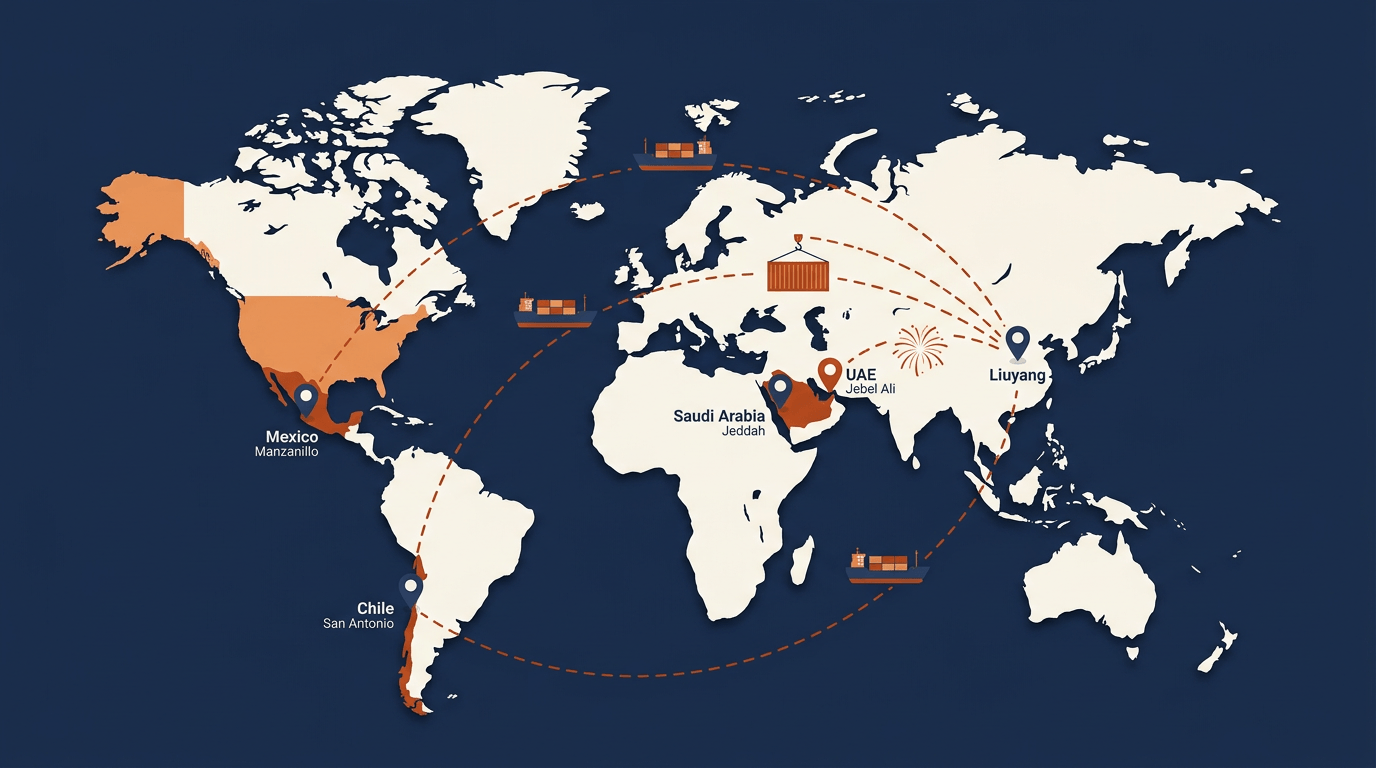
But knowing where to buy is not the same as knowing how to buy. This guide is the clear, step-by-step playbook on how to import fireworks from China as a B2B buyer — the costs, the fireworks import regulations in your region, how to pick a reliable fireworks supplier in China, and what it really takes to move a container from Liuyang to Jebel Ali, Jeddah, Manzanillo or San Antonio.
Why Import Fireworks from China
The short answer: price, capacity and concentration. China, and specifically Liuyang, is the only place in the world where you can buy fireworks at scale, at a competitive price, and with a full export document set.
- Price: Factory FOB out of Liuyang is the price at the factory gate. A regional distributor's price in the Middle East or Latin America for the same cakes, fountains and firecrackers already includes freight, duty and their margin. How the layers add up in one US container example is in our factory-direct margin guide.
- Capacity: Liuyang produces around 60% of the world's fireworks. The city can absorb huge orders for peak seasons — Eid, National Day, Diwali, Christmas, New Year, Día de Muertos — without losing quality.
- Cluster effect: Hundreds of licensed factories, dozens of DG-ready forwarders, and a full support network of testing labs, packaging suppliers and export agents all sit inside a 50 km radius.
For any serious fireworks wholesale China buyer, the question is not whether to source from China — it is how to do it safely and profitably. That is what the rest of this guide covers.
Types of Fireworks You Can Import (1.3G vs 1.4G)
Before we talk about price or shipping, you need to understand the two hazard classes. Every fireworks shipment from China falls into one of them, and the class decides almost everything else — cost, permits, carrier acceptance, storage.
Class 1.4G — Consumer Fireworks (UN0336)
This is the mass market. Cakes, fountains, Roman candles, firecrackers, rockets for retail customers and small public shows. 1.4G means the product cannot mass-detonate and is safe to store in smaller magazines.
- Lower DG freight surcharges (often 30–50% less than 1.3G).
- Accepted by most container carriers on normal booking.
- Lower storage and permit burden in destination countries.
- Best fit for distributors, wholesalers and retail chains.
Class 1.3G — Display / Professional Fireworks (UN0335)
These are the large aerial shells, professional cakes and big mines used in stadium shows, national day events and public festivals. They produce much bigger breaks, but they are also a far stricter hazard class.
- Significantly higher DG surcharges and tonnage caps per vessel.
- Only a limited number of carriers accept 1.3G on each lane.
- Stricter import permits and magazine requirements at destination.
- Best fit for display operators, event contractors and government buyers.
Distributor tip: If you sell to retail stores and B2B resellers, keep your mix heavily weighted to 1.4G. A small 1.3G line is useful for bigger customers, but 1.3G-heavy containers cost more to ship and are harder to clear in many Middle East and Latin America ports.
Step-by-Step Process to Import Fireworks
The full import cycle, from first enquiry to retail shelf, usually takes 90 to 150 days. Here is how to do it, step by step.
Step 1 — Find a Reliable Supplier
Start with the factory, not the broker. A real fireworks supplier in China will give you:
- A factory name, address and production licence number.
- Export experience to your region (ask for reference shipments).
- Test reports and certifications for the exact SKUs you want.
- Clear FOB pricing by SKU, not a vague "full container" number.
If the supplier cannot answer these four points in one email, move on. We cover supplier checks further down this guide, and our dedicated sourcing and supplier-trust playbook lays out the full pre-payment vetting sequence.
Step 2 — Confirm Local Regulations
Do this before you place the order. Every country has its own rules. In the Middle East you need approval from civil defence or the interior ministry. In Latin America, the military or defence ministry usually controls imports.
Get your local permit or import licence application started on day one. In many countries it takes 30–90 days to be issued, and no Chinese factory should load your container until the licence is in place.
Step 3 — Confirm Product Classification
Every SKU needs a UN number and a classification certificate. For consumer fireworks, this is usually UN0336 (1.4G). For display shells, it is UN0335 (1.3G).
Your factory should provide:
- Classification certificate from a recognised test lab.
- Material Safety Data Sheet (MSDS / SDS) per product family.
- Net Explosive Quantity (NEQ) per carton and per container.
- HS code (normally 3604.10 for fireworks).
Step 4 — Arrange Shipping
Fireworks are shipped as dangerous goods (DG). You cannot use a normal forwarder.
Work with a DG-specialist forwarder — one that regularly handles Class 1 cargo and has volume agreements with the carriers that still accept explosives. Book on FOB terms from Huangpu Old Port, Shenzhen, Shanghai or Ningbo. The factory handles export clearance and DG paperwork, and you control the ocean leg and destination clearance.
We look at fireworks shipping cost in detail in the next section.
Step 5 — Clear Customs at Destination
When the container arrives, your customs broker files the import entry using the correct HS code, UN number and NEQ. The key documents are:
- Commercial invoice and packing list.
- Bill of lading with DG marks.
- Dangerous Goods Declaration (DGD / IMO form).
- Local import permit and magazine approval.
- Certificate of origin (China Form A / Form E where applicable).
Clean paperwork clears in 3–10 working days. Missing or wrong paperwork can hold the container for weeks — and storage of Class 1 cargo at port is expensive.
Fireworks Import Regulations by Region
Treat this section as a routing map, not as the full legal workflow. This distributor guide shows which authority usually controls the shipment; the country-level permit steps belong in the dedicated regional hubs linked below.
| Market | Main gatekeeper | Practical importer note | Deep guide |
|---|---|---|---|
| UAE | Ministry of Interior + Civil Defence | Per-shipment approval, licensed storage and DG-cleared entry through Jebel Ali or another approved port. | GCC compliance hub / Jebel Ali clearance |
| Saudi Arabia | GDCD + SABER/SASO conformity | Saudi imports need shipment-level approval and conformity paperwork tied to the importer, HS code and product family. | Saudi SABER guide |
| Qatar / Kuwait / Bahrain / Oman | Interior ministry or civil-defence explosives desk | Smaller GCC lanes still require a licensed local importer, declared NEQ, approved storage and clean DG documentation. | Six-country GCC table |
| Chile | DGMN + registered polvorista | Consumer bans do not mean B2B import is closed; the legal route is a registered professional importer and per-shipment authorisation. | Chile DGMN guide |
| Mexico | SEDENA | The importer needs an active explosives permit and shipment paperwork aligned with SEDENA and the chosen port. | Mexico SEDENA guide |
| Brazil / wider Latin America | National army / customs / local broker | Expect market-by-market registration, season-specific demand and longer Atlantic-side lead times. | Latin America import hub |
Practical rule: Your destination permit is always your responsibility, not the factory's. Under FOB Incoterms, the moment the goods are on board the vessel at the named Chinese port, the legal risk is on the importer. Never skip this step to save time.
Shipping Fireworks from China: Costs and Methods
For a distributor, the shipping decision is simple at the top level: Class 1 fireworks move by sea, normally as a full 20ft container. Airfreight is effectively unavailable for commercial Class 1 explosives, and LCL is usually refused or priced so high that it destroys the unit-cost advantage.
- Container baseline: one 20ft FCL, built around a multi-SKU 1.4G mix, is the practical starting point for Middle East and Latin America buyers.
- Cost baseline: freight plus DG surcharge commonly adds several thousand dollars per 20ft container before destination THC, brokerage, duty and inland delivery.
- Lane choice: GCC port strategy, Red Sea exposure, Latin America transit time and Incoterm control all belong in the logistics guides rather than in this importer overview.
Use the dedicated shipping cost breakdown for all-in cost math, the shipping time guide for transit windows, and the Middle East logistics hub for GCC ports, Red Sea routing and FOB/CIF/DDP trade-offs.
Common Mistakes When Importing Fireworks
These are the five errors we see most often from new distributors in the Middle East and Latin America. Any one of them can easily cost more than the margin on the first container.
- Picking the wrong supplier. Trading companies with no real factory, slick websites but no production licence, unrealistic prices that turn into quality issues at destination.
- Not understanding DG classification. Treating UN0336 and UN0335 as if they were the same thing — then getting a surprise DG surcharge or a rejected booking at the port.
- Ignoring local regulations. Placing an order before the GDCD, DGMN or SEDENA permit is in hand, and then scrambling to keep the container out of storage.
- Ordering too late for the season. Chinese New Year shuts factories for 3–4 weeks every year. A spring order that ignores this date never lands in time for summer or autumn sales.
- Taking CIF without an FOB comparison. Freight, DG surcharges and forwarder markups disappear into one number. Get an FOB quote as well and price the ocean leg with your own DG forwarder.
How to Choose a Reliable Fireworks Supplier in China
A good supplier is the single biggest factor in a smooth import. A bad one will quietly cost you your margin — and sometimes your customers.
Use this short checklist before you send a deposit:
- Factory experience. At least 5–10 years of real production in Liuyang, not a reseller pretending to be a factory.
- Export experience to your region. Ask for shipment references to the UAE, Saudi Arabia, Chile, Mexico or your specific country. A factory that has never exported to your region will make paperwork mistakes that cost you at customs.
- Compliance frameworks. ISO 9001 is a baseline framework. For Europe, CE and EN 15947 (EU-bound shipments include applicable CE / EN 15947 documentation prepared per shipment — see our EU market inquiry page); for the US, APA 87-1; for the Middle East, GCC and SABER awareness; for Latin America, DGMN / SEDENA experience with the correct documents.
- Full document set. They can send, on request, a classification certificate, MSDS, test reports, product photos, and a sample packing list with NEQ values.
- Transparent pricing. Clear FOB prices by SKU, not an opaque "turnkey" number.
- Production control. They own the factory floor (or have a long-term contract), so they control lead time and quality — not a third-party workshop.
A reliable supplier will also push back on bad ideas. If you propose a product mix that is unsafe for your destination country or a shipping plan that cannot actually be booked, a good factory will warn you. That is a green flag, not a red one.
2026 Routing Note: Red Sea Impact on GCC Imports
Red Sea disruption still matters for GCC planning, but this guide only needs the distributor-level rule: build extra buffer into GCC peak-season orders, especially Saudi-bound cargo, and confirm the actual vessel rotation before production finishes. Latin America lanes from China are normally planned separately because they do not depend on the Red Sea corridor.
For the full port-by-port view — Jebel Ali, Jeddah, Dammam, Hamad, war-risk premiums, Cape routing and Incoterm control — use the Middle East fireworks logistics hub. For compliance by country, use the GCC Compliance Hub.
Why Liuyang Is the Global Fireworks Hub
Almost everything described above happens in one place: Liuyang, in Hunan Province, central China. Liuyang has been making fireworks for more than 1,400 years. Today it produces around 60% of the world's fireworks and exports to 160+ countries.
As a B2B buyer, Liuyang matters to you for four concrete reasons:
- Scale. Hundreds of licensed factories in one cluster, which means price competition is real and MOQs are flexible.
- Depth. Testing labs, DG packaging suppliers, inland DG trucking, and experienced export agents all sit inside the same region.
- Capacity for peaks. Liuyang can produce for Eid, Diwali, National Day, Christmas and New Year without the kind of quality drop that small clusters suffer under pressure.
- Custom fireworks solutions. Bigger factories will co-develop private-label cakes, branded packaging and region-specific product lines. For growing distributors in the Middle East and Latin America, this is often the easiest way to differentiate from the mass market.
For distributors who want to see the cluster with their own eyes, many buyers visit during the annual Liuyang International Fireworks Festival, usually held in October. Attending the festival is one of the most efficient ways to meet multiple factories in a short trip. If you are planning how to go to Liuyang China, the closest major airport is Changsha Huanghua International (CSX), with a 60–90 minute drive to most factory districts. A practical fireworks festival China travel plan typically combines factory visits during the week with the festival on the weekend, so the whole trip pays for itself in the deals you can close face to face.
Buyers often ask: is fireworks festival in China safe? For professional B2B visitors, the short answer is yes — the festival is run with proper safety zones, trained operators and government oversight. On the practical side, most of our distributor guests travel on a standard business visa; some combine it with a tourist visa, so it is worth checking the current China visa for tourists rules for your passport before you book. Factory visits are usually hosted directly by the supplier, and Liuyang fireworks tickets for the public display nights are arranged locally — in practice, your host will sort it out. None of this is tourism for its own sake; it is simply the fastest way to verify who you are working with.
Whether you visit in person or not, the core business of sourcing fireworks from Liuyang is the same: pick the right factory, align on classifications, and build a repeatable shipping process. Done well, working with suppliers in Liuyang becomes one of the more predictable parts of your distribution operation.
FAQ
Is it legal to import fireworks from China?
Yes, in almost every country, as long as you hold the correct local permit. In the UAE, approval comes from the Ministry of Interior and Civil Defence. In Saudi Arabia, the GDCD issues per-shipment permits. In Chile, the DGMN controls imports. In Mexico, SEDENA regulates explosives imports. Never ship before your local permit is issued.
How much does it cost to import fireworks from China?
For a mixed 20ft container of 1.4G consumer fireworks from Liuyang: FOB cargo USD 8,000–25,000, ocean freight with DG surcharge USD 3,500–8,000, inland trucking USD 300–600, destination THC and brokerage USD 500–1,400, plus customs duty (usually 5–15%). All-in landed cost typically falls in the USD 14,000–36,000 range on your first container.
What is the minimum order quantity (MOQ) for fireworks from China?
For a Middle East or Latin America distributor, the realistic MOQ is one full 20ft container (FCL), which in Liuyang usually carries around 16 tonnes net of Class 1.4G product across a multi-SKU mix. LCL is not a practical option for Class 1 explosives on these lanes — most DG-competent carriers simply do not accept consolidated explosives, and the few that do quote rates that wipe out the unit-price saving entirely. First-time distributors normally reach the minimum by spreading that mix across fast-moving cakes, fountains, firecrackers and rockets.
How long does shipping fireworks from China to the Middle East or Latin America take?
Plan on roughly 3 to 5 months from signed PO to goods-in-warehouse. Factory production alone runs about 5 to 9 weeks, depending on SKU complexity, season and pre-shipment inspection. Sea transit is typically 22–28 days to Jebel Ali, 25–32 days to Jeddah, 30–40 days to Manzanillo and 35–45 days to San Antonio. Allow another 1 to 2 weeks at destination for customs entry, DG last-mile delivery and magazine intake. On your very first shipment, also add the one-off lead time for your national explosives permit — usually 30 to 90 days in most Middle East and Latin America jurisdictions.
Do GCC countries require Halal certification for fireworks?
Fireworks themselves do not require formal Halal certification because they are non-food, non-cosmetic articles. However, Saudi and UAE buyers increasingly request a Manufacturer's Declaration confirming no animal-derived components are used in the pyrotechnic composition or packaging. Most Liuyang factories provide this declaration on request at no cost.
Importing fireworks from China is not difficult — it just punishes shortcuts. Get your local permit first, pick a real Liuyang factory, understand 1.3G vs 1.4G, buy FOB with a DG-specialist forwarder, and keep your paperwork clean. Do those five things and your first container will land as smoothly as your tenth.
Continue Reading by Market
- Latin America buyers → Latin America Import Hub (Brazil, Chile, Mexico)
- Middle East / GCC buyers → GCC Import & Compliance Hub (Saudi, UAE, Qatar, Kuwait, Bahrain, Oman)
- US / UK / EU first-time buyers → Beginner's Guide for US, UK & EU
- All markets → UN Numbers & Shipping Classifications
Continue the Distributor's Playbook
Deeper guides on the specific steps in this article — landed cost, DG transit, classification, supplier checks and the right sourcing window for ME & LATAM containers.
Planning Your First Container from China?
If you distribute fireworks in the Middle East or Latin America and you want a realistic landed-cost quote, an SKU mix built for your market, or a quick review of your local permit requirements, our Liuyang team is happy to help. We work with distributors in over 30 countries and can discuss custom fireworks solutions for your brand.
WhatsApp Email