Most first-time buyers don't fail at finding a Liuyang factory — they fail at everything that happens after the order is placed. Fireworks are not just another product. They are Class 1 explosives, regulated at every border, and a single missing licence or wrong line on a Dangerous Goods Declaration can freeze a $30,000 container in port for weeks. We see it every peak season: a new importer lands a great factory price, then burns the entire margin on demurrage, re-bookings, and a customs hold.
This guide is the short, honest version of how to import fireworks from China as a beginner — the regulations you actually have to satisfy, the logistics chain from our warehouse in Liuyang to your door, and the documents that keep your container moving. It's written from the factory side of the desk, after 10+ years of shipping UN0336 to the US, UK, EU, Middle East and beyond.

Why Liuyang Is the Default Origin
Before regulations, a quick word on why this conversation keeps starting in Liuyang. The city of Liuyang in Hunan Province produces roughly 60% of the world's fireworks and exports to more than 160 countries. The cluster here holds the densest concentration of licensed factories, the supporting lab infrastructure (classification, CE testing, storage), and the only inland freight lanes in China that are set up specifically for Class 1 cargo out to Shanghai, Ningbo and Yueyang ports. If you want UN0336 at scale with clean paperwork, you are almost always shipping out of Liuyang — exactly what our export product range was built for. What differs is only how well you plan around it.
The Three Legal Realities Beginners Underestimate
Every first-time importer I meet is surprised by one of these three things. Get them right up front and the rest of the process is mechanical.
- You need a licence in your country before you touch a PO. No Liuyang factory should be loading your container if you can't produce a valid destination-side explosives licence. If a supplier offers to ship without it, that's a red flag about the supplier, not a shortcut for you.
- Customs classification is your liability, not the factory's. Under Incoterms FOB — the default for fireworks — risk passes to you once the container is on board the vessel at the named Chinese port. (The old “ship's rail” wording was dropped from the rules in 2010; on-board is the test that applies now.) Incorrect UN numbers, NEQ errors or missing classification certificates are your problem at destination.
- Fireworks season is dictated by the Chinese New Year. Production stops for 3–4 weeks every January or February. A July 4th stock order placed in March has basically already missed the window.
Step-by-Step: The Import Timeline
The full cycle from first enquiry to retail shelf usually runs 90 to 150 days. Here is how that breaks down on a typical 20ft FCL from Liuyang to a Western port.
| Stage | Typical Duration | Who Owns It |
|---|---|---|
| Destination import licence & site storage approval | 30–120 days (one-off) | Importer |
| Factory quotation, sample, PO & 30% deposit | 7–14 days | Shared |
| Production & in-line QC | 35–60 days | Factory |
| Pre-shipment inspection & 70% balance | 3–5 days | Shared |
| Classification + export documents | 5–7 days (parallel) | Factory |
| Liuyang → port inland trucking | 2–3 days | Forwarder |
| Ocean freight (US WC / EU / ME) | 18–40 days | Carrier |
| Destination clearance & delivery | 3–10 days | Importer + broker |
Regulations — What Your Country Actually Requires
Every destination has its own regime. This guide focuses on the three Western regimes first-time buyers ask about most — the US, EU and UK — boiled down to what you must have before the first PO.
United States
- ATF Federal Explosives Licence (FEL) as Importer (Type 8) or Dealer (Type 20). Consumer 1.4G products are covered by an APA 87-1 compliant line of SKUs; display 1.3G is far more restricted.
- DOT / PHMSA compliance via an EX number for every item, cross-referenced on the Dangerous Goods Declaration.
- CPSC compliance on fuses, labelling and overall construction for consumer items.
- Approved magazine storage per ATF 27 CFR 555 Subpart K.
European Union
- CE marking under Directive 2013/29/EU — EU-bound SKUs require CE marking per EN 15947 (categories F1/F2/F3), with applicable Notified Body references and the 4-digit NB number printed on the product. See our EU market inquiry page for documentation prepared per shipment and SKU list.
- Category F1/F2/F3 for consumer fireworks, F4 for professional. Categories are not interchangeable across member states.
- National importer registration (e.g. BAM in Germany, INERIS testing route in France, AEPS storage in Spain).
- REACH compliance on all chemical compositions.
United Kingdom
- HSE Explosives Licence with a registered storage site and assessed Net Explosive Quantity (NEQ) limit.
- UKCA marking (since 2023 — BS 7114 is obsolete) aligned to the EU CE regime.
- Police notification for movement under the Explosives Regulations 2014.
Beyond the US, UK & EU
Shipping into the Middle East or Latin America instead? Those regimes are permit-heavy and country-specific, so they have their own dedicated playbooks rather than a thin summary here. Start with the Middle East & Latin America distributor's guide, then drill into the GCC compliance hub (Saudi SABER, UAE DCD, plus Qatar, Kuwait, Bahrain and Oman) or the Latin America import hub (Brazil, Chile and Mexico).
For the two other Western regimes we are asked about: Australia needs a state WorkSafe per-shipment permit plus AS 2187.4 storage compliance, and Canada needs a Natural Resources Canada ERD import permit plus TDG compliance.
Rule of thumb: if your supplier can't tell you which of these regimes applies to you and which documents fall on their side of the table, walk away. A beginner paired with an inexperienced factory is the most common recipe for a seized container.
Classification: UN0336, HS 3604.10 and Why Both Matter
There are two parallel classifications on every fireworks shipment and they do different jobs.
UN number (transport)
Decides how the cargo is carried. Consumer fireworks are UN0336, Class 1.4G. Display / professional is UN0335, Class 1.3G. Class 1.3G carries stricter stowage and up to $1,500/container more in DG surcharges, so you'll want your SKU mix deliberately weighted toward 1.4G where possible.
HS code (customs)
Decides how much duty you pay. Fireworks sit under HS 3604.10. Many countries break this down further:
- US HTS: 3604.10.10.00 / 3604.10.90.00 — generally duty-free under MFN, subject to current trade actions.
- EU TARIC: 3604 10 00 — 6.5% MFN duty.
- UK Tariff: 3604 10 00 — 6.5% MFN (aligned).
- GCC: 3604.10 — commonly 5% customs duty across the bloc.
- Mexico: 3604.10.01 — 15% MFN duty (subject to TIPAT / USMCA exclusions).
- Brazil: 3604.10.00 — Mercosur common external tariff at 18%, plus IPI and ICMS state taxes.
- Chile: 3604.10.00 — 6% MFN, often 0% under the China–Chile FTA.
- Argentina: 3604.10.00 — Mercosur 18% plus statistical fee.
- Peru: 3604.10.00 — 6% MFN, 0% under the China–Peru FTA with origin certificate.
Always confirm the exact tariff code and current duty with your destination customs broker before you quote a retail price. A 6.5% miss on a $40,000 container is $2,600 you weren't planning to pay.
Logistics: Moving the Container from Liuyang to Your Warehouse
Once you have the licence and classification right, the physical logistics are routine. There are five moving pieces.
1. Origin port selection
Liuyang is inland — about 900 km by road to Shanghai or Ningbo, 250 km to Yueyang's river port. Shanghai and Ningbo dominate outbound DG traffic because the major carriers (MSC, Evergreen, ZIM, Yang Ming) run regular direct calls to the US, Europe and the Middle East. Yueyang can be cheaper for regional Southeast Asia lanes. Inland trucking Liuyang → port runs $300–600 per 20ft — let the ocean rate decide which port, not the trucking bill.
2. Freight forwarder — don't use a generalist
Class 1 cargo is a specialist category. Generalist forwarders either refuse it or quote 20–40% high to cover their learning curve. A proper DG-specialist forwarder gives you:
- Volume agreements with the handful of carriers that regularly take explosives.
- DGD/IMO declarations that clear first time — no re-bookings, no demurrage.
- Knowledge of DG-competent transhipment hubs (Singapore, Port Klang, Colombo, Algeciras).
- Current awareness of IMDG amendments and port-specific restrictions (some ports cap 1.3G tonnage per vessel).
Any serious Liuyang manufacturer works with two or three vetted DG forwarders every week. Ask for introductions and check references with other fireworks importers before committing. Before you get that far, make sure the factory itself checks out — our sourcing and supplier-trust playbook covers verifying the maker and structuring safe payment terms.
3. FCL only — skip LCL for Class 1
Less-than-container-load for explosives is either refused, delayed or priced punitively. DG surcharges are mostly per-container, so a half-empty box costs almost as much as a full one. The practical minimum is a 20ft FCL — about 22 CBM and 16 tonnes net. If you can't fill it, mix dense SKUs (firecrackers, small cakes) with bulkier items (fountains, sparkler packs) or add non-DG accessories like firing systems and racks where the carrier accepts them in a Class 1 load. For a full walkthrough of assembling one from many SKUs, see our fireworks MOQ and mixed-container guide.
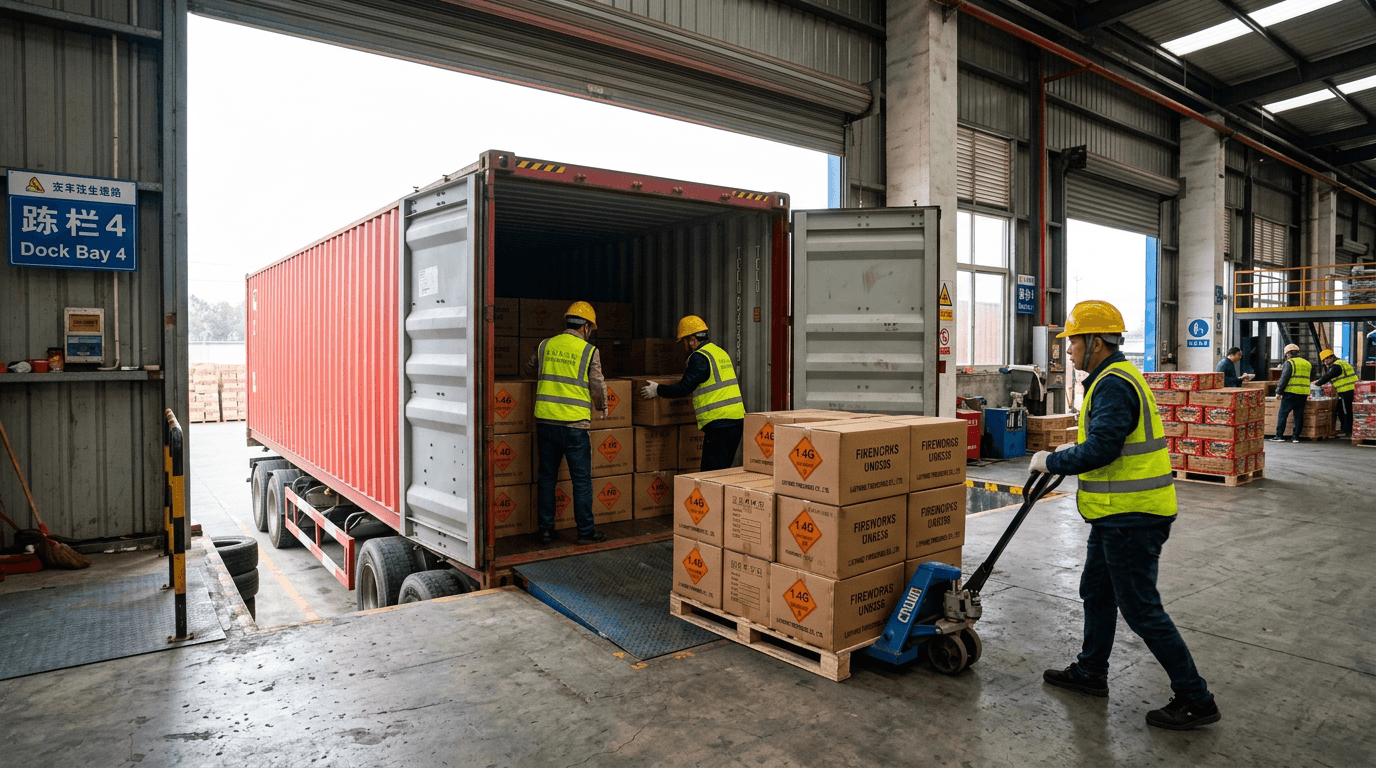
4. Seasonal booking windows
DG vessel slots are scarce and the fireworks calendar swings hard. Peak demand windows (March–June for July 4th, September–October for NYE/Diwali) carry +20–40% rates and slots sell out 4–6 weeks ahead. Back-calculate from your selling date:
- July 4th: order October–November, ship January–February.
- New Year's Eve: order May–June, ship July–August.
- Diwali: order April–May, ship June–July.
5. Incoterms
The default for fireworks is FOB Shanghai / Ningbo. It keeps the export clearance and DG documentation with the factory (where the expertise is) and gives you full control of the ocean leg and destination clearance (where the liability sits). CIF is simpler for a first container, but one CIF price hides the freight, the DG surcharge and any forwarder markup — ask for FOB alongside it and have your own DG forwarder price the same lane.
The Document Set That Actually Moves a Container
A complete fireworks export file has roughly a dozen documents. Six of them will be prepared by the factory, the other six sit on the importer and the forwarder. If any one of them is wrong, the container stops.
Factory-side
- Commercial Invoice showing UN numbers, HS code, FOB value per SKU.
- Packing List with carton counts, gross/net weight and NEQ per package and total.
- Dangerous Goods Declaration (DGD / IMO form) signed by a qualified DG Safety Advisor.
- MSDS / SDS for each product family.
- Classification Certificate from a UN-recognised lab (BAM, BRE, or an authorised Chinese body).
- Certificate of Origin (and Form E, Form A or equivalent for preferential tariffs where applicable).
Importer / forwarder-side
- Destination import licence / permit (ATF, HSE, national explosives authority).
- Bill of Lading with correct DG marks, UN number and emergency contact.
- Marine cargo insurance — 0.5–0.8% of cargo value, all-risks, warehouse-to-warehouse.
- Customs entry at destination with correct HS code and duty calculation.
- CE / UKCA / APA 87-1 conformity documents as proof of product compliance.
- Storage / magazine approval at the receiving site, matched to the NEQ on the BL.
Near-zero rejections at origin and destination is achievable, but only if the factory and importer share a single checklist. We build that list into every first-time buyer's onboarding — it's the cheapest improvement you will ever make to your margin.
A Realistic First-Container Budget
For a beginner sourcing a mixed 20ft of 1.4G consumer fireworks from Liuyang, expect landed cost to break down roughly as follows.
- FOB cargo value: $8,000–25,000 depending on product mix.
- Ocean freight + DG surcharge: $3,500–8,000.
- Inland trucking Liuyang → port: $300–600.
- Destination THC + customs brokerage: $500–1,400.
- Import duty (varies by country): 0–8% of CIF.
- Marine insurance: 0.5–0.8% of cargo value.
- Inland delivery to magazine: $300–900.
All-in landed cost on your first 20ft usually sits in the $13,000–$36,000 band. The factory FOB is only 55–70% of that number — which is exactly why the regulations and logistics side deserves as much attention as product selection.
Five Mistakes That Cost Beginners the Most
- Ordering before the licence is in hand. An ATF FEL or HSE licence can take 60–120 days. Start that process on day one — not after you've picked SKUs.
- Trusting a trading company that can't name its factory. Ask for the factory name, licence number, and CE/APA test reports. A real Liuyang manufacturer will send them inside an hour.
- Under-insuring the container. Saving $200 on premium is false economy on a $25,000 box of explosives. Insist on all-risks, warehouse-to-warehouse.
- Ignoring the CNY factory shutdown. A spring PO that skips over Chinese New Year without a buffer is a July 4th disaster waiting to happen.
- Taking CIF without an FOB comparison. Read the Incoterms section above before you sign.
FAQ
Do I need a licence to import fireworks from China?
Yes, in every country. US buyers need an ATF FEL, UK buyers need an HSE explosives licence, EU buyers need CE-marked SKUs (EN 15947) plus national importer registration, and most other countries require per-shipment explosives permits. Start the application before you place your first order.
What HS code do fireworks use?
HS 3604.10 covers fireworks; 3604.90 covers other pyrotechnic articles. Always confirm the full 8–10 digit code with your destination customs broker to get the exact duty rate and any non-tariff controls.
What is the minimum order to import fireworks from Liuyang?
A 20ft FCL — roughly 22 CBM / 16 tonnes net — is the practical floor. LCL for Class 1 explosives is either refused or priced so high it erases the savings. A mixed-SKU 20ft typically starts around USD 8,000 FOB.
How long does the full import process take?
Plan 90 to 150 days door to door. Production 35–60 days, inland 2–3 days, ocean 18–40 days depending on destination, destination clearance 3–10 days. Add your one-off licence lead time on the first order.
Who is legally responsible if the container is held at destination customs?
Under the standard FOB Incoterm, the importer of record is liable from the moment the container is on board the vessel at the named Chinese port. A reputable factory will prepare the full export document set, but the compliance burden at destination — licence, storage, customs entry — sits with the buyer.
Importing fireworks isn't harder than importing any other regulated product — it's just unforgiving of shortcuts. Get the licence, buy FOB, work with a DG-specialist forwarder, and make sure the factory's paperwork is auditable. Do those four things and your first container will land as cleanly as your tenth.
Continue the First-Time Buyer's Playbook
Deeper guides on the specific steps in this article — sourcing window, costs, transit, classification and supplier checks for your first US, UK or EU container.
Planning Your First Container from Liuyang?
Send us your destination country and target selling date. We'll come back with a realistic landed-cost quote, the licence checklist for your jurisdiction, and introductions to vetted DG forwarders on your lane.
WhatsApp Email