When people anywhere in the world light a firework — whether a humble sparkler at a backyard party or a massive professional shell bursting over a stadium — there is a good chance it was made in Liuyang, China. This mid-sized city nestled in Hunan Province is the undisputed global capital of fireworks, supplying roughly 60% of the world's fireworks and exporting to over 160 countries. But Liuyang's relationship with pyrotechnics is not a modern industrial story — it is a living tradition rooted in over 1,400 years of craft, culture, and community identity. (For the wider backdrop of how fireworks were invented and spread around the globe, see our companion guide to the history and origins of fireworks.)
The factory and current wholesale catalog start on the Liuyang fireworks homepage; this page is the history.
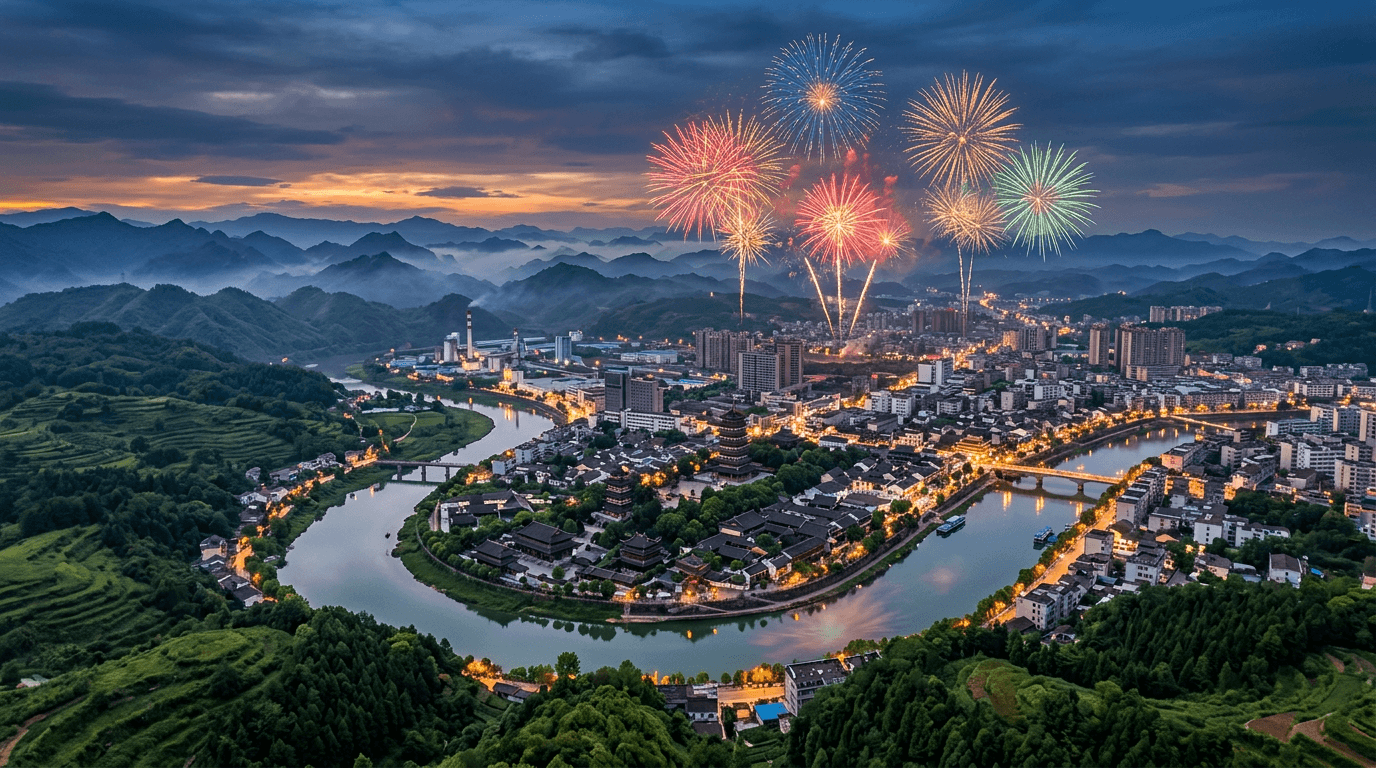
Where Is Liuyang? A City Defined by Its Craft
Liuyang (浏阳) is a county-level city administered by Changsha, the capital of Hunan Province, in south-central China. Situated along the banks of the Liuyang River (浏阳河) and surrounded by forested hills, Liuyang covers approximately 5,007 square kilometers and is home to about 1.5 million people. The city is roughly 60 kilometers east of Changsha.
To outsiders, Liuyang might appear to be a typical mid-sized Chinese city. But Liuyang is unique: fireworks are not just an industry here — they are woven into the identity, economy, language, and daily life of the community. Nearly every township in Liuyang has some connection to fireworks production, from raw material suppliers to finished-goods manufacturers to export trading companies.
Liuyang (浏阳) is recognized by China's central government as the nation's official "fireworks capital" — a designation that reflects both the city's historical primacy and its continuing dominance of the global fireworks industry.
The Origins of Liuyang Fireworks: Tang Dynasty Beginnings
The story of Liuyang fireworks begins in the Tang Dynasty (618–907 CE), making this tradition more than 1,400 years old. Historical records describe craftsmen in the Liuyang area experimenting with gunpowder — the transformative invention of that era — to create ceremonial explosions for festivals and religious rituals.
Local legend holds that a craftsman named Li Tian (李畋) — revered to this day as the "Father of Firecrackers" — lived during the early Tang Dynasty and is credited with creating the first true fireworks by packing gunpowder into bamboo tubes. Li Tian is said to have created these early firecrackers to protect his village from evil spirits during a plague. His creation spread rapidly, and the craft took root in Liuyang's fertile soil.
Li Tian's birthday, on the 18th day of the 4th lunar month, is still celebrated in Liuyang and across China as the "Firecrackers Festival" (炮祖节). Artisans gather to honor their craft's founder — a tradition that has been maintained for over a thousand years, making it one of the longest continuously observed occupational traditions in the world.
Song and Ming Dynasties: The Golden Age of Liuyang Fireworks
During the Song Dynasty (960–1279 CE), Liuyang fireworks-making expanded dramatically. The Song court was known for its love of entertainment and spectacle, and Liuyang craftsmen found eager patrons in the imperial court and wealthy merchant class. This period saw major innovations:
- The development of paper tubes as the primary casing for fireworks, replacing bamboo
- The introduction of metallic compounds to create colored flames — a Liuyang innovation that would eventually spread to the entire world
- The creation of the aerial shell — a firework designed to be launched into the sky and burst at height
- The establishment of specialized fireworks guilds in Liuyang, codifying knowledge and protecting trade secrets
The Ming Dynasty (1368–1644 CE) saw Liuyang fireworks reach a new level of artistry and recognition. Imperial court records describe spectacular Liuyang-made fireworks at state celebrations. The Ming emperors — particularly the Yongle Emperor, who moved the capital to Beijing — commissioned grand fireworks displays for major festivals, and Liuyang manufacturers became the preferred suppliers for these royal events.
During this era, Liuyang craftsmen developed the concept of combination effects — fireworks that produced multiple distinct bursts in sequence — and refined the art of timing, using carefully calibrated fuses to choreograph displays. These innovations made Liuyang fireworks qualitatively superior to those made elsewhere, cementing the city's reputation as the pinnacle of pyrotechnic craftsmanship.
Qing Dynasty: Liuyang Fireworks Go Global
During the Qing Dynasty (1644–1912 CE), Liuyang fireworks took a decisive step toward global reach. As trade between China and the rest of the world expanded through ports like Guangzhou and Shanghai, Liuyang fireworks began to be exported in significant quantities to Southeast Asia, Europe, and the Americas.
European merchants who encountered Liuyang fireworks were astonished by their quality. The vivid colors, the complexity of aerial patterns, and the reliability of the products far exceeded what European manufacturers could produce at the time. Liuyang fireworks quickly became a prestige commodity in international trade.
By the 19th century, Liuyang had established trade guilds specifically for export, with agents in major Chinese port cities managing international orders. This early globalization of Liuyang fireworks established distribution networks that, in evolved form, continue to underpin the modern Liuyang export industry.
A traditional saying in Liuyang captures the deep pride of the community: "天下烟花出浏阳" — "All the world's fireworks come from Liuyang." This is not merely boastful; for centuries, it was essentially true that the finest fireworks on earth came from this city on the Liuyang River.
The 20th Century: Industrialization and Innovation
The 20th century brought profound changes to Liuyang's fireworks industry. After the founding of the People's Republic of China in 1949, Liuyang's fireworks workshops were gradually organized into state-run enterprises, systematizing production and improving quality control. The Liuyang Fireworks Factory, established in the early 1950s, became a major force in both domestic and international supply.
China's reform and opening-up policies of the 1980s transformed Liuyang's fireworks industry again. Private enterprises flourished, thousands of family-run workshops re-emerged, and a new generation of Liuyang fireworks manufacturers competed vigorously to develop innovative products and win international contracts. Export volumes grew exponentially through the 1980s and 1990s.
This era also saw significant investment in safety and quality standards. Tragic accidents at fireworks factories — a real risk of the industry — prompted the Liuyang government and manufacturers to develop stricter safety protocols, modernize facilities, and pursue international certifications including CE marking for the European market and ISO 9001 quality management certification.
Why Liuyang? The Natural and Cultural Advantages
Why did Liuyang become the world's fireworks capital, rather than any other city in China or the world? Several factors converged over the centuries:
Abundant Natural Resources
The hills surrounding Liuyang are rich in the raw materials essential for fireworks production. Sulfur deposits exist in the region, and the area's forests historically provided abundant charcoal. Crucially, Liuyang was close to trading routes that supplied saltpeter (potassium nitrate) — the third key ingredient of gunpowder. This local availability of materials gave early Liuyang craftsmen a significant competitive advantage.
The Liuyang River: Commerce and Transport
The Liuyang River (浏阳河) — immortalized in one of China's most beloved folk songs — provided a natural transportation artery. Boats carrying raw materials upriver and finished fireworks downriver toward Changsha and beyond made Liuyang an efficient hub for production and trade. The river also provided water for cooling during manufacturing and served as a natural safety buffer between production facilities.
Deep Cultural Integration
Unlike industries that were imposed on communities from outside, fireworks-making in Liuyang grew organically from local culture and ritual. Generations of families passed down specialized knowledge — particular chemical formulas, shell construction techniques, fuse-timing methods — that were kept as closely guarded family secrets. This culture of craft knowledge created a concentration of expertise that was impossible to replicate elsewhere.
Community Ecosystem
Over centuries, Liuyang developed a complete ecosystem around fireworks: raw material suppliers, chemical producers, paper and tube manufacturers, skilled craftsmen, quality inspectors, and export traders all concentrated in a single geographic area. This industrial cluster effect dramatically reduced costs, facilitated knowledge exchange, and made Liuyang fireworks more competitive than products from dispersed manufacturers.
Liuyang Fireworks Today: A Modern Global Industry
Today, Liuyang fireworks is a multi-billion-dollar industry. The city is home to hundreds of licensed fireworks manufacturers ranging from small family workshops to large modern factories, plus thousands of supporting businesses in chemical supply, packaging, logistics, and export services.
Liuyang fireworks are exported to every corner of the globe, supplying major international distributors and retail chains in the United States, Europe, the Middle East, Southeast Asia, Australia, and beyond — the same markets served by our wholesale export lineup. The products span an enormous range: consumer fireworks for backyard celebrations (sparklers, fountains, roman candles, multi-shot cakes), professional display fireworks (large aerial shells, specialized effects), and special effects fireworks for concerts, sporting events, film production, and theatrical performances.
The Liuyang International Fireworks Festival
Liuyang hosts the International Fireworks Festival (浏阳国际烟花节), which attracts professional pyrotechnic teams from around the world to compete in breathtaking display competitions over the Liuyang River. This festival is one of the premier fireworks events globally, drawing both industry professionals and hundreds of thousands of visitors each year. It serves as both a celebration of Liuyang's heritage and a showcase for the latest innovations in pyrotechnic artistry.
Modern Innovation While Honoring Tradition
Contemporary Liuyang fireworks manufacturers combine ancient craft knowledge with modern technology. Computer-aided design tools assist in developing new effect patterns. Electronic firing systems allow precise choreography of complex displays. Advanced chemical research has produced new color formulations, longer burn times, and reduced smoke outputs that comply with increasingly stringent environmental regulations worldwide.
At the same time, the most skilled Liuyang pyrotechnicians still practice hand-assembly techniques passed down through generations — because there are aspects of fireworks construction where human expertise and tactile judgment remain irreplaceable. This blend of ancestral wisdom and modern innovation is the hallmark of authentic Liuyang fireworks quality.
Cultural Significance: Fireworks in Liuyang's Identity
For the people of Liuyang, fireworks are far more than an industry — they are a core part of community identity and cultural pride. Local schools teach about Liuyang's fireworks heritage; the city's museums dedicate significant space to the history of pyrotechnics; and the annual festivals draw the entire community together in shared celebration.
The Li Tian Temple (李畋祀), dedicated to the legendary founder of firecrackers, stands in Liuyang as a place of cultural pilgrimage. Craftsmen still visit to pay respects before major production seasons, maintaining a thread of ritual continuity stretching back more than a thousand years.
Liuyang fireworks have also inspired one of China's most famous folk songs — "Liuyang River" (浏阳河) — written in 1951, which describes the beautiful river winding through the home of China's fireworks. The song is known to virtually every Chinese person, and its lyrics celebrate the Liuyang River as a symbol of Chinese culture and homeland.
When you see fireworks light up the sky anywhere in the world — at a New Year's celebration in New York, a national day in Dubai, a festival in London, or a wedding in Jakarta — the art and craft behind that spectacle traces, with overwhelming probability, back to the streets and workshops of Liuyang, China — and to a tradition that has been burning brightly for over 1,400 years.
Choosing Authentic Liuyang Fireworks
Because of Liuyang's reputation, the "Liuyang fireworks" label has become a mark of quality recognized by buyers worldwide. Genuine Liuyang fireworks are manufactured under documented production controls, supported by per-shipment compliance documentation prepared in line with destination-market regulations, and backed by the accumulated expertise of generations of pyrotechnic craftsmen.
When sourcing fireworks, buyers and distributors should look for:
- CE marking under EN 15947 — required for EU consumer fireworks (categories F1/F2/F3); see our EU market inquiry page for documentation prepared per shipment and SKU list
- ISO 9001 framework — a recognized quality management system framework that many factories align production controls to
- DOT EX number — prepared per article for shipments to the United States
- CIQ inspection records — China Inspection and Quarantine export records prepared for each export shipment
- Direct factory relationships in Liuyang — for traceability, batch-level QC visibility, and verified provenance
At Liuyang Tauron Fireworks Co., Ltd., our facility is rooted in Chengchong Town, Liuyang — one of the most celebrated production areas within the fireworks capital itself. We maintain direct control over production quality with multi-stage QC, batch-level traceability and per-shipment compliance documentation prepared in line with destination-market regulations, offering our international clients authentic Liuyang fireworks with the heritage and reliability that the name demands.
Sources & Further Reading
Liuyang's 1,400-year fireworks lineage is recorded in Chinese local histories and civic records, and the broader gunpowder chronology it sits within is set out in the standard academic literature:
- Joseph Needham, Science and Civilisation in China, Volume 5, Part 7 — Military Technology: The Gunpowder Epic (Cambridge University Press) — for the Tang- and Song-dynasty origins of gunpowder that underpin the Li Tian tradition.
- Liuyang and Hunan local gazetteers (地方志) — notably the Liuyang County Gazetteer (浏阳县志) — which record the city's fireworks trade from the Tang dynasty onward and the Li Tian (李畋) founder tradition.
For the wider global story this local history branches from, see our history of fireworks. To see how the heritage translates into product today, the Liuyang fireworks category guide and our manufacturing quality-control guide carry the thread forward.
Frequently Asked Questions
Why is Liuyang called the fireworks capital of the world?
Liuyang, in Hunan Province, China, has made fireworks for over 1,400 years and today supplies roughly 60% of the world's fireworks, exporting to more than 160 countries. China's central government officially recognizes it as the nation's fireworks capital. Its dominance comes from a complete local ecosystem — raw materials, skilled craftsmen, factories and export traders all concentrated in one area.
How long has Liuyang been making fireworks?
More than 1,400 years. The tradition began in the Tang Dynasty (618–907 CE), when local craftsmen experimented with gunpowder to create ceremonial explosions. It expanded greatly during the Song and Ming dynasties and became a global export industry during the Qing Dynasty.
Who was Li Tian?
Li Tian (李畋) is revered as the "Father of Firecrackers." According to Liuyang legend he lived in the early Tang Dynasty and created the first true firecrackers by packing gunpowder into bamboo tubes to protect his village from evil spirits during a plague. His birthday, the 18th day of the 4th lunar month, is still celebrated in Liuyang as the Firecrackers Festival.
How do I buy authentic Liuyang fireworks?
Source directly from a licensed Liuyang factory and verify compliance documentation for your destination market — CE marking under EN 15947 for the EU, a DOT EX number for the United States, and CIQ export inspection records. A direct factory relationship gives you batch-level traceability and verified provenance rather than relying on a reseller label.
Partner with a Liuyang Fireworks Manufacturer
Liuyang Tauron Fireworks Co., Ltd. — 1,400 years of pyrotechnic heritage, multi-stage QC and CIQ export inspection records, exporting to 30+ countries. Contact us for wholesale pricing, custom orders, and factory visits.
WhatsApp Email