That huge, symmetrical sphere of trailing gold that fills the sky at New Year's — that's a chrysanthemum shell (菊花弹, júhuā dàn). If you've ever watched a competition display and asked which shell won the round, the answer is usually this one. In Liuyang we still consider it the benchmark — the effect every shell builder is judged by.
This piece covers what matters if you're buying Liuyang chrysanthemum shell fireworks: how they're built, which sizes suit which show, how to tell a well-made one from a sloppy one, and why the craft still sits here rather than anywhere else.
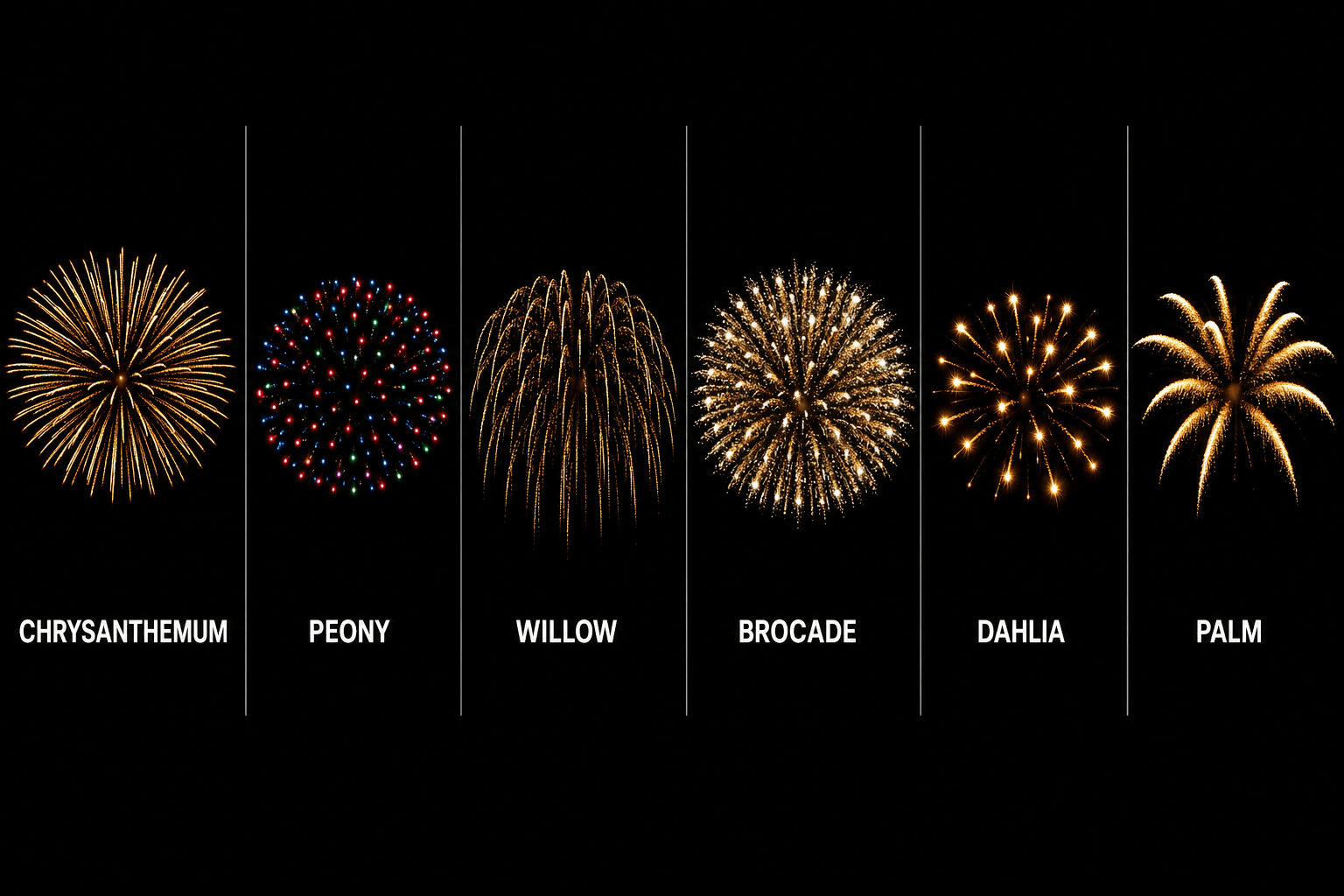
What Makes a Shell a Chrysanthemum
A chrysanthemum shell is a round aerial shell that opens into a full sphere of stars, each star pulling a long glowing tail behind it. The tail is the whole point — it's what separates a chrysanthemum shell firework from a peony (same shape, no tails), or from a brocade — a word two trade glossaries define differently.
Getting those tails even, the sphere clean, and the color consistent across every star is much harder than it sounds. Most shells that look "almost right" in the sky failed at one of those three.
Why the name? The chrysanthemum (菊花) is one of the Four Gentlemen of Chinese art — a flower tied to longevity and resilience. Liuyang's shell builders named their most demanding product after it on purpose.
A Short History of the Shell
Firecrackers came first. The credit still goes to Li Tian (李畋), a Tang-dynasty monk from Liuyang, born in Dayao Town around 601 CE. The jump from a paper cracker to a shell that bursts high in the air took another thousand years. By the Ming and Qing dynasties, Liuyang artisans were already building spherical paper casings and working out how to pack stars around a central burst charge — the core idea we still use today.
The modern chrysanthemum took shape in the 20th century when metallic fuels — magnesium-aluminum alloy and titanium sponge — gave the stars the long, bright trails the effect depends on. Today Liuyang chrysanthemum shells are the finale pieces for Sydney Harbour, Lake Biwa, Doha National Day, and most of the Montreal competition entries.
What's Inside
Five components, and every one of them has to be right. A few grams off anywhere, and the sphere goes oblong.
1. The Casing (球壳)
Layered kraft paper, pasted wet around a hemispherical mold — the technique is called 糊壳. A professional shell gets 8–10 layers. The casing has to be thick enough to hold pressure until the burst charge fully ignites, and uniform enough to crack open evenly. Thin spots blow first; that's how you get a lopsided break.
2. The Stars (药珠 / 星体)
The glowing pellets that paint the sky. For a chrysanthemum, the composition is tuned to burn slow and leave a tail — usually a charcoal-rich base with iron powder or mag-al alloy added. Stars are rolled by hand to a precise weight and diameter. Premium shells use multi-layer stars: an inner core that changes color partway through the flight (red → silver, green → gold), an outer shell that lays down the tail.
3. Star Placement (排星)
This is the step that separates a good shell from a mediocre one. Stars get laid into each hemisphere by hand, one at a time, on a fixed grid. Spacing has to be equal in every direction. Join the two halves, and you have a sphere of stars around a central burst charge. Every master shell builder I know can feel an uneven layup by weight alone — machines still can't do this step reliably.
4. The Burst Charge (开包药)
A measured pouch of fast powder at the geometric center. Too light, the shell opens soft and the stars fall short. Too heavy, the stars get blown to pieces on the break. The charge-to-casing ratio is the single most calibrated number in the shell.
5. Lift Charge & Time Fuse (发射药 & 延时引信)
Lift powder sits under the shell in the mortar and launches it. A time fuse burns during flight and fires the burst charge at apogee. Rule of thumb: roughly 100 feet of altitude per inch of shell. A 6" shell should open around 600 ft; a 12" shell closer to 1,200 ft.
Chrysanthemum vs. Other Spherical Shells
The chrysanthemum is one member of a larger family. Pick the wrong cousin and the show reads flat. Here's the quick cheat sheet:
| Shell Type | Chinese Name | Trailing Tails | Visual Character |
|---|---|---|---|
| Chrysanthemum | 菊花弹 | Yes — long, visible trails | Full sphere with radial trailing "petals" |
| Peony | 牡丹弹 | No — stars burn as points | Sphere of bright color dots, no trails |
| Willow | 柳树 | Yes — very long, drooping | Stars fall downward like weeping branches |
| Brocade | 锦冠 | Yes — dense golden/silver | Thick cascading curtain of glittering trails |
| Dahlia | 大丽花弹 | Minimal — thick stars | Fewer but larger stars, less dense pattern |
| Palm | 棕榈 | Yes — thick comet trails | Heavy golden trails resembling palm fronds |
Of the lot, the chrysanthemum is the hardest to build well — and it's the one shell every Liuyang factory still uses to prove its craft. That's why it anchors the display side of our global wholesale range.
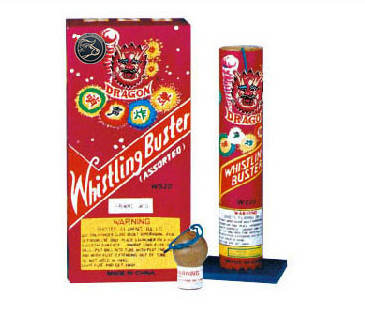
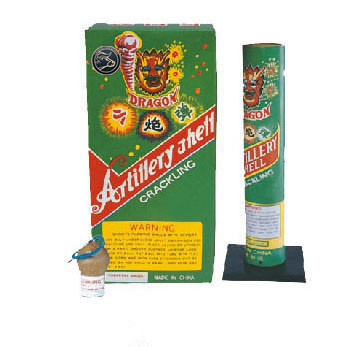
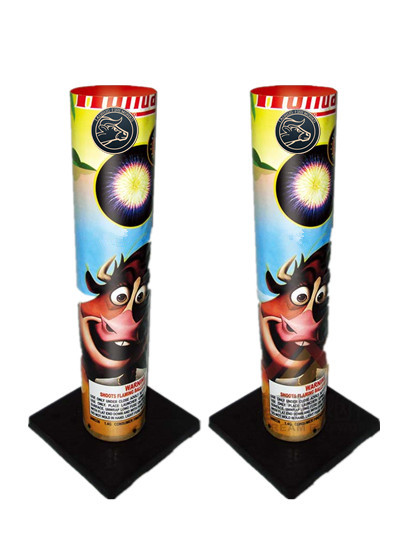
Featured Shell Series from the Liuyang Catalog
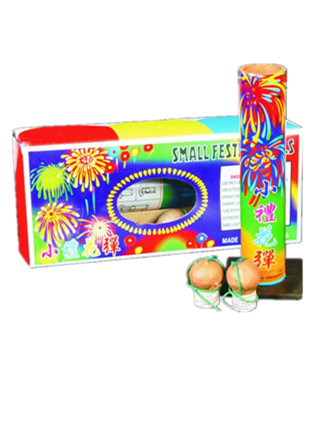
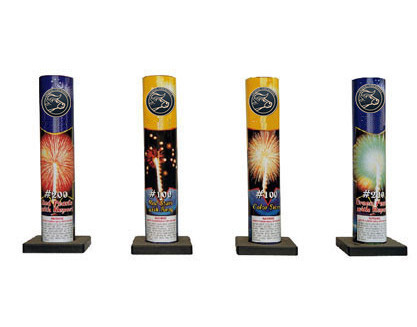
A snapshot of the shell SKUs we ship most often — consumer artillery shells, assortment shells and professional display shells listed inside category 6 of our global wholesale catalog. Click any product card to open the Shells category and jump to that SKU.
Calibers and What They're For
Picking the right chrysanthemum shell size comes down to the space you've got. Use the burst diameter to check your safety distances, not just the caliber.
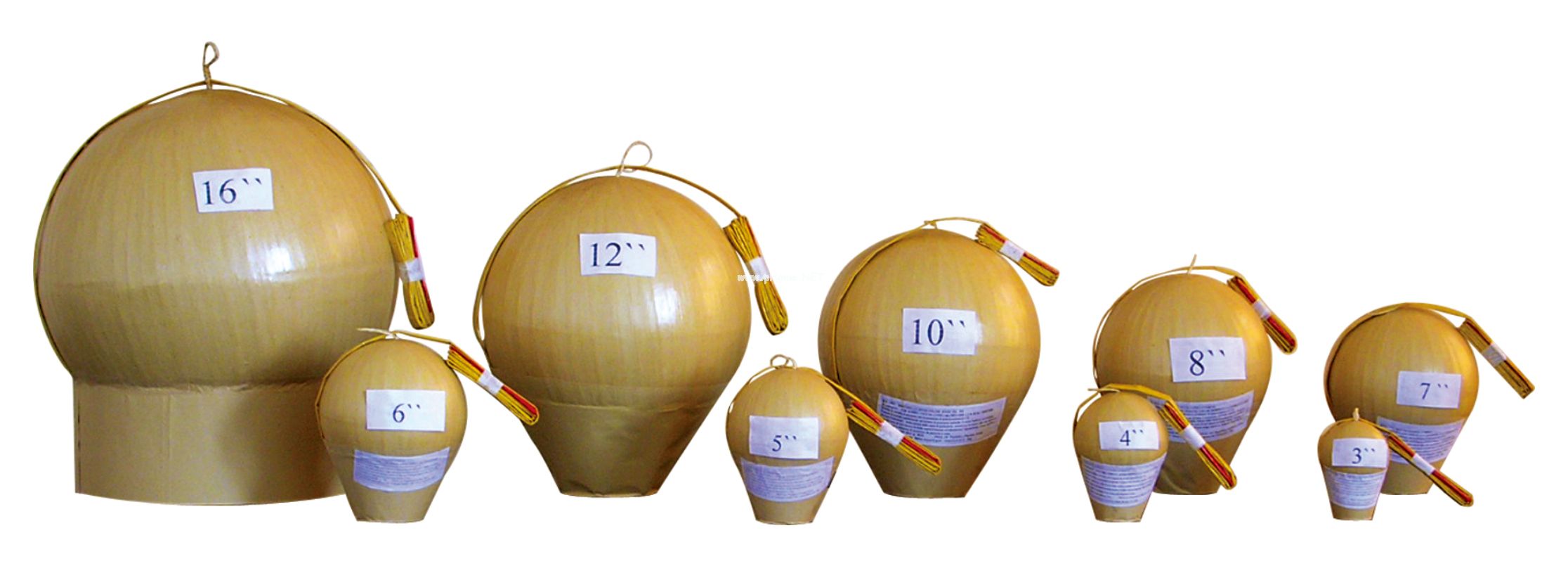
7 shell calibers drawn to shared scale — tube size, altitude line and burst sphere are all rendered proportional to the real measurements. Notice how the burst diameter ramps up faster than the altitude: a 12" shell flies ~3.5× higher than a 3" but opens to a sphere ~5× wider. That's why safety-distance planning starts from burst diameter, not caliber.
Rule of thumb: roughly 100 ft of altitude per inch of shell. A 6" shell opens around 600 ft, a 12" closer to 1,200 ft. The figure draws altitude and burst diameter to the same px-per-metre scale so the proportions you see are the proportions you fire.
View as table (full numbers in m + ft)
| Shell Caliber | Burst Diameter | Burst Altitude | Typical Use |
|---|---|---|---|
| 3" (75mm) | ~40m (130ft) | ~90m (300ft) | Small professional shows, consumer in some markets |
| 4" (100mm) | ~55m (180ft) | ~120m (400ft) | Standard professional displays |
| 5" (125mm) | ~70m (230ft) | ~150m (500ft) | Mid-size professional displays |
| 6" (150mm) | ~90m (300ft) | ~180m (600ft) | Large-scale events, competitions |
| 8" (200mm) | ~130m (425ft) | ~240m (800ft) | Major national celebrations |
| 10" (250mm) | ~170m (560ft) | ~280m (920ft) | Prestige events, New Year's shows |
| 12" (300mm) | ~200m (650ft) | ~320m (1050ft) | World-class spectacular finales |
The record for the largest chrysanthemum ever fired sits at 48" (120cm), weighing over 400 kg. It opened at roughly 800 m across. Those shells are built once — specialist crews, one-off jobs.
Why Symmetry Is So Hard
Five variables have to line up. Miss any one and the sphere breaks:
- Every star identical in mass and composition — a few grams of drift and trajectories go off
- Star placement uniform across the full inner sphere
- Burst charge sitting exactly at center — any offset biases the break in one direction
- Casing thickness equal everywhere — thin spots fracture first
- Burst-to-casing ratio tuned to push stars to full extension without shredding them
Master shell builders (制壳师傅) in our factory are all past 20 years on the bench. They can catch a misaligned layup by weight before it ever gets closed up. No machine we've seen touches that level of judgment.
Modern Variants Worth Knowing
The basic chrysanthemum hasn't changed much. The variants have — and these are the effects buyers ask for most:
Color-Change Chrysanthemums
Multi-layer stars that shift color mid-flight — red to silver, green to gold. The most-ordered variant in competition displays.
Crossette Chrysanthemums
Each star has a small internal charge that splits it mid-flight into four fragments. You get a chrysanthemum where every petal branches again — noticeably more detail in the sky.
Strobe and Glitter Chrysanthemums
Tweaked compositions that flicker (strobe) or throw off intermittent bright flashes (glitter) along the tails. Adds rhythm to what is normally a smooth effect.
Multi-Break Chrysanthemums
Two or three concentric layers of stars that break in sequence — a burst inside a burst. Often the outer layer is a classic gold chrysanthemum with a colored pistil at the center.
Where You'll See Them
The chrysanthemum is the reference shell at every serious competition: Montreal (L'International des Feux Loto-Québec), Macau, the Philippine International Pyromusical Competition, Hannover, Omura Bay. Judges score on symmetry, color purity, tail uniformity, and visual impact. Shells built in Liuyang still take most of the podium positions.
Buying Chrysanthemum Shells Wholesale
When you source chrysanthemum shells from Liuyang, a few practical items up front:
- Caliber — confirm the factory actually builds your size in-house. Many only finish 3"–5"; larger calibers get subcontracted
- Effects — a serious factory carries 20+ color and effect variants; ask for sample video before you order a full container
- Grading — competition-grade shells cost 30–50% more than standard. Worth it for a show, wasted on club-date work
- Paperwork — CE paperwork matching the article (EN 16261 for F4 professional), UN classification (typically UN0335 for 3"+ shells), CIQ inspection, and the destination approval that applies (e.g. a US DOT EX number). All should be available same-day
- MOQ — typically one 20' or 40' container for a mixed order
Our factory runs chrysanthemums from 3" to 12" across dozens of effect variants. Shells are hand-built, QC sampled by caliber, and shipped with full export documentation — including applicable CE paperwork for EU-bound professional shells (Directive 2013/29/EU and EN 16261, not the consumer EN 15947 standard) prepared per shipment (see our EU market inquiry page). Whether you need a classic gold chrysanthemum for a traditional show or a color-change multi-break for a competition entry, we can quote the same week.
FAQ
What is a chrysanthemum shell?
A round aerial shell that opens into a full sphere of long-tailed stars. The tails are the distinguishing feature — that's what makes it look like a blooming chrysanthemum flower rather than a simple dot pattern.
Why are Liuyang shells considered the benchmark?
Depth of craft. The technique is hand-intensive, passed down in families, and the supply chain for every raw material is in the same city. That combination still isn't available anywhere else.
What sizes are available?
3" (75mm) through 12" (300mm) is the standard export range. One-off projects have gone to 16", 24", and in a handful of record cases, 48".
Chrysanthemum vs. peony — what's the difference?
Same spherical shape. The chrysanthemum's stars leave long trailing tails; the peony's stars burn clean as dots without tails. A peony reads crisper, a chrysanthemum reads fuller.
Chrysanthemum Shells, 3" to 12", Built in Liuyang
Send us your caliber list and effect preferences. We'll send back video of the closest matching SKUs from the current catalog and a container quote with DG freight included.
WhatsApp Email