Two shells, same size, same round burst — and to most people in the crowd they look identical. But ask any display designer and they'll name them in a heartbeat: that one's a peony, that one's a chrysanthemum. The tell is one detail you can train yourself to spot in a single burst: does each star trail a tail, or not?
That's genuinely the whole difference. Peony and chrysanthemum are the two most basic spherical breaks in the aerial-shell vocabulary, built in the same casings, fired from the same mortars, sold at almost the same price — what separates them is the star recipe inside. For a buyer that one detail decides how a show reads on camera and at distance, so it's worth knowing exactly what you're ordering before you spec a container.
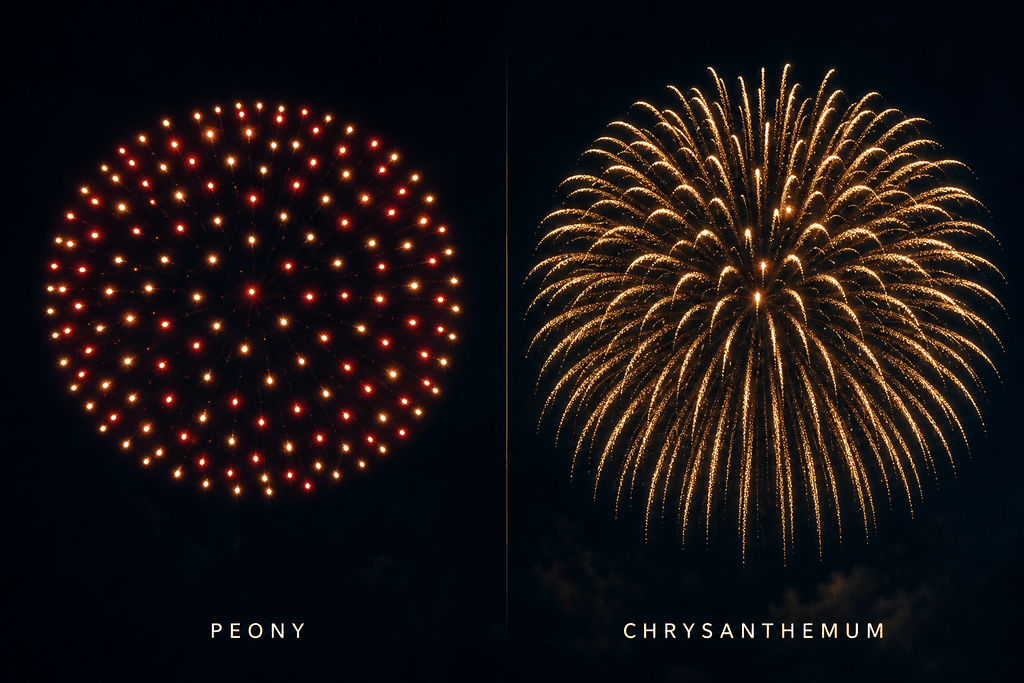
The Short Answer
A peony breaks into a sphere of bright, discrete points of light — clean dots with no trailing spark, fading more or less where they stop. A chrysanthemum breaks into the same sphere, but every star drags a glowing tail behind it, so the burst reads as a full, soft flower of radial streamers. Same geometry, same symmetry; the difference is whether the stars trail. Both are aerial display shells — 3-inch and larger, 1.3G professional product fired by a licensed pyrotechnician.
Peony Shell
The look: A clean sphere of distinct light points, no tails.
The stars: Bright color or metal stars that burn without a charcoal trail.
Reads as: Crisp, modern, color-forward; the symmetry benchmark.
Class: 1.3G display shell, 3"–12".
Chrysanthemum Shell
The look: A full sphere of radial streamers — points plus tails.
The stars: Charcoal-bearing "tailed" stars that trail sparks outward.
Reads as: Warm, classic, full-bodied; fills the sky.
Class: 1.3G display shell, 3"–12".
What a Peony Shell Is
The peony (牡丹) is the purest expression of the spherical break. Inside the shell, stars are packed in even geometric layers around a central burst charge. When the charge fires, it throws every star outward at the same velocity, and because peony stars burn without a tail, what you see is a perfect ball of separate, glowing points expanding and then fading in place.
That cleanliness is exactly why the peony is a craftsman's benchmark. With no tails to hide behind, any flaw in the build shows instantly — an uneven layer makes a lopsided sphere, a weak burst makes a ragged one, a mistimed fuse breaks it too low or too high. When a Liuyang factory wants to prove its shell-rolling is honest, it fires a peony, because the peony has nowhere to hide.
What a Chrysanthemum Shell Is
The chrysanthemum (菊花) starts from the identical sphere, then changes one thing: the stars carry charcoal or another tail-producing fuel, so each one trails a visible streamer of sparks as it flies outward. The result is the flower most people picture when they think "firework" — a dense, radiating bloom whose tails arrive a fraction of a second after the leading points, giving the burst body and softness.
Because the tails fill the gaps between stars, a chrysanthemum looks fuller than a peony built with the same star count, and it photographs and broadcasts beautifully — the streamers register on camera where bare points can wash out. It's the workhorse aerial break of nearly every large display, and the starting point for the whole long-tailed family.
Construction — Same Shell, Different Stars
Here is the part that surprises buyers: a peony and a chrysanthemum of the same caliber are, structurally, almost the same object. The casing, the burst charge, the lift, the time fuse, the hand-pasting — all identical. The difference lives entirely in the star composition and how it's layered.
Peony — bright stars, no trail
Peony stars are built around clean-burning color or metal compositions with little or no charcoal, so they light, hold their color, and extinguish without throwing a tail. They're often slightly harder-pressed and sized for an even burn time, because the whole effect depends on every point fading together. Symmetry of layering matters most here.
Chrysanthemum — tailed stars
Chrysanthemum stars include charcoal (or similar) that keeps sparking as the star travels, producing the signature tail. Adjusting the charcoal content and star size lengthens or shortens the trail — a small change in the recipe is what turns a chrysanthemum into a willow or a brocade. The casing and assembly don't change; the chemistry does.
This is why, in a Liuyang workshop, the same roller who builds a 6-inch peony in the morning can build a 6-inch chrysanthemum in the afternoon. The skill — even layering, tight pasting, correct fuse timing — transfers directly. It also means quality control questions are the same for both: it's the rolling and the timing, not the tail, that decide whether a shell breaks true.
Side-by-Side Specifications
The practical comparison for a buyer or a show designer:
| Specification | Peony Shell | Chrysanthemum Shell |
|---|---|---|
| Trailing tail | None — discrete points | Visible glowing tail on every star |
| Break appearance | Clean dotted sphere | Full sphere of radial streamers |
| Star composition | Bright color / metal stars, little charcoal | Charcoal-bearing "tailed" stars |
| Symmetry perception | Unforgiving — flaws are obvious | Tails visually soften minor asymmetry |
| Visual weight on camera | Crisp, can read thin from far away | Fuller, broadcasts and photographs richly |
| Common calibers | 3" to 12" | 3" to 12" |
| Derivative effects | Dahlia, peony with pistil, crossette peony | Willow, brocade, kamuro, chrysanthemum with pistil |
| Role in a show | Clean color statements, pattern accents | Full-body bursts, warm finales |
| UN hazard class | 1.3G (UN0335) | 1.3G (UN0335) |
| Typical FOB range (Liuyang, 3"–8") | ~$3–35 per shell (indicative) | ~$3–38 per shell (indicative) |
| Typical MOQ | 1,000–5,000 per caliber | 1,000–5,000 per caliber |
Price tracks caliber and color chemistry, not the tail. A 6-inch blue peony and a 6-inch blue chrysanthemum cost nearly the same; the blue itself adds far more to the FOB than the choice between trailing and non-trailing stars.
The Family Tree — Where the Tail Leads
Once you understand that a chrysanthemum is just "a peony with tails", the rest of the spherical-break catalog falls into place. They're all variations on these two ideas — more tail, longer tail, an added center, or a color change mid-flight.
From the peony
A dahlia is a peony with fewer, larger, longer-flying stars, giving a sparser, big-petal look. A peony with pistil adds a contrasting-color core. A crossette peony uses stars that split into little crosses. All keep the clean, tail-free signature.
From the chrysanthemum
Lengthen the tails and let them droop and you get a willow; make them denser, slower and gold and you get the long-hang gold effects sold as brocade or kamuro — two words the trade uses for different things, so neither one is safe on an order without a sample. These long-hang variants are the headline moments of most finales — and they all begin with the same charcoal-tail idea as the basic chrysanthemum.
We cover the long-hang end of the family — willow, brocade, kamuro — in our chrysanthemum shell guide, and the full caliber and altitude data in the professional aerial shells guide. Worth knowing before you write any of those words on an order: brocade and kamuro are two of the terms the trade genuinely disagrees on, which our encyclopedia of fireworks effect names sets out alongside the fields that pin a break down.
Which Reads Better for Your Show
Neither is "better" — they do different jobs, and a good program carries both. The choice comes down to viewing distance, the mood you want, and whether the show is being filmed.
- Close range and intimate events (weddings, private parties): peonies read as clean and elegant, and their crisp points look refined at short distance.
- Large outdoor crowds and New Year's Eve: chrysanthemums and their willow/brocade cousins fill the wide sky and feel grander from far away.
- Broadcast and photography: chrysanthemums carry the body of the frame; peonies and pattern shells add crisp accents the camera can resolve.
- Color showcases: peonies put the color front and center with no charcoal warmth diluting it — the right pick when a brand color has to be exact.
For a deeper look at how aerial breaks slot into a full program alongside multi-shot cakes, see our cake vs. shell fireworks cost and safety comparison; for why certain colors cost more regardless of break type, see the science behind blue stars.
Sourcing Both Out of Liuyang
Liuyang builds a large share of the world's professional display shells, and peony and chrysanthemum are core inventory at most serious shell factories. Because the two share a casing and a process, you order them the same way and on the same lead time — what changes between SKUs is caliber, color and break, not the production line.
What to specify
Per caliber (3, 4, 5, 6, 8 inch and up), name the break (peony, chrysanthemum, willow, brocade), the colors, and any pistil or color-change. MOQ typically runs 1,000–5,000 per caliber, with FOB from roughly $3–5 for a 3-inch to $30–40 for an 8-inch. Lead time is 8–16 weeks for hand-pasted larger calibers.
Insist on video proof-firing of the sample lot before the production PO. A peony exposes symmetry flaws instantly and a chrysanthemum's tails reveal whether the stars are timed correctly — proof-firing both is the fastest way to judge a factory's real shell quality.
That's how many display companies prefer to buy: both breaks, full caliber range, from one Liuyang factory whose rolling they've verified — exactly how we structure our display shell catalog.
FAQ
What is the difference between a peony and a chrysanthemum firework?
Both are spherical aerial shell breaks of the same shape and symmetry — the difference is the tail. A peony's stars are bright points with no trailing spark, so the break reads as a clean dotted sphere. A chrysanthemum's stars carry a glowing charcoal tail, so each point trails outward and the break looks fuller and softer. Same shell geometry, different star composition.
Do peony and chrysanthemum shells cost the same?
At the same caliber they are priced almost identically — FOB Liuyang runs roughly $3–5 for a 3-inch up to $30–40 for an 8-inch for both. The cost is driven by caliber, star count and color chemistry, not by whether the stars trail. Premium colors like deep blue cost more than the peony-vs-chrysanthemum choice ever does.
Is a chrysanthemum the same as a willow or brocade?
They are relatives, not the same. A chrysanthemum has a tail that burns out roughly as the sphere reaches full size. A willow uses long-burning charcoal stars whose tails droop and hang far longer. Shells sold as brocade or kamuro hang longer still; the two names are not interchangeable. All three share the trailing-star idea — the chrysanthemum is the baseline.
Can both be made in the same caliber?
Yes. Peony and chrysanthemum are star recipes loaded into the same spherical shell casings, so both are built across the full display range — 3, 4, 5, 6, 8, 10 and 12 inch. A factory can build a 6-inch peony and a 6-inch chrysanthemum on the same line; only the star composition and layering change.
Which should I order for a wedding, New Year's Eve or a broadcast show?
For weddings and intimate events, peonies give clean, elegant color that reads well at close range. For New Year's Eve and large outdoor crowds, chrysanthemums and their willow/brocade cousins fill the sky and feel grander. For broadcast, designers mix both — chrysanthemums for the full body, peonies and pattern shells for crisp accents. A balanced order carries both in your main calibers.
Bottom Line
Peony and chrysanthemum aren't competing products — they're two settings of the same instrument. The peony is the clean, color-forward, symmetry-exposing break; the chrysanthemum is the warm, full-bodied, sky-filling one, and the doorway to willows and brocades. Knowing which is which lets you read a show, brief a designer, and place a sharper order.
The practical takeaway for buyers: spec your shells by caliber, color and break, carry both peony and chrysanthemum in your main sizes, and verify a factory's rolling with a proof-firing before you commit. That's how good display inventory has been built in Liuyang for generations.
Source Display Shells Direct from Liuyang
Liuyang manufacturer with documented multi-stage QC, batch-level traceability and per-shipment compliance documentation prepared by destination market. Full-range 3" to 12" peony, chrysanthemum, willow and brocade shells, with video proof-firing of your sample lot before production. Ask for the display-shell catalogue and a proof-firing sample pack.
WhatsApp Email