Ask anyone who actually makes fireworks which colour is the hardest, and the answer is always the same: blue. Red is easy, green is routine, gold and silver are practically free. A clean, saturated blue star is the one formulation that separates a world-class factory from an average one — hence the old pyro shorthand, "the holy grail of fireworks chemistry."
This piece explains the chemistry behind blue stars in fireworks — why the physics is brutal, why Paris Green got retired, and what today's copper chloride / ammonium perchlorate systems actually do inside the flame. Read it as a buyer's guide as much as a science primer: once you know what a real blue looks like, you can judge a supplier from a single shell.
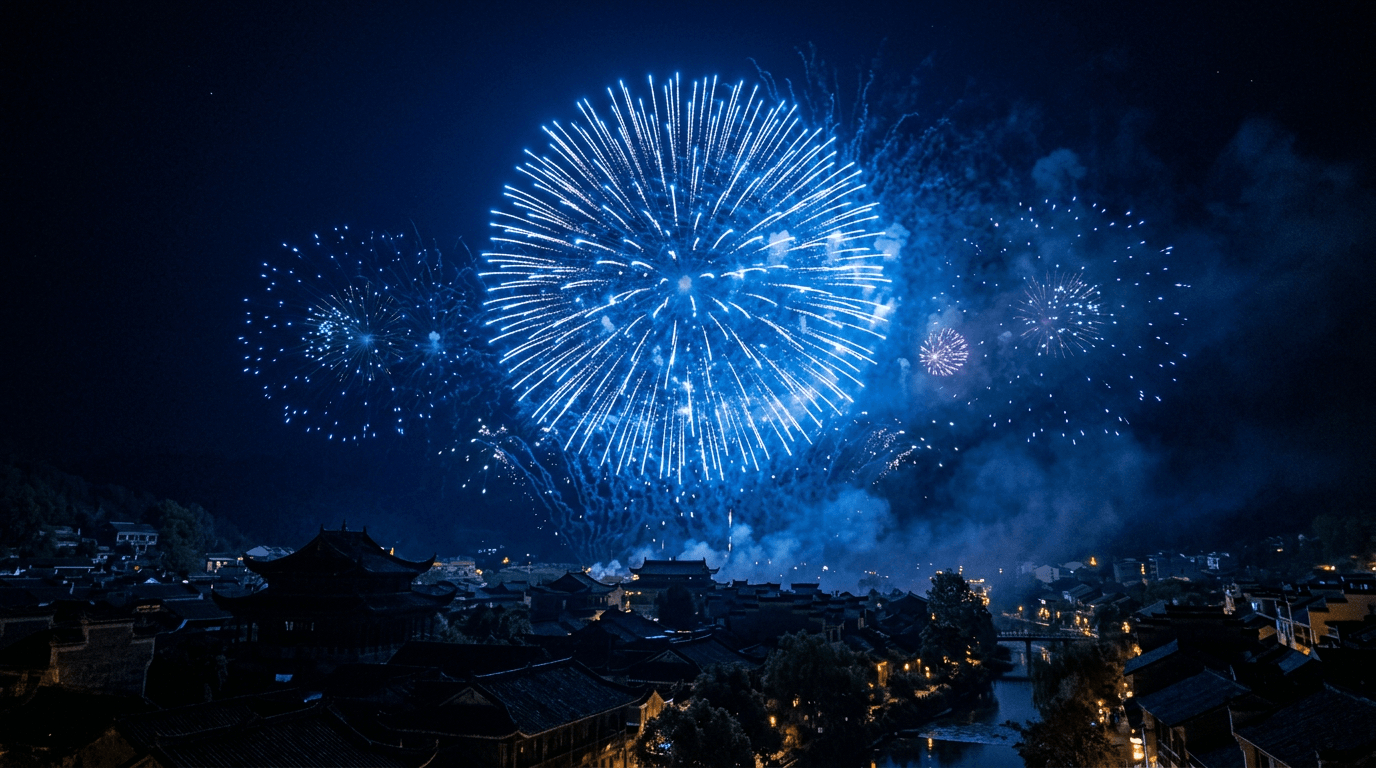
How Fireworks Actually Make Colour
Two different mechanisms produce light in a firework, and the difference is the whole reason blue is hard.
Incandescence
Hot particles glow. Iron at 800 °C is dull red; at 2500 °C it's white. That's blackbody radiation, and it's what every silver, gold and white effect runs on — burning titanium, magnesium or aluminium. Bright, easy, forgiving.
Atomic and molecular emission
True red, green, blue and purple come from a completely different process. Specific metal atoms or molecules get kicked into excited electronic states and drop back down, emitting a fixed wavelength of light. The colour is set by which species is emitting, not by how hot the flame is.
Where each primary emitter sits on the visible spectrum (400–700 nm). CuCl's 420–460 nm band lands deep in the blue, exactly where the human eye is least sensitive — one of three independent reasons blue is intrinsically dimmer than the rest of the palette.
Purple isn't an emitter — it's a perceptual blend. Pyrotechnicians get purple by firing CuCl and SrCl stars together (blue + red), inheriting all of the difficulty of blue and then some.
View as table
| Color | Primary Emitter | Peak Wavelength | Difficulty |
|---|---|---|---|
| Red | SrCl (strontium monochloride) | 605–682 nm | Easy |
| Orange | CaCl (calcium monochloride) | 591–622 nm | Easy |
| Yellow | Na atoms | 589 nm (D-line) | Trivial |
| Green | BaCl (barium monochloride) | 505–535 nm | Moderate |
| Blue | CuCl (copper monochloride) | 420–460 nm | Very Hard |
| Purple | CuCl + SrCl (mixture) | Blue + red blend | Hard |
Notice that every colour except yellow relies on a fragile metal monochloride molecule. Those molecules only survive inside a narrow temperature band — hot enough to emit, cool enough not to fall apart. SrCl and BaCl have a generous window. CuCl does not.
The Real Problem: Copper Monochloride (CuCl)
To get a true blue, you have to form CuCl inside the burning star, excite it, and let it emit at 420–460 nm. Every one of those steps fights you.
Getting CuCl to form
CuCl comes from a copper source meeting a chlorine donor in a reducing flame. Copper sources in use today:
- Copper(II) oxide (CuO) — stable and cheap.
- Copper(II) carbonate — moderates flame temperature as it decomposes.
- Basic copper carbonate (malachite) — the modern workhorse for colour purity.
- Copper oxychloride — carries both copper and chlorine in one compound.
- Copper(I) chloride itself — used in high-performance blues.
The chlorine comes from ammonium perchlorate, potassium perchlorate paired with an organic chlorine source, Parlon (chlorinated rubber), PVC, or hexachloroethane. Too little chlorine and copper ends up as atomic Cu or CuO — both of which emit green.
The dissociation ceiling
The Cu–Cl bond has a dissociation energy of about 384 kJ/mol. Above roughly 1200 °C, thermal energy rips CuCl apart faster than it can emit, and you see green copper atoms plus blackbody continuum instead of blue. Below about 1000 °C, the flame can't excite the molecule efficiently and the star burns dim and pale.
That leaves a usable window of roughly 200 °C. Compare with the rest of the palette:
The flame-temperature band each emitter actually works in. Three of the four colours below get a comfortable 700–1200 °C window. CuCl gets barely 200 °C — squeezed between "too cold to excite" and "too hot, the molecule falls apart."
The two dashed vertical lines mark the only window where CuCl is allowed to live. Inside: a clean 420–460 nm blue. Outside: green-white wash. Every formulation tweak in a blue star is about keeping the flame inside that 200 °C corridor.
View as table
| Color | Useful Flame Temperature Window | Width |
|---|---|---|
| Red (SrCl) | ~900–1700 °C | ~800 °C |
| Green (BaCl) | ~1000–1700 °C | ~700 °C |
| Yellow (Na) | ~800–2000 °C | ~1200 °C |
| Blue (CuCl) | ~1000–1200 °C | ~200 °C |
A blue composition has to stay inside that 200 °C window for the whole burn. You can't reach for magnesium, aluminium or titanium to brighten it, because they'll push the flame past 1200 °C and kill the colour. That's why a real deep blue firework star is always dimmer than a red or green — the chemist has to keep brightness down on purpose to keep the colour.
The blue paradox in one line: the brighter you try to make it, the more green and white you get. The only way to deep blue is restraint — cooler fuels, less metal, more chlorine, and tight control over every ingredient.
The Eye Works Against Blue, Too
Even a perfect composition still fights human vision. The photopic sensitivity curve peaks at 555 nm (yellow-green). At 450 nm — where CuCl emits — the eye is only 3–4% as sensitive. At equal radiant power, a blue star looks about 30× dimmer than a green one. Matching green brightness at 450 nm would require 30× more radiant power, which is thermodynamically off the table under the cool-flame constraint. Blues aren't weaker — they're fighting biology.
From Paris Green to Today
Pre-1900: chlorate + Paris Green
The first genuinely great blues appeared in the late 19th century, built on potassium chlorate and Paris Green (copper acetoarsenite). Cool flame, easy CuCl formation, an "electric blue" nobody has truly surpassed.
Problem: arsenic. Paris Green poisoned workers and rained arsenic oxides on crowds. It was phased out through the mid-20th century and is now banned for pyro use in every major jurisdiction.
Mid-20th century: ammonium perchlorate
Ammonium perchlorate (AP), originally a rocket-propellant ingredient, changed everything — powerful oxidiser and chlorine donor in one molecule, relatively cool-burning, and well suited to CuCl chemistry. AP with copper oxychloride or basic copper carbonate has been the professional standard ever since.
Modern Liuyang formulations
A typical high-grade blue today looks something like:
- Oxidiser: AP primary, with a trim of KClO4 to tune burn rate.
- Copper source: basic copper carbonate or copper oxychloride, ultra-fine mesh.
- Chlorine donor: Parlon (chlorinated rubber) — serves as binder and chlorine supply together.
- Fuel: red gum or shellac. No magnesium, aluminium or titanium in a pure blue.
- Solvent: acetone- or alcohol-cut Parlon, with low-VOC systems where possible.
The result is a saturated, deep blue with none of the toxicity of the arsenite era, acceptable shelf life, and something that survives high-throughput star-rolling and cut-star machinery — the same composition running through our European consumer range and export shells.
Why Most Commercial Blues Disappoint
Grey, pale or greenish-white blues usually come from one of five failure modes:
1. Flame too hot
The most common cause. Too much oxidiser, or stray metal in the mix, pushes temperature past 1200 °C and CuCl dissociates. Fix: cut AP, add a cool fuel like red gum, keep the composition completely metal-free.
2. Not enough chlorine
Low Cl:Cu ratio leaves copper as atomic Cu and CuO — both green. Fix: more Parlon, a copper source that carries its own chlorine, or a secondary donor like PVC or hexachloroethane.
3. Sodium contamination
Sodium is the loudest emitter in pyrotechnics. Traces from impure raws, tap water, even sweat on a worker's hand will yellow out the blue. Serious factories use pigment- or pyro-grade chemicals and often run a dedicated blue line.
4. Soot or metal residue
Hot carbon or stray metal adds blackbody continuum and washes out the molecular emission. A good blue burns cleanly; smoke is white or pale grey, not black.
5. Humidity
Copper chlorides and AP are hygroscopic. Stars that absorb moisture burn cooler, dimmer, or fail to light at all. Humidity-controlled storage and sealed packaging are non-negotiable.
What a Great Blue Star Actually Looks Like
- Dominant wavelength 440–455 nm, little contamination above 500 nm (measurable on a spectrometer).
- Unambiguously blue to the eye — not bluish-white, not teal. The informal benchmark: colour of a gas stove flame at full burn.
- Burn time of about 2–3 seconds for a 1-inch professional star.
- Fine pale-blue trail as particles cool through the emission window — not grey, not yellow.
- Every star in the break looks the same. Variation means wet, poorly mixed or badly dried composition.
Blue in Combinations: Purple, Aqua, Pastel
Purple is CuCl + SrCl, usually 60/40–70/30 copper-heavy for violet, 40/60 for magenta. It inherits both the narrow blue window and the chlorine balance problem, so it's almost as difficult as a pure blue. Aqua is CuCl + BaCl, a little more forgiving because barium chloride is robust. Pastel blue is CuCl plus a pinch of titanium or aluminium for soft incandescence — technically easier, but commercially niche. For how the other emitters behave, and why a colour can only be specified as a family plus an approved fired sample, see our guide to fireworks effect names and chemistry.
How to Read Blue as a Buyer
Blue is the most honest quality signal in fireworks. When you're sampling a supplier:
- Saturated blue from a small item (2" shell or compact cake) → the factory has solved the hardest part of the craft.
- Good reds and greens, pale blue → mid-tier operation on generic formulas. Fine for mass consumer, not premium.
- No blues in the line at all → margin-driven shop without the tech depth for blue. Use caution on higher-end work.
- Consistent deep blue across 2", 3" and 4" → world-class formulation and QC; the rest of the line will usually track.
When you evaluate a new Liuyang supplier, always ask for a pure blue star in the sample pack. If the blue is clean and saturated, you can trust the rest of their work.
Sources & Further Reading
The chemistry in this guide — flame emission, the copper monochloride (CuCl) emitter, chlorine donors and the effect of temperature on colour saturation — follows the established literature of pyrotechnic chemistry. The standard references are:
- John A. Conkling & Christopher J. Mocella, Chemistry of Pyrotechnics: Basic Principles and Theory (CRC Press) — the standard modern textbook on flame colour, oxidisers and metal-salt emitters.
- Takeo Shimizu, Fireworks: The Art, Science and Technique — a classic reference on shell construction, star composition and colour production.
For how these formulations are held consistent batch after batch, see our fireworks quality-control guide; for where blue chemistry sits in the wider story, the history of fireworks traces colour from black powder to the modern palette. To see blue in finished product, the chrysanthemum shell guide covers the shells where a clean blue is hardest to pull off.
FAQ
Why is blue the hardest colour in fireworks?
Because CuCl, the molecule that makes blue, only survives in a 1000–1200 °C window. Below that the flame can't excite it; above that it falls apart and the light goes green. Every other colour has a much wider tolerance.
What chemical makes blue in fireworks?
Copper monochloride (CuCl), formed in the flame when a copper compound reacts with a chlorine donor — typically basic copper carbonate or copper oxychloride with ammonium perchlorate, Parlon or PVC. It emits at 420–460 nm.
What was Paris Green?
Copper acetoarsenite — gave the best blues of the 19th century, but contained arsenic. Poisoned workers and audiences, and is now banned everywhere that matters. Replaced by AP-based copper chemistry.
Why do most blues look pale?
Flame too hot (CuCl dissociates), metal or soot washing out the molecular emission, or not enough chlorine to form CuCl in the first place. Sodium contamination is another common reason blues come out yellowish.
Can blue match red or green for brightness?
Not under current chemistry. The flame has to stay below ~1200 °C, so metal brighteners are out, and the eye is only 3–4% as sensitive at 450 nm as at 555 nm. Professional blues typically read 30–50% dimmer; good designs compensate with star count and pattern density.
What temperature does a blue star burn at?
Roughly 1000–1200 °C — much cooler than a red or green, which can push past 1700 °C. That's why blues use organic fuels like shellac and red gum instead of metal.
Is "cobalt blue" real?
Only as marketing. Modern pyrotechnic blues all run on copper. "Cobalt" or "sapphire" blue just describes the deep violet shade of a well-tuned CuCl formulation.
How do I tell a world-class factory from an average one?
Look at their blue. A clean, saturated blue from a 2" shell or small cake is the single most reliable indicator. If the blue is right, the rest of the palette almost always follows.
Blue is hard because physics, chemistry and biology all push back. The narrow temperature window, fragile emitter, sensitive eye response and zero tolerance for contamination combine to make deep blue the real test of a pyrotechnic factory.
Want Real Deep Blue in Your Next Order?
We've spent years on our blue-star formulations. Every consumer cake and professional shell we export is tested for colour purity, burn consistency and saturation. Send us your programme — we'll put a sample blue on your desk.
WhatsApp Email