Fireworks are one of humanity's most universal expressions of joy. Whether lighting up the sky over a New Year's Eve countdown, a national holiday, or a wedding celebration, fireworks have the power to unite people in shared wonder. But where did fireworks come from? Who invented them, and how did they travel from a single discovery in ancient China to become a global phenomenon? The story of fireworks is a fascinating journey spanning over two millennia of human ingenuity, culture, and art.
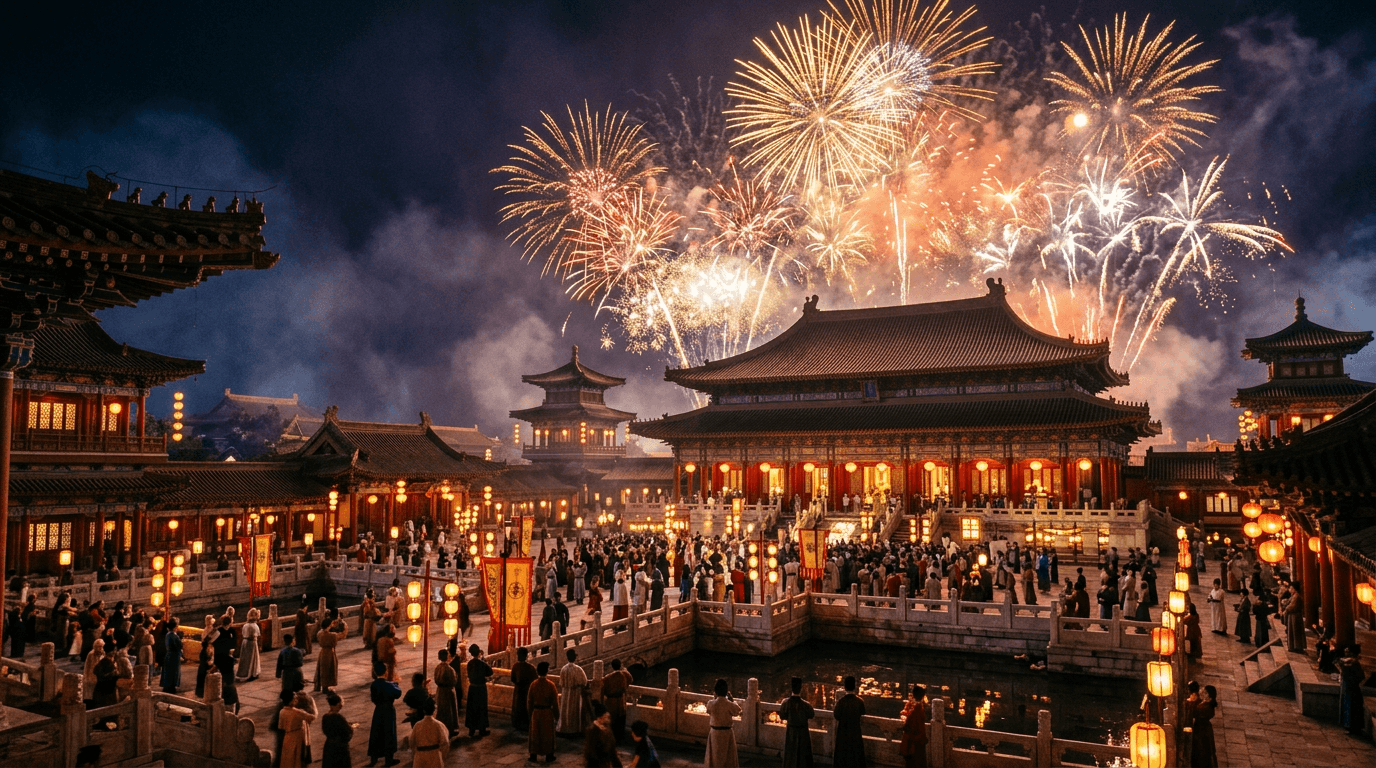
The Ancient Roots: Fire, Bamboo, and the Birth of Fireworks
The history of fireworks begins in ancient China, approximately 2,000 years ago during the Han Dynasty (around 200 BCE). Long before gunpowder existed, the earliest "fireworks" were remarkably simple: bamboo stalks thrown into fire. When heated, the air pockets inside bamboo sections would expand rapidly and explode with a loud crack — a sound the Chinese believed would ward off evil spirits and bring good luck.
These roasted bamboo crackers, known as baozhu (爆竹, literally "exploding bamboo"), became deeply woven into Chinese ceremonial life. They were used during the Chinese New Year, weddings, funerals, harvests, and military victories — any occasion that called for driving away misfortune and inviting prosperity.
The Chinese character for firecracker — 爆竹 (baozhu) — literally means "exploding bamboo," reflecting the very origins of fireworks before gunpowder was ever invented.
The Game-Changer: The Invention of Gunpowder
The transformative moment in fireworks history arrived with the invention of gunpowder, one of the Four Great Inventions of ancient China. According to historical records, gunpowder was discovered by Taoist alchemists during the Tang Dynasty (618–907 CE) — and it was, famously, an accident.
The alchemists were not searching for an explosive substance. They were pursuing the elixir of immortality, experimenting with combinations of sulfur, charcoal, and saltpeter (potassium nitrate) in hopes of achieving eternal life. Instead, they created something far more earthly but equally astonishing: a powder that ignited violently when exposed to flame.
The formula was first recorded in a Tang Dynasty military manual, the Wujing Zongyao (武经总要), compiled around 850 CE. Early on, gunpowder was used for military purposes — fire arrows, bombs, and primitive grenades. But it was also quickly embraced for festivities. Gunpowder packed into bamboo tubes produced far more dramatic explosions than bamboo alone, and soon craftsmen began experimenting with aerial effects.
Song Dynasty: The Birth of True Fireworks
During the Song Dynasty (960–1279 CE), fireworks as we recognize them today began to take shape. Chinese artisans discovered that adding metallic salts to gunpowder created colored flames and sparks — a revelation that transformed simple firecrackers into spectacular aerial displays. The concept of the aerial shell was born: a paper tube packed with gunpowder and metallic compounds, launched into the sky to burst in cascading patterns of light and color.
Song Dynasty records describe elaborate fireworks shows at imperial court celebrations, with descriptions of "golden flowers," "silver rain," and "fire trees." The art of pyrotechnics became a revered craft, passed down through specialized families and guilds. The city of Liuyang in Hunan Province — where our company is rooted today — emerged as one of the most important centers of this craft, a tradition that continues unbroken for over 1,400 years. For the full story of how this one Chinese city became the world's fireworks capital, see our dedicated guide to the 1,400-year history of Liuyang fireworks.
Fireworks Travel the Silk Road: From China to the World
Knowledge of gunpowder and fireworks began spreading westward along the Silk Road trade routes around the 13th century. Arab traders, Mongol armies, and European travelers all encountered Chinese fireworks and brought the secrets back to their home regions.
Fireworks in the Middle East
By the 13th century, Arab chemists had documented gunpowder formulas, and fireworks were being used in the Islamic world for military displays and celebrations. The brilliant colors and sounds became symbolic of power and festivity across Middle Eastern cultures.
Fireworks Reach Europe
European accounts of gunpowder appear by the 13th century, with the English friar Roger Bacon (c. 1214–1292) describing its explosive properties in writing. By the 14th and 15th centuries, Italy had become the center of European fireworks artistry. Italian pyrotechnicians — particularly from Florence and Venice — developed new techniques for creating aerial bursts, colored stars, and theatrical displays.
Fireworks became a fixture of European royal celebrations. In 1486, King Henry VII of England commissioned fireworks for his wedding. Queen Elizabeth I was so fond of fireworks that she created the official title of "Fire Master of England." European royalty competed to stage ever more magnificent pyrotechnic spectacles, driving rapid innovation in the craft.
The word "fireworks" itself entered the English language in the 16th century, derived from the combination of "fire" (the element) and "works" (the skilled craft). The parallel development of this art in East and West — both rooted in Chinese gunpowder — illustrates fireworks' unique role as a truly global heritage.
The Science of Color: How Fireworks Get Their Colors
One of the most captivating aspects of fireworks is their vivid colors. The chemistry behind this is called atomic emission spectroscopy — a phenomenon where metallic compounds, when heated to high temperatures, emit light at characteristic wavelengths. Different metals produce different colors:
- Red — Strontium salts (strontium carbonate, strontium nitrate)
- Orange — Calcium salts (calcium carbonate, calcium chloride)
- Yellow — Sodium compounds (sodium nitrate, sodium oxalate)
- Green — Barium compounds (barium nitrate, barium chlorate)
- Blue — Copper compounds (copper carbonate, copper chloride)
- White / Silver — Titanium, magnesium, or aluminum powder
- Gold — Iron powder or charcoal, producing glittering sparks
- Purple — Combinations of strontium (red) and copper (blue) compounds
Achieving true blue fireworks was historically one of the most difficult challenges in pyrotechnics, as copper compounds are chemically unstable at high temperatures. The mastery of the full color spectrum required centuries of experimentation and remains a mark of skilled fireworks craftsmanship.
Fireworks in the Modern Era: Industrial Revolution to Today
The Industrial Revolution of the 18th and 19th centuries brought dramatic changes to fireworks manufacturing. Mass production of chemicals, improvements in paper and cardboard, and advances in metallurgy allowed fireworks to be produced on a large scale and became affordable for public celebrations beyond royal courts.
The 20th century introduced electronic ignition systems, computer-controlled choreography, and new chemical compounds that enabled unprecedented precision and complexity in fireworks displays. Today's professional fireworks shows can synchronize hundreds of shells to burst in perfectly timed patterns — often choreographed to music — creating immersive theatrical experiences that draw millions of viewers worldwide.
Modern fireworks fall into two broad categories:
- Consumer fireworks — Smaller-scale products designed for personal use, including sparklers, fountains, roman candles, firecrackers, and multi-shot cakes. These are sold commercially in many countries for celebrations like New Year's, Diwali, Guy Fawkes Night, and the Fourth of July — in Europe, the CE-marked F1–F3 consumer range covers this entire tier.
- Professional / display fireworks — Large-caliber shells and professional-grade devices used in licensed public shows. These include massive aerial shells that can burst at heights of several hundred meters, creating effects visible for miles.
Fireworks as Cultural Heritage Across the World
Today, fireworks are universally associated with celebration. Yet each culture has developed its own relationship with pyrotechnics:
- China — Fireworks remain central to the Spring Festival (Chinese New Year), Mid-Autumn Festival, and national holidays. The deep cultural belief in fireworks' power to bring good luck and ward off evil spirits persists to this day.
- United States — Independence Day (July 4th) is synonymous with fireworks, with over 14,000 fireworks shows lighting up the country annually.
- India — Diwali, the Festival of Lights, features massive fireworks displays as a symbol of the triumph of light over darkness.
- United Kingdom — Guy Fawkes Night (November 5th) traditionally celebrates with bonfires and fireworks, commemorating the foiling of the 1605 Gunpowder Plot.
- Japan — Hanabi (花火, "fire flower") festivals are a beloved summer tradition, with some displays featuring shells designed to bloom like chrysanthemums or peonies — an art form refined over centuries.
- Middle East — Fireworks mark national days, Eid celebrations, and major sporting events, often on a grand professional scale.
The Art and Craft of Fireworks: A Living Heritage
Despite centuries of technological advancement, the core craft of fireworks-making remains an art passed down through generations of skilled artisans. The selection of chemical compositions, the geometry of shell construction, the timing of fuses — all require deep knowledge and experience that no machine can fully replicate.
In Liuyang, China — the world's fireworks capital — this living heritage is embodied in thousands of family workshops and factories that have been perfecting the craft for over 1,400 years. The Liuyang tradition combines ancestral knowledge with modern safety standards and chemical science, producing fireworks that are exported to over 160 countries worldwide — the living basis of our worldwide fireworks catalog.
As both a physical spectacle and a cultural symbol, fireworks represent something deeply human: our desire to transform matter into light, sound, and beauty — to mark our most significant moments with brilliance against the darkness of the night sky.
From an accidental discovery in a Tang Dynasty alchemist's laboratory to the billion-dollar global fireworks industry of today, the story of fireworks is the story of human creativity, culture, and the universal language of celebration.
Sources & Further Reading
The chronology in this guide follows the mainstream scholarly account of the invention of gunpowder and the development of pyrotechnics in China. For readers who want the primary academic treatment, the standard references are:
- Joseph Needham, Science and Civilisation in China, Volume 5, Part 7 — Military Technology: The Gunpowder Epic (Cambridge University Press) — the definitive academic history of gunpowder's origins in Tang- and Song-dynasty China.
- Song-dynasty records such as Meng Yuanlao's Dongjing Meng Hua Lu (东京梦华录, c. 1147), which describes the pyrotechnic and firecracker performances of the Northern Song capital, together with standard museum accounts of gunpowder's westward spread along the Silk Road and through the Mongol expansions.
To go deeper on the two threads this history only introduces — the chemistry of colour and the modern manufacturing craft — see our companion guides on the science behind firework colour and how modern fireworks quality control works. For the specific lineage of the world's fireworks capital, see the history of Liuyang fireworks.
Frequently Asked Questions
Who invented fireworks?
Fireworks were invented in ancient China. The earliest forerunners were bamboo stalks thrown into fire around 2,000 years ago (Han Dynasty, c. 200 BCE), which exploded with a loud crack. True gunpowder fireworks emerged after Taoist alchemists discovered gunpowder during the Tang Dynasty (618–907 CE), and recognizable aerial fireworks developed during the Song Dynasty (960–1279 CE).
When were fireworks first invented?
There are three milestones. Bamboo firecrackers (baozhu) date back roughly 2,000 years to the Han Dynasty. Gunpowder was discovered during the Tang Dynasty (618–907 CE). Fireworks as we recognize them today — paper shells with colored aerial bursts — took shape during the Song Dynasty (960–1279 CE), when craftsmen added metallic salts to create colored flames.
How do fireworks get their colors?
Colors come from atomic emission: when metallic salts are heated to high temperatures they emit light at characteristic wavelengths. Strontium produces red, calcium orange, sodium yellow, barium green, copper blue, titanium or magnesium white, and iron or charcoal gold. Blue is historically the hardest color because copper compounds are unstable at high temperatures.
Where are most fireworks made today?
Liuyang in Hunan Province, China, is the world's fireworks capital and has produced fireworks for over 1,400 years. Today the region exports to more than 160 countries and accounts for the large majority of the world's consumer and professional fireworks.
Experience Authentic Fireworks from Liuyang, China
Liuyang Tauron Fireworks Co., Ltd. carries on this 1,400-year tradition — crafting premium fireworks products for wholesale buyers, distributors, and event professionals worldwide.
WhatsApp Email