Modern fireworks come in two dominant shapes. Flat rectangular boxes with one fuse sticking out — the multi-shot cake. And paper-wrapped spheres and cylinders that need a mortar to go anywhere — the aerial display shell. Every meaningful sourcing, selling or show-design decision starts with telling these two apart.
This is a practical guide to the difference between cake and shell fireworks: what each one actually is, how it's built, how it flies, what it costs, what regulations apply, and when to reach for one instead of the other. The numbers come from day-to-day manufacturing in Liuyang, the Chinese city that produces the large majority of the world's cakes and shells.
The Short Answer
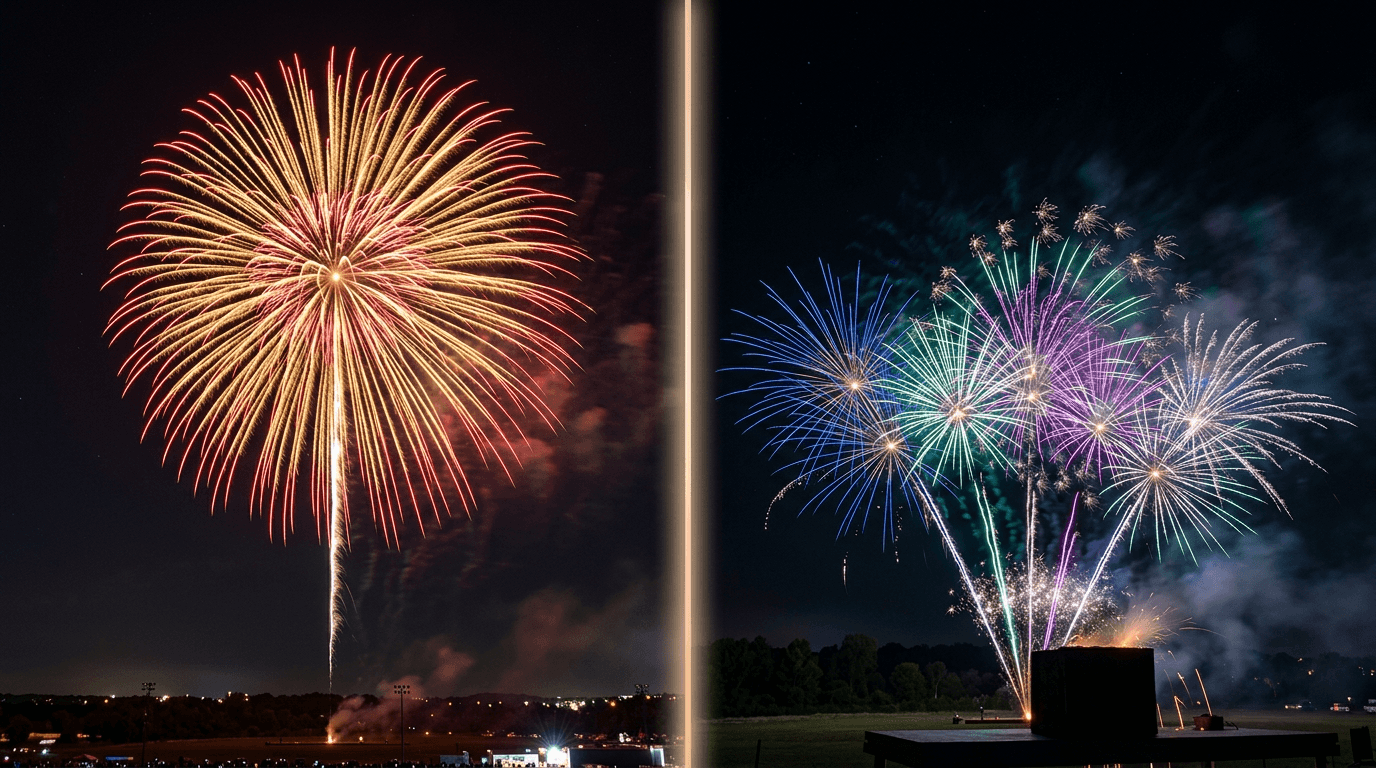
A cake is a finished product: one cardboard box full of pre-loaded, pre-fused tubes that fires a complete mini show from a single fuse. A shell is a single projectile: one paper-wrapped ball or cylinder that has to be dropped into a separate mortar tube and fired on its own, normally by a licensed pyrotechnician. The cake is the meal; the shell is an ingredient a professional assembles into a show.
Cake Firework
What it is: A consumer multi-shot box with 9–500+ pre-loaded tubes fused in sequence.
Who uses it: Consumers, retailers, small event hosts.
How it fires: One external fuse lights the entire sequence automatically.
UN Class: usually 1.4G (UN0336) when the cake stays inside the destination consumer limit.
Aerial Display Shell
What it is: A single spherical or cylindrical projectile loaded into a separate mortar tube.
Who uses it: Licensed pyrotechnicians, professional display companies.
How it fires: Hand-lit or electrically fired one shell at a time from a mortar.
UN Class: 1.3G (UN0335) — professional only.
Quick sourcing call: if you sell at retail or run a backyard or small private event, cakes are almost always the answer. If you're a licensed display company, shells carry the program. Importers building a catalog usually lead with cakes (broad legal market, simple handling) and add shells only once they have licensed buyers and 1.3G logistics in place. When you request a quote, have your destination market, required certificates (CE / CPSC), target UN class, MOQ and a proof-firing request ready.
What a Cake Firework Actually Is
A multi-shot cake (repeater, barrage, 组合烟花) is a single cardboard box with dozens of vertical tubes packed into a grid. Each tube holds a small effect — star, comet, mine or mini break — on top of a lift charge. Internal quick-match and visco fuses link every tube together, so one external fuse fires the whole sequence in the order the factory designed.
The defining trait is that a cake is self-contained. No mortars, no hand-loading, no training. Set it on a flat surface, light the fuse, step back. Standard sizes are the 200-gram and 500-gram multi-shot cake formats, with shot counts from 9 to 500+ and retail between $8 and $80.
A $30 cake puts 25+ shots in the sky in about 20 seconds, with nothing to set up. That convenience is why cakes have become the dominant — and still-growing — share of consumer fireworks sales worldwide. On the consumer shelf, its closest companion buy is the single-tube roman candle — see roman candle vs. cake fireworks for how the two split the aisle.
What a Shell Firework Actually Is
An aerial display shell (mortar shell, 礼花弹) is a single projectile, usually 3–12 inches across. Inside: a lift charge at the bottom, a time fuse through the middle, and a burst charge surrounded by stars at the top. On its own, a shell does nothing — it's ammunition for a mortar.
Choosing between a round ball shell and a cylinder (canister) shell is a different comparison — see ball shell vs. cylinder shell.
Firing it means a licensed pyrotechnician loads the shell into a heavy HDPE, fibreglass or steel mortar tube anchored in a rack. The external leader is either hand-lit or connected to an electronic firing system. Lift charge fires, shell clears the tube, time fuse burns during flight, the burst charge detonates at apogee and throws stars outward in the signature spherical "flower" — a clean peony or a trailing chrysanthemum depending on the stars inside.
One 4" shell = one burst — but that burst is up to 80 m across at about 90–120 m altitude. The big-stage moments you've seen — Olympics openings, Sydney NYE, Macy's 4th of July — are built largely on professional aerial display shells.
Construction
How each one is physically built explains most of the downstream differences — regulatory, commercial and logistical.
Cake — grid of small tubes in a box
Small paper tubes (15–30 mm diameter, 70–200 mm tall) are pressed into cardboard dividers and fixed with hot-melt. Each tube gets a metered lift charge at the bottom, an optional time delay, and an effect payload — stars, comets, crackling, whistles or a mini break with stars. A quick-match network meters delays from 50 ms to a few seconds between tubes. The stack is shrink-wrapped and boxed in the retail carton. Most production is now machine-assembled; hand assembly is reserved for premium finale cakes.
Shell — built from the inside out
At the core sits the burst charge — black powder coated on rice hulls or pellets. Around it, stars are packed in precise geometric layers. The whole core is then pasted with layer after layer of wet kraft paper, dried between layers, building a casing strong enough to contain internal pressure long enough to throw stars outward symmetrically. A calibrated time fuse runs through the casing into the burst charge. A separate lift-charge cup of granular black powder sits at the bottom, and a quick-match leader ignites both lift and time fuse at the same moment. The lift and burst are black-powder work; a salute shell adds a flash-powder core — see black powder vs. flash powder for how the two split the job.
In short: a cake is industrial assembly — standardised tubes, metered powder, repeatable timing. A shell, especially 6" and up, is still hand-pasted by Liuyang craftsmen whose families have been doing it for generations. It's why shell quality varies far more between factories than cake quality does.
Side-by-Side Specifications
The numbers every buyer and display designer should know:
| Specification | Multi-Shot Cake | Aerial Display Shell |
|---|---|---|
| Product form | Self-contained rectangular box | Single spherical or cylindrical projectile |
| Launch equipment | None — fires from its own tubes | Requires a separate mortar tube & rack |
| Shots per unit | 9 to 500+ shots | 1 shot per shell |
| Typical caliber | 15–30 mm internal tubes | 75 mm (3") to 300 mm (12") shells |
| Burst altitude | 15–60 m (50–200 ft) | 60–300 m (200–1,000 ft) |
| Burst diameter | 5–15 m (small flowers) | 40–250 m (massive flowers) |
| Ignition | Single external fuse, manually lit | Hand-lit leader or electronic e-match |
| Who can fire it | Consumers (subject to local law) | Licensed pyrotechnicians only |
| UN hazard class | 1.4G (UN0336) | 1.3G (UN0335) for 3" and larger |
| Regional category | F2/F3 (EU), 1.4G (US/CA) | F4 (EU), 1.3G professional (US/CA) |
| FOB price (Liuyang) | $1.00–$15.00 per unit | $3.00–$50.00 per unit |
| Typical retail price | $8–$80 per box | Not sold at consumer retail |
| Primary use | Backyard & small-event displays | Professional choreographed displays |
Altitude and Scale
The decisive performance difference is scale. A 30 mm cake tube can't safely launch a payload bigger than about 25 mm, and the consumer ceiling — 500 g NEC per item in the US, the F2 and F3 tiers in the EU — caps cakes at roughly 60 m altitude and a 15 m flower.
Shells have no such ceiling. A 3" shell bursts at roughly 60–90 m with a 40–60 m flower; a 6" at around 160–190 m with a 120–150 m flower; a 12" near 300 m with flowers 260 m and wider. Eiffel Tower finales, Sydney Harbour waterfalls, Burj Khalifa showpieces — all shells, because cakes physically can't reach that altitude or that diameter.
Rule of thumb: each extra inch of caliber adds roughly 25–35 m of burst altitude — a 4" reaches about 90–120 m, a 6" about 160–190 m, an 8" about 200–240 m. For exact apogee and flower size per caliber, see the per-caliber shell table.
Regulation — 1.4G vs 1.3G
The regulatory gap is bigger than the performance gap, and it's what actually drives import and storage economics. The full framework — UN numbers, hazard divisions and compatibility groups — is covered in our UN numbers and shipping classifications guide.
UN classes
- 1.4G (UN0336) — usual freight class for consumer-limit product. Covers cakes within the destination's consumer limit (500 g NEC per item in the US), fountains, Roman candles, sparklers and small aerial. Ships at standard DG rates; moderate quantities can be stored without a specialty magazine.
- 1.3G (UN0335) — display fireworks. Covers aerial shells 3" (75 mm) and larger, big comet mines and oversized finale racks. Needs licensed magazines for storage, specialist DG freight (30–60% premium), and licensed operators to handle.
That single class digit — 1.4G versus 1.3G — is what decides freight and storage. Who may legally buy and fire each product is a separate use-category question. Our 1.3G vs. 1.4G fireworks guide walks through the freight and storage impact, and our consumer vs. display fireworks guide covers who may buy and fire each side of that line.
Regional overlays
- EU (CE): cakes are F2 or F3 under EN 15947 in our EU consumer catalog; display shells are F4, tested to EN 16261, licensed operators only.
- US (CPSC / DOT): cakes are consumer fireworks under 16 CFR 1507. Reloadable shells up to 1.75" may stay consumer; anything 3" or larger is display fireworks — ATF storage licence and a state pyrotechnician licence to fire.
- Canada: cakes = Consumer Fireworks (CF); shells = Display Fireworks (DF), requires a Display Fireworks Supervisor (DFS).
A 40ft of 1.4G cakes out of Liuyang lands at roughly $4,500–$6,500 ocean freight to US West Coast. The same box of 1.3G shells runs roughly $6,000–$10,000 — about 30–60% more, because 1.3G needs compatible stowage, segregation and specialist handling at every port on the route. See our fireworks shipping cost breakdown for how hazard class and shipping lane drive landed cost.
Who Can Legally Fire What
Cakes — for the public
Cakes are designed around an untrained operator: one external fuse, stable self-standing box, set-back distances printed on the carton. In most markets where consumer fireworks are legal — across North America, much of the EU, parts of the GCC and Latin America — cakes are the category sold through seasonal retail, with stricter, permit-based access in markets like Australia. The exact rules and permitted sizes vary by country and even by state or region. The main risk is user error, which is why warnings dominate the packaging.
Shells — licensed pyrotechnicians only
Shells are professional ammunition. Firing one needs mortar loading, time-fuse calibration, a spectator stand-back distance commonly set at about 70 feet (21 m) per inch of shell caliber under NFPA 1123, plus wind calls, misfire drill and mortar inspection after the show. In the US that typically means a state-issued display pyrotechnician licence; in the EU an F4 operator certificate under national rules. In most places, firing a shell without that credential is both a legal violation and a serious safety risk.
Sound, Smoke, Debris
- Report: cakes give light-to-medium bangs. Shells run the whole range — from soft willow poofs to titanium salutes you feel in your chest at 200 m.
- Duration: one cake runs 15–120 s of continuous action; one shell is a 1-second event. Designers use shells for the big beats and cakes for the rhythm in between.
- Smoke: cakes generate ground-level smoke from their own tubes — an issue in windless or enclosed venues. Shells only smoke at altitude. Indoor and stadium shows lean heavily on low-smoke cakes and comets; big outdoor shows lean on shells.
- Debris: cakes produce almost none. Shells drop paper and fragments 50+ m from the mortar — which is why shell shows demand fall-out zones and downwind exclusion swaths.
Cost — Unit Price vs Total Show Cost
On paper a shell looks cheaper than a cake per unit. A 3" Liuyang shell at $3–5 FOB seems like a bargain next to a $10 finale cake. That's misleading — unit price isn't the cost of firing a display.
| Cost Component | Cake-Based Display | Shell-Based Display |
|---|---|---|
| Product unit price | $10–80 per cake | $3–50 per shell |
| Mortar tubes & racks | None required | $15–60 per mortar tube + racks |
| Firing system | Manual flare, ~$5 | Electronic firing system: $2,000–50,000 |
| Labor (per show) | 1 untrained operator | Licensed pyro + 2–6 technicians |
| Licensing & insurance | None (consumer use) | $1M–$5M event liability policy |
| Regulatory permits | Usually none | Local fire marshal + ATF, per event |
| Fully-loaded cost ratio | 1× (baseline) | 10–20× baseline |
A $300 backyard cake show exists and delivers roughly $300 of visible product. A "$300 shell show" does not — mortars, firing system, insurance and crew push the realistic floor for even a small professional shell display to $3,000–$5,000. That gap is the reason cakes own consumer retail and shells own professional display. Different business models, different products.
When to Use a Cake
Cakes are the right call if any of the following apply:
- Operator is a consumer, retailer or small event host without pyro training.
- Venue is a backyard, farm or small private property.
- Budget is under $5,000 and you don't have licensing.
- Audience under 200, watching from 30–70 m.
- Show is under 5 minutes and doesn't need high-altitude signatures.
- The product is being sold at retail, where one-fuse simplicity drives sales.
They're not the right call when you need high-altitude signatures, 10+ minutes at consistent visual weight, effects visible from 500+ m, or anything intended for broadcast. That work needs shells.
When to Use a Shell
Shells are the right — and usually only — call when:
- It's a professional display fired by a licensed pyrotechnician.
- Audience is 500+ at 150 m or further.
- Show is choreographed to music via an electronic firing system.
- The brief demands signature aerial moments — waterfalls, kamuro brocades, ghost and pattern shells.
- Local regulations allow 1.3G and the permit is in hand.
- Budget covers the fixed costs: mortars, racks, licensing, insurance.
They are not the right call for backyard use, unlicensed retail, or anywhere the operator isn't credentialed. Firing a shell without training is extremely dangerous and, in most jurisdictions, illegal.
How Professional Shows Mix the Two
The great international displays aren't cake shows or shell shows — they're integrated programmes where each category does what it's uniquely good at.
The professional playbook
In a 10-minute competition programme, roughly 60–70% of the visual weight is shells — the signature moments that define the show. The other 30–40% is cakes, comet racks and mine racks that fill the mid-altitude register, carry the rhythm, and crucially deliver the wall-of-fire finale. No realistic shell budget can match that finale density — it's the specific job cakes do.
That's why many of the world's professional display companies source both cakes and shells through the same Liuyang supply chain. One chemistry, one QC system, one delivery schedule across both lines — exactly how we structure our cake and shell catalog.
Sourcing Both Out of Liuyang
Liuyang produces the large majority of the world's consumer cakes and a dominant share of its professional shells. The reason is concentration: nearly every raw input — paper, chemicals, fuse cord, tubes, adhesives, packaging — is made within a short radius of the city. No other region has replicated that cost and quality base at the same scale.
Cakes
MOQ is typically one mixed 20ft (~800–1,200 cartons). FOB runs $1–$15/unit from small 200 g items to premium 500 g finale racks. Private-label packaging is standard, with artwork usually included at MOQ — a custom print run adds a one-time plate and a per-SKU minimum. Most factories hold CE (EN 15947) marking and test their consumer lines to CPSC 16 CFR 1507 requirements.
Shells
More specialised. MOQ 1,000–5,000 per caliber; lead time 8–16 weeks for hand-pasted large calibers. FOB $3–5 for a 3" up to $30–50 for an 8". Freight runs 30–60% above 1.4G because it's 1.3G. Always insist on video proof-firing of the sample lot before the production PO — shell quality spreads far wider between factories than cake quality, and one bad batch ruins a professional programme. Our guide on how to spot high-quality fireworks walks through what to check.
FAQ
What's the main difference between a cake and a shell firework?
A cake is a self-contained consumer product: dozens or hundreds of pre-loaded tubes in one box, firing a whole mini show from one fuse. A shell is a single projectile loaded one-at-a-time into a separate mortar — professional product, one very large burst per shot.
Can consumers legally buy aerial shells?
In most countries, no. Shells are 1.3G (F4 in the EU) and require a licensed pyrotechnician to buy, transport and fire. A few US states allow 1.75" reloadable consumer shells under 1.4G, but true 3"+ display shells are restricted to licensed operators in most markets.
Which produces a bigger effect, cake or shell?
A single shell is far bigger per burst. A 4" bursts around 120 m with an 80 m flower; a cake tube is typically 25–60 m with much smaller flowers. But a 500 g finale cake puts 100+ shots up in seconds — a continuous wall of fire no single shell can produce. Cakes win on density and duration; shells win on scale and altitude.
Why are shells more expensive to run than cakes?
A 3" shell is actually cheap FOB ($3–8) vs a finale cake at $5–15. What makes shells expensive is everything around them: mortars, racks, electronic firing systems, insurance, a licensed crew. Fully-loaded cost of a shell display is typically 10–20× a cake-based one.
Can you mix cakes and shells in the same show?
Yes — that's the professional standard. Most choreographed programmes use shells for the big aerial signatures and cakes for body work, mid-altitude sweeps and the finale.
What does 1.4G vs 1.3G mean in practice?
1.4G (UN0336) is the consumer class — minor package-level hazard. Covers cakes, fountains and small aerial. 1.3G (UN0335) is the professional class — mass fire hazard with minor blast. Covers large display shells. 1.3G freight costs 30–60% more and needs licensed storage and handling.
What should I buy for a backyard 4th of July?
Cakes, in almost every case. Without a licensed pyrotechnician on site, cakes are the simplest, lowest-risk and most widely legal option. Three or four 500 g cakes, a handful of 200 g cakes, plus fountains and sparklers, and you have a show most guests will remember. Leave the shells to the professionals.
Bottom Line
Cakes and shells aren't competitors — they're complementary tools. Cakes solve the problem of delivering a real fireworks experience to a consumer with no training, no equipment and a modest budget. Shells solve the problem of aerial art at scale for large audiences, broadcast venues and choreographed shows. Drop either one and an entire half of the industry collapses.
The practical takeaway for buyers: know the classification of what you're buying, match category to your legal situation and operational capability, and source both from a Liuyang factory whose quality you've verified with a proof-firing. That's how good programmes — consumer and professional — have been built for thirty years.
Source Cakes and Shells Direct from Liuyang
Liuyang manufacturer with multi-stage documented QC, batch-level traceability and per-shipment compliance documentation prepared by destination market. Cakes from 6 to 100 shots, full-range 3" to 12" display shells, mixed containers from $8K, private label at MOQ. Ask for the catalogue and a proof-firing sample pack.
WhatsApp Email