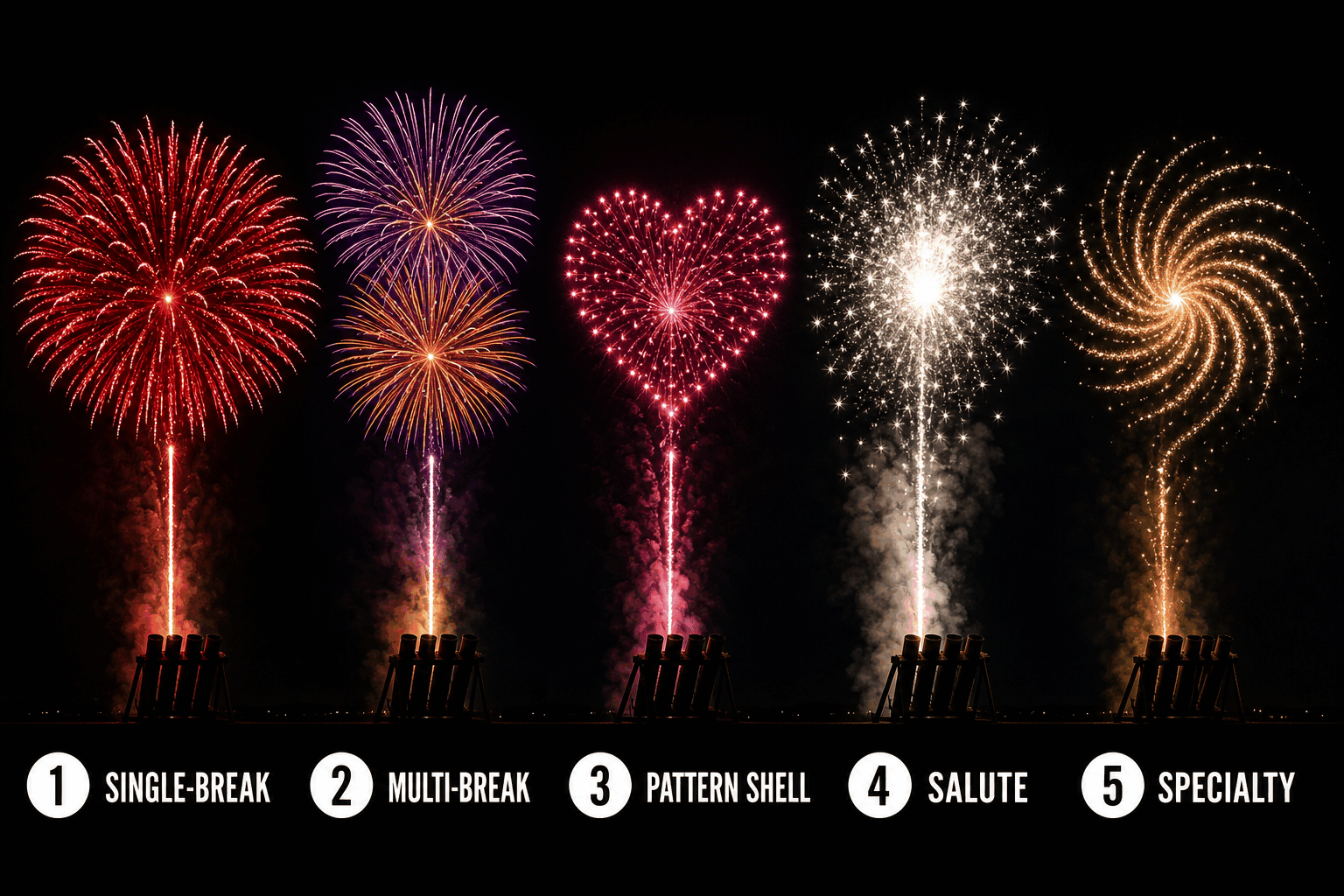
Ask any pyrotechnician to name the one product that defines Liuyang, and the answer is the same: the professional aerial shell (专业礼花弹). Cakes carry the volume on the consumer shelf and roman candles drive choreography, but the shell is the moment a crowd actually goes quiet — the soft thump from the mortar, two seconds of silence, and then the sky opens.
This guide is the working buyer-side view: what a professional shell really is, the five burst types Liuyang factories build, the calibers that matter, and what separates a real Liuyang shell from a generic copy. It pairs with the broader types-of-Liuyang-fireworks overview and goes deeper than the consumer-friendly chrysanthemum shell guide.
What Counts as a Professional Aerial Shell
A professional aerial shell is a sphere or short cylinder of paper, paste and stars, loaded into a steel or fiberglass mortar tube and launched by a separate lift charge. It is not a self-contained product like a cake. Without the mortar and the operator, it does nothing. That separation is the whole reason it can be tuned, sequenced and synchronized for serious displays. Whether a shell is a round ball or a stacked cylinder changes both its break and how it is built — see ball shell vs. cylinder shell.
Inside every shell are three working parts: the lift charge at the bottom of the mortar that throws the shell skyward; a time fuse that burns down during ascent; and a burst charge at the core that ignites at apogee, sending the stars outward in the pattern the shell was built for. All three are black-powder work; a salute adds a flash-powder core, and the two powders are compared in black powder vs. flash powder. Calibers run from 3-inch (75 mm) for opening salvos up to 12-inch (300 mm) for finale moments, with apogees between 60 and 300+ meters depending on size.
The 5 Burst Types Liuyang Builds
Every shell in a Liuyang display catalog falls into one of five families. A serious export catalog carries SKUs in all five — show designers mix them by intent, not by size. These five group shells by how they are built, not by what the break is called. The effect names inside those families are defined in our encyclopedia of fireworks effect names.
1. Single-Break
One burst, one pattern, executed cleanly. The opener of an opener — peony, dahlia, chrysanthemum — one symmetrical flower on the sky and gone. This is the category Liuyang star-rolling craft is judged on; a 6-inch single-break peony with even color saturation across all 360 degrees is the textbook Liuyang shell. Our #500 Blue Chrysanthemum (TF6001) is the catalog benchmark in this family — blue is the hardest color to land cleanly, so we use it as the color-purity reference SKU.
2. Multi-Break
Two or three bursts stacked vertically inside the same casing, firing in timed sequence. The first break opens on the way up, a second time fuse keeps burning, and the next break opens 80–120 meters higher — the last one near apogee. Reads as one long-form effect rather than two separate shells. Used to fill height between waves so the sky never feels empty.
3. Pattern Shells
Stars set on an internal disc to draw a shape rather than a sphere — hearts, smiley faces, letters, rings. The disc has to land facing the audience, so pattern shells are usually fired into a known wind angle. They get the loudest reaction at weddings and brand events. They also fail most visibly when the disc tumbles, which is why Liuyang factories test-fire pattern SKUs on every production run.
4. Salutes
Flash powder, white flash, heavy concussion. No color, no trail — just a single bright pulse and a chest-hitting bang. Used on beat drops, finale waves and military commemorations. Salutes are the loudest products in the catalog, so every market regulates them tightly: in EU shows the per-shell NEC limit is the gating spec; in the US the operator class and minimum-distance tables decide what size you can use. For the heavy-concussion seat in a salute fan, our Thundering King (TF6004) is the standard pick.
5. Specialty
Everything that is neither a flower nor a salute — glitter, strobe, crossette, flying fish, tourbillion. Each one solves a different problem in show design: glitter to slow the sky down, strobe for texture, crossette for the secondary geometry, flying fish for motion, tourbillion for the spinning whistle. A catalog without specialty SKUs is one any factory can copy; with them, it is a catalog show designers keep coming back to.
Working rule we use when building a 1.3G container for a serious display buyer: roughly half single-break and multi-break for the volume of the show, a quarter specialty for texture, and the remaining quarter split between salutes and pattern shells for accents. Adjust by event — a wedding leans pattern, a national-day finale leans salute, a music-driven show leans specialty.
Caliber, Apogee & Where Each Size Fits
Most show designers think in calibers, not in product names. The number on the order line decides apogee, burst diameter, mortar size and operator distance — before anyone talks about color or pattern.
| Caliber | Apogee | Burst Diameter | Typical Use |
|---|---|---|---|
| 3-inch (75 mm) | 60–90 m | 40–60 m | Volume opener, wedding pattern shells, compact outdoor display sites |
| 4-inch (100 mm) | 90–120 m | 60–90 m | Workhorse single-breaks, mid-show waves |
| 5-inch (125 mm) | 120–160 m | 90–120 m | Salutes, multi-breaks, primary specialty SKUs |
| 6-inch (150 mm) | 160–190 m | 120–150 m | Most-used hero caliber for medium and large shows |
| 8-inch (200 mm) | 200–240 m | 160–200 m | Finale wave, large-format pattern shells, civic events |
| 10-inch (250 mm) | 250–290 m | 210–260 m | Closing shells, national-day shows, stadium spectacles |
| 12-inch (300 mm) | 290–320 m | 260–310 m | Single hero shell of the night — one or two per show |
The honest workhorse range is 4-inch to 6-inch. Those calibers fit standard mortar racks, transit safely in pre-built modules, and the price-per-effect lets a designer use dozens of them without breaking the budget. Anything 8-inch and above is reserved for moments — the shell that tells the audience the show has shifted gear.
Featured Display Shells from the Liuyang Catalog
A snapshot of the shell SKUs we ship most often, mapped to the five burst types above. The full set sits inside the Shells category of our wholesale catalog, alongside cakes, roman candles and the rest of the display range. This guide focuses on the 3–12 inch range that covers most professional shows; the catalog also lists 1.5-inch and 2.5-inch entry-level assortment shells and special-order calibers up to 16-inch for record displays.
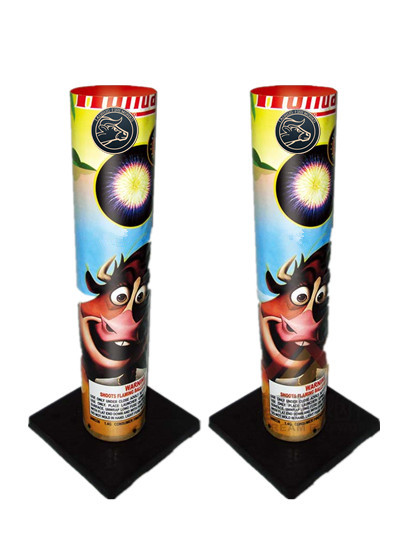
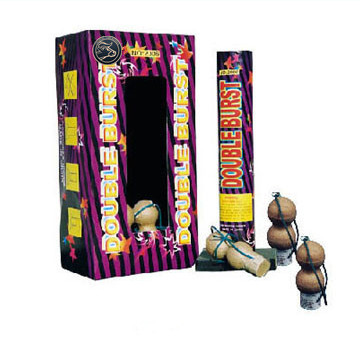
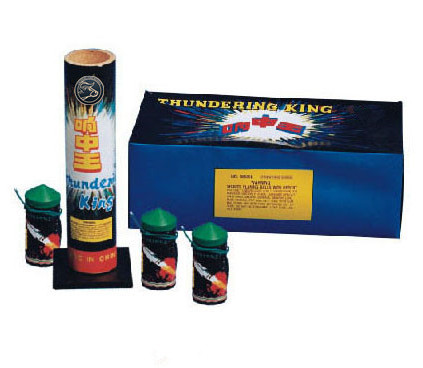
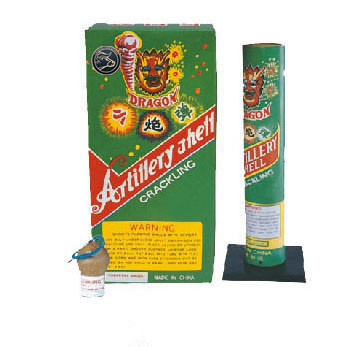
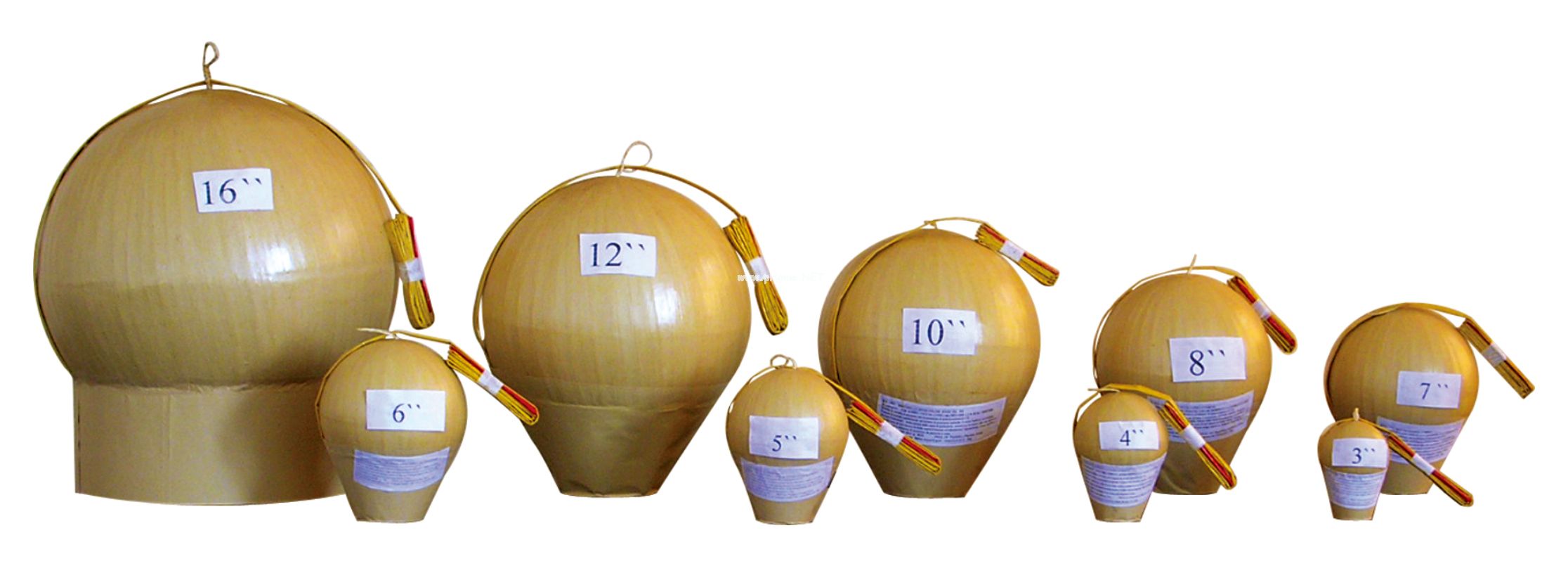
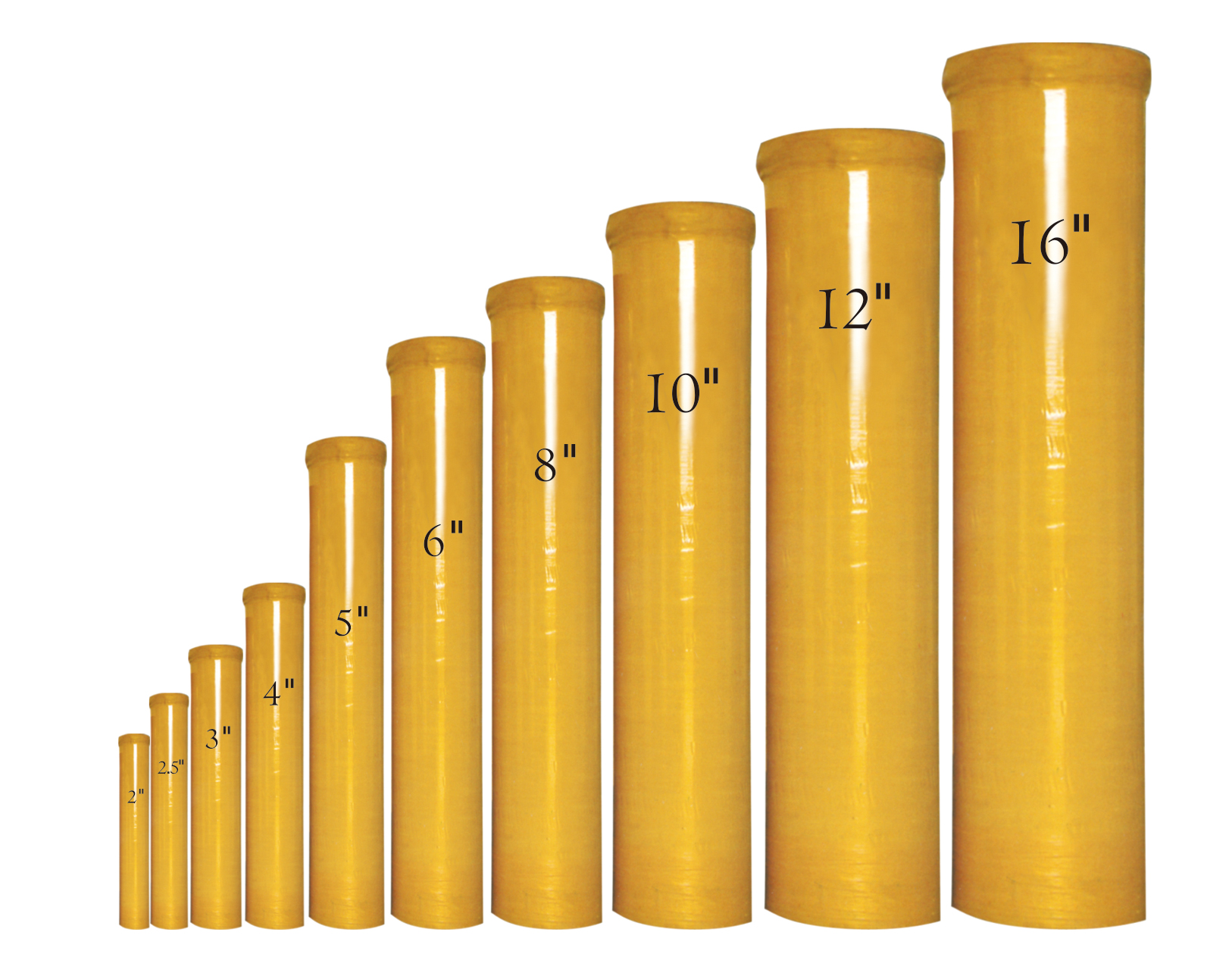
Twelve shell SKUs in the active catalog — including Assorted Whistling Buster (W520), Assortment Shell (TF6003), 2" Assortment Shell (TF6002) and 1.5" Assortment Shell (K8011) — bundled into 1.3G display containers paired with their matching mortar racks. See the full Shells category for the complete list.
How to Spot a Real Liuyang Shell
A copied shell looks identical on a pallet photo. On the firing line the difference shows in 90 seconds. After enough containers, you stop reading the wrapper and start reading these four signals.
- Symmetry of the burst. A real Liuyang single-break opens as a clean sphere — stars evenly spaced across all 360 degrees, not bunched on one side. Asymmetry means the stars were poured rather than hand-rolled and arranged.
- Color purity. Reds that look pink, blues that drift to white — both signal cheap oxidizers or contaminated star compositions. A Liuyang shell holds its color all the way to burnout. Blue in particular is the hardest color to manufacture cleanly; if blue reads true, the rest of the catalog usually does too.
- Time-fuse consistency. Two shells of the same SKU should break at the same height. If one opens at 140 m and the next opens at 95 m, the time fuses were not cut on a calibrated rig. Inconsistent break height ruins choreography no matter how good the stars are.
- Hemisphere paste-up. Cut a defective shell open after a hangfire and the two paper hemispheres tell the story. Hand-pasted Liuyang shells use 6–10 layers of kraft paper with overlapping seams; cheap copies skip layers and run the seams in straight lines that vent under pressure.
Who Buys Professional Shells — Show Types & Operators
Unlike consumer product, professional shells never reach a retail shelf. Every buyer sits inside a licensed display chain, and the four segments below cover almost all of the demand.
- Licensed display companies — the core buyer. They hold the operator credentials for their market (in the EU, authorisation as a person with specialist knowledge under Directive 2013/29/EU, which is what category F4 articles may be supplied against; in the US, a federal explosives licence or permit under 27 CFR Part 555 plus state or local display operator certification) and run municipal contracts, July 4th and New Year's Eve shows. They buy multi-caliber 1.3G containers built around the 4–6 inch workhorse range with a few hero 8-inch-plus SKUs for finales. How that buying works against a public procurement calendar is set out in our guide to municipal fireworks tenders.
- Festival, competition and pyromusical teams — buyers who need tightly matched break heights and colour purity because the shells are choreographed to music. This segment cares more about time-fuse consistency and colour fidelity than price-per-effect.
- Government, national-day and civic events — national days, expo openings and civic anniversaries, frequently routed through a nominated event contractor. In the Gulf these run through the frameworks mapped in our Middle East fireworks import hub.
- Resort, hotel and theme-park programmes — venues running recurring or nightly shows want repeatable SKUs and reliable reorder, so consistency across containers matters more than a one-off hero effect.
The common thread: every one of these buyers is a licensed operator, not a reseller, and the 1.3G classification — explained in the 1.3G vs. 1.4G guide — decides who can legally take delivery before any of the caliber or effect choices come into play.
Sourcing — Compliance & Order Reality
Professional aerial shells are not consumer goods. Most ship as UN0335 / 1.3G display articles, with a handful of small calibers cleared as 1.4G in some markets. That single classification decides almost everything that follows — our 1.3G vs. 1.4G fireworks guide breaks down how that one code drives freight, storage and who can legally buy.
- Container mix. Legally 1.3G shells and 1.4G consumer cakes can co-stow — both are compatibility group G — but mixing them rates the whole container to the stricter 1.3G class for freight, so the standard Liuyang shipment is a dedicated 1.3G display container of mixed shell calibers, often paired with a separate 1.4G consumer container if the buyer wants both.
- Operator licensing. Display shells legally require a licensed pyrotechnician at the destination. EU markets restrict category F4 to persons with specialist knowledge authorised by the member state (EN 16261 being the product standard those articles are tested to, not the authorisation itself); the US works through a federal explosives licence or permit under 27 CFR Part 555 together with state or local display operator certification; Gulf and SE Asia markets work through nominated event contractors. The factory does not relax this even on private orders.
- Documentation. Standard documents prepared per shipment include a CIQ inspection report, the UN classification and packaging spec for the boxes, and matching MSDS / SDS, plus the destination-market approval that applies, such as a US DOT EX number. EU-bound containers add EN 16261 test reports for SKUs that hold a valid certificate; the exact documentation package is confirmed against destination market and SKU mix before production starts.
- Lead time. Plan for 60–90 days from confirmed order to ex-works on a multi-caliber 1.3G shell container, longer for custom pattern shells (the disc tooling alone runs 2–3 weeks). For July 4th, place by mid-March; for New Year, by early September.
Why Liuyang on This Category, Specifically
Aerial shells are the one product where the entire Liuyang industrial ecosystem shows up at once: kraft paper from the local mills, lift powder and time fuse from neighboring villages, color compositions from chemists who have made nothing else for thirty years, hand-pasted hemispheres from craftsmen whose families have done this work since before the Qing dynasty. That cluster is what keeps a 6-inch Liuyang peony reading the same way show after show, year after year — and it is the one thing a copied catalog from anywhere else cannot replicate.
FAQ
What is a professional aerial shell?
A spherical or cylindrical paper-and-clay shell loaded into a steel or fiberglass mortar tube and launched by a separate lift charge. A time fuse burns during ascent and ignites a burst charge at apogee. Calibers run from 3-inch (75 mm) up to 12-inch (300 mm), with apogees between 60 and 300+ meters.
How is a Liuyang shell different from a consumer cake?
A cake is a self-contained block of glued tubes that fires from a single fuse in a fixed pattern. A professional shell is a single round projectile launched from a separate mortar — the operator controls the show by sequencing many shells across many mortars. Cakes are 1.4G consumer goods; shells are 1.3G display goods that need a licensed operator in most markets. See the cake vs. shell fireworks cost and safety guide for the full comparison.
Which shell size do most professional shows actually use?
The workhorse range is 4-inch to 6-inch (100–150 mm). Those calibers produce a 60–130 meter burst diameter, fit standard mortar racks, and the price-per-effect lets a designer use dozens in a single show. 8-inch and above is reserved for hero moments and finales.
Can professional shells ship in the same container as consumer fireworks?
Usually they ship separately, though not because it is forbidden. Both 1.4G and 1.3G are compatibility group G, so the IMDG Code generally allows co-stowage — but mixing them rates the whole container at the stricter 1.3G class for freight, and many carriers and destination permits handle display goods on their own. So a 1.3G shell order normally ships as a dedicated 1.3G container with its own DG documents and arrival permits.
What information should I send for a professional shell quotation?
Six lines on a quote brief usually get a workable reply:
1. Caliber mix and effect intent — single-break / multi-break / pattern / salute / specialty share
2. Total quantity per caliber
3. Destination market and event date
4. Certification required — EN 16261, CE, or local equivalent
5. Container plan — dedicated 1.3G or split with 1.4G consumer goods
6. Mortar racks bundled or sourced separately
With those six in hand we can usually quote lead time and FOB without a second round of questions. Skip any of them and the first reply has to bounce back asking for the same details, which is what stretches a quote cycle from days into weeks.
Who actually buys professional aerial shells?
Only licensed display operators, never retail. Four segments cover most demand: licensed display companies running municipal, July 4th and New Year contract shows (the core buyer for 4–6 inch workhorse calibers); festival, competition and pyromusical teams that need matched break heights and colour purity for choreography; government, national-day and civic events, often through a nominated event contractor; and resort, hotel and theme-park programmes running recurring shows that value reorder consistency. All of them hold operator certification because professional shells are UN0335 / 1.3G display goods.
Professional Aerial Shells — Factory-Direct from Liuyang
Single-break, multi-break, pattern, salute and specialty shells from 3-inch to 12-inch, sourced from Chengchong Town factories within the Liuyang cluster. Send the show brief and caliber mix — we quote 1.3G FOB and confirm the documentation package (DG, MSDS, EN 16261 where applicable) against your destination market before production.
WhatsApp Email