Watch a professional aerial display long enough and you start to see two different personalities in the sky. Some bursts open into a flawless, perfectly round flower — every star the same distance from the center, the geometry almost mathematical. Others unfold in stages: a break, then a second break a beat later, then a third, the effect telling a small story as it climbs. Both came out of the same mortar tube. The difference is the shell inside it.
That is the choice every display buyer eventually has to make: the ball shell or the cylinder shell. Two shapes, two pyrotechnic traditions — East and West — and two very different answers to the question of what a single shot should do. This is a factory-side guide to telling them apart: how each is built, what each does best, how they price, and which one belongs in your program. The numbers and methods come from day-to-day shell production in Liuyang, China, where both styles are made side by side.
The Short Answer
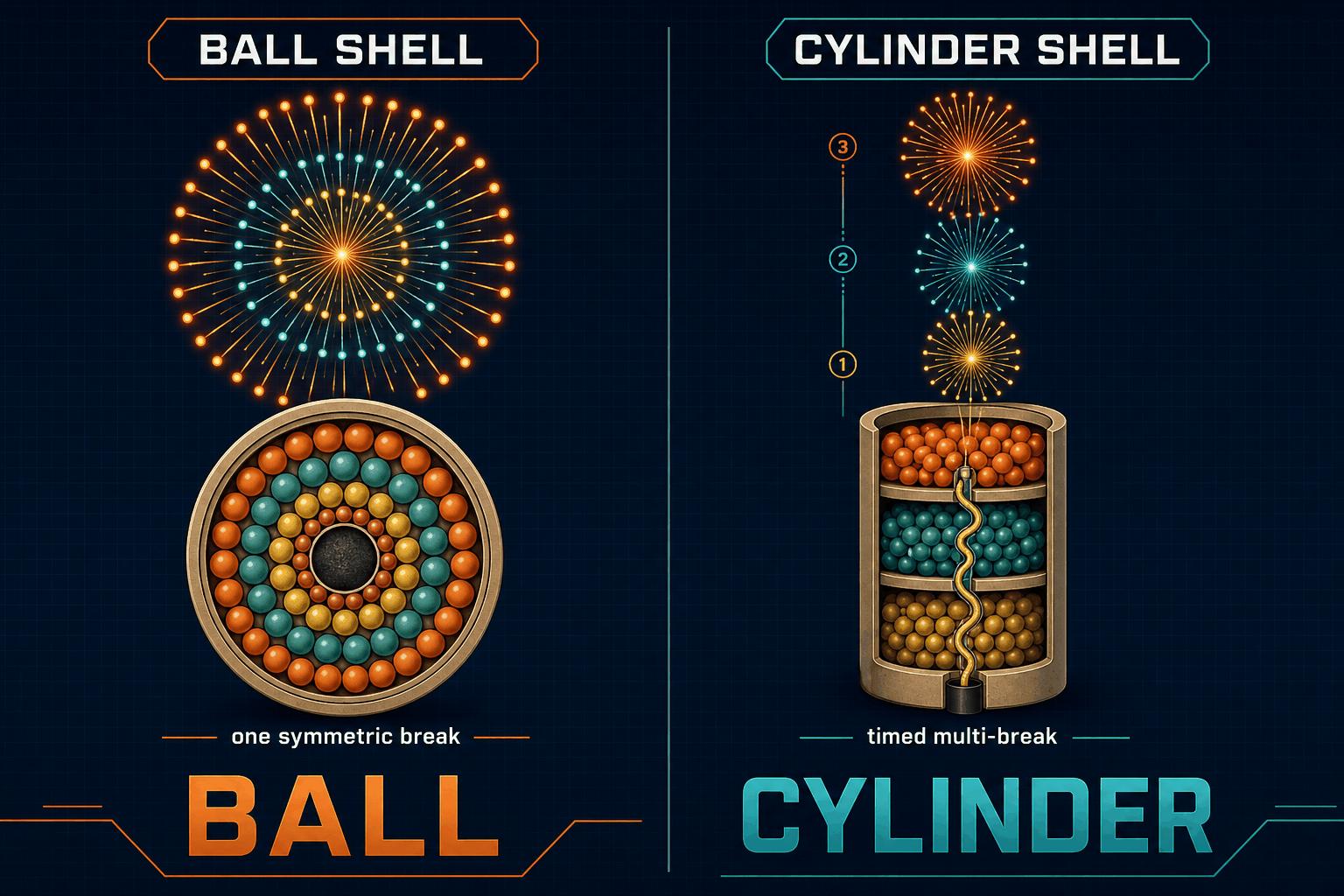
A ball shell is a sphere. Stars are packed in even layers around a central burst charge, so when it opens it throws those stars outward in every direction at once — a clean, symmetrical flower that looks the same from any seat in the house. It is almost always a single break: one shot, one perfect circle.
A cylinder shell — also called a canister shell — is a tube. That shape lets the maker stack several separate charges end to end inside one casing and link them with time fuse, so the shell can fire two, three or more breaks in timed sequence from a single shot. The trade-off is that a cylinder's break is usually a little less perfectly round than a ball's. Put simply: the ball shell competes on symmetry, the cylinder shell competes on layers and complexity.
Ball Shell
Shape: Spherical casing, stars around a central core.
Signature: One clean, symmetrical circular break.
Tradition: Eastern — perfected in Japan, mass-produced in China.
Best for: Pattern shells and flawless peony / chrysanthemum breaks.
Cylinder (Canister) Shell
Shape: Cylindrical casing, charges stacked along the tube.
Signature: Timed multi-break sequences and complex effects.
Tradition: Western — Italian and Maltese.
Best for: Layered “story” breaks, salutes and big finales.
Quick sourcing call: if your program lives on clean, repeatable signature breaks — pattern shells, color peonies, broadcast-friendly symmetry — lead with ball shells. If you want a single tube to deliver a sequence, or you are building complex finales, you need cylinder shells. Most serious display companies order both. Whichever you buy, true 3″+ display shells are 1.3G product for licensed operators, and the single most important step is video proof-firing the sample lot before the production PO.
What a Ball Shell Actually Is
A ball shell (round shell) is a paper sphere, typically 3 to 12 inches in diameter. Cut it open and the logic is immediately clear: a burst charge sits at the center, stars are arranged in one or more concentric layers around it, and a time fuse runs from the surface into the core. The whole sphere is wrapped in layer after layer of pasted kraft paper until the casing is strong enough to hold pressure for the split second the burst needs.
Because the stars start out evenly spaced around a central point, they all get pushed outward with roughly equal force at the same instant. The result is the signature you picture when you think “firework”: an expanding sphere of light, perfectly round, identical from every viewing angle. That symmetry is exactly why the ball shell became the world standard for the clean peony and chrysanthemum breaks and for pattern shells — hearts, rings, smiley faces — where the geometry only works if the sphere opens true.
The round shell is the Eastern tradition. It has its roots in Japan, where makers perfected the largest and most precise ball shells in the world, and it spread to China, which now produces the overwhelming majority of the round shells fired globally. When people praise the “Japanese-style” shell — the kamuro and the perfectly concentric color-changing peony — they are describing the ball shell at its best.
What a Cylinder Shell Actually Is
A cylinder shell (canister shell, can shell) is a paper tube with end plugs rather than a sphere. In its simplest single-break form it works much like a ball: a burst charge with stars arranged around it. But the tube shape unlocks something the sphere cannot do easily — you can build several complete shells, called breaks, and stack them one on top of another inside a single long casing.
Each break is linked to the next by a length of time fuse. The lift charge throws the whole stack into the air; the first break fires from the leader, and the explosion of that break lights the fuse to the second, which lights the third, and so on. From one shot in the sky you get a sequence — break, pause, break, pause, break — often changing color or effect with each stage. This is the classic multi-break shell, and it is what a cylinder does that a ball generally cannot.
The cylinder is the Western tradition. It was developed in Italy centuries ago — which is why canister shells are still called “Italian shells” — and the craft flourished in Malta, where multi-break shells the size of a person are a point of regional pride. The cylinder's break is typically a touch less perfectly symmetrical than a ball's, sometimes reading as an oval or a soft cross rather than a flawless circle, but in exchange it offers complexity, sequencing and the ability to hold a heavier, more varied payload. Salutes — the sharp report shells with no stars to keep round — are also commonly built as cylinders for exactly this reason.
Construction — Pasted Sphere vs Stacked Cylinder
Almost every downstream difference — symmetry, sequencing, price, lead time, even how much factory-to-factory quality varies — traces back to how each shell is physically built.
Ball shell — built from two hemispheres
The maker starts with two paper hemisphere cups. Stars are arranged against the inside wall of each cup in an even layer, the burst charge fills the middle, and the two halves are brought together into a sphere. The seam is taped, the time fuse is set through the casing into the core, and then the whole ball is pasted with successive layers of wet kraft paper and dried between coats. The number of paste layers sets how hard the shell breaks: more layers, more containment, a sharper and rounder burst. It is exacting work — the stars must be placed symmetrically or the flower opens lopsided — but the method is highly standardized, which is why ball-shell quality is relatively consistent between good factories.
Cylinder shell — rolled, stacked and time-fused
A cylinder begins as a rolled paper tube. For a single-break shell, stars are arranged around a central burst core and the ends are plugged. For a multi-break shell, the maker builds several of these break units and stacks them in one long casing, threading time fuse from each break to the next so they fire in order. The lift charge sits at the base; a leader ignites the first break. Large multi-break cylinders are among the most labor-intensive products in all of pyrotechnics — every break is built, weighed and timed by hand, and the whole stack has to fire in the correct sequence or the effect collapses. That hand-work is why complex cylinders vary more between factories, and why proof-firing matters most here.
The short version: a ball shell is a single, symmetrical event built for one perfect break; a cylinder shell is an assembly built to deliver a timed sequence. One is engineered around geometry, the other around choreography inside a single shot.
Side-by-Side Specifications
The comparison every display buyer and show designer should have in front of them:
| Specification | Ball Shell | Cylinder (Canister) Shell |
|---|---|---|
| Casing geometry | Spherical — two pasted hemispheres | Cylindrical — rolled tube with end plugs |
| Break symmetry | Highly symmetric, true circular flower | Less round — oval, cross or wider spread |
| Breaks per shell | Usually a single break | Single, or 2–5+ stacked breaks |
| Sequencing | One synchronized burst | Timed sequential breaks from one shot |
| Star arrangement | Layered around a central burst core | Stacked along the tube, break by break |
| Build method | Hand-pasted hemispheres, standardized | Rolled, stacked, hand-timed (multi-break) |
| Build difficulty | Demanding but repeatable | Multi-break is the most labor-intensive |
| Origin tradition | Eastern — Japan / China | Western — Italy / Malta |
| Typical caliber | 75 mm (3″) to 300 mm (12″) | 75 mm (3″) to 300 mm (12″) |
| Mortar | Matching-caliber mortar (round bore) | Same mortar — needs correct tube length / fit |
| FOB price (Liuyang, indicative) | ~$3 (3″) to $30–50 (8″) | Comparable per caliber; multi-break adds a premium |
| UN hazard class | 1.3G (UN0335) at 3″ and larger | 1.3G (UN0335) at 3″ and larger |
| Show role | Signature symmetric beats, pattern shells | Layered sequences, salutes, complex finales |
Note on calibers: both shapes are sold by the caliber of the mortar they fire from, and the altitude and flower size scale the same way — roughly each extra inch of caliber adds about 25–35 m of burst height. A 4″ of either shape reaches around 90–120 m; a 6″ around 160–190 m. For the full per-caliber apogee and flower-size table, see our professional aerial display shells guide.
The Effects Each One Does Best
Ball shells — symmetry and pattern
When the show design calls for a flawless circular flower that reads the same from every angle — a deep-color peony, a trailing chrysanthemum, a glittering kamuro — the ball shell is the tool. It is also the only practical way to make true pattern shells: rings, hearts, stars and smiley faces depend on stars being placed in an exact 2D layer inside the sphere, so the shape only appears correct when a symmetric ball opens flat to the audience. For broadcast and choreographed shows where every signature beat has to look identical and clean, ball shells carry the work.
Cylinder shells — sequence and story
Where the cylinder wins is anything that unfolds over time. A single multi-break canister can climb and open three or four times in a row, changing color with each break — a complete mini-sequence from one tube. Maltese-style multi-break shells are famous for exactly this. Cylinders are also the natural home of the hard salute, because a report shell has no stars to keep symmetric, and they tend to hold heavier, more varied payloads. When a designer wants drama, layering and complexity rather than pure geometry, the cylinder delivers.
One Mortar, Two Shells — Loading & Safety
Both shells fire from the same kind of mortar: a heavy HDPE, fiberglass or steel tube of the matching caliber, anchored in a rack. A 4-inch ball and a 4-inch cylinder both drop into a 4-inch tube. The one practical difference is length — a cylinder shell is taller than a ball of the same caliber, so the mortar must be long enough and the shell must seat freely with the lift charge at the bottom and the leader run out cleanly.
Everything else about safe handling is identical to any display shell, and none of it is optional. Loading, time-fuse handling, spectator stand-back distance — commonly about 70 feet (21 m) per inch of caliber under NFPA 1123 — wind calls, misfire procedure and mortar inspection after the show all apply. In the US firing either shell needs a state display-pyrotechnician license; in the EU an F4 operator certificate. True 3″+ ball and cylinder shells are both 1.3G (UN0335) display fireworks, restricted to licensed operators — the shape changes the effect, not the law. Our 1.3G vs 1.4G guide covers what that classification means for storage and freight.
Sourcing — Why Proof-Firing Matters More for Cylinders
Liuyang builds both traditions in the same district, on the same chemistry and QC systems, which is why a display company can source round shells and cylinder shells from one supply chain. But the two are not equally forgiving to buy.
Ball shells
More standardized and more consistent between good factories. MOQ is typically 1,000–5,000 per caliber; FOB runs from around $3 for a 3″ up to $30–50 for an 8″. Lead time is 8–16 weeks for hand-pasted large calibers. The main thing to verify is break quality and color — that the flower opens round and the stars hold their color to burnout.
Cylinder shells
Higher variance, especially for multi-break work, because so much depends on hand-timing. A simple single-break cylinder prices close to a ball of the same caliber; a complex multi-break commands a premium for the labor. Here proof-firing is non-negotiable: insist on video of the actual sample lot and confirm that every break opens, in the right order, with no blind breaks or flowerpots. One mistimed batch can ruin a sequence in front of an audience. Our guide on how to spot high-quality fireworks walks through what to check before the production PO.
What to put on the purchase order: for an accurate quote and the right product, specify caliber (3″–12″), shape (ball or cylinder), break count for multi-break cylinders, the effect names you want (peony, kamuro, multi-break color change), the required UN class and destination-market certificates, and ask for a video proof-firing of the sample lot. For cylinders, confirm mortar length and fit before loading.
Whichever shape leads your order, the sourcing discipline is the same: confirm caliber and UN class, match the product to your license and market, and verify a Liuyang factory with a proof-firing before you commit. Many programs run a mixed shell order — ball shells for the clean signatures, cylinders for the sequences — through a single shell catalog and one delivery schedule.
FAQ
What is the difference between a ball shell and a cylinder shell?
A ball shell is spherical: stars are packed around a central burst charge, so it opens into a clean, symmetrical circular flower — usually one break. A cylinder (canister) shell is tube-shaped, which lets the maker stack two or more charges end to end and fire them in sequence, so it can produce timed multi-break effects and more complex, less perfectly round patterns. In short, the ball shell is built for symmetry, the cylinder shell for layered complexity.
Which shell produces multi-break effects?
The cylinder shell is the classic multi-break format. Because the casing is a tube, several individual breaks can be stacked and linked by time fuse so they fire one after another, each break taking fire from the one before it. Ball shells are usually a single synchronized break; multi-break ball assemblies (peanut shells) exist, but the staged, story-telling sequence is the cylinder tradition.
Are cylinder shells harder to make, and does that affect quality?
Large multi-break cylinder shells are among the most labor-intensive items in pyrotechnics: each break is built and timed by hand and the stack has to fire in the right order. Simple machine-rolled cylinders are straightforward, but complex ones leave more room for variation between factories than a standard ball shell. That is exactly why proof-firing a sample lot matters more for cylinders — you are checking that every break opens, in order, before you commit the production run.
Do ball and cylinder shells use the same mortar?
Yes — both fire from the same matching-caliber mortar, so a 4-inch shell of either shape goes in a 4-inch tube. The one detail is fit: a cylinder is longer than a ball of the same caliber, so the tube must be long enough for it to seat freely. Always match the shell to a mortar rated for its caliber and confirm fit before loading.
Which is the “Japanese” shell and which is the “Italian” shell?
The round ball shell is the Eastern tradition — perfected in Japan and produced at scale in China — and is prized for its precise, perfectly circular breaks. The cylinder shell is the Western tradition, associated with Italy and Malta, and is known for layered multi-break sequences and complex effects. Liuyang factories build both, so a display company can source either style from one supply chain.
Are cylinder shells more expensive than ball shells?
Per caliber they are broadly comparable — a simple single-break cylinder costs about the same as a ball shell. Complexity is what adds cost: a hand-built multi-break cylinder takes far more labor, so it commands a premium. As a rough Liuyang FOB guide, plan from about $3 for a 3″ up to $30–50 for an 8″, more for complex multi-break.
Which should my display company order from a Liuyang factory?
Match the shell to the moment: ball shells for clean signature beats — symmetric peonies, chrysanthemums and pattern shells — and cylinder shells for timed multi-break sequences and big finales. Most programmes order both. Either way, these are 1.3G display product for licensed operators, so request video proof-firing before the production PO.
Bottom Line
Ball and cylinder shells are not rivals so much as two answers to two different questions. The ball shell answers “how do I get a perfect, repeatable, symmetrical break that reads from every seat?” — which is why it owns pattern work and the clean color signatures of modern displays. The cylinder shell answers “how do I make one shot unfold over time?” — which is why it owns multi-break sequences, salutes and complex finales. Drop either tradition and the sky gets noticeably poorer.
For the buyer, the practical takeaway is simple: design the mix around the moments you need — symmetry from balls, sequence from cylinders — confirm the caliber and 1.3G handling for your market, and verify any Liuyang factory with a proof-firing before the order, paying special attention to the multi-break cylinders where hand-work makes quality vary most. That is how strong shell programs have been built for decades.
Source Ball and Cylinder Shells Direct from Liuyang
We build both round ball shells and Italian-style cylinder multi-break shells, 3″ to 12″, with documented QC and per-shipment compliance papers prepared by destination market. Ask for the catalogue and a video proof-firing sample pack.
WhatsApp Email