Every fireworks invoice, packing list and bill of lading carries one short code that quietly decides more about your shipment than any product photo ever will: 1.4G or 1.3G. It looks like a minor technicality on a dangerous-goods form. In practice it sets your ocean freight rate, dictates the kind of warehouse you're allowed to store the goods in, and even determines whether you can legally sell the product to the general public.
This guide explains the difference between 1.3G and 1.4G fireworks the way it actually matters to an importer or distributor — not as chemistry, but as money, paperwork and market access. We'll cover what UN0335 vs UN0336 really means, why 1.3G freight costs more, how the class maps to EU and US categories, whether you can mix the two in one container, and how to read the class straight off a Liuyang spec sheet. The numbers come from shipping cakes and shells out of Liuyang, China every week.
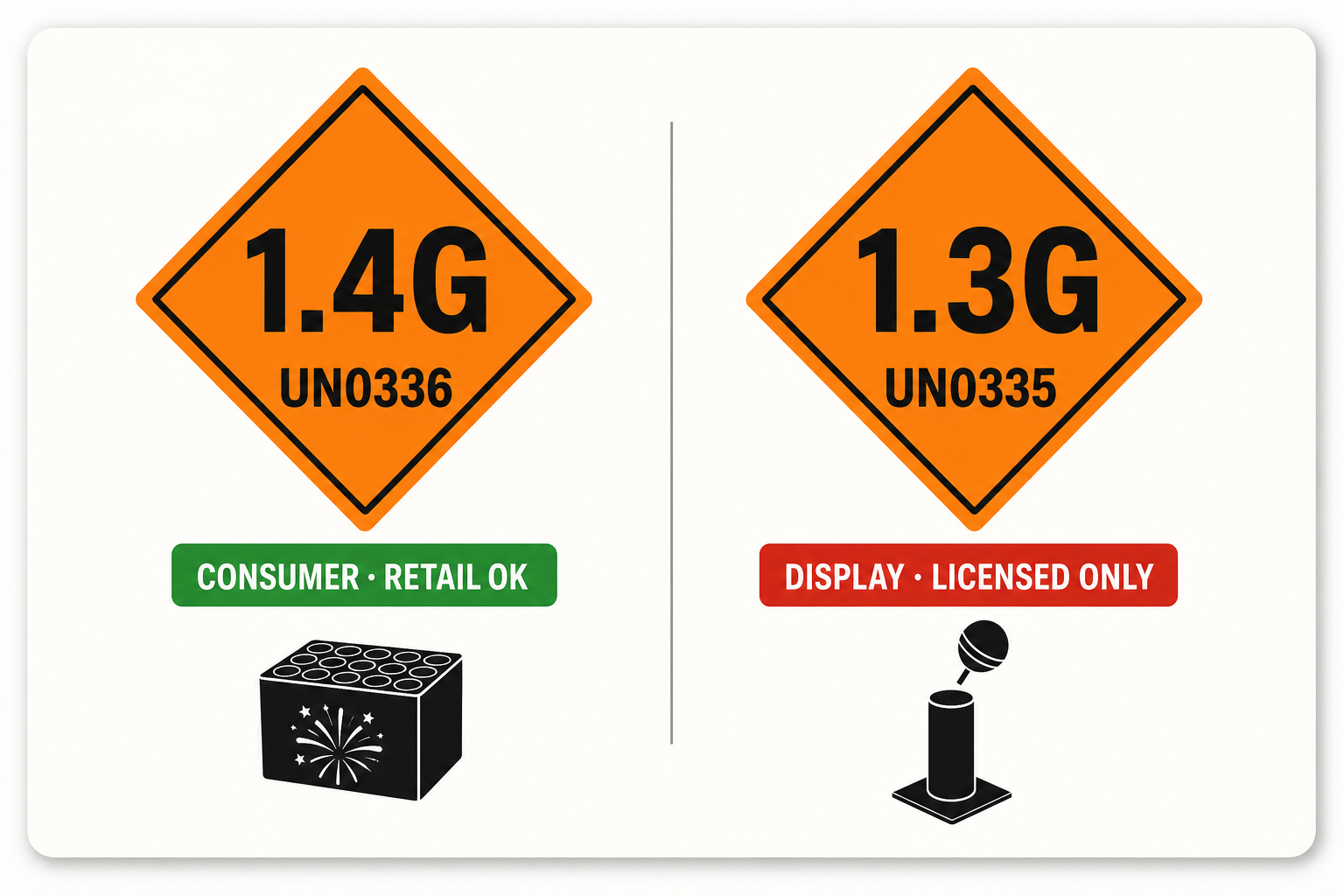
The Short Answer
Both codes describe a Class 1 explosive in compatibility group G (a pyrotechnic substance or article containing one). The only thing that changes is the hazard division — the second digit — and that single digit drives almost everything that follows. 1.4G (UN0336) means the hazard is limited to the package: if it ignites, you get fire and the odd pop, but no mass explosion that threatens everything around it. 1.3G (UN0335) means a mass fire hazard with minor blast or projection — if a pallet lights up, the whole pallet goes, fast and hot.
Read this before the tables below. The UN division answers a freight and storage question — how the goods behave inside a container or a magazine. It does not, by itself, decide who is allowed to buy or light them. The two systems correlate strongly and are easy to use as shorthand, which is why this page pairs them, but they are separate labels and they do come apart: professional-only stage and close-proximity product routinely ships as 1.4G or 1.4S despite being restricted to licensed operators. Where they line up and where they don't is set out in Regional Overlays below. If you are working backwards from an occasion rather than from a container, start with our guide to sourcing fireworks by event type, which decides the class from the venue, the operator and the date.
1.4G — UN0336
What it is: Consumer-grade product — multi-shot cakes, fountains, Roman candles, sparklers, small aerial.
Usually sold to: the general public, subject to local law.
Freight & storage: Standard DG rates; modest quantities stored without a specialty magazine.
In one line: the class that keeps freight and storage ordinary.
1.3G — UN0335
What it is: Display-grade product — 3-inch and larger aerial shells, big comet mines, oversized finale racks.
Usually sold to: licensed pyrotechnicians and display companies.
Freight & storage: Specialist DG freight (30–60% premium), licensed magazine, trained handling.
In one line: the class that puts a magazine and a premium on the quote.
Quick sourcing call: if your business is retail, wholesale-to-retail, or any sale to the public, you live in the 1.4G world — keep your container pure 1.4G and your freight and storage stay simple. The moment you add even a few cartons of 1.3G display shells, the entire shipment is treated as 1.3G for freight and handling. When you request a quote, state your destination market, the certificates you need (CE / CPSC), your target UN class, and ask us for the tested classification of every line item on the DG declaration — not the assumed one.
What 1.4G (UN0336) Actually Means
1.4G is the usual transport class for consumer product. The "1.4" tells transport and storage authorities that the goods present no significant blast hazard — the effects are confined largely to the package, and an incident stays small enough that emergency services can manage it without evacuating a neighbourhood. The "G" tells them it's pyrotechnic. Together, UN0336 is the workhorse code for the products most people picture when they hear "fireworks for sale".
It covers the bulk of what crosses a retail counter: multi-shot cakes up to the consumer limit, fountains, Roman candles, mines, small reloadable kits, sparklers and novelties. The defining design intent is that an untrained member of the public can use the product safely by following the printed instructions. That same intent is why 1.4G enjoys standard dangerous-goods freight rates and far lighter storage rules — moderate volumes can sit in a general DG store rather than a purpose-built explosives magazine.
1.4G is what makes a seasonal fireworks business possible at all. Standard freight, broadly available storage and, where local law allows, sale to the public are the three things that let an importer turn a container into thousands of retail transactions. If a product loses its 1.4G status, the retail channel usually goes with it.
What 1.3G (UN0335) Actually Means
1.3G is the usual transport class for display product. The "1.3" signals a mass fire hazard — minor blast and projection, but predominantly fierce, fast-spreading fire. If one item in a stack ignites, the rest are expected to follow. That is exactly what a professional display shell is engineered to do at altitude, and it is why the same product is handled with so much more caution on the ground.
UN0335 covers aerial display shells of 3 inches (75 mm) and up, large comet and mine racks, and finale assemblies that exceed consumer limits. None of it is designed for an untrained user. Purchase, storage, transport and firing are restricted to licensed display professionals, and every link in that chain — magazine, truck, vessel, operator — carries an extra compliance burden. This is the cost side of the spectacular: the very property that produces a 200-metre flower is the property that makes 1.3G expensive and tightly controlled to move.
Side-by-Side: 1.4G vs 1.3G
The attributes every importer, warehouse manager and freight forwarder should have memorised:
| Attribute | 1.4G (UN0336) | 1.3G (UN0335) |
|---|---|---|
| UN number | UN0336 | UN0335 |
| Hazard description | Minor explosion hazard, confined to package | Mass fire hazard, minor blast/projection |
| Typical products | Cakes (≤500 g NEC), fountains, Roman candles, sparklers, small aerial | 3"+ aerial shells, large mines, finale racks |
| EU category | F2 / F3 (consumer) | F4 (professional) |
| US status | Consumer fireworks (CPSC, 16 CFR 1507) | Display fireworks (ATF-regulated) |
| Canada status | Consumer Fireworks (CF) | Display Fireworks (DF) |
| Usually sold to | General public (per local law) | Licensed operators |
| Usually fired by | Consumers | Licensed pyrotechnicians |
| Ocean freight | Standard DG rate | +30–60% premium |
| Storage | General DG store (volume limits apply) | Licensed explosives magazine |
| Mixed stowage | Can ship with 1.3G (both group G) | Container rated to 1.3G if mixed |
Read that table top to bottom and the pattern is obvious: the product, the chemistry and even the factory can be nearly identical, but the hazard division changes the commercial reality at every step from quote to retail shelf. This is the practical extension of the cake vs. shell distinction — cakes are the headline 1.4G product, shells the headline 1.3G one — viewed through the lens of paperwork instead of effects.
Two of those rows are firm and two are habit. The UN number and the hazard description come from a test result and travel with the goods. The market-status rows — EU category, US and Canada status, who buys and who fires — describe how the two systems usually line up, not a rule the transport code imposes. Treat them as a reliable first assumption you still confirm against the destination's own use category.
Freight and Storage — Where the Money Is
The performance gap between 1.4G and 1.3G is real, but the gap that hits your landed cost is the logistics gap. Carriers treat a mass fire hazard very differently from a package-level one, and that difference compounds at every port.
Why 1.3G freight runs 30–60% higher
Shipping lines accept only a limited tonnage of 1.3G per sailing, apply stricter stowage and segregation from incompatible cargo, and route it on fewer vessels. Scarcer capacity plus extra handling means the per-cubic-metre rate sits well above 1.4G — typically 30–60% more, and higher still on lanes with thin DG capacity. As a rough illustration, a 40ft of pure 1.4G cakes from Liuyang to the US West Coast might land around $4,500–$6,500 ocean freight, with the same box space of 1.3G shells closer to $6,000–$10,000. Our fireworks shipping cost breakdown shows how hazard class and lane drive the final number.
Storage: general DG store vs licensed magazine
1.4G can be held in a general dangerous-goods store up to the quantity limits in your local explosives regulation — manageable for a seasonal retailer or distributor. 1.3G almost always demands a licensed explosives magazine: distance separation from occupied buildings, alarmed and access-controlled, with a net-explosive-quantity licence. Renting magazine space, or being turned away from a 3PL that won't touch 1.3G, is a cost and a constraint many first-time importers don't price in until the goods are afloat.
None of this is optional paperwork. The packing, marking, segregation and documentation that move hazard-class fireworks legally are covered step by step in our dangerous-goods shipping process guide, and the levers that genuinely reduce the bill are in how to reduce freight costs on dangerous goods.
Regional Overlays — EU, US, Canada, GCC
Here is the single most common source of confusion: the transport class (1.3G / 1.4G, a UN system) and the use category (EU F-numbers, US consumer/display) are separate systems that happen to overlap. One product carries both at once. Don't treat them as the same label.
- EU (CE): consumer fireworks are F1/F2/F3 under EN 15947 and generally ship as 1.4G — these populate our EU consumer catalog. Professional display product is F4 (EN 16261) and usually ships as 1.3G, for certified operators only.
- United States (CPSC / DOT / ATF): 1.4G consumer fireworks fall under CPSC 16 CFR 1507. Reloadable shells up to 1.75" can remain consumer; anything 3" and larger is display fireworks needing an ATF storage licence and a state pyrotechnician licence to fire.
- Canada: 1.4G maps to Consumer Fireworks (CF); 1.3G maps to Display Fireworks (DF), which require a Display Fireworks Supervisor and an approved magazine.
- GCC & Middle East: import is permit-and-event driven; civil-defence approval usually keys off the UN class and net explosive quantity, so a clean 1.4G vs 1.3G split on your documents speeds clearance. See our Middle East import guide.
A single 6-inch shell is, simultaneously, 1.3G for transport, F4 in the EU, and display fireworks in the US. None of those three is a substitute for the others on a customs or insurance form. The broader framework — UN numbers, divisions and compatibility groups — is laid out in our UN numbers & shipping classifications guide. For the market side of the same divide — who may legally buy and fire each product, and the two business models behind them — see our consumer vs. display fireworks guide.
Can You Load 1.3G and 1.4G in the Same Container?
In principle, yes: both UN0335 and UN0336 are compatibility group G, so the IMDG Code generally allows them to be stowed together without segregation between the two. In practice, though, co-loading is the exception rather than the rule — for two reasons importers should price in before asking for a mixed container.
The whole box inherits the worst class
Mix even a handful of 1.3G shells into a container of 1.4G cakes, and the entire container is documented, freighted and handled as 1.3G. Your cakes don't get cheaper 1.4G freight just because they're the majority — the most restrictive class governs the unit. That's why a small shell order can quietly inflate the freight on a large cake order riding alongside it.
Why most orders still ship separately
Beyond the freight re-rating, many carriers, forwarders and destination permits handle display goods on their own — so the standard Liuyang shipment is a dedicated 1.3G container of display product, paired with a separate 1.4G consumer container when a buyer needs both. When the 1.3G volume is small, the shells are usually consolidated with other display orders to share the premium rather than re-rating a full container of cakes. We'll model both options on the proforma so you can see the freight delta before you commit.
How to Read the Class on a Liuyang Spec Sheet
You should never have to guess the class. On a compliant Liuyang spec sheet and dangerous-goods declaration, every line item shows it explicitly. Check these four fields before you sign a PO:
- UN number: UN0336 (1.4G) or UN0335 (1.3G). This is the definitive transport class for that item.
- Proper shipping name: "FIREWORKS" plus the class — e.g. Fireworks, 1.4G, UN0336. It should match the UN number exactly.
- NEC / NEQ (net explosive content): grams of explosive per item — also written NEQ (net explosive quantity) on international DG paperwork. For cakes claiming consumer 1.4G, confirm it sits within the destination's consumer ceiling (commonly ≤500 g NEC).
- Test/classification reference: the classification should trace to UN Series 6 test results, not a factory's assumption. Ask for the classification approval if a "consumer" cake sits suspiciously close to the limit.
The trap to avoid: a borderline finale cake described as "1.4G" on the catalogue but actually testing as 1.3G. If that's discovered at the destination port, your whole consignment can be re-rated, delayed, or refused — and the freight you budgeted for 1.4G evaporates. Insist on the tested class, item by item. Verifying documentation is part of the wider quality check in our guide on how to spot high-quality fireworks.
FAQ
What is the difference between 1.3G and 1.4G fireworks?
Both are hazard Division 1.3/1.4, compatibility group G (pyrotechnic). 1.4G (UN0336) is a minor package-level fire hazard, no mass explosion — the usual freight class for cakes, fountains, Roman candles, sparklers and small aerial. 1.3G (UN0335) is a mass fire hazard with minor blast and projection — the usual freight class for 3-inch and larger aerial shells and big finale racks. The class decides freight and storage. Who may buy or light the item is a separate use-category question: stage close-proximity can ship as 1.4G and still be licensed-operator only.
Why does 1.3G cost more to ship than 1.4G?
1.3G is a mass fire hazard, so carriers apply stricter stowage and segregation rules, accept it on fewer sailings, and cap how much can ride on one vessel. That scarcity plus extra handling typically adds 30–60% to ocean freight versus the same volume of 1.4G, and the gap widens on lanes with limited DG capacity.
Can consumers buy 1.3G fireworks?
In almost all markets, no. 1.3G (UN0335) is typically restricted to licensed pyrotechnicians or display companies for purchase, storage, transport and firing. The UN class is not itself that licence. A few US states allow certain 1.75-inch reloadable shells to stay 1.4G, but true 3-inch-plus display shells are licensed-only.
Are all cake fireworks 1.4G?
Most are, but not automatically. A multi-shot cake stays 1.4G (UN0336) as long as it meets the consumer limits — commonly up to 500 g of net explosive content (NEC) per item and tube/effect limits set by the destination standard. Oversized finale cakes that exceed those limits, or fail the consumer test series, are classified 1.3G (UN0335) and handled as display product. Always confirm the tested class on the DG declaration rather than assuming.
Can I load 1.3G and 1.4G fireworks in the same container?
Legally they can: both are compatibility group G, so the IMDG Code generally permits co-stowage without segregation. In practice most fireworks orders ship separately — partly because the whole container is then rated to the most restrictive class (1.3G) and pays 1.3G freight, and partly because many carriers and destination permits handle display goods on their own. The usual approach is a pure 1.4G container plus a separate, often consolidated, 1.3G shipment.
How does 1.3G and 1.4G map to EU F-categories and US classes?
Transport class (UN) and use category (EU/US) are separate systems that overlap. 1.4G consumer product is generally EU F2/F3 and US 1.4G consumer; 1.3G display product is generally EU F4 and US display fireworks (ATF-regulated). A single shell therefore carries a transport class (1.3G), an EU category (F4) and a national use status at once — they are not interchangeable labels.
Bottom Line
1.3G and 1.4G aren't grades of quality — they're hazard divisions, and the difference between them is the difference between a product you can ship cheaply, store easily and sell to the public, and one that demands premium freight, a licensed magazine and a credentialed buyer. UN0336 opens the consumer market; UN0335 opens the professional one. Most product lines live cleanly on one side, and trouble usually starts when the two get mixed without anyone pricing in the consequences.
The practical discipline for any importer is short: confirm the tested UN class of every line item, keep consumer and display volumes deliberately separated unless mixing genuinely makes sense, and budget freight and storage to the real class on the document — not the one you hoped for. Get that right and the classification stops being a risk and becomes just another field on a clean shipment.
Source 1.4G and 1.3G Fireworks Direct from Liuyang
Liuyang manufacturer with documented multi-stage QC and per-shipment dangerous-goods paperwork prepared for your destination market. Tell us your market and the UN class you need, and we'll send a quote with the classification documents for each line item.
Get a Quote