Every fireworks wholesaler learns the same painful lesson eventually: a container that looked fine on paper turns into a stack of retailer complaints, refund emails, and a margin that evaporates overnight. The frustrating part is that most of those bad containers were actually spottable before the deposit was wired — the clues were right there in the construction, the paperwork, and the way the supplier answered your questions. Judging the product is only half the job, though — the upstream question of who you're dealing with, and on what terms, is the subject of our fireworks sourcing and supplier-trust playbook.
This guide is the shortlist we hand to new buyers walking into our Liuyang factory for the first time. No fluff, no buzzwords — just what to look at, what to ask for, and what to walk away from.
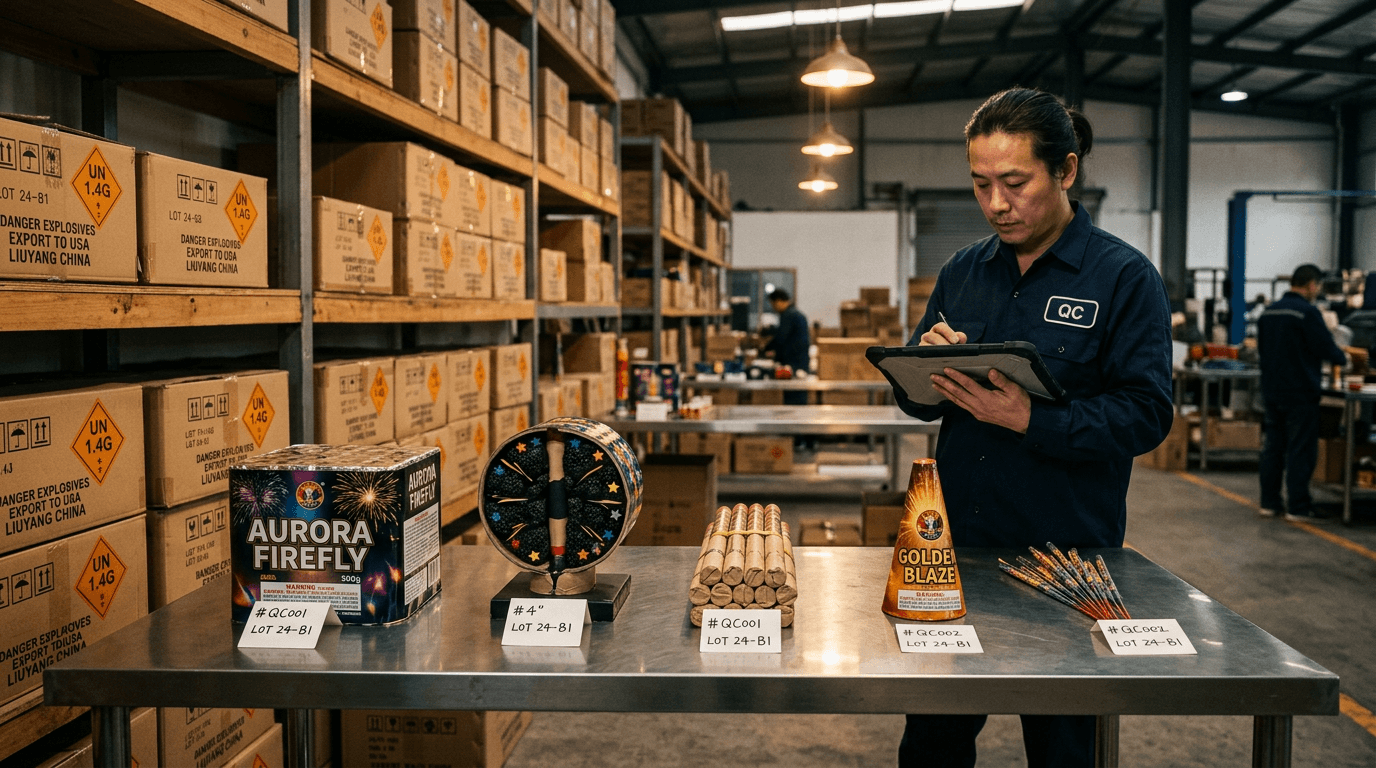
1. The Hand Check: Eight Things to Look At Before Anything Else
Before you talk about test fires or contracts, pick up the item. Twenty minutes with a sample on the table tells you more than a glossy catalog ever will.
- Tube walls. Press a fingernail into the edge of a cake tube. A good tube is dense and firm. If it dents easily, the paper wrap is too thin and the lift charge will tilt the shot.
- Tube alignment. Look straight down into the cake. Tubes should sit flush, parallel, and snug — no lean, no gaps. A leaning tube is a sideways shot waiting to happen.
- Fuses. Wax-coated, straight, firmly seated, with a fuse cap. Dry or frayed fuse is where misfires start.
- The base. Put it on a flat table. It should sit dead-flat. If it rocks, it won't launch straight.
- Glue lines. Thin, even, fully cured. Globby hot-melt smeared around seams usually hides bad dimensions underneath.
- Labels. Printing should be sharp and the label must carry the warnings, NEQ, CE category (F1–F4) or APA class, UN number, and a lot code. Missing or smudged regulatory text will get stopped at customs.
- Weight. Grab a kitchen scale and spot-weigh five pieces. If the real weight strays more than ±5% from spec, someone is skimping on the expensive stuff — usually the lift charge or the stars.
- Outer carton. 5-ply export kraft, square corners, factory-printed UN marks. Soft or re-used cartons tell you the factory cuts corners on the last mile — exactly where dangerous goods can't forgive sloppiness.
Quick tip: compare the production unit side-by-side with the master sample you approved. The master sample is the contract. Adjectives in the PO are not.
2. The Test Fire: What to Actually Watch For
Hand checks narrow the risk. A live test fire removes it. Pull 3–5 pieces per SKU from different cartons — not from a curated box the salesman hands you — and watch these five things.
| What to watch | Good | Reject |
|---|---|---|
| Lift & flight | Consistent height, straight up | Tip-overs, ground bursts, shots >25% low |
| Break shape | Round, even star spread | Lopsided, half-break, blind side |
| Color & brightness | Deep, saturated — especially the blues | Washed-out, orange-shifted, dying early |
| Timing | Rows fire on beat, clean finale | Missed shots, choppy rhythm, gaps |
| Duds | < 0.5% on cakes, < 0.3% on shells | Anything above 2%, or burning pieces on the ground |
If you only have time to watch one thing, watch the blue. A deep, clean blue star is the hardest effect in pyrotechnics to produce — it depends on a narrow flame-temperature window that only disciplined factories can hold. We dug into why in the science behind blue stars. Pale or orange-tinted blue usually means the rest of the batch is cutting corners too.
3. The Paperwork That Actually Matters
Documents don't create quality, but missing documents almost always mean missing quality. Build this pack into every PO and don't release the balance until it lands in your inbox:
- Production license & ISO 9001 — confirms the factory is real and runs a documented QC system.
- CE Type Examination (for EU) with a verifiable Notified Body number, and the SKUs listed must match your order. The manufacturer's EU Registration Number should appear on the label.
- APA 87-1 compliance for US-bound consumer fireworks.
- CIQ export inspection records, UN classification (UN0336, UN0335, or UN0333) matching the DGD, plus any destination-specific approval such as a US DOT EX number. Our piece on UN numbers for fireworks explains what each one means.
- A redacted batch record tying raw-material lots to the production line, inspector, and finished-goods test data. This is the single best indicator of a serious factory — genuine ones can pull it in minutes.
4. Red Flags vs. Green Flags
After the product and paper, evaluate the supplier. Quality is produced by people and systems, not tooling.
Green flags
- A verifiable factory address in a licensed Liuyang production zone, and an open invitation to visit.
- Willingness to share a redacted batch record on request.
- In-house QC with a proving area and fuse tester — not just a showroom.
- Repeat buyers in your destination market you can actually call.
- Competitive but realistic pricing.
- No issue with third-party pre-shipment inspection.
Red flags
- Prices 20%+ below the market. Nobody gives fireworks away — someone is being substituted out.
- Trading company pretending to be a factory. Ask for the production license; a broker can't produce one.
- CE certificate that doesn't cover your SKUs, or a Notified Body number that can't be checked.
- Mixed or missing lot codes across one shipment.
- Pressure to pay 100% upfront, or to skip pre-shipment inspection.
- Factory name that seems to change every couple of years — that usually follows something going wrong.
5. Category-Specific Tells
Different product families hide their quality (or lack of it) in different places. Quick pointers, with more depth in our full category guide:
- Multi-shot cakes (200g / 500g). Watch tube alignment and row timing. The finale should match the marketing video.
- Display shells. Look for round breaks and consistent lift across a rack. The chrysanthemum shell is still the benchmark.
- Roman candles. Even tempo, straight flight, uniform break height. They reveal factory discipline quickly.
- Fountains. Watch for tip-overs during the burn — that's the #1 complaint at retail.
- Sparklers. Straight wire, coating that doesn't flake, and a clean burn-down without the stick burning through.
6. A Buying Workflow That Keeps You Safe
Don't improvise quality checks at the last minute. Lock in a repeatable sequence:
- Qualify the supplier — license check, factory visit or live video, references.
- Order samples, do the hand check and a test fire.
- Approve and seal a master sample per SKU at your own warehouse.
- Write explicit quality acceptance criteria into the PO.
- Book a pre-shipment inspection with live test-fire sampling.
- Only release the balance after the full document pack is in your inbox.
Why Liuyang Still Matters
Liuyang, Hunan is widely estimated to account for around 60% of the world's fireworks. That concentration means more licensed factories competing for your order, deeper pyrotechnic talent, and mature CE / APA paperwork — all things that lower your risk as a wholesale buyer. For the story behind the region, see our 1,400-year history of Liuyang fireworks.
Regional Buyer Preferences: Middle East & Latin America
Beyond raw quality, what your end customers consider "high-quality" varies sharply by region. Wholesalers in the Middle East and Latin America buy against very different tastes than US or EU markets. Knowing the local preference helps you pick SKUs that sell through quickly — and reject samples that "look fine" but won't move on your shelves.
Middle East (UAE, Saudi Arabia, Kuwait, Qatar)
- Visual style: dense, bright, color-saturated bursts. Gold, red and white are universal favorites; deep blue and purple sell well at premium tier. Big, bold breaks are preferred over delicate single-color effects.
- Format mix: heavy on 200g / 500g multi-shot cakes for retail and wedding events; large-caliber display shells for civic and royal events.
- Sound profile: loud is a feature, not a defect. Whistles, crackles and salutes that get muted in EU markets are positively requested in GCC retail.
- Quality tells specific to ME buyers: uniform finale density across the cake (no "weak last 3 shots"), zero duds out of a 100-shot rack, and sturdy outer cartons that survive 40°C+ summer warehouse storage in Jebel Ali or Dammam.
- Packaging: Arabic dual-language warning text earns trust at retail. Conservative imagery (no human figures or explicit themes) is required for KSA in particular.
Latin America (Mexico, Brazil, Chile, Argentina, Peru)
- Visual style: Brazil and Mexico favor warm-color brocade tails and willow effects; Chile and Argentina lean toward bright, fast-strobe finales. Crackling effects are universally popular across LATAM.
- Format mix: Brazil drives huge volumes of fogos de artifício consumer assortments and Roman candles for São João. Mexico and Chile pull large-caliber cakes for Independence Day. Argentina trends toward bottle rockets and mid-tier 200g cakes for summer New Year.
- Sound profile: mid-loud. Crackle preferred over salute. Excessive whistle SKUs sometimes face local restrictions.
- Quality tells specific to LATAM buyers: humidity-resistant fuses (containers sit in tropical port yards for weeks), reinforced inner cardboard partitions to survive long inland trucking from Manzanillo or Santos, and clearly printed Portuguese/Spanish warnings that pass Army (CFE) and SEDENA inspections.
- Packaging: Portuguese for Brazil, Spanish for the rest. Bilingual labels (Spanish + English) clear customs faster in Chile, Peru and Argentina.
The single biggest sourcing mistake regional buyers make: ordering a US- or EU-tuned SKU pack and being surprised when end customers don't respond to it. Always send your supplier a short brief — 3–5 bullet points on local preference — before the SKU mix is finalized.
FAQ
What's an acceptable dud rate for wholesale fireworks?
Under 0.5% on consumer cakes, under 0.3% on display shells. Anything consistently above 2% is a red flag — you'll see it in retailer complaints within a season.
Which certifications really matter?
EU: a valid CE Type Examination covering your SKUs, plus the manufacturer's EU Registration Number on the label. US: APA 87-1 and a DOT EX number. Baseline for any China-made goods: ISO 9001 quality records, CIQ export inspection, UN classification matching the DGD; other destination-specific approvals are prepared per market.
Can I judge quality without firing them?
Most of the risk, yes — construction, paperwork, and supplier behavior tell you a lot. But a live test fire is still the only way to prove effect, brightness, and dud rate. Don't skip it.
How do I spot a risky supplier?
Prices far below market, vague or missing factory address, CE certificates that don't match your SKUs, mixed lot codes, and pressure to pay 100% upfront. A real manufacturer welcomes inspection.
Should I still use pre-shipment inspection if the factory has strong QC?
Yes. Internal QC is the factory's view; PSI is yours. It's one of the cheapest bits of insurance in international fireworks trade — our pre-shipment inspection & proof-firing guide covers the AQL sampling, the test-fire video and the documents to check before you pay the balance.
Need a Supplier You Can Actually Audit?
Liuyang Tauron Fireworks Co., Ltd. — fireworks manufacturer in Chengchong Town, Liuyang. Licensed production, multi-stage QC, batch-level traceability, CIQ export inspection records, open factory visits. Tell us what you need and we'll walk you through the paperwork.
WhatsApp Email