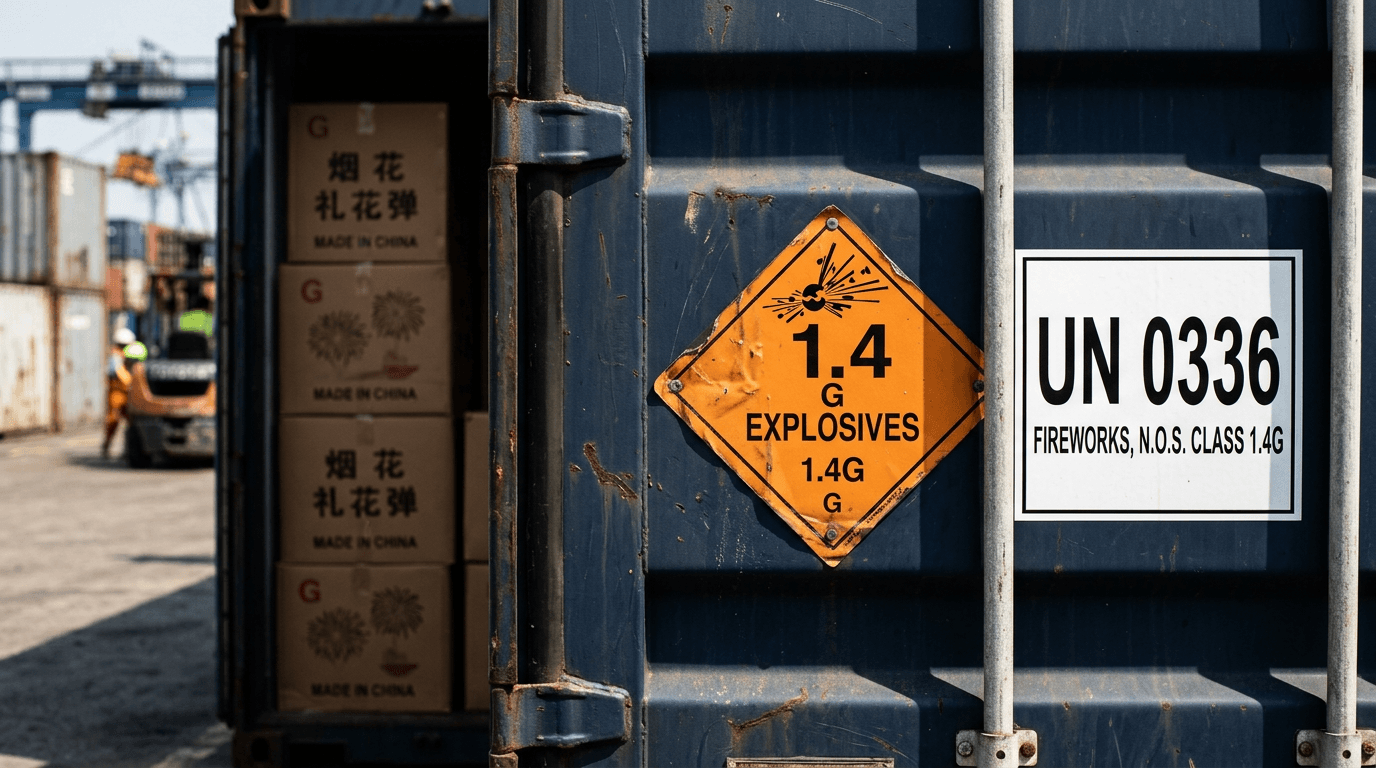
Every fireworks shipment that crosses a border carries a UN number — a four-digit code that tells carriers, customs and first responders what's actually in the box. Get it wrong and the container is rejected at the terminal, or worse, fined and seized. Get it right and you cut DG surcharges and clear customs faster.
This is a practical guide to UN numbers and hazard classifications for fireworks — what the codes mean, where they come from, and how to use them to save money on a Dangerous Goods Declaration.
What a UN Number Actually Is
UN numbers are four-digit IDs from the UN "Orange Book" (UN Recommendations on the Transport of Dangerous Goods). Every regional code — IMDG for ocean, IATA DGR for air, ADR for European road, RID for rail, 49 CFR for US DOT — inherits from it. Each number points to a specific article with its class, division, compatibility group and proper shipping name.
For fireworks, five numbers cover almost all real trade:
| UN Number | Class / Division | Proper Shipping Name | Typical Products |
|---|---|---|---|
| UN0336 | 1.4G | FIREWORKS | Consumer cakes, Roman candles, fountains, sparklers, firecrackers, small aerial shells |
| UN0335 | 1.3G | FIREWORKS | Professional display shells (3"+), large cakes, professional-grade Roman candles |
| UN0337 | 1.4S | FIREWORKS | Very low-hazard consumer fireworks: wire sparklers, small fountains, novelty items where effects are confined to the package |
| UN0333 | 1.1G | FIREWORKS | Large-caliber display shells (8"+), mass-explosion-hazard items |
| UN0431 | 1.4G | ARTICLES, PYROTECHNIC | Stage/indoor pyrotechnics, signal flares, igniters |
| UN0432 | 1.4S | ARTICLES, PYROTECHNIC | Very low-hazard items (party poppers, Christmas crackers, some toy caps) |
Class 1 Divisions: What the Numbers Mean
All fireworks are Class 1 (Explosives). The division after the decimal — 1.1, 1.3, 1.4 — describes how dangerous the hazard actually is, and it drives almost every cost on your shipment.
1.1 — Mass explosion
The whole load can detonate at once. 1.1G (UN0333) applies to very large professional shells and specialty items. Few carriers accept it, stowage is restrictive, surcharges are the highest of the group.
1.2 — Projection hazard
Significant fragmentation but no mass explosion. Rarely seen in commercial fireworks — mostly a military designation.
1.3 — Fire hazard, minor blast
UN0335 (1.3G) is the usual entry for professional display fireworks: 3–8" shells, large professional cakes, high-power Roman candles. DG surcharges typically run 2–3× a 1.4G shipment and fewer lines will take it.
1.4 — Minor hazard
UN0336 (1.4G) is the workhorse for consumer fireworks worldwide. Cakes, fountains, Roman candles, sparklers, firecrackers, small aerial — practically everything shipped out of Liuyang for retail, and the backbone of our international wholesale catalog. Lowest surcharges, broadest carrier acceptance, easiest stowage.
One distinction worth pinning down before the cost discussion. These are transport hazard divisions, not product categories. The pairings above describe what the market usually looks like, not a rule: the division comes from how the actual article performs under test, not from whether it is sold as consumer or display product. A large consumer cake can test into 1.3G, and a modest professional item into 1.4G. Treating "1.4G" and "consumer" as synonyms is one of the more expensive assumptions in this trade, because it drives artwork, freight budget and permit route at the same time — the labelling side of that is worked through in our guide to GCC labels and DG carton marks.
The division is the single biggest cost lever on the whole shipment. The pure Class 1 DG surcharge runs roughly $300–600 per 20ft for 1.4G versus $800–1,500 for 1.3G, so making sure your consumer SKUs are properly tested as 1.4G (and not defaulted to 1.3G) saves several hundred dollars per container in surcharges alone — and more once 1.3G's restricted-carrier premiums are counted. For a buyer's breakdown of how the 1.3G/1.4G split drives freight, storage and who can legally buy, see our 1.3G vs. 1.4G fireworks guide.
1.4S — The exempt tier
The "S" means sufficiently insensitive: any effect stays inside the package. The fireworks entry here is UN0337 (1.4S) — party poppers, Christmas crackers and similar novelties — low enough hazard to escape most Class 1 restrictions, with some items acceptable by air under IATA. Watch the entry name rather than just the division: near-identical articles made for technical rather than entertainment purposes are ARTICLES, PYROTECHNIC under UN0431 (1.4G) or UN0432 (1.4S), which is where indoor cold fountains and stage effects often land.
The "G" — Compatibility Group
The letter after the division (A–S) says which other explosives the item can ride with. Almost all fireworks are Group G: pyrotechnic substances and articles. Practically, all G items can load in the same container — 1.4G, 1.3G and even 1.1G can legally share space, although individual carriers often tighten this. What G items cannot co-load with is non-G cargo like detonators (B) or propellants (C).
How a Product Actually Gets Classified
Classification isn't self-declared. A product earns its UN number through testing:
- Series 6 tests — the definitive set. Samples are ignited inside their transport packaging; blast overpressure, thermal radiation and fragment projection decide whether it's 1.1, 1.2, 1.3 or 1.4.
- Default classification — standard consumer SKUs under defined NEQ thresholds in approved packaging can be assigned 1.4G by analogy, without individual Series 6 testing.
- Classification certificate — issued by a competent authority: BAM (Germany), HSE/BRE (UK), DOT-approved US labs, or China's National Quality Supervision Center for Fireworks and Crackers in Liuyang. The cert carries the UN number, division, group, NEQ and any special conditions.
Every SKU we export ships with a current classification certificate on file. Buyers and forwarders can request the paperwork on any product by code.
NEQ — The Number Everyone Gets Wrong
Net Explosive Quantity (NEQ) is the mass of explosive and pyrotechnic composition inside an item — not the packaging, casings or fuses. You will also see it written NEC or NEW, and the IMDG Code and transport documents call it net explosive mass (NEM). The trade uses these interchangeably and in practice they refer to the same figure, but individual regimes define them slightly differently, so quote whichever term the receiving document uses. NEQ matters in four specific places:
- It is a primary input into which division a product lands in — though the division comes from Series 6 testing or an approved default classification, not from the NEQ figure on its own.
- It caps the per-inner and per-outer package under IMDG packing instruction P135.
- It's the container-level limit many carriers enforce (usually 10,000–14,000 kg 1.4G in a 20ft).
- Some carriers calculate DG surcharges on total NEQ, so accuracy directly affects freight cost.
Labels, Marks and Placards
Bad labelling gets the container rejected at the gate. Every shipment needs:
Note that the transport marks below are only one of the printed layers on a shipment. The retail pack answers to the destination country's product rules instead, and the two are governed separately — a distinction worked through in detail in our guide to Arabic labels and DG carton marks for the GCC.
On each package
- UN number ("UN0336" etc.) preceded by the letters "UN", in characters at least 12 mm high — reduced to at least 6 mm on packages of 30 litres or 30 kg maximum net mass and under, and an appropriate size on packages of 5 litres or 5 kg and under.
- Proper shipping name: "FIREWORKS" or "ARTICLES, PYROTECHNIC".
- Class 1 hazard diamond (100 × 100 mm min.) showing the division and the compatibility group. The symbol is not the same on every division: 1.1, 1.2 and 1.3 carry the exploding-bomb graphic, while 1.4, 1.5 and 1.6 replace it with large numerals. A consumer carton therefore reads 1.4 over G, with EXPLOSIVES and the class number 1 below — artwork studios working from a generic "explosives" clip-art get this wrong routinely.
- NEQ per package where the destination, carrier or terminal calls for it — a common box-face requirement rather than a universal package mark under the Code.
- Orientation arrows if the item must stay upright.
On the container
- Class 1 placards (250 × 250 mm) on all four sides.
- Orange UN number panel next to the placard.
How UN Numbers Map to Local Rules
United States (DOT / ATF)
The US implements the UN system through 49 CFR. 1.4G still carries the legacy "DOT Class C" label in older paperwork. Any Class 1 import requires an ATF Federal Explosives License; the UN number is the primary identifier on permits.
European Union (ADR / IMDG + Pyrotechnic Directive)
The EU applies UN classifications directly via ADR (road) and IMDG (ocean). On top of that, the Pyrotechnic Articles Directive (2013/29/EU) assigns F1–F4 use categories. These are sale-and-use categories, not transport classes, and the two are set independently: consumer categories F1, F2 and F3 generally ship as 1.4G (UN0336), while professional F4 is generally 1.3G (UN0335) — but the transport division comes from Series 6 testing or an approved default classification, not from the F-number. EU placement requires CE marking under both regulatory systems — see our EU market inquiry page for the documentation prepared per shipment and SKU list.
Middle East (UAE, Saudi Arabia, GCC)
GCC states use UN numbers as the primary classification but bolt national permitting on top. In the UAE, the UN0336 / UN0335 designation is what the Civil Defence permit and Jebel Ali DG manifest are written against. Saudi Arabia requires the GDCD to verify the UN number against the SABER conformity record before customs release at Jeddah or Dammam. Most consumer importers in the region operate exclusively on UN0336 (1.4G); UN0335 (1.3G) display imports face tighter control and, in some markets, additional defence-ministry sign-off. In Qatar, for example, 1.3G display product is handled through the MOI and Civil Defence rather than a separate defence sign-off — see the Qatar import playbook. Confirm the exact route market by market.
On the GCC customs side the UN number never travels alone — it is cleared against HS code 3604.10 (fireworks) on the import declaration, and the two have to agree with the DG declaration, the packing list and the commercial invoice before the entry is accepted. In Saudi Arabia the SABER Shipment Certificate of Conformity (SCoC) is raised against that same UN number and HS code, so a late SKU swap that shifts the division (1.4G → 1.3G) can invalidate the SCoC and the customs entry at the same time. Duty and VAT are assessed on the 3604.10 line, and because the GCC applies a Unified Customs Tariff, the classification filed at the first port of entry follows the cargo if it is later transhipped from Jebel Ali to Dammam or trucked inland to Riyadh — the UN number and HS code stay locked to the consignment across the whole GCC leg. The country-by-country permit picture is mapped in our GCC fireworks import hub, and the Saudi conformity chain in our SABER and SASO guide.
Latin America (Mexico, Brazil, Chile, Argentina, Peru)
Latin America ports use the IMDG framework via national regulations, and the UN number is what every regional explosives authority registers against. Mexico's SEDENA explosives import permit lists each UN number per shipment. Brazil's Army (COLOG / SFPC) classification register is built on UN0335 / UN0336. Chile's DGMN, Argentina's ANMaC and Peru's SUCAMEC all reconcile the DGD's UN number to their internal classification database before clearing the container at Manzanillo, Santos, San Antonio, Buenos Aires or Callao.
Practical rule for ME and LATAM importers: the UN number on the lab certificate must match the DGD, the bill of lading, the import permit and the customs declaration — character for character. Any mismatch triggers re-submission and 5–10 days of demurrage. Getting the classification paperwork right is part of the wider document pack you should secure before releasing the balance — see our sourcing and supplier-trust playbook.
Australia, Japan, South Korea
Australia (ADG Code), Japan and South Korea all use UN numbers as the primary classification system with minor local wording changes and per-shipment permits.
Classification Mistakes That Cost Real Money
- Mixing 1.4G and 1.3G in the same container — the whole shipment is treated as 1.3G for surcharges and stowage. Separate containers when the math works; the assortment side of that trade-off is worked through in our guide to building a 1.4G mixed container for GCC retail seasons.
- Shipping on an expired certificate. Many labs issue 5-year certs; check validity before booking.
- Wrong NEQ on the DGD. Over-declaring inflates surcharges; under-declaring is a violation. Use actual tested NEQ, not guesses.
- Dropping the compatibility letter ("1.4" instead of "1.4G") — carriers reject the docs on sight.
- Putting 1.4G on products that should be 1.3G (typical trap: 6" display shells). Classification is based on test data, not what you'd prefer.
Where Classification Becomes Cost Savings
- Division gap: the Class 1 DG surcharge is roughly $300–600 per 20ft for 1.4G versus $800–1,500 for 1.3G. Getting consumer SKUs properly certified as 1.4G instead of defaulting to 1.3G saves several hundred dollars per container in surcharges — more once 1.3G's restricted-carrier premiums are added.
- Carrier access: most lines take 1.4G on standard services; 1.3G acceptance is narrower with less frequent sailings.
- Tight NEQ: declaring actual tested NEQ (not padded estimates) avoids overpaying on per-kg surcharges.
- 1.4S edge: UN0432 items can be surcharge-exempt on some carriers and can move by air, which opens express options.
- Clean paperwork: correct UN numbers, valid certs and precise proper shipping names avoid the rebookings, demurrage and detention that kill logistics budgets.
FAQ
What is the UN number for consumer fireworks?
UN0336, Class 1.4G. Covers cakes, Roman candles, fountains, sparklers, firecrackers and small consumer aerial.
UN0336 vs UN0335 — what's the difference?
UN0336 (1.4G) is minor blast, no mass explosion — in practice most consumer product. UN0335 (1.3G) is fire hazard with minor blast or projection — in practice most professional display product. The DG surcharge on 1.3G is often 2–3× a 1.4G rate; all-in ocean freight more often lands 30–60% higher. Fewer carriers take 1.3G. The division is set by test result rather than by how the item is sold, so read it off the SKU's classification certificate rather than assuming it from the catalogue page.
What does the "G" mean in 1.4G?
It's the compatibility group — pyrotechnic substances and articles. G items can co-load with other G items, but not with non-G explosives like detonators or propellants.
What labels are required on a fireworks package?
Proper shipping name, the UN number preceded by the letters “UN”, and the Class 1 hazard diamond with the division and compatibility group — plus container-level Class 1 placards on all four sides. Watch the diamond artwork: 1.1–1.3 carry the exploding-bomb symbol, but 1.4, 1.5 and 1.6 replace it with large numerals, so a consumer carton reads 1.4 above the letter G with no bomb graphic. Which of those marks sits on the retail box rather than the export carton is a separate question — see our GCC labels and carton marks guide.
How much does classification affect freight cost?
A lot. The Class 1 DG surcharge is roughly $300–600 per 20ft for 1.4G versus $800–1,500 for 1.3G, and 1.3G's narrower carrier acceptance pushes its all-in cost higher still. Proper 1.4G certification typically saves several hundred dollars per container before any other optimisation.
What is NEQ?
Net Explosive Quantity — the mass of explosive and pyrotechnic composition inside an article, excluding packaging. It drives classification thresholds, packaging and container limits, and on some carriers, the surcharge itself.
UN numbers aren't fine print — they're the main control you have over DG surcharges, carrier choice and customs clearance speed on every fireworks shipment. Once your classifications are locked, the same UN numbers thread through every later stage of the seven-step dangerous goods shipping process — packaging, booking, loading and customs all reference back to them.
Need Classification Docs for a Shipment?
Every SKU we export comes with a current classification certificate, accurate NEQ data, and properly prepared DGD. Send us the product list and destination — we'll send back the paperwork you need to book.
WhatsApp Email