Shipping is often the second-largest cost line after the product itself. For importers in the Middle East and Latin America, the final price of a container of fireworks depends less on the factory quote and more on what you pay between the port in China and your own warehouse.
This guide breaks down the real fireworks shipping cost from China. We will cover what you actually pay for, where the money disappears, and how buyers in Dubai, Jeddah, Mexico City, São Paulo, Santiago or Panama City can plan more accurate landed costs.
It is written for distributors, wholesalers and retailers who already understand the basics of importing, but want a clearer view of sea freight, DG fees and hidden charges.
What Affects Fireworks Shipping Costs
Many factors shape the final fireworks freight cost. Most of them are outside your direct control, but all of them can be planned for.
The most important ones are:
- Hazard class (1.3G vs 1.4G). Consumer fireworks are usually Class 1.4G (UN0336). Professional display shells are Class 1.3G (UN0335). 1.3G products face stricter stowage rules and higher surcharges, which can add hundreds of dollars per container.
- Shipping distance and lane. A container going from Shanghai to Jebel Ali is not priced the same as one going to Manzanillo or Callao. Longer lanes, extra transhipments and less common routes all raise the price.
- Port of loading. Liuyang cargo usually leaves from Huangpu Old Port, Shenzhen, Shanghai or Ningbo. Each port has its own DG handling capacity, truck access and carrier mix, which changes both cost and lead time.
- Season. Peak seasons (spring for US 4th of July, autumn for year-end festivals) push DG slot prices up. Off-peak months are much cheaper.
- Booking difficulty. Not every carrier accepts Class 1 cargo. When DG slots are tight, prices jump quickly. Late bookings usually pay the worst rates.
Small changes in any of these factors can shift the total fireworks import cost by 15–30% per container.
Main Shipping Methods for Fireworks from China
Fireworks are explosives. That single fact decides almost everything about transport.
For commercial volumes, fireworks are shipped only by sea. Air freight is not a realistic option. IATA rules block most consumer fireworks from commercial flights, and the few items that might qualify are far too expensive to ship that way.
So when we talk about shipping fireworks from China, we are almost always talking about sea freight fireworks China exports.
Fireworks ship as dangerous goods (DG) under the IMDG Code. In practice this means:
- Only certain vessels and carriers accept them.
- They usually travel in full container loads (FCL). LCL is rarely offered for Class 1.
- Each shipment needs a full DG documentation set.
- A DG surcharge applies on top of the base ocean rate.
This DG logic is why fireworks cost more per container than general cargo. It is also why working with experienced partners matters far more than for regular goods.
Detailed Cost Breakdown (Per Container)
A typical fireworks container invoice is not one line. It is a stack of smaller fees, each with its own logic. Here is how a landed bill usually breaks down.
Ocean Freight
The base ocean freight pays for moving the box from origin to destination port. It changes with the route, carrier, vessel schedule and market conditions. On most invoices, this is the single biggest line.
Port Charges
These cover terminal handling at both ends — loading, unloading, yard moves and equipment use. Origin THC and destination THC are usually billed separately. Together they can add several hundred dollars per container.
Customs Clearance
Fireworks need formal customs declarations on both sides. In China, there is an export clearance fee. At the destination, your broker charges for import clearance, HS classification and handling of permits or licences.
DG Surcharge
This is the extra fee carriers charge for accepting explosive cargo. It covers stricter stowage, extra inspection and risk handling. The dangerous goods shipping cost element alone can represent 15–25% of the total freight bill.
Documentation Fees
DG shipments require a DG Declaration, MSDS sheets, a classification certificate, a bill of lading with special marks, and sometimes country-specific permits. Every one of these documents has a small fee attached. Individually they are minor. Together they add up.
Other common items on the invoice include inland trucking from Liuyang to the port, cargo insurance, and destination delivery from the port to your warehouse.
Fireworks Shipping Cost Per Container (20ft / 40ft)
Buyers always want a number. The honest answer is: it depends on the lane and the month. Still, realistic ranges are useful for planning.
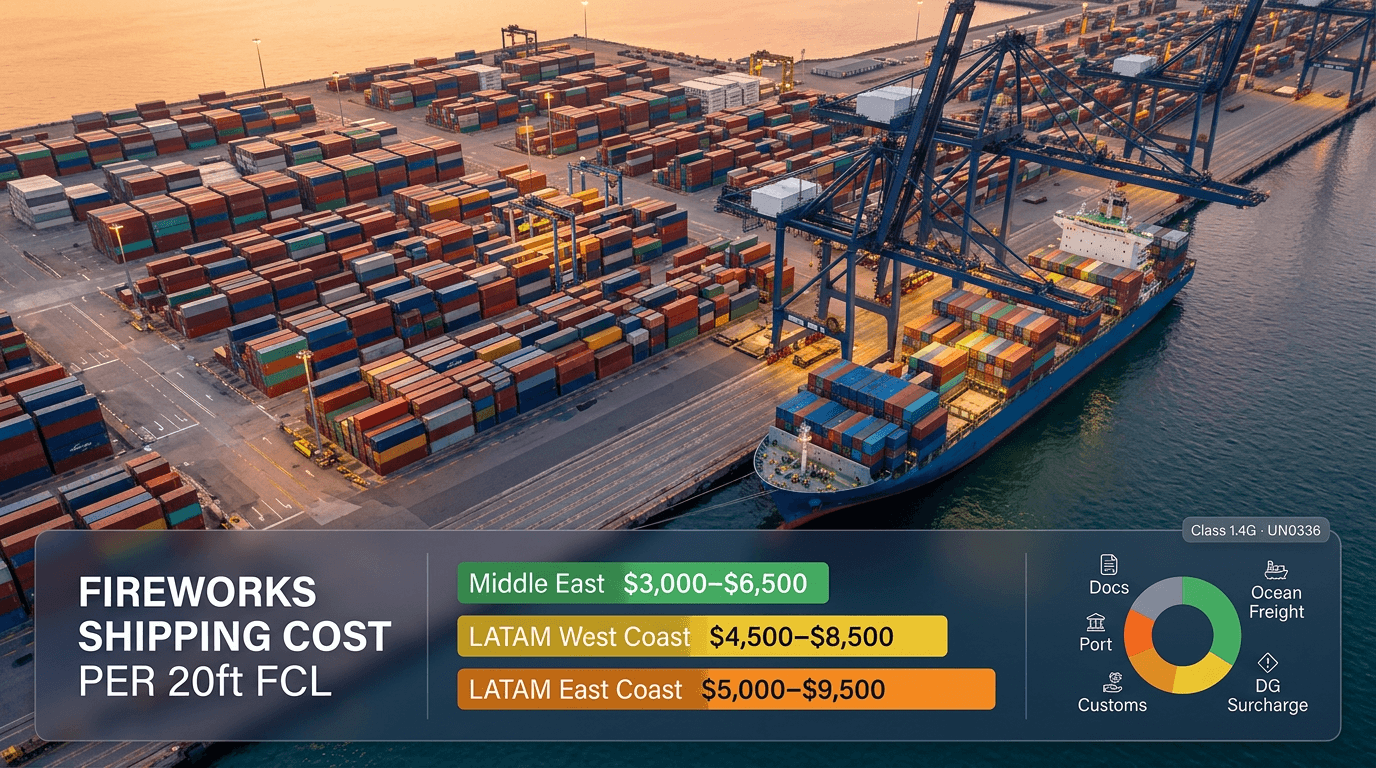
For a 20ft FCL of 1.4G consumer fireworks, typical all-in fireworks shipping cost per container looks like this:
- China → Southeast Asia (Laem Chabang, Port Klang, Tanjung Priok): $1,800–$4,500
- China → Middle East (Jebel Ali, Dammam, Jeddah): $3,000–$6,500
- China → Latin America West Coast (Manzanillo, Callao, San Antonio): $4,500–$8,500
- China → Latin America East Coast (Santos, Buenos Aires, Veracruz): $5,000–$9,500
Southeast Asia is the cheapest lane because the sea leg is so short, but the Class 1 DG surcharge still applies in full, so the freight rarely drops to normal-cargo levels. On the Indonesia lane in particular, Tanjung Priok handles fireworks through authorized channels only — budget for a licensed consignee and approved-channel handling rather than an open commercial rate. The market-by-market detail is in our Southeast Asia fireworks market guide.
Mexico appears on both Latin American lines — Manzanillo on the Pacific, Veracruz on the Gulf — and for fireworks those two rates are not freely interchangeable. The customs office of entry is one of the fields in the SEDENA import permit application, filed months before there is a vessel to book, so the cheaper line is only available to you if it is the one the permit names. Our Manzanillo vs Veracruz guide sets out which parts of this cost stack actually move with the port and which do not.
For a 40ft HQ, costs are usually 1.2–1.5× the 20ft rate, not double. The cube is bigger, so per-unit freight usually drops.
These are ranges for a reason. The market moves. DG shipping cost China numbers can change by 20–40% in a single quarter when there is a fuel spike, a vessel shortage or a peak-season rush.
Main drivers of the swing:
- Season — peak months cost the most.
- Route — direct services are cheaper than those with two transhipments.
- Carrier mix — only a few lines take Class 1 cargo on each lane.
- Supply and demand — when DG slots are tight, rates move fast.
Always ask for a fresh quote for the specific month you plan to ship.
Hidden Costs You Should Know
The first quote is rarely the final cost. Experienced importers plan a 5–10% buffer for charges that appear later.
Common hidden costs include:
- Demurrage fees. Charged when your container stays in the port beyond free days. Rates of $100–$300 per day are normal. With a DG hold, this can easily add $1,000–$2,000.
- Detention fees. Charged when you keep the empty container too long after delivery. Usually $50–$150 per day.
- Storage fees. Applied in the port yard or customs warehouse while clearance is still in progress. DG cargo tends to move slower, which makes storage a frequent surprise.
- Inspection fees. Customs and port authorities can select a DG container for physical check. Inspection is rarely free. Fees, handling and re-sealing can easily add $200–$500.
- Insurance premiums. Marine cover for fireworks runs around 0.5–0.8% of cargo value. Skipping it is risky. For a $30,000 container, it costs around $150–$240 and protects the whole investment.
- Document corrections. Mistakes in UN numbers, weights or declarations trigger re-booking, amendment and sometimes demurrage fees.
A good forwarder will quote most of these upfront. A weaker one will only show them on the final bill.
War Risk Insurance Surcharge for MENA-Bound Vessels (2026)
Since late 2023, security problems near the Bab-el-Mandeb strait have made war risk surcharge a real line item for some Middle East sailings. For fireworks buyers the key question is simple: does it apply to your container? The answer depends entirely on which GCC port you ship to.
Most China-to-Gulf containers are not directly exposed. A box bound for Jebel Ali, Dammam or Hamad sails the Indian Ocean and enters through the Strait of Hormuz — it never transits the Red Sea or Bab-el-Mandeb, so the war-risk premium usually does not apply to it. The one regional exception is Saudi Arabia's Red Sea coast: Jeddah and King Abdullah Port sit on the Red Sea, so carriers calling there do price in the risk.
When it does apply, the surcharge shows up in one of two forms:
- A percentage of cargo value. Carriers typically apply a war-risk premium of 0.05%–0.5% of declared cargo value on Suez/Red Sea-routed sailings, with Jeddah-bound voyages occasionally seeing higher add-ons during active disruption windows.
- A flat surcharge per box. Some lines instead publish a flat war-risk fee of roughly USD 50–300 per TEU on affected lanes.
This sits on top of the standard Class 1 DG surcharge, not instead of it. There is also an indirect cost even for Gulf importers who never touch the Red Sea: carriers that reroute Asia–Europe services around the Cape of Good Hope (adding roughly 14–21 days per voyage) pull capacity out of the global pool, which firms up rates on every lane. A blanket "add war risk to everything" rule overshoots for most GCC buyers. The realistic move is to confirm with your forwarder whether your specific service is Suez-routed or already on a Cape rotation, and budget against that answer. The full port-by-port routing picture is laid out in our guide to shipping fireworks to the Middle East.
Shipping Regulations for Dangerous Goods
You do not need to memorize the full rulebook, but you should understand the shape of it.
International fireworks transport follows the IMDG Code (International Maritime Dangerous Goods). It is the global standard for moving hazardous cargo by sea. Key points:
- Each product has a UN number — usually UN0336 for 1.4G consumer items.
- Every box needs approved UN-marked packaging, hazard labels and handling marks.
- Each container needs a Dangerous Goods Declaration signed by a qualified person.
- Each shipment needs a classification certificate issued by a recognized lab.
- Mixed-cargo rules decide what can be loaded together, and how.
On top of this, each destination country has its own rules. The Middle East often requires civil defence or interior ministry approval. Latin American countries usually require import licences, army or police permits and specific classification reviews.
Any reliable exporter should handle this side professionally. Proper paperwork is one of the clearest signals you are dealing with a serious supplier, and it directly affects how much you pay in hazardous goods shipping fees.
How to Reduce Fireworks Shipping Costs
You cannot control the market. You can control how you prepare for it. Buyers who ship 3+ containers per year use the following playbook to cut 15–30% off their freight bill.
Book Early
DG vessel slots are limited. Booking 4–6 weeks ahead of sailing is usually enough. Booking 8–10 weeks ahead during peak months can save hundreds of dollars per container.
Pick the Right Port
The cheapest port is not always the closest one. Shanghai usually has the widest carrier choice to Latin America. Ningbo can be cheaper to parts of Asia and the Middle East. Small inland trucking savings can be wiped out by a higher ocean rate, so evaluate both legs together.
Optimize the Container
Fireworks are dense. A 20ft container can reach its weight limit before its volume limit. Good loading mixes heavy SKUs (firecrackers, small cakes) with lighter ones (fountains, novelties) to use both limits fully. Optimized container loading can push 10–15% more product into the same box, which directly lowers per-unit freight. The carton-sizing and loading-diagram tactics behind that lift are written up in our companion guide to reducing fireworks freight costs.
Work With an Experienced Supplier
Generalist forwarders often price Class 1 cargo too high simply because they do not handle it often. Working with reliable fireworks suppliers in China — and the DG-specialist forwarders they already use — typically gives you better carrier rates, cleaner paperwork and fewer delays.
Standardize Packaging
Custom packaging that is tuned to pallet and container dimensions reduces wasted space and lowers per-unit freight. A 2 cm change in carton height can add or remove a whole layer per pallet. Over a full container, that is real money.
Ship Off-Peak
January–February is usually the cheaper sailing for a July 4 order, and July–August for New Year's Eve, but only if the deposit is paid months before that season's deposit date on our sourcing calendar. The sailing that matches the season is the one on that calendar.
GCC Port Charges Side-by-Side: Jebel Ali vs Dammam vs Hamad
Ocean freight and the DG surcharge get most of the attention, but the destination port you clear through quietly changes the bottom line too — through terminal handling charges (THC), clearance speed, and how often a Class 1 box gets held. For Gulf importers the three workhorse entry points are Jebel Ali (UAE), Dammam (Saudi Arabia) and Hamad (Qatar). All three are reached via the Strait of Hormuz, so none of them carry Red Sea routing risk on the China leg.
The table below compares them on the cost factors that actually move a landed bill. Treat the dollar figures as planning ranges for a normal-market 20ft DG container — always confirm the live number with your forwarder for the month you sail.
| Factor | Jebel Ali (UAE) | Dammam (Saudi Arabia) | Hamad (Qatar) |
|---|---|---|---|
| Approach | Strait of Hormuz | Strait of Hormuz | Strait of Hormuz |
| Red Sea exposure | None on the China leg | None on the China leg | None on the China leg |
| Typical sea transit | ~18–25 days | ~20–26 days | ~19–25 days |
| DG handling | Routine flow (DP World dedicated DG regime) | Established, growing since 2024 | Modern, digital-paperwork friendly |
| Typical clearance | ~5–10 working days | ~7–12 working days | ~7–12 working days (case-by-case) |
| Destination THC (20ft, approx.) | ~USD 300–550 | ~USD 350–600 | ~USD 350–600 |
| Best fit | Lowest-variance first entry; transhipment hub | Riyadh & Eastern Region; sidesteps Red Sea entirely | Qatar-only destination; event & national-day volume |
Planning ranges for a normal-market 20ft 1.4G container; clearance days assume complete documentation and a DG-experienced agent.
Three takeaways for cost planning. First, Jebel Ali is usually the lowest-variance choice — DG slots and clearing agents are plentiful, which keeps surprise charges down even in peak windows. Second, Dammam is the cleanest Saudi option when the buyer serves Riyadh or the Eastern Province, and it removes Red Sea routing risk entirely versus a Jeddah call. Third, Hamad treats each fireworks shipment as an individual case, so clearance can run a little longer; budget the buffer rather than assuming a Jebel Ali timeline. Country-level compliance — SABER for Saudi Arabia, DCD/MOI for the UAE — is covered in our GCC fireworks import guide, and the full port-by-port logistics picture in our Middle East shipping hub.
Why Liuyang Offers Better Shipping Efficiency
Liuyang is not just the historical capital of fireworks. It is also the most efficient place in the world to ship them from.
A few structural reasons matter for importers in the Middle East and Latin America:
- Dense supplier cluster. Most Liuyang factories sit within a small geographic area. Consolidating orders from several workshops into one container is routine and fast.
- Mature DG ecosystem. Local forwarders, truckers and warehouses specialize in Class 1 cargo. DG documentation is daily work here, not a special case.
- Short inland trucking. Distances to Huangpu Old Port, Shenzhen, Shanghai and Ningbo are predictable. Inland trucking cost to the port is usually $300–$600 per container.
- High loading efficiency. Experienced factory teams load fireworks containers every week. They know how to mix dense and light SKUs to maximize both weight and cube.
- Scale. Liuyang produces the majority of the world's fireworks. Suppliers here hold stronger volume positions with DG carriers, which often translates into better rates for their buyers.
For importers working with reliable fireworks suppliers in China, these structural advantages quietly reduce per-container cost every cycle. Combined with good product mix planning and optimized container loading, they are often the difference between a profitable season and a tight one.
Freight doesn't have to eat your margin. Classify right, book right, pack right, and document right — the savings compound every container, every year.
FAQ
How much does it cost to ship fireworks from China to the Middle East or Latin America?
For a 20ft FCL of 1.4G consumer fireworks, typical all-in freight is $3,000–$6,500 to Middle East ports (Jebel Ali, Dammam, Jeddah), $4,500–$8,500 to LATAM West Coast (Manzanillo, Callao, San Antonio), and $5,000–$9,500 to LATAM East Coast (Santos, Buenos Aires, Veracruz). Always plan a 5–10% buffer for hidden fees like demurrage, inspection and document corrections.
What is the cheapest way to ship fireworks?
Full container loads (FCL) by sea. LCL is rarely offered for Class 1 cargo and, when available, costs more per unit. Air freight is not a commercial option. Within sea freight, the cheapest setups combine off-peak sailing, direct services, a DG-specialist forwarder and fully loaded containers.
Why is DG shipping more expensive?
Fireworks are classified as explosives. Carriers must provide special stowage, extra safety measures, limited space and additional paperwork. Fewer vessels accept Class 1 cargo, which reduces competition on each lane. All of this is reflected in the DG surcharge and in higher dangerous goods shipping cost levels overall.
How long does shipping take?
Typical sea freight transit time is 18–28 days to the Middle East, 25–35 days to Latin America West Coast and 35–50 days to Latin America East Coast. Add 1–2 weeks for customs clearance and permits, plus port handling and inland delivery, on top of factory production lead time. Most importers should plan a full cycle of about 60–90 days to the Middle East and 75–110 days to Latin America from order confirmation to warehouse arrival, longer still on a first shipment.
Does the war-risk surcharge apply to a container shipped to Jebel Ali or Dammam?
Usually not. Containers to Jebel Ali, Dammam and Hamad reach the Gulf via the Strait of Hormuz and never transit the Red Sea or Bab-el-Mandeb, so the war-risk premium normally does not apply. The exception is Saudi Arabia's Red Sea coast — Jeddah and King Abdullah Port — where carriers price in war risk (typically 0.05%–0.5% of cargo value, or a flat USD 50–300 per TEU). Confirm whether your service is Suez-routed or already on a Cape rotation.
How much do DG and war-risk surcharges add on top of ocean freight?
The Class 1 DG surcharge is typically USD 300–600 per 20ft for 1.4G consumer fireworks (UN0336/UN0337) and USD 800–1,500 per 20ft for 1.3G display fireworks (UN0335). On Red Sea-routed sailings a war-risk premium of 0.05%–0.5% of cargo value, or a flat USD 50–300 per TEU, sits on top. The DG surcharge alone can be 15–25% of the total freight bill — which is why a 1.3G box into a Red Sea port costs materially more than the same box into Jebel Ali.
Planning Your Next Fireworks Shipment?
If you are looking for a reliable fireworks supplier with efficient shipping solutions, feel free to contact us for more details. We can share realistic per-container cost estimates for your specific route and volume, and help you plan for the next season.
WhatsApp Email