Shipping time is often the single biggest unknown for fireworks importers. Price you can negotiate. Product you can specify. But fireworks shipping time is something you have to plan around, not control.
For distributors, wholesalers and retailers in the Middle East and Latin America, the difference between a 60-day and a 110-day cycle can decide whether your containers land before the peak selling window or after it.
This guide breaks down the real transit timelines for shipping fireworks from China. We cover how long a shipment actually takes from the day you sign the PO to the day the container reaches your warehouse — lane by lane, stage by stage.
It is written for importers who already understand the basics, but want a clearer view of sea freight windows, DG-specific overhead and the practical levers buyers in Dubai, Jeddah, Mexico City, São Paulo, Santiago and Panama City use to stay on schedule.
How Long Does It Take to Ship Fireworks from China
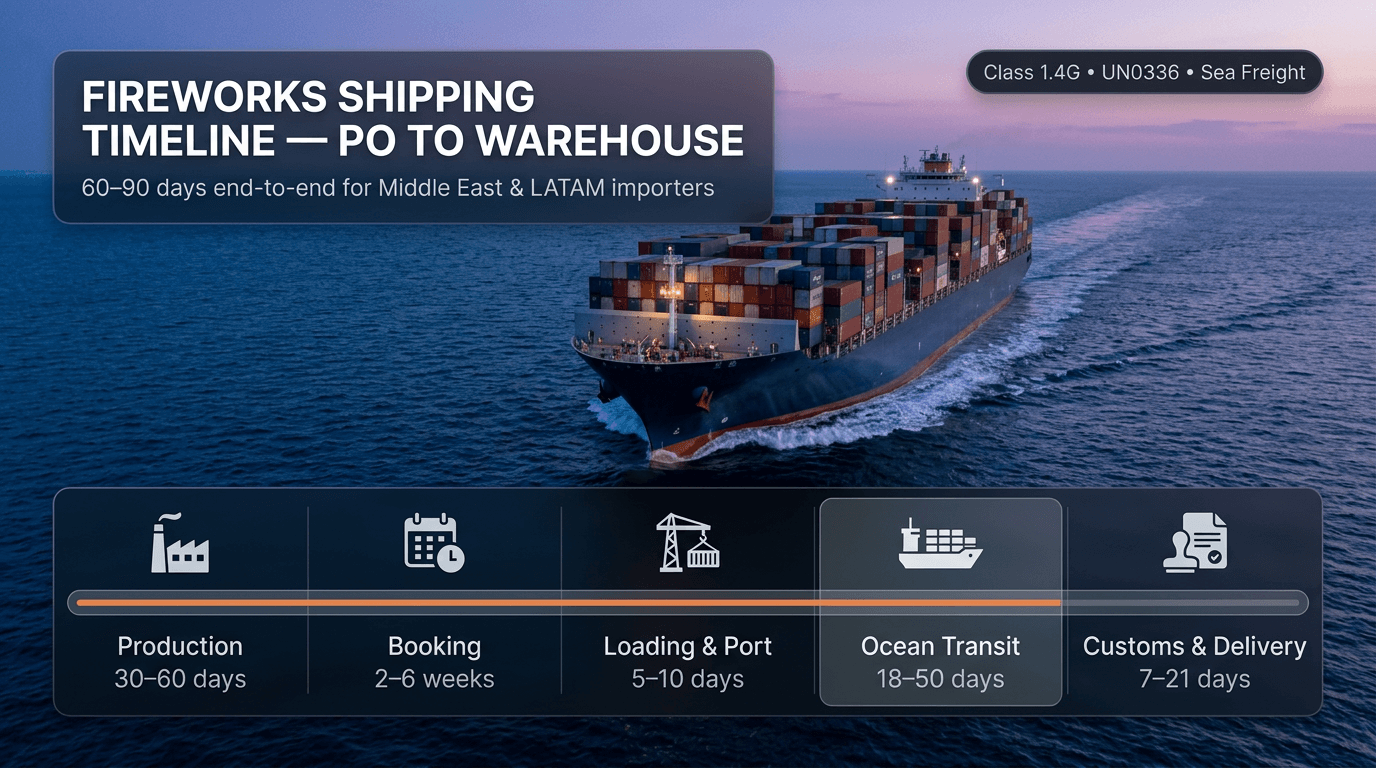
The short answer: plan for a full cycle of about 60–90 days to the Middle East and 75–110 days to Latin America, measured from order confirmation to warehouse arrival — and longer on a first shipment, when the one-off import permit adds its own lead time.
Pure ocean transit — the "ship on the water" portion — is much shorter than the full cycle. Typical sea freight transit time looks like this:
- China → Middle East (Jebel Ali, Dammam, Jeddah): 18–28 days
- China → Latin America West Coast (Manzanillo, Callao, San Antonio): 25–35 days
- China → Latin America East Coast (Santos, Buenos Aires, Veracruz): 35–50 days
But fireworks transit time is rarely the whole story. Production, booking lead time, port handling, customs clearance and inland delivery together add roughly another 45–70 days on top of the ocean leg. Real fireworks shipping time, measured from PO to warehouse, is always the bigger number.
Different regions also see different totals. A container to Jebel Ali often clears faster than one to Buenos Aires, even though the ocean gap is "only" 20 days. Route structure, carrier mix and local DG handling speed all play a role.
So when buyers ask how long does it take to ship fireworks from China, the honest answer always has two numbers — pure transit, and full cycle. Both matter. Both need planning.
Main Shipping Method and Transit Time (Sea Freight Only)
Fireworks are explosives. Under the IMDG Code, they are Class 1 dangerous goods — usually UN0336 for consumer items and UN0335 for professional display shells.
That single fact decides how fireworks move.
For commercial volumes, fireworks ship only by sea. Air freight is not a realistic option. IATA rules block most consumer fireworks from commercial flights, and the few items that might technically qualify cost many times more to fly than to sail. No serious importer ships by air.
When we talk about shipping fireworks from China, we are almost always talking about sea freight transit time China windows in full container loads.
The standard flow looks like this:
- Factory packs and seals the container in Liuyang.
- Inland truck moves it to Huangpu Old Port, Shenzhen, Shanghai or Ningbo.
- Container waits in the port DG yard until its vessel arrives.
- Ship carries it to the destination port.
- Local customs clearance and inland trucking deliver it to your warehouse.
Each stage has its own time window. The ocean transit is usually the longest single leg, but it is rarely where the surprises happen. The surprises happen on either side of the ocean — at the origin port, and at the destination port.
This is why DG shipping time planning needs a wider view than "how many days on the water".
Transit Time by Region (Middle East, Latin America & Southeast Asia)
Pure ocean transit is the most comparable number across lanes. Here are realistic ranges for a DG container leaving Liuyang-feeding ports under normal market conditions.
Middle East (UAE, Saudi Arabia)
Typical fireworks shipping time on this lane is 18–28 days of sea transit. Main destinations:
- Jebel Ali (UAE) — usually 18–24 days
- Dammam (Saudi Arabia) — usually 20–26 days
- Jeddah (Saudi Arabia) — usually 22–28 days
The Middle East has some of the shortest DG transit windows out of China. Direct services are common. DG handling in Jebel Ali in particular is mature, so port delays tend to be short.
Latin America (Mexico, Chile, Peru, Brazil, Argentina)
Latin America splits into two very different lanes.
West Coast — 25–35 days of sea transit:
- Manzanillo (Mexico) — usually 25–30 days
- Callao (Peru) — usually 28–33 days
- San Antonio / Valparaíso (Chile) — usually 30–35 days
West Coast LATAM has the advantage of Pacific crossings, but routes often transship at Busan or another Asian hub before heading east.
East Coast — 35–50 days of sea transit:
- Santos (Brazil) — usually 35–42 days
- Buenos Aires (Argentina) — usually 40–48 days
- Veracruz (Mexico, Atlantic side) — usually 38–45 days
East Coast LATAM is the longest lane by sea out of China. Most services transship through Singapore or Cartagena. Each transhipment adds 2–5 days. For Mexico, the difference between the two coasts is not only a schedule choice: the customs office of entry is one of the fields in the SEDENA import permit application, so it has to be settled before there is a vessel to book — worked through gate by gate in Manzanillo or Veracruz: choosing a Mexican port of entry.
One note on how these numbers are used elsewhere on the site. The ranges above are port-to-port sailing times on a service that runs to schedule. Our country guides and the Latin America sourcing calendar quote slightly wider bands — 25–40 days to Manzanillo, 30–45 to San Antonio, 35–50 to Santos — because a season plan has to absorb a rolled booking or a missed connection without moving the retail date. Use the tighter figures to judge whether a quoted schedule looks credible; use the wider ones when you are deciding what month to place the order.
Southeast Asia (Thailand, Malaysia, Indonesia)
Southeast Asia is the shortest DG lane out of China — most services are direct or single-transhipment through Singapore or Tanjung Pelepas, so sea transit is measured in days rather than weeks:
- Laem Chabang (Thailand) — usually 7–12 days
- Port Klang (Malaysia) — usually 5–12 days
- Tanjung Priok (Indonesia) — usually 10–14 days; Class 1 fireworks move through authorized channels only, so confirm the importer's licence and approved-consignee status before booking rather than assuming an open commercial lane.
On a lane this short the binding constraint is rarely transit time — it is Class 1 DG vessel space and destination licensing, not distance. For the market-by-market picture, see our Southeast Asia fireworks market guide.
These shipping time container China ranges hold under normal conditions. Peak season, weather and carrier changes can push every number up by 5–15%.
Red Sea Disruption and What It Really Does to China–Gulf Transit (2026)
Since late 2023, security problems near the Bab-el-Mandeb strait have pushed many carriers off their usual Red Sea and Suez Canal routings. For fireworks buyers the headlines can mislead, because the effect on a China-to-Gulf shipment is mostly indirect — and very different from the effect on a China-to-Europe one.
The part that matters for planning: a container moving from China to Jebel Ali, Dammam, Hamad or the other Persian Gulf ports does not normally pass through the Red Sea at all. The practical lane runs across the Indian Ocean and in through the Strait of Hormuz; it never needs a Bab-el-Mandeb transit. The route itself is not “blocked” by the Red Sea situation.
What the disruption does is tighten the wider market. Carriers that reroute their Asia–Europe and Asia–Mediterranean services around the Cape of Good Hope burn more vessel-days per voyage, which pulls capacity out of the global pool and firms up rates and schedules everywhere — including on Gulf lanes that never touched the Red Sea. Your Jebel Ali box still sails Indian Ocean → Hormuz; it just competes for space in a tighter market.
The one regional exception is the Saudi Red Sea coast. Jeddah and King Abdullah Port sit on the Red Sea, so they are exposed directly: services calling there may be rerouted or delayed, and that is the lane where buyers should add the most buffer. For how to weigh these gateways against each other, see our GCC fireworks import guide.
Cape of Good Hope Re-Routing: Where the Extra 14–21 Days Land
When a service is rerouted via the Cape of Good Hope instead of the Suez Canal, it adds roughly 14–21 days to that voyage. It is worth being precise about which voyages take the hit, because the answer changes how you buffer a fireworks order.
The lanes that genuinely swing by 14–21 days are the Suez-linked ones: Asia to North Europe, the Mediterranean, the US East Coast via Suez, and the Red Sea ports themselves. A shipment to Jeddah can feel the full penalty. A shipment to Jebel Ali, which was never on the Suez lane, does not add three weeks of its own routing — its exposure shows up as tighter slots and the occasional schedule slip, usually a handful of days.
For Latin America the Cape question barely applies: those lanes cross the Pacific or run via Singapore and Cartagena, away from the Red Sea entirely. So a blanket “add three weeks for the Red Sea” rule overshoots for most GCC importers. The realistic move is to confirm with your forwarder whether your specific service is Suez-routed or already on a Cape rotation, then size the buffer against that answer rather than the headline.
Port-by-Port Transit Reference: Jebel Ali, Dammam, Hamad, Sohar, Salalah and Jeddah
Different Gulf gateways carry different transit ranges and different exposure to the routing issues above. The table below is a quick reference for a normal-market DG container leaving China — useful when you are deciding which port to clear through, especially if Hormuz or Red Sea headlines are making a buyer nervous.
| Port | Approach / body of water | Typical sea transit | Red Sea exposure | Planning note |
|---|---|---|---|---|
| Jebel Ali (UAE) | Persian Gulf, via Strait of Hormuz | 18–24 days | Indirect (market capacity) | Most mature DG handling in the region |
| Dammam (Saudi Arabia) | Persian Gulf, via Hormuz | 20–26 days | Indirect | Main Saudi east-coast gateway |
| Hamad (Qatar) | Persian Gulf, via Hormuz | 21–27 days | Indirect | Qatar's primary deep-water port |
| Sohar (Oman) | Gulf of Oman, outside Hormuz | 19–25 days | None on the route | Sits outside the strait — a genuine fallback if Hormuz is in the news |
| Salalah (Oman) | Arabian Sea / Gulf of Oman, outside Hormuz | 18–24 days | None on the route | Major transhipment hub, also outside the strait |
| Jeddah (Saudi Arabia) | Red Sea, via Bab-el-Mandeb | 22–28 days (longer if Cape-rerouted) | Direct | The one regional port genuinely on the Red Sea — buffer most here |
Two patterns stand out. First, the Persian Gulf ports cluster tightly around three weeks of sea time and share the same indirect, capacity-driven exposure. Second, Sohar and Salalah both sit outside the Strait of Hormuz — Sohar on the Gulf of Oman, Salalah further south on the Arabian Sea — which is why some buyers keep them on the shortlist as a routing fallback. Jeddah is the outlier — the only major regional gateway on the Red Sea itself, and the one where the routing buffer needs to be real. The compliance and document side of choosing a gateway is covered in our Middle East shipping guide.
Full Shipping Timeline Breakdown
Ocean transit is only the middle of the story. A realistic timeline from PO to warehouse has five major stages.
Production Time (30–60 days)
Most custom orders need 30–45 days to manufacture. In peak months (April–June and September–November), and for complex mixed containers or high-SKU orders, this can reach 60 days.
Production time is usually the largest single block on the calendar.
Booking Space
DG vessel slots are limited. Not every carrier accepts Class 1 cargo on every lane. Booking 4–6 weeks ahead of sailing is the safe window during normal months.
During peak DG windows, 8–10 weeks ahead is better. Last-minute bookings usually pay the worst rates and often miss the preferred sailing.
Loading & Port Handling (5–10 days)
Once the container is packed and trucked to port, it usually waits 3–7 days in the DG yard before loading. Add 1–3 days for weighing, sealing and customs clearance at origin.
For Class 1 cargo, export documentation review is slower than for normal goods.
Ocean Transit (18–50 days)
The on-water leg, as detailed in the previous section. This is the most predictable stage once the vessel sails — weather and port calls aside.
Customs Clearance & Delivery (7–21 days)
Destination clearance is usually the second-longest stage. Fireworks need import permits, DG classification review and sometimes civil defence or army approval.
Clean paperwork clears in 3–7 days. Missing documents, HS classification disputes or random inspections can push this to 14–21 days. After clearance, 2–5 days of inland trucking reaches your warehouse.
Put together, with vessel space booked while production runs: 60–90 days for most Middle East lanes, 75–110 days for most Latin American lanes. When production, port handling, customs and the sea leg all run long together, that is about 120 days to the Middle East, about 125 to the Latin America west coast and about 140 to the east coast.
Why Fireworks Shipping Takes Longer Than Normal Goods
General cargo from China to Dubai ships in 14–18 days. General cargo to Santos ships in 28–34 days. Fireworks on the same lanes ship in 18–28 days and 35–50 days respectively.
Why the gap? Three structural reasons.
DG Restrictions
Fewer vessels accept Class 1 cargo. Each Class 1 container needs special stowage positions away from accommodation blocks and fuel tanks. When the first few DG positions on a vessel fill up, your container waits for the next sailing.
Route Limitations
Many of the fastest direct services are run by carriers that do not accept Class 1 cargo at all. DG shipments often take indirect routes via transhipment ports that add 2–5 days per hop. Your container can lose a week simply because it cannot take the shortest route.
Stricter Port Requirements
Both origin and destination ports treat fireworks differently from general cargo. DG yards have limited capacity. Inspections are more frequent. Documentation review takes longer.
All of this is part of the hazardous goods shipping time overhead — predictable, manageable, but real. The added 4–8 days are baked into every DG shipping time estimate, regardless of carrier or lane.
None of it is avoidable. It is the price of moving explosives safely across borders.
Common Causes of Shipping Delays
Even well-planned shipments can run late. For DG cargo, the risk is higher than for general goods. These are the most common causes of fireworks shipping delays.
Port Congestion
Major Chinese ports like Shanghai and Ningbo regularly run at high utilisation. During peak weeks, DG containers can wait an extra 3–7 days for a slot.
At destination ports the same thing happens — Jebel Ali during Eid, Santos during Carnival, Callao during fishing peak weeks.
Weather Disruptions
Typhoon season on the Chinese east coast runs roughly July to October. A single typhoon can close a port for 2–4 days and delay every vessel in the queue.
Hurricanes on the Gulf side of Mexico, storms on the Río de la Plata approach, and fog in the Strait of Hormuz all add smaller but real delays.
Documentation Problems
Wrong UN number on the DG declaration. Mismatched net explosive quantity (NEQ) between the packing list and the DGD. Missing classification certificate.
Any of these forces a re-submission that costs 2–5 days, sometimes more. Paperwork is the single biggest preventable cause of fireworks shipping delays.
Security Inspections
Customs and port authorities can select any DG container for physical inspection, at origin or destination. Selection is usually random. Inspections take 2–5 days on average, longer if a container needs full unpack and re-pack.
Peak Season Demand
Spring (US 4th of July), autumn (year-end festivals) and the weeks before Chinese New Year all push DG slots to their limits. Slot prices rise, and so do waiting times. Typical dangerous goods shipping duration stretches 10–25% longer in these windows.
How to Avoid Shipping Delays
You cannot remove structural delays. You can remove most of the preventable ones.
Book Early
DG vessel slots are limited. Booking 4–6 weeks ahead of sailing is the baseline. During peak months, 8–10 weeks ahead is better. The earlier you book, the more choice of sailings you have and the less pressure on documentation.
Prepare Complete Documentation
A clean DG declaration, classification certificate, MSDS, commercial invoice, packing list and import permit on the first submission saves 5–10 days per shipment.
Work with your supplier to check paperwork before the container leaves the factory, not after.
Use the Season's Sailing
For a July 4 or New Year's Eve shipment, use the deposit date and the sailing on our sourcing calendar.
Work with Experienced Teams
A generalist freight forwarder with no regular DG experience will cost you days at every stage. Working with reliable fireworks suppliers in China — and the DG-specialist forwarders they already use — gives you better carrier access, cleaner paperwork and faster port handling.
Build a Buffer
Plan for 15–20% extra time on every cycle. If your target arrival is June 1, aim for May 15. That single buffer covers most weather, inspection and congestion variability without hurting your selling window.
Efficient logistics coordination is the single biggest controllable factor in total fireworks shipping time. It is also the one buyers most often underestimate.
Why Liuyang Helps Reduce Shipping Time
Liuyang is not just the historical capital of fireworks. It is also one of the most efficient places in the world to ship them from. A few structural advantages directly shorten transit time.
- Dense supplier cluster. Most Liuyang factories sit within a small geographic area. Consolidating SKUs from multiple workshops into one container is routine, not complex. This saves 3–7 days compared with mixed-origin orders.
- Mature DG ecosystem. Local forwarders, truckers and warehouses handle Class 1 cargo every day. DG documentation is daily work here. A shipment that might take 10 days to prepare in a generalist region often clears in 5 days in Liuyang.
- Fast inland trucking. Distances from Liuyang to Huangpu Old Port, Shenzhen, Shanghai and Ningbo are predictable. DG trucking bookings rarely wait more than 2–3 days.
- Experienced container loading. Factory teams load fireworks containers every week. They know how to mix dense and light SKUs to maximise both weight and cube, which cuts the total number of containers and simplifies booking.
- Scale with carriers. Liuyang suppliers hold stronger volume positions with DG carriers, which usually translates into earlier sailing slots and more consistent transit times for their buyers.
For importers working with experienced DG handling partners, these structural advantages quietly reduce fireworks transit time every cycle. Combined with early booking and clean paperwork, they are often the difference between landing before the season and chasing it.
Transit time isn't luck. Classify right, book early, pack right, document right — and work with a team that does all four every week. The days saved compound across every container you ship.
FAQ
How long does it take to ship fireworks from China?
Typical sea freight transit time is 18–28 days to Middle East ports, 25–35 days to Latin America West Coast and 35–50 days to Latin America East Coast. Add 30–60 days for production, 5–10 days for port handling and 7–21 days for customs and delivery. Vessel space is booked while production runs, so it is not added again. Most importers should plan about 60–90 days to the Middle East and 75–110 days to Latin America from PO to warehouse arrival. When those stages all run long together, the Middle East reaches about 120 days, the Latin America west coast about 125 and the east coast about 140. A first shipment runs longer when the one-off import permit adds lead time.
Why is DG shipping slower?
Fireworks are Class 1 explosives under the IMDG Code. Fewer vessels accept Class 1 cargo, which limits sailing choices. Special stowage rules, more frequent inspections and stricter documentation review add time at both origin and destination ports. All of this is structural — it applies to every DG container, every lane.
What is the fastest way to ship fireworks?
Full container loads (FCL) by sea on direct services with a DG-specialist forwarder. Air freight is not a commercial option. Within sea freight, speed comes from booking early, choosing direct services without transhipment, using ports with mature DG handling, and submitting clean paperwork on the first attempt.
Can shipping delays be avoided?
Most preventable delays can be. Booking early, preparing full documentation, avoiding peak DG windows and working with experienced supplier and forwarder teams removes most of the delay risk. Structural delays — weather, random inspections, port congestion — cannot be removed, but can be buffered with 15–20% extra planning time on every cycle.
Does the Red Sea situation delay shipments to Jebel Ali?
Not on the route itself. A China-to-Jebel Ali container sails the Indian Ocean and enters through the Strait of Hormuz, so it does not transit the Red Sea or Bab-el-Mandeb. The disruption affects it only indirectly, by tightening global capacity. The directly exposed lane is Saudi Arabia's Red Sea coast — Jeddah and King Abdullah Port — where you should add the most buffer.
Which GCC port has the shortest transit time from China?
Jebel Ali, typically 18–24 days of sea transit, with the most mature DG handling in the region. Salalah and Sohar in Oman are similar at 18–25 days and both sit outside the Strait of Hormuz — Sohar on the Gulf of Oman, Salalah further south on the Arabian Sea. Dammam and Hamad run a few days longer.
Are Sohar and Salalah affected by the Strait of Hormuz?
No. Both Omani ports sit outside the Strait of Hormuz — Sohar on the Gulf of Oman and Salalah further south on the Arabian Sea — so a container can reach them without passing through the strait. That is why some buyers keep Sohar and Salalah on the shortlist as a routing fallback whenever Hormuz tensions are in the news.
How much buffer should I add for a Jeddah shipment in 2026?
Jeddah is the most Red Sea-exposed regional gateway, so plan conservatively. If your service is still Suez-routed, a Cape re-routing can add 14–21 days; if it is already on a Cape rotation, that time is in the schedule but reliability is better. Confirm the specific service with your forwarder and buffer against that answer.
Planning Your Next Fireworks Shipment?
If you are looking for a reliable fireworks supplier with stable shipping timelines, feel free to contact us for more details. We can share realistic end-to-end transit estimates for your specific route and volume, and help you lock in sailing slots before peak season.
WhatsApp Email