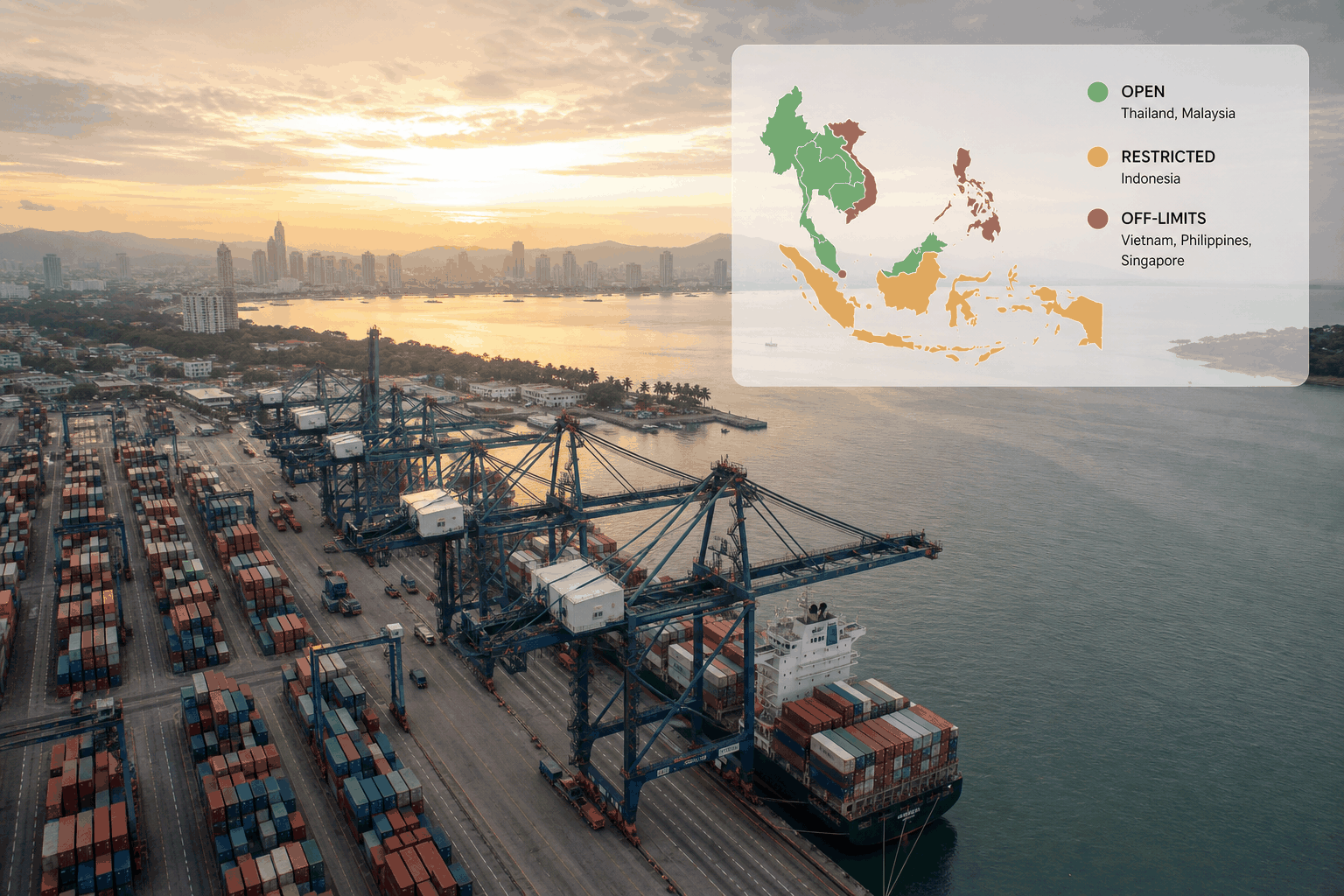
Southeast Asia looks, from a distance, like one big fireworks-loving region: Loy Krathong on the rivers of Thailand, Chinese New Year across the Malaysian peninsula, lantern festivals up and down the archipelago. Up close it is something very different — a patchwork where one country is an open, workable B2B market, the one next door is a government-only channel, and a third bans private fireworks outright.
This page is the hub. It maps which Southeast Asian markets a distributor can actually import fireworks into, who the regulator is in each, the festival windows that drive the calendar, and which countries we plainly do not recommend chasing right now — and why.
Southeast Asia Is a Patchwork of Open, Restricted and Banned Markets
For a Liuyang factory, the honest framing of Southeast Asia is this: it is geographically the closest export region we have — a container reaches the main ports in one to two weeks — but the legal map is one of the most uneven of any region we ship to. "Can we sell fireworks there?" has a different answer in almost every country, and a headline about a festival tells you nothing about whether a commercial import lane exists.
After two filters — is it legal and is it actually worth doing — two markets stand up as real B2B lanes for our current sourcing plan: Thailand and Malaysia. Indonesia is a controlled, police-authorized channel rather than an open market, worth a brief mention but not a workflow. And Vietnam, the Philippines and Singapore are, for an importer's purposes, off the map. Here is the one-page orientation; all of it should be confirmed with a local customs broker before you order.
| Market | Primary Regulator | B2B Import Status | Peak Seasons | Main DG Port |
|---|---|---|---|---|
| Thailand | Ministry of Interior / DOPA (local registrar) | Open with license | Loy Krathong (Nov), Songkran (Apr), Chinese New Year | Laem Chabang |
| Malaysia | KKDN (Home Affairs) + Royal Malaysia Police | Open via local partner | Chinese New Year, Deepavali (Oct–Nov), Hari Raya | Port Klang |
| Indonesia | Indonesian National Police (Polri) | Authorized channel only | Imlek (CNY), Independence Day (Aug) | Tanjung Priok |
Thailand — Loy Krathong, Songkran and the Region's Cleanest Legal Path
Thailand is the most straightforward commercial market in Southeast Asia, which is why it is the natural first stop for a distributor entering the region. Fireworks are openly part of the culture — Loy Krathong in November, when rivers fill with floating lanterns; Songkran in April; and Chinese New Year across the Thai-Chinese community — and a clear licensing route exists.
- Ministry of Interior — Department of Provincial Administration (DOPA) — fireworks fall under the Firearms, Ammunition, Explosives, Fireworks and Imitation Firearms Act. Importing or trading fireworks requires a license issued through DOPA via the local registrar; without it, import is prohibited.
- License before arrival — the import license must be secured before the goods arrive and presented to Customs at clearance. It is generally valid for one year from issue, and the registrar can attach storage conditions.
- Laem Chabang — Thailand's main deep-sea port and the usual discharge point for China-origin Class 1 containers; transit from China is short, on the order of one to two weeks.
The factory-side lesson is the same one that holds across every market we ship to: the license is the long-lead item, not the production. A well-planned order can usually be built and loaded to a festival schedule; what slips a Thai shipment is the import license being chased after the container is already moving. For the full season-by-season Thailand playbook — the permit layers, the Chinese-Thai New Year overlap and a backward plan from Liuyang to Loy Krathong — see our dedicated Thailand fireworks sourcing guide.
Malaysia — KKDN Approval, the Police Permit and a Chinese New Year Market
Malaysia is a real market with a heavier compliance load. The single biggest driver is Chinese New Year, followed by Deepavali (October–November) and Hari Raya — a genuinely multi-ethnic calendar that spreads demand across the year. The catch is that fireworks sit under the Explosives Act 1957, and the approval chain has more than one gate.
- KDN / Ministry of Home Affairs (MOHA) — the ministry (Kementerian Dalam Negeri, which importers also search as KKDN) controls the import and use of pyrotechnics. Importing companies and display operators must be registered and approved, and only specific permitted product types are allowed.
- Royal Malaysia Police (PDRM) — a separate permit from the police sits on top of the KKDN approval, and company members are security-screened. Customs will not release the cargo without both in place.
- Work through a local partner — foreign companies generally cannot import or run displays on their own; they operate in collaboration with a registered Malaysian pyrotechnics company. That local partner, not the factory, is usually the gatekeeper for a clean import.
For an exporter, this means Malaysia rewards the buyer who has already lined up a registered local importer before asking for a quote. For the full breakdown — the two-gate KKDN and police-permit route, what the law actually permits versus the banned firecracker, the Deepavali / Hari Raya / CNY calendar and a 120-day backward plan — see our dedicated Malaysia fireworks sourcing guide.
Indonesia — A Police-Authorized Channel Only
Indonesia comes up often because the population is huge and Imlek (Chinese New Year) and Independence Day both bring fireworks demand. But it is not an open B2B market in the way Thailand and Malaysia are, and it is important to say so plainly rather than overstate the opportunity.
Fireworks (kembang api) are controlled by the Indonesian National Police (Polri) under the 2017 police regulation on the licensing and control of commercial explosives. Import and commercial handling require prior authorization from the police, and high-explosive firecrackers are banned outright. In practice that makes Indonesia an authorized-channel market: legitimate movement runs through police-permitted entities, not a standard distributor lane. We treat it as a watch-list market — if you have a genuinely authorized Indonesian buyer we will work to their permit, but we will not pretend a casual import route exists.
Why Vietnam, the Philippines and Singapore Are Currently Off the Map
Three more countries come up in conversation, and for an importer all three fail the "can it actually be done" test today. We would rather leave them off than print a workflow that does not hold.
- Vietnam — there is no open commercial B2B import lane. Explosive firecrackers remain banned for ordinary use, and under Decree 137/2020/ND-CP (as amended) the research, production, import and supply of fireworks are reserved for enterprises under the Ministry of National Defence and the Ministry of Public Security. The non-explosive consumer fireworks that individuals may now buy must be sourced from those authorized state enterprises — not from a private importer. Public displays are state-sanctioned. That is a government-controlled channel, not a private B2B lane.
- Philippines — under Republic Act 7183 the import of finished firecrackers and fireworks is prohibited outright; only licensed local manufacturers may import raw chemicals and explosive ingredients, and the Philippine National Police enforces it. With a large domestic industry around Bulacan, there is no legal lane to import finished Chinese fireworks for resale — so for an importer it is off the map.
- Singapore — dangerous fireworks have been prohibited for decades; possession, sale and discharge are controlled under weapons and explosives law, and public displays are run by licensed operators under tight authority control. There is no open consumer or general B2B import lane.
Shipping Routes — China to Laem Chabang, Port Klang and Tanjung Priok
The one clear advantage of Southeast Asia is proximity. Fireworks move by sea — airfreight of Class 1 explosives is effectively impossible outside tiny samples — but the lanes from China are short and do not touch the Red Sea, so the Bab-el-Mandeb disruption that has stretched China–Gulf transit has no direct effect here.
- China → Laem Chabang (Thailand) — roughly 7–12 days; the main Thai gateway for China-origin Class 1 cargo.
- China → Port Klang (Malaysia) — roughly 5–12 days; the principal Malaysian port and a major regional transhipment hub.
- China → Tanjung Priok (Jakarta) — roughly 10–14 days; relevant only within Indonesia's authorized-channel framework.
Because the sea leg is short, the timeline is dominated by everything around it: factory production of about five to nine weeks, and the destination permit or police approval, which is the real long-lead item. The stage-by-stage DG-shipping mechanics — production, booking and clearance — are broken down in our shipping time guide and cost breakdown, both of which now carry the China-to-Southeast-Asia lanes (Laem Chabang, Port Klang and Tanjung Priok) alongside the Middle East and Latin America ranges.
Practical rule: Get the destination license or police permit before the factory loads the container. Under FOB Incoterms risk passes to the importer once the goods are on board the vessel at the named Chinese port — and Class 1 cargo stuck at a Southeast Asian port without valid authorization is one of the most expensive demurrage problems there is, short transit or not.
Common Southeast Asia Sourcing Mistakes
These are the errors we see most often from distributors new to the region. Any one of them can cost more than the margin on a first container.
- Reading "retail fireworks are common" as "import is easy." Fireworks being visible at a Thai festival does not mean a foreign company can import them without a DOPA license. Check the rule for your license class, not the street scene.
- Treating KKDN approval and the police permit as one step. In Malaysia they are separate gates, and Customs needs both. Skipping the police permit stalls the container at the port.
- Trying to import into Indonesia around the authorized channel. Polri authorization is the only legitimate route; a sample sent outside it risks being held or refused.
- Mistaking a Vietnam consumer enquiry for a B2B opportunity. Private companies cannot import fireworks — only authorized Ministry of National Defence or Public Security enterprises can. An enthusiastic buyer does not change the legal channel.
- Ignoring the Spring Festival collision. Chinese New Year is the peak in Malaysia and a real window in Thailand — and it lands exactly when Chinese factories slow for the same holiday. Book early or miss the season.
Frequently Asked Questions
Can we ship display fireworks to Thailand without a local import license?
No. Under Thailand's Firearms, Ammunition, Explosives, Fireworks and Imitation Firearms Act, the importer must hold an import license issued through the Ministry of Interior's Department of Provincial Administration (DOPA) before the goods arrive, and present it to Customs at clearance. It is generally valid for one year, but the application takes time — so start it before the production run, not when the container is already on the water.
How does KKDN approval interact with Malaysian customs and the police permit?
They are separate layers and you need all of them. Under the Explosives Act 1957, import requires approval from the Ministry of Home Affairs (KDN / MOHA) plus a permit from the Royal Malaysia Police (PDRM), and Customs will not release Class 1 cargo without both. Foreign companies generally cannot import on their own — they work through a registered local pyrotechnics company, so line up that partner before you quote.
Can we ship a small B2B sample to Indonesia outside the authorized channel?
We do not recommend it. In Indonesia, fireworks import is controlled by the Indonesian National Police (Polri) and requires prior police authorization; high-explosive firecrackers are banned outright. Sending product around that authorized channel risks the container being held or refused. If you have a genuinely authorized Indonesian buyer we will work to their permit — otherwise treat it as a watch-list market, not a live lane.
Why isn't Vietnam covered as an import market here?
Because there is no open commercial B2B import path in Vietnam. Explosive firecrackers remain banned for ordinary use, and under Decree 137/2020/ND-CP (as amended) research, production, import and supply of fireworks are reserved for enterprises under the Ministry of National Defence and the Ministry of Public Security. The non-explosive consumer fireworks individuals may now buy must come from those authorized state enterprises, not a private importer. That is a government-controlled channel, not a distributor lane, so we leave Vietnam off rather than imply an import route that does not exist for private buyers.
How early should we book for Loy Krathong, Deepavali or Chinese New Year?
Plan roughly 90 days of lead time before the festival, and longer on a first shipment. Southeast Asia sits close to China, so the sea leg is short — typically one to two weeks to Laem Chabang, Port Klang or Tanjung Priok — but that is the smallest part of the timeline. Factory production runs about five to nine weeks, the destination permit or police approval is the real long-lead item, and the Chinese factory slowdown around Spring Festival collides directly with Chinese New Year demand in Malaysia. Count back from the festival date, secure the permit first, and book the container early in peak season.
Continue Reading by Market
- Thailand deep dive → Thailand Fireworks Sourcing (Loy Krathong, Songkran & CNY)
- Malaysia deep dive → Malaysia Fireworks Sourcing (KKDN, Police Permit & Seasons)
- Latin America buyers → Latin America Import Hub
- Middle East / GCC buyers → GCC Import & Compliance Hub
- Distributor playbook → Distributor's Guide (costs, permits & DG shipping)
- Shipping costs → Fireworks Shipping Cost Breakdown
- Transit times → China Shipping Time & Delays
- Classification → UN Numbers & Shipping Classifications
Importing Fireworks to Southeast Asia?
Tell us your Southeast Asia market, buyer status and target shipment window. Our Liuyang team will review the permit path for Thailand, Malaysia or Indonesia, prepare the export-side document set before the container is sealed, and flag early if a market isn't a clean lane for this order.
Request a Southeast Asia Quote