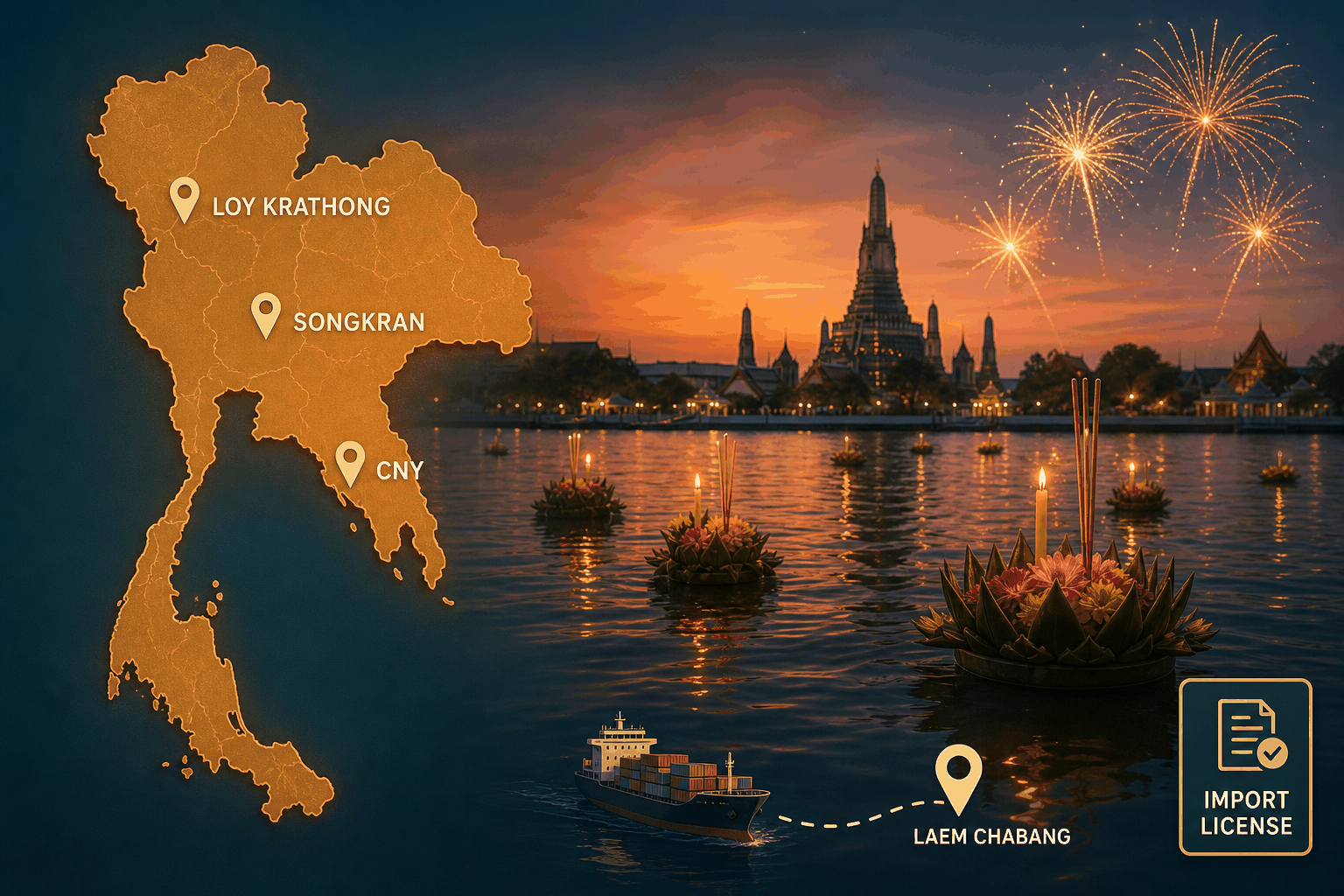
On a Loy Krathong night the rivers of Thailand glow with floating lanterns, and somewhere above the water a sheaf of sparklers and a small cake of shots go up. It looks effortless — fireworks are simply part of the Thai calendar, from the November full moon to the Songkran water festival to Chinese New Year in the Thai-Chinese community. That visibility fools a lot of first-time importers into thinking the selling is the hard part.
It isn't. For a Liuyang factory shipping into Thailand, the festival date is the one thing that never moves your timeline. What moves it is the import license. This guide lays out how Thailand actually lets fireworks in, the three seasons that drive demand, what each one buys, and a 90-day backward plan from our production line to the riverbank.
Why Thailand Is the Cleanest Fireworks Lane in Southeast Asia
Across Southeast Asia, the legal map for fireworks is a patchwork — an open market here, a government-only channel next door, an outright ban a border away. Thailand sits at the workable end of that map. Fireworks are an accepted part of public celebration, a licensing route genuinely exists, and the country is only a short sea leg from the Chinese ports that load Class 1 cargo. For a distributor entering the region, it is the natural first stop, which is exactly why we treat it as a deep-dive rather than a footnote in our Southeast Asia hub.
"Workable," though, is not the same as "casual." Thailand controls fireworks as an explosive good, the import paperwork is real, and the long-lead item is administrative, not industrial. A well-planned order can be built and loaded to a festival schedule with months to spare; what usually slips a Thai shipment is a license chased after the container is already on the water. Get that sequence right and Thailand becomes one of the more predictable markets to ship into.
Three Seasons That Drive Thai Fireworks Demand
Unlike a single-peak market, Thailand spreads demand across the year through three distinct windows. Each one leans toward a different product mix, and each one counts back to a different order date.
| Season | When (Gregorian) | What It Drives | Lead Product |
|---|---|---|---|
| Loy Krathong / Yi Peng | Full moon, 12th lunar month — 25 Nov 2026, 14 Nov 2027 | Riverbank and lantern nights, temple fairs, tourist hubs (Chiang Mai, Sukhothai, Bangkok) | Sparklers, fountains, small cakes |
| Songkran (Thai New Year) | 13–15 April (fixed) | Nationwide street celebration, the year's biggest public festival | Consumer assortments, novelties, sparklers |
| Chinese New Year | Late Jan – mid-Feb — 17 Feb 2026, 6 Feb 2027 | Thai-Chinese community — Bangkok's Yaowarat, Phuket, Hat Yai | Firecrackers (where permitted), cakes, sparklers |
The dates matter because they are not interchangeable. Loy Krathong slides earlier each year as it tracks the lunar calendar, so a plan that worked for a late-November festival can run two weeks short the following year. Songkran is fixed and easy to plan around. And Chinese New Year carries a hidden trap we will come back to: it lands at the exact moment Chinese factories slow for the same holiday.
The DOPA Import License — How Thailand Actually Lets Fireworks In
Fireworks in Thailand fall under the Firearms, Ammunition, Explosives, Fireworks and Imitation Firearms Act B.E. 2490 (1947), and they are named in it explicitly — sparklers, firecrackers and the rest are controlled goods, not general merchandise. That single fact is what separates a clean Thai shipment from a container parked in customs custody.
- Ministry of Interior — Department of Provincial Administration (DOPA). Ordering or importing fireworks requires a written import license issued through DOPA via the local registrar for the importer's locality. Without that license, import is prohibited.
- License before the goods clear. The permit must be presented to the Customs Department at clearance, and the cargo is held in customs custody until release is authorized. Once the registrar grants permission, the importer is expected to take up the license within a set window (on the order of 60 days), so the application has to be timed against the sailing, not started after arrival.
- A licensed Thai company is the importer of record. In practice a foreign exporter does not hold the Thai license; the registered local importer does. They are the party the registrar and Customs deal with, and they are the gatekeeper for a clean entry. Line that partner up before you quote.
- Storage and conditions can be attached. The registrar can place conditions on quantity and storage, so the importer's magazine or storage arrangement is part of the picture, not an afterthought.
None of this is exotic for an explosive good — it is the same shape of control we see in every serious market — but the practical takeaway is blunt: confirm the exact license class, documents and timing with a Thai customs broker or DOPA before you order, because the permit, not production, sets the critical path.
The 90-Day Backward Plan — From a Liuyang Line to a Loy Krathong Float
Working back from a festival date is the single most useful habit a Thai importer can build. The plan below is anchored to Loy Krathong on 25 November 2026; shift the same shape of timeline for Songkran or Chinese New Year. "D-" counts days before the retail window.
Two tracks have to land on the same day. The factory side — SKU, production, QC and the export document set — is the part Liuyang controls and times tightly. The importer side — the DOPA license at the Thai registrar — runs on the registrar's clock, not yours, which is why it has to open early and finish before the box arrives. The two only meet at clearance.
D-120SKU & Artwork Lock
Carton-level SKU list and retail artwork signed off (~late July); Liuyang reserves a production slot against it.
D-75Production & First-Batch QC
Production starts (~early Sept); first-batch QC on fuse burn, lift charge, composition and seal before the full run is committed.
D-50Production Complete & Packing
Run wraps (~early Oct); batch and date stamps, bilingual UN0336 1.4G labelling, packing list matched to the order.
D-35Class 1 DG Vessel Booked
Forwarder confirms a Class 1 DG slot to Laem Chabang from a DG-certified southern Chinese port (~mid Oct); DGD and Shipper's Declaration prepared.
D-20Container Sealed & Docs Issued
Sealed under DG supervision (~early Nov); full document pack (CO, MD, DGD, CIPL, batch photos) sent ahead for clearance prep.
D-100DOPA File Opened
Importer of record files the license with the local registrar (~mid Aug) — the long-lead item, opened in parallel with production, not after it. Liuyang supplies CO and Manufacturer Declaration drafts.
D-30Granted & Taken Up
Registrar grants the permission and the importer takes it up within the set window (~mid Oct).
Pre-arrivalMust Be Valid in Hand
The license has to be live before the container lands — the quiet date that decides whether the shipment clears on time.
D-0Laem Chabang Clearance & Retail Push · Loy Krathong window
Both lanes meet here: the container clears only when a valid DOPA license and a clean document pack line up. Goods break down against the carton list and the retail and temple-fair push begins.
The point of laying the two lanes side by side is that the dates which decide a Thai shipment are set months before the festival, and the license is the one piece you can't rush. So if a SKU list still isn't locked and the importer hasn't opened the DOPA file, the safer move is to start that conversation with the factory and your Thai partner in early autumn — not in October.
Product Mix for the Thai Calendar — What Each Season Actually Buys
Thai demand is overwhelmingly a 1.4G consumer story, with a smaller 1.3G display tail at temple fairs, municipal events and hotel programmes. The two usually involve different buyers and different permits, so it helps to spec them separately rather than blend one order.
Consumer Core — 1.4G (UN0336)
The bulk of Loy Krathong, Songkran and retail volume.
- Sparklers — the signature riverbank and lantern-night item (gold, silver, colour-flame)
- Cone and tube fountains for retail and venue use
- Small to mid multi-shot cakes (12–36 shots, crowd-friendly heights)
- Novelty cartons (ground spinners, snakes, party poppers, bang snaps)
- Small Roman candles and crackling balls
- Firecracker strings for Chinese New Year, where locally permitted
Display Tail — 1.3G (UN0335)
A real tail at temple fairs, municipal and hotel shows; a separate buyer and a separate permit.
- 3″ and 4″ display shells for civic and temple programmes
- Large multi-shot cakes (100+ shots) for hotel and waterfront shows
- Mid-size Roman candles for stage and hospitality use
- Comet and mine effects for choreographed sequences
One season-specific note: Loy Krathong is a water-and-light festival at heart, so sparklers and low fountains that suit a crowd at the riverbank tend to outsell big aerial product, whereas Songkran's nationwide street energy pulls a broader consumer assortment. Spec the mix to the occasion, not just the country.
Shipping China → Laem Chabang — The Short Sea Leg and Its One Catch
Proximity is Thailand's structural advantage. Fireworks move by sea — airfreight of Class 1 explosives is effectively impossible outside tiny samples — and the lane from southern China to Laem Chabang, Thailand's main deep-sea port, is short. Transit is on the order of one to two weeks, and the route does not pass through the Red Sea, so the Bab-el-Mandeb disruption that has stretched China-to-Gulf sailings has no direct effect here.
That short leg is also a trap, because it makes the rest of the timeline look more forgiving than it is. The sea time is the smallest piece: factory production runs about five to nine weeks and the import license is the real long-lead item. The day-by-day DG mechanics — booking a Class 1 slot, the declarations, port handling — are the same ones we break down in our shipping time guide and cost breakdown; the day-ranges there are quoted for other lanes, but the production, booking and clearance logic carries straight over to Thailand. For how the 1.3G and 1.4G split drives the paperwork, our UN numbers guide is the reference.
Practical rule: The DOPA license must be valid before the container reaches Laem Chabang. Under FOB Incoterms risk passes to the importer once the cargo is on board the vessel at the named Chinese port — and Class 1 cargo stuck at the quay without authorization is one of the most expensive demurrage problems there is, short transit or not.
Common Thailand Sourcing Mistakes
These are the errors we see most often from distributors new to the Thai market. Any one of them can cost more than the margin on a first container.
- Reading "fireworks are everywhere" as "import is easy." Seeing sparklers at a Loy Krathong night does not mean a foreign company can import freely. The street scene tells you nothing about the license class you need.
- Opening the DOPA file after booking the vessel. The license is the critical path, not the shipping. Start it in parallel with production, not when the container is already moving.
- Assuming the exporter holds the license. The Thai importer of record holds it. If you don't have a registered local partner lined up, you don't yet have an import lane.
- Planning Loy Krathong on last year's date. It tracks the lunar calendar and shifts every year — 25 November in 2026, but 14 November in 2027. Re-anchor the backward plan each season.
- Ignoring the Chinese New Year collision. CNY demand in Thailand lands exactly when Chinese factories slow for the same holiday. Production for a mid-February window must finish and ship before the slowdown, so order well ahead or miss it.
Frequently Asked Questions
Can a foreign company import fireworks into Thailand without a local license?
No. Under the Firearms, Ammunition, Explosives, Fireworks and Imitation Firearms Act B.E. 2490 (1947), importing or trading fireworks requires a license issued through the Ministry of Interior's Department of Provincial Administration (DOPA) via the local registrar. The license must be in place before the goods clear Customs, and the cargo is held in customs custody until release is authorized. In practice you import with a licensed Thai company as the importer of record, so line that partner up before you order.
When is Loy Krathong, and how far ahead should we order for it?
Loy Krathong falls on the full moon of the 12th Thai lunar month — 25 November in 2026, 14 November in 2027 and 2 November in 2028. Plan roughly 90 days of lead time, and longer on a first shipment. The sea leg to Laem Chabang is short, about one to two weeks, but factory production runs around five to nine weeks and the DOPA license is the real long-lead item. Count back from the festival date and open the license file first.
Which Thai season sells display shells versus consumer fireworks?
Loy Krathong and Songkran are dominated by 1.4G consumer product — sparklers, fountains, small cakes and novelties. The 1.3G display tail (3-inch and 4-inch shells, large multi-shot cakes) is driven by temple fairs, municipal events and hotel programmes, and usually involves a different buyer and a separate display permit. Chinese New Year across the Thai-Chinese community leans toward firecrackers and cakes where locally permitted.
Why does Chinese New Year make the Thai timeline tighter?
Because the Chinese factory slowdown around Spring Festival lands at the same time as Chinese New Year demand in Thailand. Production for a mid-February retail window has to be finished and shipped before Chinese factories wind down for the holiday, so the practical order date is well before the New Year itself. Booking late means competing for both production slots and Class 1 vessel space at the busiest time of the year.
Which port handles fireworks from China, and how long is transit?
Laem Chabang is Thailand's main deep-sea port and the usual discharge point for China-origin Class 1 containers. Transit from southern Chinese DG ports is short — on the order of one to two weeks — and the lane does not pass through the Red Sea, so the Bab-el-Mandeb disruption that has stretched China-to-Gulf sailings has no direct effect here. The catch is that the import license must be valid before the container arrives, because Class 1 cargo sitting at the port without authorization is an expensive demurrage problem.
Continue Reading by Market
- Region overview → Southeast Asia Fireworks Markets Hub
- Distributor playbook → Distributor's Guide (costs, permits & DG shipping)
- Transit times → China Shipping Time & Delays
- Shipping costs → Fireworks Shipping Cost Breakdown
- Classification → UN Numbers & Shipping Classifications
Sourcing Fireworks for the Thai Season?
Tell us your target festival, importer status and shipment window. We can help map the production schedule and export-side documents around your Thai importer's DOPA timeline.
Request a Thailand Quote