
Latin America is not the Gulf. It is a smaller share of the fireworks Liuyang ships every year, and the regulators speak Portuguese and Spanish instead of Arabic. But for a handful of countries the demand is real, the buyers are commercial, and the paperwork is workable — if you treat each country as its own market rather than one region.
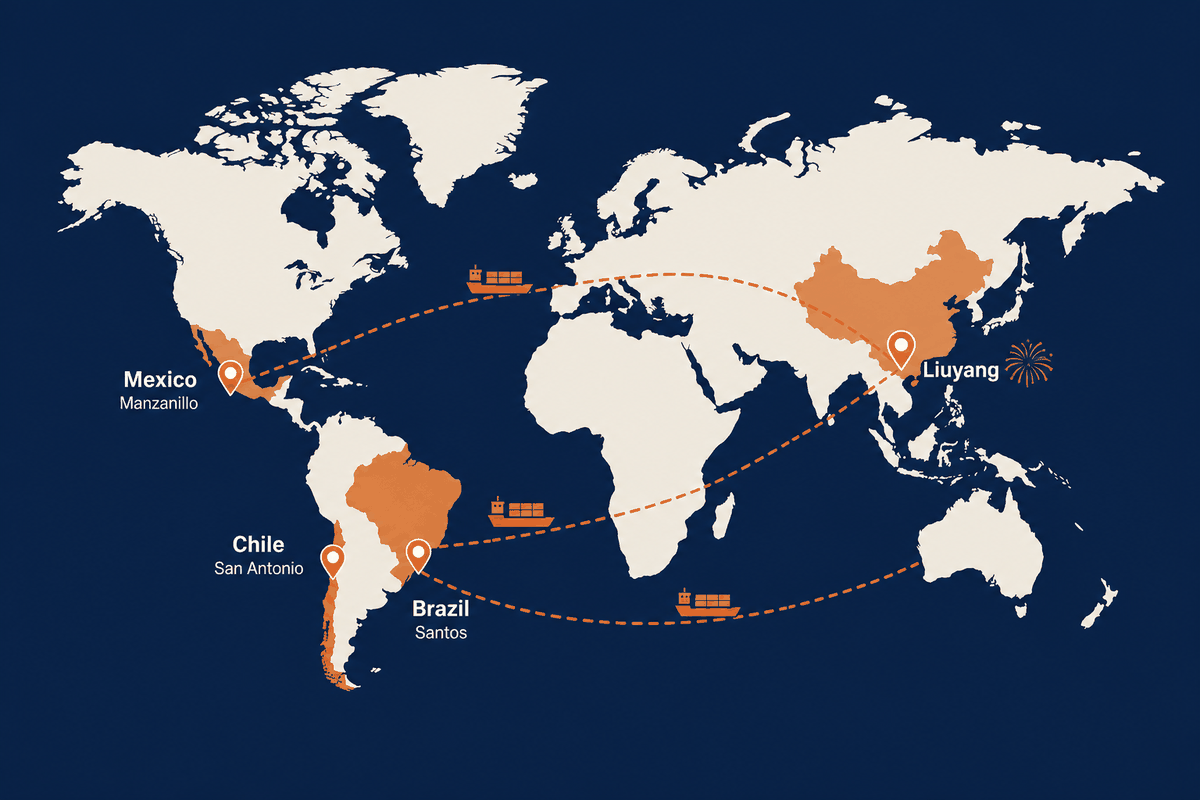
This page is the hub. It maps how to import fireworks to Brazil, Chile and Mexico, who the regulator is in each, which port your container should land at, and the festival windows that drive the buying calendar. It also says plainly which Latin American markets we do not recommend chasing right now — and why.
Why Latin America Is a Second-Tier but Real Market for Liuyang
The scale is worth stating plainly: across a typical year, the Gulf and the established US, UK and EU lanes move more Liuyang product than all of Latin America combined. Latin America is a second-tier region for us by volume, and pretending otherwise would not help a buyer plan.
What makes it worth a dedicated guide is that the demand is genuine and the buyers are real B2B distributors, not one-off consumers. We already ship to distributors in Chile and Mexico, and Brazil has long been one of the largest fireworks consumers in the southern hemisphere thanks to Réveillon and Carnaval. The difficulty is not finding demand — it is the fragmented, country-by-country regulation that scares off forwarders who only know the Gulf.
One distinction matters more than any other in this region: consumer restriction is not the same as a B2B ban. Several Latin American countries restrict or ban fireworks for individuals while still allowing registered commercial importers and licensed display companies to operate. Reading "fireworks banned" in a news headline and concluding the market is closed is a common and costly mistake we see from new entrants here.
The Three Core Markets — Brazil, Chile, Mexico at a Glance
A one-page orientation for procurement managers. Entries reflect typical 2026 practice for Class 1.4G consumer fireworks in Brazil and Mexico; 1.3G display shipments add a layer of specialist licensing in every market. Chile is the exception and should be read as a display market throughout, because public sale is prohibited there and only the display group may be imported. Always confirm the current detail with your local customs broker before you order.
| Country | Primary Regulator | Main DG Port | Peak Seasons | Transit from China |
|---|---|---|---|---|
| Brazil | Exército (Army) + Receita Federal | Santos | Réveillon (Dec 31), Carnaval (Feb–Mar) | 35–50 days |
| Chile | DGMN | San Antonio | Fiestas Patrias (Sep 18), New Year | 30–45 days |
| Mexico | SEDENA | Manzanillo | Independencia (Sep 16), Día de Muertos (Nov 1–2) | 25–40 days |
Brazil — Carnaval, Réveillon and the Import-Duty Reality
Brazil is the largest fireworks consumer in South America. Réveillon — New Year's Eve on Copacabana and on beaches and waterfronts across the country — is the biggest pyrotechnic night of the Brazilian year, followed by Carnaval in February or March. Demand is real and recurring. The complication is regulatory and fiscal, not commercial.
- Exército Brasileiro (Brazilian Army) — controls explosives and pyrotechnics through its Produtos Controlados system. The Brazilian importer must hold the Army registration (Certificado de Registro) as an authorised dealer in controlled products before any shipment moves. The per-shipment DFPC authorisation (typically CII) must be in hand before the goods are loaded abroad.
- Receita Federal (Federal Revenue / Customs) — final import clearance under NCM 3604.10 (the Mercosur tariff code for fireworks).
- Trade-remedy and tariff exposure under NCM 3604.10 — fireworks under this code have repeatedly been the subject of Brazilian trade-remedy review, and depending on the current ruling an anti-dumping or additional import tariff can apply to Chinese-origin product. Treat this as a cost to verify, not a ban: confirm the duty position that applies on your shipment date with your Brazilian customs broker (despachante aduaneiro) before you order, because it can change the landed economics of a container materially.
The practical lesson from the factory side: Brazil is open for business, but the buyer who quotes without checking the current duty position discovers the gap at clearance, when it is too late to re-price. Better to confirm it before the production run starts. For the full Brazil playbook — Réveillon and Carnaval timing, the Army registration and a backward production plan from Liuyang — see our Brazil fireworks sourcing guide.
Chile — DGMN, Polvorista Registration and San Antonio Port
Chile is one of our established Latin American lanes. Chile prohibits its two consumer fireworks groups outright, leaving only the professional display group — which leads casual observers to assume the market is closed. It is not: registered commercial and display operators import that group legally, and that is exactly the kind of buyer we work with.
- Dirección General de Movilización Nacional (DGMN) — the military-affiliated authority that controls all explosives and pyrotechnics in Chile. The importer must be registered as an authorised polvorista or pyrotechnics company, and each shipment needs its own import authorisation.
- The 31 March renewal — entries in the national register run annually and are renewed each 31 March. A lapsed registration cannot be authorised for anything, so a September season can be lost in March; see the sourcing calendar for where that sits in a backward plan.
- San Antonio — the main DG-capable port for China-origin containers; Valparaíso handles limited dangerous-goods cargo.
- Transit and timing — roughly 30–45 days China to San Antonio, so the early-spring Fiestas Patrias window (September 18) and the New Year need the order placed months ahead.
For the full Chile playbook — where the consumer-restriction-vs-commercial-legality line actually sits, how to become a registered polvorista, the per-shipment import authorisation and a backward plan from Liuyang to Fiestas Patrias — see our Chile DGMN & polvorista import guide. What happens after the goods land — how the three product groups are defined, what a municipal tender actually buys, and the permit file that decides whether a show fires — is in the companion guide to supplying Chile's display market.
Mexico — SEDENA, Día de Muertos / Independencia and Manzanillo Port
Mexico has one of the deepest fireworks cultures in the Americas, anchored in the pyrotechnics town of Tultepec. For an importer, the key fact is that explosives and pyrotechnics are regulated nationally by the armed forces, not a civilian agency.
- SEDENA (Secretaría de la Defensa Nacional) — regulates the import of explosives and pyrotechnic articles. The importer must hold an active SEDENA permit (permiso general) as an importer of pyrotechnic articles.
- Manzanillo (Pacific) — the usual discharge port for containers arriving from China; Veracruz on the Gulf side is the alternative. The entry customs office is a field in the SEDENA import permit application rather than a booking choice, so the two are weighed in our Manzanillo vs Veracruz port decision guide.
- Seasons — Independencia (September 15–16), Día de Muertos (November 1–2), the year-end period, and regionally Cinco de Mayo (May 5, strongest in Puebla and among Mexican communities in the US). Retail buying is usually planned as the three autumn-to-December windows, with Cinco de Mayo bought on a separate earlier cycle. One container often serves more than one window, so the SKU mix is broader than a single-season buy — and it has to be built alongside a large domestic industry, which our Mexican assortment guide works through line by line.
As in Brazil and Chile, treat the SEDENA permit as the long-lead item. The factory can build and load on schedule; what slips a Mexican shipment is almost always the permit being chased after production instead of before it. For the full Mexico playbook — how SEDENA regulates Class 1 imports, the permiso general and import permits, Manzanillo clearance and a backward plan across Independencia, Día de Muertos and Cinco de Mayo — see our Mexico SEDENA & Día de Muertos sourcing guide.
The Three Regulators Compared — Army, DGMN and SEDENA
Read across the three core markets and one thing stands out: in every one of them, fireworks are controlled by a military or defense-linked authority rather than a consumer-goods agency. That single fact shapes the whole import. It decides who is even allowed to be the importer, why the paperwork takes as long as it does, and why — in all three countries — the permit, not the production, is what usually determines whether a container makes its season.
| Market & Regulator | Who Can Be the Importer | Per-Shipment Step | The Long-Lead Item |
|---|---|---|---|
| Brazil — Exército (Army) + Receita Federal | A company holding Army registration (Certificado de Registro) as an authorised dealer in controlled products | DFPC per-shipment authorisation (typically CII) before load in China; Receita Federal clearance on arrival under NCM 3604.10, with the current duty position verified for that shipment | Army registration plus confirming the NCM 3604.10 duty in force |
| Chile — DGMN | A registered polvorista or pyrotechnics company | A separate import authorisation for each shipment | DGMN registration class plus the per-shipment authorisation |
| Mexico — SEDENA | A holder of the permiso general for pyrotechnic articles | An ordinary or extraordinary import permit per shipment, filed through VUCEM, with inspection at the port of entry | The standing permiso general |
The table also explains why a document set built for one market does not travel to the next. The Gulf templates that work for Saudi SABER or UAE Civil Defence map onto none of these three; even within Latin America, an Army Certificado in Brazil, a DGMN polvorista file in Chile and a SEDENA permiso general in Mexico are three different things. The common thread is sequencing, not paperwork format: in each country the authorisation is the slow part, so it has to be started before the production run, never after the container is ready. We can confirm the exact current forms and steps with you and your local broker before anything is committed.
Smaller LatAm Markets — Colombia and Peru at a Glance
Two markets come up often enough to address, but not yet enough to build a full workflow around. We flag them plainly rather than overstate the opportunity.
- Colombia — explosives and pyrotechnics are controlled through INDUMIL (Industria Militar), and several major cities have restricted or banned consumer fireworks after past injury seasons. A commercial path can exist, but it is city-sensitive and worth confirming case by case.
- Peru — SUCAMEC regulates pyrotechnics tightly, with registration and per-shipment control. Volume is modest and the compliance overhead is high relative to the size of a typical order.
For now both sit in our watch list rather than our core plan. If you have genuine commercial demand in either, contact us and we will work through the specific requirements with you.
Why Argentina Is Currently Off the Map
Argentina is a notable absence from this guide, and the reason is straightforward. Since around 2018, province- and municipal-level bans on consumer pyrotechnics — especially noise-producing items — have spread across large parts of the country, including areas in and around Buenos Aires, Santa Fe and Mendoza.
Because the restrictions are set at provincial and municipal level rather than nationally, there is no standard nationwide B2B import path we can responsibly generalize. We would rather leave Argentina off than print a workflow that may not hold in a buyer's specific province. This is the same approach we take elsewhere when a market fails the "can it actually be done" test — we say so instead of padding the page. If your case in Argentina is genuinely commercial and provincially authorised, treat it as a one-off conversation with us, not a standard lane.
Shipping Times — China to Manzanillo, San Antonio and Santos
Fireworks move by sea. Airfreight of Class 1 explosives is effectively impossible outside tiny sample shipments, and there is no overland option from China to Latin America. The good news for LatAm buyers: these lanes mostly avoid the Red Sea, so the Bab-el-Mandeb disruption that has stretched China–Gulf transit times has little direct effect on China–LatAm sailings.
- China → Manzanillo (Mexico) — roughly 25–40 days; the most regular China-origin calls of the three.
- China → San Antonio (Chile) — roughly 30–45 days.
- China → Santos (Brazil) — roughly 35–50 days, the longest of the three.
Add factory production (about 5–9 weeks) plus destination clearance and DG last-mile delivery, and a realistic plan from signed PO to goods-in-warehouse is roughly 3 to 5 months — longer on a first shipment because of the one-off permit lead time. For a head-to-head look at how the three ports differ on routing, DG handling and demurrage, see our Manzanillo vs San Antonio vs Santos clearance comparison; for lane-by-lane transit and cost detail that also applies to these routes, see our shipping time guide and the cost breakdown.
Practical rule: Get the destination permit before the factory loads the container. Under FOB Incoterms risk passes to the importer once the goods are on board the vessel at the named Chinese port — and Class 1 cargo stuck at a Latin American discharge port without a valid import permit is one of the most expensive demurrage problems there is.
China to Latin America: How a Shipment Actually Moves
It helps to picture the order as two tracks running side by side — one in our factory, one in the importer's compliance file — that have to meet at the destination port on the same day. When they meet, clearance is routine. When the compliance track runs late, the cargo sits on the quay and the demurrage clock starts.
- Lock the market and the season (about 3–5 months out). Decide which country, which window (Réveillon, Carnaval, Fiestas Patrias, Independencia or Día de Muertos) and roughly what volume, then plan backward from the on-shelf date. Our Latin America sourcing calendar sets out the four freeze points and the order and sailing month for each window.
- Importer secures the local authorisation. Army registration in Brazil, DGMN registration in Chile or the SEDENA permiso general in Mexico — plus the per-shipment import permit where the country requires one. This is the long pole; on a first shipment it can outrun production.
- Factory production (about 5–9 weeks). We build the SKU mix once the order is firm; a single Mexican or Brazilian container often covers more than one season, so the mix is usually broader than a single-window buy.
- Classification and documents. Correct UN classification — UN0335 for 1.3G display, UN0336 for 1.4G consumer — with the packing, net explosive quantity and DG declaration matched to the destination regulator's expectations.
- Book the Class 1 space early. Dangerous-goods slots are limited; in peak season they need booking roughly 6–8 weeks ahead, well before the boxes are sealed.
- Sailing (about 25–50 days). Manzanillo is the shortest of the three lanes, Santos the longest; these Pacific and Atlantic routes mostly avoid the Red Sea.
- Destination clearance. The import permit and Class 1 paperwork must be in hand before the vessel arrives; in Mexico, SEDENA inspection happens at the port of entry.
- DG last-mile. Final delivery to a licensed magazine or store, not an ordinary warehouse.
What It Costs to Land a Container in Latin America
There is no single landed-cost figure we can publish, because it depends on your SKU mix, the destination and the duty position on the day. What we can do is name every line so nothing surprises you at clearance:
- FOB factory price — the product itself, ex Liuyang. Ask us for a quote on your specific mix.
- Sea freight plus the Class 1 DG surcharge — explosives carry a premium over general cargo, and DG space is rationed in peak season.
- Import duty and taxes — destination-specific. Chile and Mexico are relatively predictable. Brazil is the line to watch: fireworks under NCM 3604.10 can carry an anti-dumping or additional tariff on top of the ordinary import duty. There is no permanent anti-dumping figure to quote — it is a position that changes with each trade-remedy review — so confirm what applies on your shipment date with the despachante.
- Permit and broker fees — the local authorisation, customs brokerage and any inspection costs.
- Demurrage — the avoidable line. It is driven almost entirely by whether the permit is in hand when the box arrives.
The honest summary: in Mexico and Chile, freight and the permit timeline are the variables that matter most; in Brazil, the duty position can move the landed cost more than freight does. Build it into the quote the same way you build in shipping, and verify it before you commit to a buyer's price.
Common Latin America Sourcing Mistakes
These are the errors we see most often from distributors new to the region. Any one of them can cost more than the margin on a first container.
- Reading a consumer ban as a B2B ban. Restricting fireworks for individuals does not mean a registered commercial importer cannot operate. Check the rule that applies to your licence class, not the headline.
- Quoting Brazil without checking import duties. Pricing a Brazilian deal on FOB plus freight alone — without verifying whether an anti-dumping or extra tariff currently applies under NCM 3604.10 — can wipe out the margin when it surfaces at clearance.
- Forcing a Gulf document set onto a LatAm shipment. SABER and Civil Defence templates do not map onto Army registration in Brazil, DGMN in Chile or SEDENA in Mexico. Build the document set for the destination regulator.
- Chasing the permit after production. The permit is the long-lead item in every LatAm market. Start it before the production run, not when the container is ready.
- Underestimating seasonal lead time. Réveillon, Carnaval, Independencia and Día de Muertos all need the order placed months ahead — and they can collide with the Chinese factory slowdown around Spring Festival.
- Trying to split one container across countries. One container clears to one importer in one country. Plan a separate FCL per destination.
Frequently Asked Questions
Does an anti-dumping duty apply to Chinese fireworks imported into Brazil?
It can, so verify it before you quote. Fireworks under NCM 3604.10 have repeatedly been subject to Brazilian trade-remedy review, and depending on the current ruling an anti-dumping or extra import tariff may apply to Chinese-origin product. Treat it as a cost to confirm, not a ban: ask your Brazilian broker (despachante) for the duty position on your shipment date before you order. You still need Army importer registration and a clean Class 1 document set.
Can we consolidate Brazil, Chile and Mexico stock in one container?
No. Each country clears against its own importer of record, its own permit (Army registration in Brazil, DGMN in Chile, SEDENA in Mexico) and its own port. One container goes to one importer in one country. If you sell in more than one LatAm market, plan a separate full container load per destination.
Why isn't Argentina covered in this guide?
Province- and municipal-level bans on consumer pyrotechnics have spread across Argentina since around 2018, so there is no standard nationwide B2B path we can responsibly generalize. Rather than print a workflow that may not hold in your province, we leave it off. If your case is genuinely commercial and provincially authorised, contact us and we will look at it case by case.
How much does it cost to import a container of fireworks into Brazil, Chile or Mexico?
There is no single number, because the landed cost is a stack: the FOB factory price, sea freight plus the Class 1 dangerous-goods surcharge, destination import duty and taxes, permit and broker fees, and any demurrage if the box waits. The line that varies most is duty. Mexico and Chile are relatively predictable; Brazil is the one to price carefully, because fireworks under NCM 3604.10 can carry an anti-dumping or additional tariff on top of the ordinary duty — and that can move the landed cost more than freight does. Ask us for an FOB quote on your SKU mix, then confirm the destination duty with your local broker before you commit to a buyer's price.
Do I need my own import license, or can the Liuyang factory import for me?
The importer of record has to be a company in the destination country holding the local authorisation — Army registration in Brazil, a DGMN polvorista registration in Chile, the SEDENA permiso general in Mexico. A Chinese factory cannot be the importer into those markets. What we handle is the export side: correct UN classification, the Class 1 document set and packing that matches what the destination regulator expects. If you do not yet hold the local permit, that is the first thing to start, because it is the long-lead item.
How far ahead should we place the order for Réveillon, Carnaval or Día de Muertos?
Plan backward from the season and allow three to five months from signed PO to goods in the warehouse — longer on a first shipment, because the one-off permit lead time stacks on top. Production runs about five to nine weeks, the sea leg is roughly 25–50 days depending on port, and clearance plus DG delivery still come after that. Booking late also collides with the Chinese factory slowdown around Spring Festival, which lands right before Carnaval — the Réveillon leg sails earlier and is usually clear of it.
Can a US or European importer ship fireworks on to Mexico or Brazil under their own paperwork?
No. Each Latin American market clears against its own importer of record and its own permit, and one container is consigned to one importer in one country. A US or EU company can be the commercial buyer and arrange the order, but the goods have to enter Brazil, Chile or Mexico through a locally registered importer with the right authorisation. Plan a separate full container load per destination rather than routing one shipment through another country's paperwork.
Continue Reading by Market
- Latin America buyers → Latin America Import Hub (this page)
- Brazil deep dive → Réveillon & Carnaval Sourcing Guide
- Chile deep dive → DGMN & Polvorista Import Guide
- Chile display side → Supplying Chile's Display Market (group 3, tenders and the show permit)
- Mexico deep dive → SEDENA & Día de Muertos Import Guide
- Mexico assortment → Building a Mexican Mixed Container (what to import next to a large hand-built domestic industry)
- Labels & box marks → Spanish & Portuguese Fireworks Labels (what changes per country, and who signs the artwork off)
- Port comparison → Manzanillo vs San Antonio vs Santos Clearance Guide
- Mexico port choice → Manzanillo or Veracruz: Choosing a Mexican Port of Entry
- Timing → Latin America Fireworks Sourcing Calendar (order and sailing months for all six windows)
- Distributor playbook → Distributor's Guide for ME & LATAM
- Middle East / GCC buyers → GCC Import & Compliance Hub
- Southeast Asia buyers → Southeast Asia Markets Hub
- US / UK / EU first-time buyers → Beginner's Guide for US, UK & EU
- Shipping costs → Fireworks Shipping Cost Breakdown
- Transit times → Fireworks Shipping Time & Transit Delays
- Classification → UN Numbers & Shipping Classifications
Importing Fireworks to Latin America?
Tell us your Latin American market and target season. Our Liuyang team will review the permit path for Brazil, Chile or Mexico, prepare the export-side document set before the container is sealed, and flag early if the timing doesn't work for this order.
WhatsApp Email