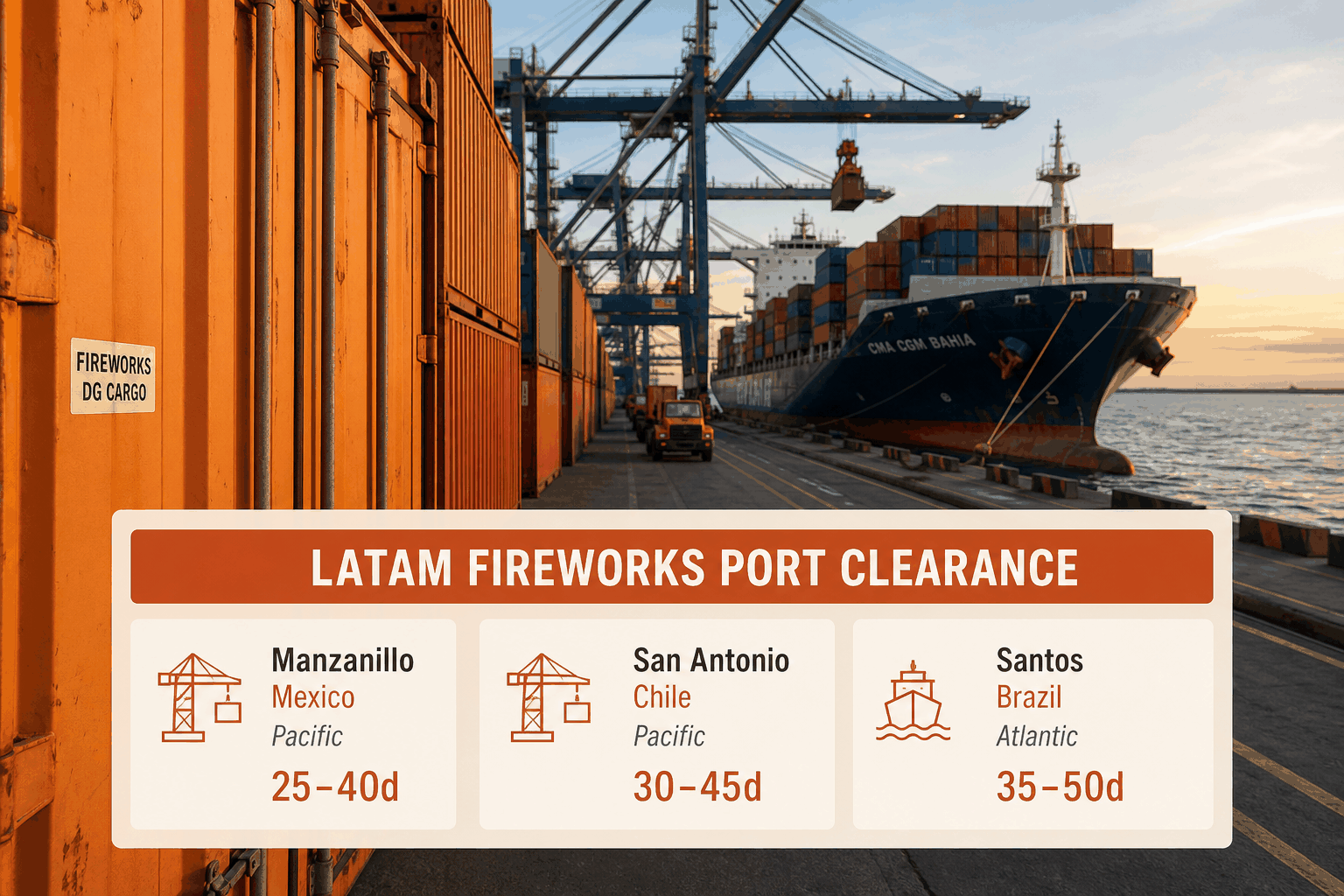
Three countries, three ports, two oceans. When a distributor asks us which Latin American port is best for clearing fireworks from China, the honest answer is that the port is rarely the variable that matters — the regulator behind the quay is. Manzanillo in Mexico, San Antonio in Chile and Santos in Brazil are the three default dangerous-goods gateways for the lanes we ship most, and each sits in front of a different national gate.
For buyers weighing more than one Latin American lane, this comparison puts the three side by side from the Liuyang side: ocean routing and transit time, dangerous-goods handling, demurrage and Class 1 storage limits, and the permit gate at each — SEDENA, the DGMN and Brazil's Army with Receita Federal. The aim is not to crown one winner, but to show why you ship to the port that serves your buyer's market, and where the real risk lives once the box is at the quay.
Why the Port Is the Last Mile, Not the Decision
It is tempting to treat the port as a choice — pick the fastest or cheapest and route everything through it. For fireworks that instinct is misleading. A Class 1 container clears into the country whose regulator issued the permit, so a Mexican buyer's cargo lands at a Mexican port, a Chilean buyer's at a Chilean port, and a Brazilian buyer's at a Brazilian one. You are not really choosing between Manzanillo, San Antonio and Santos; you are shipping to whichever one your market sits behind.
What the comparison does tell you is what each lane costs in time and risk, and where the surprises hide. The three ports differ most in geography — two are Pacific, one is Atlantic, and that alone swings transit by up to three weeks. They differ less in how they handle dangerous goods at the quay, because the binding constraint everywhere is the same: limited Class 1 storage and a fast demurrage clock. And the thing that actually decides whether a container clears in days or sits for weeks is identical at all three: whether the import permit and paperwork are ready before the vessel arrives.
So read this comparison as a planning tool, not a shopping list. If you supply more than one Latin American market — and many distributors do — understanding all three lanes side by side is what lets you build one production calendar that lands cleanly in each.
The Three Ports at a Glance
Here is the shape of the three lanes in one view. Transit figures are typical sea-freight ranges from China; the regulator column is the gate the container has to pass on arrival, which is covered in depth in each country guide.
| Port | Country & coast | Transit from China | Regulator at the gate |
|---|---|---|---|
| Manzanillo | Mexico — Pacific | ~25–40 days (trans-Pacific) | SEDENA (Army) permit + customs |
| San Antonio | Chile — Pacific | ~30–45 days (trans-Pacific) | DGMN polvorista + per-shipment authorisation |
| Santos | Brazil — Atlantic | ~35–50 days (Cape / Panama) | Army registration + Receita Federal |
Two things jump out. First, the transit gap: Santos is the longest core lane by a clear margin, simply because it is on the far side of the continent. Second, every gate is a controlled, defence-or-army-linked authorisation rather than an ordinary import licence — that is the family resemblance across Latin America, and the reason the permit is always the long-lead item, not the freight.
Manzanillo (Mexico) — the Pacific Workhorse
Manzanillo, on Mexico's Pacific coast, runs among the most regular China-origin container calls of any Latin American port and has mature dangerous-goods handling, which makes it the default for Class 1 fireworks bound for Mexico. Veracruz, on the Gulf side, is the usual alternative and is chosen case by case depending on the importer's location and broker, but for most Liuyang-to-Mexico sailings Manzanillo is the port forwarders are set up for. That domestic choice is a decision in its own right, because the entry customs office is named in the SEDENA permit application rather than picked at booking — see our Manzanillo vs Veracruz guide.
The gate behind the quay is the Secretaría de la Defensa Nacional (SEDENA) — the Army — which regulates explosives and pyrotechnics under the Ley Federal de Armas de Fuego y Explosivos. A commercial importer holds a permiso general as standing status and files an ordinary or extraordinary import permit through the VUCEM single window for each consignment. Mexico also applies general import duty and 16% IVA on landed goods tied to the HS 3604.10 classification, so the duty position belongs in the price before the box is built. The full step-by-step is in our Mexico SEDENA guide.
For timing, Manzanillo is roughly 25–40 days from China on a direct trans-Pacific crossing, the shortest of the three core lanes. That shorter transit gives a Mexican plan a little more slack than the Chilean or Brazilian one — but only if the SEDENA permit is already live when the vessel arrives.
San Antonio (Chile) — a Pacific DG Lane Behind a Strict Gate
San Antonio is Chile's default dangerous-goods-capable port for China-origin fireworks and runs the most regular calls; Valparaíso handles limited dangerous-goods cargo nearby and is used case by case. Like Manzanillo it sits on the Pacific, so the routing is clean and direct, but the lane is a little longer at roughly 30–45 days from China because Chile is further south.
Chile is the lane most often misread as closed. Chile prohibits its two consumer fireworks groups outright, leaving only the professional display group — which makes the market look shut from the outside. It is not: registered commercial and display operators import that group legally every year through the DGMN (Dirección General de Movilización Nacional). The key is the polvorista registration as standing status, with each individual shipment carrying its own import authorisation on top. That two-layer gate is the defining feature of the Chilean lane, and it is set out in full in our Chile DGMN & polvorista guide.
Because the per-shipment authorisation is a separate step from the standing registration, the Chilean lane rewards early, document-led planning more than most. A polvorista who treats each container's authorisation as routine is the one who ends up paying demurrage at San Antonio while the paperwork catches up.
Santos (Brazil) — the Atlantic Outlier and the Longest Lane
Santos, near São Paulo, is Brazil's default dangerous-goods-capable port for China-origin fireworks and runs the most regular calls; ports such as Itajaí or Paranaguá in the south can be used depending on the importer's location and broker. What sets Santos apart is not the quay but the geography: it is on the Atlantic side of South America, so the lane is the longest of the three at roughly 35–50 days from China, routing via the Cape of Good Hope or, on some services, the Pacific and the Panama Canal.
The gate is again army-linked: a Brazilian importer registers with the Exército (Brazilian Army) to handle controlled product, and clearance runs through Receita Federal against the NCM 3604.10 tariff code, where a trade-remedy or additional tariff may apply and should be confirmed per shipment with the importer's broker. The two seasons that drive the lane — Réveillon and Carnaval — and the duty reality are covered in our Brazil Réveillon & Carnaval sourcing guide.
The practical consequence of the longer lane is simple: a Brazilian plan has the least slack. A 35–50 day transit leaves no room for a late production start, and the Carnaval follow-on wants a November or December sailing, because anything that slips into January runs straight into the Chinese Spring Festival slowdown. On the Santos lane, booking early is not a nicety — it is the plan. Our Latin America sourcing calendar sets out how the two Brazilian seasons are usually committed as one order for exactly this reason.
Shipping to more than one of these markets? Send us the destination countries and the SKU range, and from the export-document side we will map the right port, classification and document set for each before anything is built. Talk to the Liuyang team about your Latin American lanes.
Transit and Routing Compared — Three Lanes, Two Oceans
The single biggest difference between the three ports is how the cargo gets there. Two of the lanes cross the Pacific to the western seaboard of the Americas; the third runs the long way round to the Atlantic coast. That is why a one-size schedule does not work across all three.
The headline for all three is reassuring: none of these lanes depends on the Red Sea, so the Bab-el-Mandeb disruption that has stretched and inflated China–Gulf sailings has little direct effect on the Latin American routes. The Pacific lanes to Manzanillo and San Antonio are inherently clear of it, and the Brazilian lane to Santos routes around it via the Cape or Panama. That removes the most volatile freight-risk variable of the past two years from the Latin American calculation.
It does not remove the calendar risk, which simply moves upstream to production. With the route stable, the thing most likely to derail a season is the Chinese Spring Festival slowdown, when factories pause for several weeks around Lunar New Year. An order placed too late loses its production slot before it ever loses its vessel — and on the longer Santos lane there is no transit slack to absorb that. For lane-by-lane transit detail that applies to all three, see our shipping time guide.
Demurrage and DG Storage — the Cost That Is the Same Everywhere
If geography is where the three lanes differ most, demurrage is where they are most alike. At every one of these ports, dangerous-goods storage is tightly limited and the free time on a Class 1 container is short, so demurrage runs faster than it does on general freight. A fireworks box that lands without a clean clearance path is one of the most expensive forms of delay in the trade, and the bill grows daily.
The mechanism is the same at Manzanillo, San Antonio and Santos. Clearance is assessed against the documents, so the UN number and net explosive quantity on the IMO dangerous-goods declaration have to match exactly what the import permit and customs entry describe. A mismatch — a classification that does not line up, an NEQ that does not reconcile, a permit that is not yet live — is not a paperwork detail; it is a hold, and a hold on Class 1 cargo is a storage problem within days. The classification side of that is worth getting right at source; see our explainer on UN numbers and shipping classifications, and for the end-to-end paperwork the dangerous-goods shipping process guide.
Practical rule: The port does not decide your demurrage — your readiness does. Have the import permit confirmed and the customs paperwork in motion before the factory loads the container, and make the export documents describe exactly the cargo on board. Under FOB Incoterms risk passes to the importer once the goods are on board the vessel at the named Chinese port, so a clean clearance path has to be open before the vessel sails, not arranged once it arrives. For the full landed-cost picture, see our cost breakdown.
How to Choose Your Latin American Entry Port
In practice the port follows the market, so the decision is usually made for you. The useful question is not “which port?” but “what does my market's lane demand of my calendar?” A few rules of thumb pull the comparison together:
- Selling into Mexico? Plan around Manzanillo. It is the shortest lane (25–40 days) and the most forgiving on timing, but the SEDENA permit is the long-lead item and the autumn calendar stacks two seasons close together.
- Selling into Chile? Plan around San Antonio. The lane is moderate (30–45 days), but the two-layer DGMN gate — polvorista registration plus per-shipment authorisation — means the paperwork rhythm, not the freight, sets the pace.
- Selling into Brazil? Plan around Santos with the least slack of all. The 35–50 day Atlantic lane plus the Army-and-Receita-Federal gate plus the NCM 3604.10 duty question means early booking is the whole strategy.
- Supplying more than one market? Build one backward calendar anchored to the longest lane (Santos), and run the shorter Pacific lanes inside it. Do not try to consolidate three countries through one port — each clears against its own national permit.
Seen this way, the three ports are not competitors but three doors into the same region, each with its own lock. The factory-side job is identical at all of them: classify and document the cargo correctly for the destination regulator, and get the box moving early enough that the longer lane and the slower permit both have room to breathe.
Frequently Asked Questions
Which Latin American port is best for importing fireworks from China?
There is no single best port in the abstract — the right one is decided by your destination market and the regulator behind it, not by the quay, because the Class 1 permit and customs entry are country-specific. Manzanillo serves Mexico under SEDENA, San Antonio serves Chile under the DGMN, and Santos serves Brazil under the Army and Receita Federal. That said, of the three lanes Manzanillo is the shortest and tends to be the most predictable for Class 1 cargo, with San Antonio and Santos adding transit days. So you do not really pick a port; you ship to the one that serves your buyer's country and plan its lane accordingly.
Is the port the main thing that decides how fast a fireworks container clears?
No. Across all three ports the decisive factor is readiness, not the quay. A Class 1 container clears quickly when the import permit and customs paperwork are already in hand and describe exactly the cargo on board, and it stalls when they are not. Dangerous-goods storage is tightly limited everywhere, so demurrage on Class 1 cargo runs faster than on general freight. The port sets the templates and the gate; the timing is set by whether the SEDENA, DGMN or Army release is lined up before the vessel arrives.
Do Manzanillo, San Antonio and Santos all avoid the Red Sea?
Effectively yes, for slightly different reasons. China–Manzanillo and China–San Antonio cross the Pacific and never transit the Red Sea or Bab-el-Mandeb, so the disruption that has stretched China–Gulf sailings has little direct effect on them. The China–Brazil lane to Santos mostly avoids the Red Sea too, routing via the Cape of Good Hope or the Pacific and the Panama Canal. For all three the bigger calendar risk is the Chinese Spring Festival production slowdown rather than a shipping-route one.
Can I use one regulator's paperwork across all three countries?
No. Each country runs its own gate and its own document set. Mexico's SEDENA permits, Chile's DGMN polvorista registration plus per-shipment authorisation, and Brazil's Army registration with Receita Federal clearance do not map onto one another. A Brazilian or Gulf template forced onto a Mexican or Chilean entry is a clearance risk. The export side from Liuyang — correct UN classification, NEQ, labelling and the matching document set — has to be built for the specific destination regulator from the start.
What causes demurrage on a Class 1 fireworks container, and how do I avoid it?
Demurrage builds when a container sits beyond the free time because clearance is not ready — a missing or mismatched permit, a UN number or NEQ that does not match the import authorisation, or a Class 1 storage slot that runs out before the paperwork catches up. Because dangerous-goods storage is limited and the clock runs fast, the fix is the same at all three ports: confirm the import permit is live before the production run, make the export documents describe exactly the cargo on board, and book the dangerous-goods vessel space early so the box arrives into a clearance path that is already open.
Continue Reading by Market
- Region overview → Latin America Import Hub (Brazil, Chile & Mexico)
- Timing → Latin America Fireworks Sourcing Calendar (which sailing each season needs)
- Mexico lane → Mexico SEDENA & Día de Muertos Guide
- Mexico port choice → Manzanillo or Veracruz (the entry port is named in the permit application, not at booking)
- Chile lane → Chile DGMN & Polvorista Import Guide
- Brazil lane → Brazil Réveillon & Carnaval Sourcing Guide
Sourcing Fireworks Across Latin America?
Tell us which Latin American port you clear through — Manzanillo, San Antonio or Santos. Our Liuyang team will prepare the classification, labelling and export document set before the box is sealed, so the container lands into a clearance path that is already open.
Request a Latin America Quote