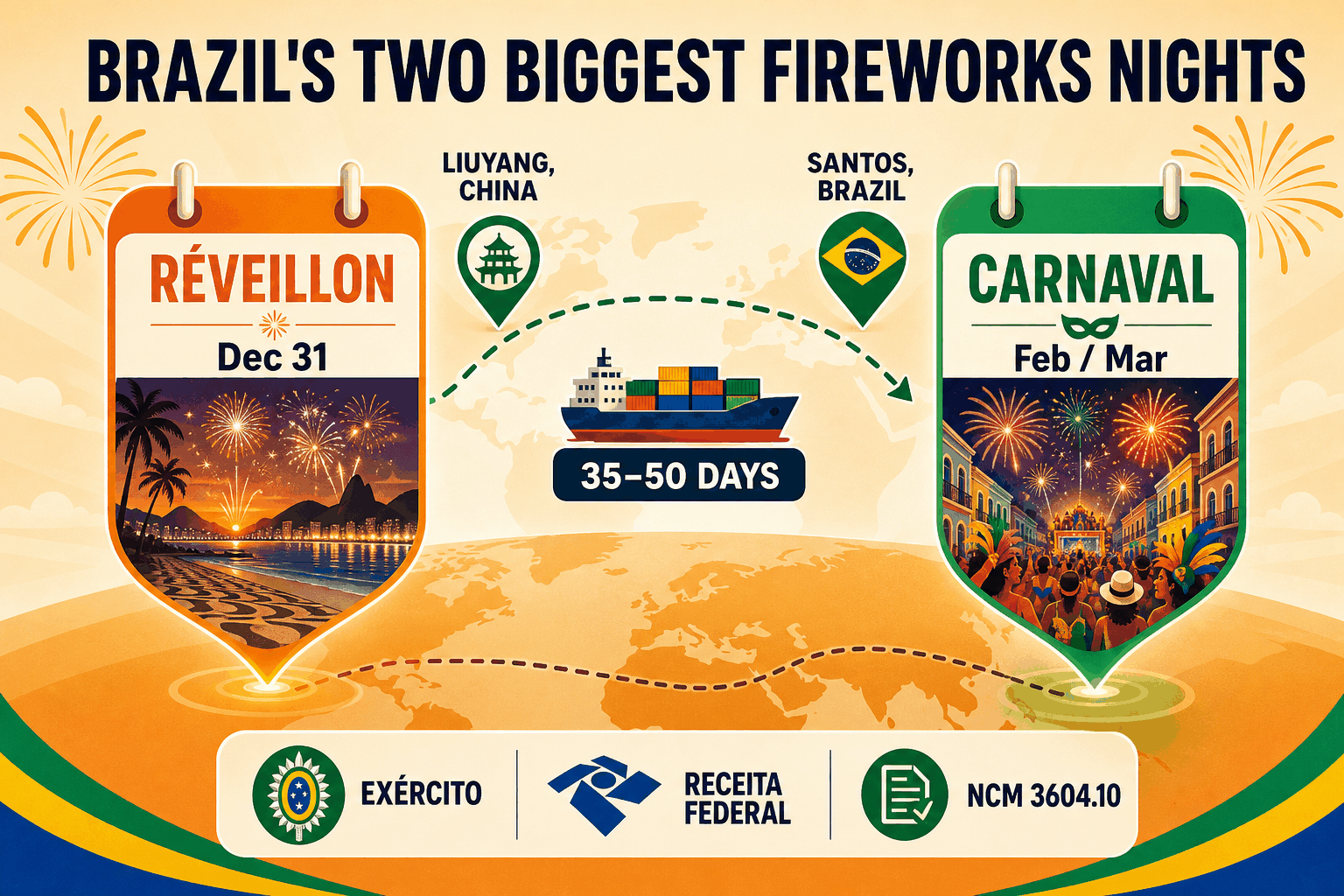
Brazil is the largest fireworks market in South America, and two nights carry most of it: Réveillon, the New Year's Eve on Copacabana and every beach and waterfront in the country, and Carnaval a few weeks later. Demand is large, recurring and culturally locked in. What stops many distributors is not the demand — it is the regulation. Fireworks are controlled products here, overseen by the Army, cleared by federal customs under a tariff code that has its own duty history.
This guide sits inside our Latin America Import Hub and walks the Brazil lane step by step from the Liuyang side: who the regulators are, what the NCM 3604.10 import-duty reality actually means for your quote, how the two seasons differ in SKU mix, what a workable backward plan looks like when Santos is 35–50 days away, and the mistakes that quietly eat a first container's margin.
Why Brazil Is South America's Biggest Fireworks Market
Brazil sits at the top tier of the region for fireworks volume. The reason is cultural rather than commercial accident. Réveillon — New Year's Eve — is one of the best-known fireworks nights in the world, with millions gathering on Copacabana in Rio and on beaches from Salvador to Florianópolis, traditionally dressed in white, to watch municipal and hotel displays open the year. Weeks later Carnaval fills the streets of Rio, Salvador and Recife/Olinda with colour and noise. Between them sit Festas Juninas in June, regional saints' days and a steady consumer trade year-round.
For a Liuyang factory, that translates into real, repeat B2B demand from established Brazilian importers and distributors — not the one-off enquiries that characterise smaller or more restricted markets. The harder part is not buyer demand; it is that the path from a Chinese loading port to a Brazilian retail shelf runs through a military controlled-products system and a customs code with its own duty story, and forwarders who only know the Gulf tend to underestimate both.
One framing matters more than any other: in Brazil the commercial import path is open and well-trodden. The work is in the paperwork and the timing, not in winning permission to sell. Get the registration, the duty position and the backward plan right, and Brazil is one of the more rewarding lanes in Latin America.
Réveillon and Carnaval — The Two Nights That Set the Calendar
Almost every Brazilian fireworks plan is built around two fixed-but-different windows. They are one purchase and two markets at the same time, and confusing which is which is the classic first-timer error: the volume is committed once, but the product mix has to answer to two quite different kinds of buying.
- Réveillon (December 31) — the single biggest night. Beachfront and waterfront displays dominate, mixing large municipal and hotel shows with heavy consumer buying for private parties. The retail build-up runs through December, so stock needs to be cleared and in the distributor's hands by late November or early December at the latest.
- Carnaval (February or March) — the date moves with the pre-Lenten calendar, typically falling in February or early March. It is more street-level and consumer-driven: colour, noise and handheld items for parades and neighbourhood celebrations rather than large set-piece beach shows.
The two are only weeks apart, which is why a single well-timed container usually has to serve both. A shipment that clears Santos in late November can stock the Réveillon shelf and carry the Carnaval range straight through, as long as the SKU mix is planned for both up front. The reason this is not merely convenient is arithmetic: by the time Réveillon sell-through tells you what Carnaval actually wants, a reorder would need production plus a 35–50 day lane, and the Chinese New Year shutdown sits in the middle of that stretch. So the Carnaval range is bought on a forecast made in the middle of the year, alongside the Réveillon range — one commitment on volume, two retail windows on mix.
Who Controls Fireworks in Brazil — the Exército and Receita Federal
Two federal bodies sit between your container and the Brazilian shelf, and they do different jobs. Understanding the split is the difference between a clean clearance and an expensive surprise at the port.
- Exército Brasileiro (Brazilian Army) — fireworks are produtos controlados, and the Army's controlled-products system governs who may import and handle them. The Brazilian importer of record must hold a valid Army registration, the Certificado de Registro (CR), as an authorised dealer in controlled products before any shipment moves. This belongs to the importer in Brazil; a Chinese factory cannot hold it on a buyer's behalf.
- Receita Federal (Federal Revenue / Customs) — handles the actual import clearance and duty assessment when the container lands, under the Mercosur tariff code for fireworks, NCM 3604.10. This is where the import-duty position is applied in practice.
The practical takeaway from the factory side: the Army registration is the long-lead, importer-side item, and it is the one most often left too late. We can build and label a container to spec on schedule, but if the Brazilian importer's CR has lapsed or does not cover the product class, the cargo has nowhere to clear to. Confirm the registration is current and appropriate before the production run, not when the vessel is already at sea.
A CR on file is not a per-shipment release. Brazil's Army (DFPC) still has to authorise the consignment — typically a Certificado Internacional de Importação (CII) — before the goods are loaded abroad; Siscomex treats the NCM 3604.10 line as non-automatic. Receita Federal at Santos is the arrival customs step, not that pre-load gate. The LatAm calendar walks the same wall; this page keeps the two-season SKU and timing picture.
Not sure your importer's paperwork lines up? Send us your Brazilian importer's product class and target retail dates and we will map the document set against the production calendar before anything is built. Talk to the Liuyang team about your Brazil shipment.
NCM 3604.10 and the Import-Duty Reality
This is the part that catches distributors who price a Brazilian deal too casually. Fireworks enter Brazil under NCM 3604.10, the Mercosur code for fireworks, and that code has a trade-remedy history that should be checked at the quoting stage.
Here is the honest version, because over-stating it is as unhelpful as ignoring it: fireworks under NCM 3604.10 have repeatedly been the subject of Brazilian trade-remedy review, and depending on the ruling in force at the time of your shipment, an anti-dumping or additional import tariff may apply to Chinese-origin product. The key word is may. This is a cost to verify, not a ban — and the figure that matters is the one in force on your shipment date, not a number quoted from a previous year.
So the rule is simple and it is procedural rather than dramatic: before you order, ask your Brazilian customs broker — the despachante aduaneiro — for the duty position that applies to NCM 3604.10 on your expected clearance date. Build that number into the landed cost the same way you build in freight. The distributors who get hurt are the ones who quote on FOB plus freight alone and discover the duty position at clearance, when the container is already in Brazil and it is far too late to re-price.
None of this makes Brazil a closed market. It makes Brazil a market where the duty line in your costing has to be a real, confirmed figure rather than an assumption. Treat it as homework done once per shipment, with the broker, and it stops being a risk.
The 150-Day Backward Plan from Liuyang to the Brazilian Retail Floor
Brazil is a long lane. Santos is 35–50 days from China by sea, longer than the Gulf, so a December 31 Réveillon floor leaves little slack if the production slot is booked late. Working backward from the retail date is the only reliable way to plan it. The milestones below are anchored to a Réveillon delivery and run across roughly five months. They are drawn to the last dates that still work rather than comfortable ones — our Latin America sourcing calendar plans the same event to a late-September sailing, which is the version with margin for a rolled booking. For Carnaval, the shipping leg can move six to ten weeks later; the commitment cannot, and stays with Réveillon.
Lock the SKU range Early August
Freeze the product list for both Réveillon and Carnaval, and confirm the Brazilian importer's Army (Exército) registration is current and covers the classes you intend to ship. This is the most schedule-critical step.
Confirm duty & place the PO Early September
Have the despachante confirm the current NCM 3604.10 duty position, build it into the landed cost, then place the purchase order and book the Liuyang production slot before Q4 demand fills the line.
Production & Portuguese labelling Early October
Production runs at Liuyang. Carton-level artwork and labelling in Portuguese are frozen now, not improvised at the port — including correct UN0336 1.4G / UN0335 1.3G classification for the cargo.
Book the Class 1 DG vessel Mid-October
Reserve dangerous-goods vessel space to Santos and assemble the full document set (commercial invoice, packing list, IMO DG declaration, B/L). DG slots for the long South America lane book out early.
Sail from China Late October
Container sails. With 35–50 days to Santos, a late-October sailing targets an early-to-mid-December arrival, ahead of the December 31 retail peak with the build-up running through the month. Treat this as the last sailing that still lands in time rather than the target: at the 50-day end of the range there is no room left for a rolled booking.
Santos clearance & Army release Mid-December
Receita Federal clearance under NCM 3604.10 plus Army release. With registration and paperwork already in hand, the box moves to the distributor for the Réveillon floor — and the Carnaval range rolls straight on.
Add it up and a realistic plan from locking the SKU range to goods-in-warehouse is roughly four to five months — longer on a first shipment because of the one-off registration and duty homework. For lane-by-lane transit and cost detail that also applies to this route, see our shipping time guide and the cost breakdown.
SKU Mix — What Réveillon and Carnaval Actually Buy
Both nights are largely a 1.4G consumer story, which is what makes a combined container practical — but the emphasis shifts between them. The Réveillon mix leans toward beachfront set-pieces and finale value; the Carnaval mix toward colour, noise and handheld street items. Larger 1.3G display product for municipal and hotel beach shows is a separate, specialist layer with its own licensing and is usually handled outside the consumer container.
Réveillon (Dec 31)
Beach & waterfront, big-finish, family + venue buying
- Multi-shot cakes & large finale assortments
- Roman candles and comet/willow effects for over-water shows
- Fountains and ground effects for venues and rooftops
- Gift/value assortment packs for private New Year parties
- Some 1.3G display product for municipal beach shows (separate licensing)
Carnaval (Feb/Mar)
Street-level, colour & noise, handheld and consumer
- Handheld and novelty items for parades and street parties
- Colour-led cakes and Roman candles over set-pieces
- Fountains, sparklers and daytime smoke/colour effects
- Firecracker and noise items where municipally permitted
- Smaller assortment packs sized for repeat consumer sale
The point of planning both at SKU lock is that the same container can carry a Réveillon-weighted front and a Carnaval-weighted tail. Decide the split in July, not when the box is already at Santos.
Santos, DG Clearance and Demurrage Risk
Santos, near São Paulo, is the default dangerous-goods-capable port for China-origin fireworks containers and runs the most regular calls. Depending on the importer's location and broker, ports such as Itajaí or Paranaguá in the south can also be used, but Santos is the one most forwarders are set up for on the China lane.
The decisive factor at the port is not the port itself — it is readiness. Class 1 cargo sitting at a Brazilian quay without the Army release and Receita Federal clearance lined up is one of the most expensive demurrage problems in the trade, because dangerous-goods storage is tightly limited and the clock runs fast. Every day of a missing document on Class 1 cargo costs more than the equivalent delay on general freight.
Practical rule: Get the Army registration confirmed and the duty position priced before the factory loads the container. Under FOB Incoterms risk passes to the importer once the goods are on board the vessel at the named Chinese port — and Class 1 cargo stuck at Santos without a clean clearance path is a demurrage bill that grows daily.
Shipping China to Santos — Transit and the Spring Festival Collision
Fireworks move by sea. Airfreight of Class 1 explosives is effectively impossible outside tiny sample shipments, and there is no overland option from China to Brazil. The good news for Brazilian buyers is that the China–Brazil lane mostly avoids the Red Sea, so the Bab-el-Mandeb disruption that has stretched China–Gulf transit has little direct effect on these sailings.
- China → Santos — roughly 35–50 days, the longest of the core Latin American lanes, routing via the Cape of Good Hope or, on some services, the Pacific and the Panama Canal.
- The Spring Festival squeeze — the bigger calendar risk here is Carnaval, not Réveillon. A Réveillon container sails in the autumn, well clear of the holiday, and a Carnaval volume ordered alongside it either rides the same box or follows on a November-to-December sailing that is also clear. What runs into the shutdown is a Carnaval reorder placed in January once Réveillon sell-through is known: production has nowhere to go and the transit no longer fits. Booking the production slot and the DG vessel early is what protects the date.
For the classification side of the document set — which UN number and hazard class your cargo travels under — see our explainer on UN numbers and shipping classifications, and for the wider end-to-end process our dangerous-goods shipping process guide.
Common Brazil Sourcing Mistakes
These are the errors we see most often from distributors new to the Brazil lane. Any one of them can cost more than the margin on a first container.
- Quoting without confirming the NCM 3604.10 duty position. Pricing on FOB plus freight alone — without checking whether an anti-dumping or extra tariff currently applies under 3604.10 — can wipe out the margin when it surfaces at clearance. Verify with the despachante before you order.
- Assuming the factory handles Army registration. The Certificado de Registro belongs to the Brazilian importer of record. It cannot be held by a Chinese exporter, and it is the long-lead item that most often slips.
- Thinking a CR is enough to load. Army registration is the importer licence. The CII (or current DFPC per-shipment authorisation) has to be in hand before the container is stuffed in China — not after the vessel reaches Santos.
- Treating Réveillon and Carnaval as one undifferentiated season. They buy different mixes and the dates move differently. Plan the SKU split at lock, and use the few-weeks gap to your advantage in one container.
- Underestimating the Santos transit and the Lunar New Year squeeze. A 35–50 day lane leaves no slack for a late start, and a Carnaval volume that was not committed with Réveillon cannot be reordered in January — the shutdown plus production plus transit take roughly twice the time available. Book the slot early.
- Leaving Portuguese labelling and artwork to the last minute. Carton-level labelling and classification should be frozen during production, not improvised at the port where it becomes a clearance risk. Brazil is a separate print run rather than a translation pass — the packaging clause and the importer name it requires are set out in our guide to Spanish and Portuguese fireworks labels.
- Splitting one container across importers or states. A container clears to one importer of record. Plan a separate full container load per importer rather than trying to divide one box at destination.
Frequently Asked Questions
Do I need to register with the Brazilian Army to import fireworks?
Yes. Fireworks are controlled products in Brazil, supervised by the Exército (Army). The Brazilian importer of record must hold a valid Army registration, the Certificado de Registro (CR), as an authorised dealer in controlled products before any shipment moves. A Chinese factory cannot hold it for you — it belongs to the importer in Brazil. A CR is not enough to load: the per-shipment CII has to be in hand before the goods are loaded abroad. Treat the CR as the long-lead item and confirm it is current before the production run.
How should I price the NCM 3604.10 duty line before quoting a Brazil container?
It can, so verify it before you quote. Fireworks under NCM 3604.10 have repeatedly been subject to Brazilian trade-remedy review, and depending on the current ruling an anti-dumping or extra import tariff may apply to Chinese-origin product. Treat it as a cost to confirm, not a ban: ask your Brazilian broker (despachante) for the duty position on your shipment date before you order, because it can change the landed economics of a container materially.
How early should I start for a Réveillon (New Year) shipment?
Plan on roughly five months back from the December 31 floor, and start earlier on a first shipment. Santos transit alone is about 35–50 days and production is another five to nine weeks, so a December 31 floor means sailing by late October at the latest — and by late September if you want margin for a rolled booking, which is the figure our Latin America sourcing calendar plans to. The Carnaval volume (February or March retail) either rides the same container or follows on a November-to-December sailing, but it has to be committed alongside Réveillon: a reorder placed once Réveillon sell-through is known runs into the Chinese New Year shutdown and cannot be produced and shipped in time. Working backward, lock the SKU range and confirm the Army registration by around late July to August.
Can one container cover both Réveillon and Carnaval?
Often yes, if you plan the SKU mix for it. Réveillon (Dec 31) and Carnaval (Feb/Mar) are only weeks apart, so a single container landing in late November or December can serve both windows. The two nights buy slightly different mixes — Réveillon leans to beachfront cakes and finale assortments, Carnaval to colour, noise and handheld items — but both are largely a 1.4G consumer story, which makes a combined buy practical.
Which Brazilian port should my fireworks land at?
Santos, near São Paulo, is the main DG-capable port for China-origin fireworks containers and runs the most regular calls. Itajaí or Paranaguá can be used depending on your importer's location and broker, but Santos is the default. Demurrage is driven by whether the DFPC authorisation (typically CII) was in hand before the box loaded in China, and whether Receita Federal clearance is ready when the vessel arrives.
Can registered importers sell consumer fireworks in Brazil?
Registered importers and distributors can sell consumer fireworks in Brazil when the Army registration, customs clearance and local rules line up. Brazil has a large, established market around Réveillon and Carnaval, but some municipalities restrict noise-producing items, so the rule in your buyer's city still matters. Treat Brazil as a workable commercial B2B lane, not a casual consumer shipment.
Continue Reading by Market
- Region overview → Latin America Import Hub (Brazil, Chile & Mexico)
- Sister market → Chile DGMN & Polvorista Import Guide
- Sister market → Mexico SEDENA & Día de Muertos Import Guide
- Port comparison → Manzanillo vs San Antonio vs Santos Clearance Guide
- Timing across the region → Latin America Fireworks Sourcing Calendar (why Réveillon and Carnaval are one commitment)
- Distributor playbook → Distributor's Guide for ME & LATAM
- Shipping times → China–LatAm Shipping Time & Delays
- Shipping costs → Fireworks Shipping Cost Breakdown
- DG process → Dangerous Goods Shipping Process
- Classification → UN Numbers & Shipping Classifications
Sourcing Fireworks for Réveillon or Carnaval?
Whether you need an Army-registration-ready document set, help pricing the NCM 3604.10 duty line before you quote, or a single container planned to cover both Brazilian seasons, our Liuyang team can help prepare it before the box is sealed. We work with distributors across more than 30 countries.
WhatsApp Email