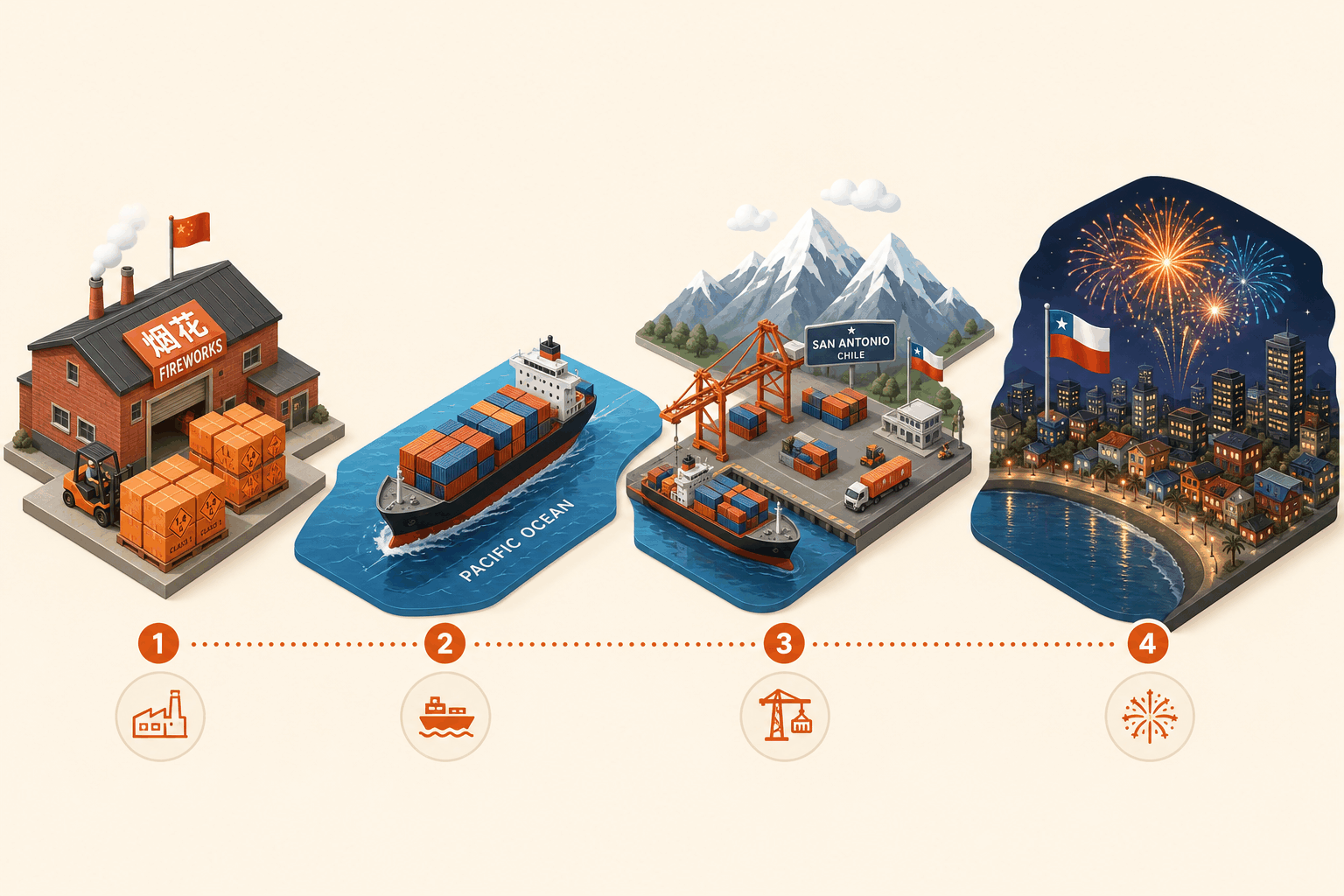
Ask most exporters about Chile and you will hear the same verdict: fireworks are banned, so the market is closed. That is half true and badly misleading. Public sale and use by individuals are indeed prohibited — but registered commercial and display operators import fireworks into Chile entirely legally, every year, for Fiestas Patrias and the New Year. The gatekeeper is the DGMN and the key that opens the lane is the polvorista registration.
This guide sits inside our Latin America Import Hub and walks the Chile lane step by step from the Liuyang side: where the line between consumer restriction and commercial legality actually sits, who the DGMN is and what the polvorista registration covers, why each shipment still needs its own authorisation, how San Antonio clearance works, and a backward plan that lands a container ahead of September 18.
Why Chile Looks Closed but Is a Real B2B Lane
Chile is one of our established Latin American lanes, and the gap between its reputation and its reality is exactly where the opportunity is. Because Chile goes further than, say, Brazil — prohibiting the two consumer groups outright rather than restricting their sale — an outside observer concludes the whole market is shut. Distributors who believe that quietly hand the lane to the few competitors who know better.
The truth is narrower and more useful. Chile restricts who may import, store, handle and set off fireworks; sale and use by the general public are prohibited, but that is not the same as a closed import market. A company registered with the national authority as an authorised pyrotechnics operator can import Class 1 cargo and supply the professional, municipal and event display work that the law permits. That is a genuine, repeat B2B lane, not a grey one — it simply runs through authorised operators rather than a consumer shelf.
For a Liuyang factory, the implication is simple: Chile is a paperwork-and-status market, not a permission-denied market. The work is in making sure the Chilean importer holds the right registration and per-shipment authorisation before the container is built. Get that right and Chile rewards the distributors willing to do the registration work, with fewer competitors than the region's fully open markets.
The Line That Matters: Consumer Restriction vs Commercial Legality
The single most important thing to understand about Chile is where the legal line falls, because almost every mistake on this lane comes from blurring it. Fireworks in Chile are governed by the country's arms and explosives control framework, administered by the military-affiliated DGMN. Under that framework the two consumer groups are prohibited outright, while the registered commercial side is open.
| What you are doing | Casual / private consumer | Registered polvorista / pyrotechnics importer |
|---|---|---|
| Buy & let off fireworks freely | Prohibited (groups 1 and 2) | Within authorised scope |
| Import a Class 1 container from China | Not available | Legal with DGMN registration + per-shipment authorisation |
| Handle group 3 display product | Not available | The only permitted group — licensed professional / display operators |
| Supply the municipal & event display market | Not available | Core of the legal commercial lane |
Read that table the right way and the strategy writes itself. The volume on this lane is in the registered commercial channel — professional display companies, event and municipal suppliers, and the authorised operators they supply. The public-sale restriction that makes Chile look closed is not a barrier to your buyer, because your buyer is a registered operator, not a member of the public. Confusing the two is what leads distributors to either walk away from a workable market or, worse, ship into it without the right status. Because much of that work arrives as public display contracts, the mechanics of buying against a tender are worth reading alongside this page: see our guide to municipal fireworks tenders, and for what happens to the goods once they are in the country — the group definitions, the purchase authorisation, the mounting clauses and the permit file that can cancel a show — our companion page on supplying Chile's display market.
DGMN — the Authority Behind Every Chilean Fireworks Import
The Dirección General de Movilización Nacional (DGMN) is the military-affiliated authority that controls all explosives and pyrotechnics in Chile. Every legal fireworks import runs through its system, and it plays a role broadly comparable to the Army's controlled-products system in Brazil or SEDENA in Mexico — the same idea of military oversight of Class 1 goods, executed Chilean-style.
From the importer's side, the DGMN does two things that matter to your shipment. First, it decides who is allowed to operate: the importer must be registered as an authorised polvorista or pyrotechnics company. Second, it controls the movement of specific cargo: individual consignments are authorised against that registration. The Chinese factory sits outside both processes — we can supply every export document, classification certificate and label the cargo correctly, but the DGMN status belongs to the importer of record in Chile.
Not sure your Chilean importer's status covers the cargo? Send us the importer's registration class and the product mix you want to ship, and we will map the export document set against it before anything is built. Talk to the Liuyang team about your Chile shipment.
Becoming a Registered Polvorista — What the Importer Has to Put in Place
The polvorista registration is the licence to operate, and it is the long-lead item on a first Chilean shipment. It is an importer-side, Chile-based process, so the detail below is the shape of what is required rather than a substitute for current DGMN guidance — confirm the exact steps and forms with the DGMN or a Chilean customs broker, because the authority updates its requirements.
One note on vocabulary, because the same status goes by several names. Polvorista is the working term for an authorised pyrotechnics operator; the regulation's own wording for the entry that lets a company trade display product is Comerciante de Fuegos Artificiales in the national register, and the approved store the goods must move into is an Almacén de Artificios. One authority, one register, three words you will meet in different documents — not three separate licences to obtain.
- Register the company with the DGMN. The importing entity applies to be recognised as an authorised pyrotechnics company or polvorista, establishing its legal standing to handle Class 1 goods.
- Authorised storage. Fireworks must be held in compliant, authorised magazine/storage facilities; storage approval is part of being a credible registered operator rather than an afterthought at the port.
- Qualified personnel and handling. The framework expects competent, authorised people handling explosives, in line with the professional nature of the licence.
- Keep the registration current and matched to the product class. A registration that has lapsed, or that does not cover the classes you intend to ship, is the single most common reason a Chilean shipment cannot clear.
- Renew it by 31 March each year. Entries in the national register run on an annual cycle with a 31 March renewal date. It is the one hard administrative date in the Chilean fireworks year that has nothing to do with a festival, and it sits months before the September season that depends on it.
That renewal date deserves a place in the buyer's calendar rather than only the importer's. An importer whose registration has lapsed is not a slow importer; they are an importer who cannot be authorised at all, at any point in the year, which means a September arrival can be lost in March without anyone noticing until the authorisation is refused. The factory-side rule is the one that applies across Latin America: confirm the importer's DGMN registration is live and appropriate before the production run, not when the vessel is already at sea. Our Latin America sourcing calendar sets out how that March date lands in a backward plan for Fiestas Patrias.
Per-Shipment Import Authorisation — the Step the Licence Doesn't Replace
A frequent and expensive misunderstanding is that the polvorista registration alone clears a container. It does not. The registration is your standing permission to operate; each individual shipment still generally needs its own import authorisation tied to that registration, covering the specific cargo, classification and quantity arriving.
Think of it as two locks on the same door. The DGMN registration says this company is allowed to import fireworks; the per-shipment authorisation says this container, with this product and this NEQ, is allowed to land now. Both have to be open before the box arrives at San Antonio. The right UN classification and net explosive quantity on the paperwork is what the authorisation is assessed against, which is why the export documents and the destination authorisation have to describe exactly the same cargo — for the classification side of that, see our explainer on UN numbers and shipping classifications.
San Antonio and Valparaíso — DG Clearance and Demurrage Risk
San Antonio, on Chile's central Pacific coast, is the default dangerous-goods-capable port for China-origin fireworks containers and runs the most regular calls. Valparaíso, just to the north, handles limited dangerous-goods cargo and is used case by case depending on the importer's broker and the service. For most Liuyang-to-Chile sailings, San Antonio is the port forwarders are set up for on the China lane.
As everywhere with Class 1 cargo, the decisive factor at the quay is not the port — it is readiness. A fireworks container sitting at a Chilean port without its DGMN import authorisation and customs paperwork lined up is one of the most expensive forms of delay in the trade, because dangerous-goods storage is tightly limited and demurrage on Class 1 cargo runs faster than on general freight. Every day a document is missing costs more here than it would on an ordinary box.
Practical rule: Have the DGMN registration confirmed and the per-shipment authorisation in motion before the factory loads the container. Under FOB Incoterms risk passes to the importer once the goods are on board the vessel at the named Chinese port — and Class 1 cargo stranded at San Antonio without a clean clearance path is a demurrage bill that grows daily. China–San Antonio ocean freight typically runs around USD 6,000–9,000 per 20ft before any demurrage; see our cost breakdown for the full stack.
Fiestas Patrias and New Year — Chile's Buying Windows and a Backward Plan from Liuyang
Chile's fireworks calendar is anchored by two windows. Fiestas Patrias around September 18 — the national independence celebrations — is the larger of the two for display and event work, and it falls in the southern-hemisphere late winter/early spring. New Year brings the second wave, with public displays over Valparaíso bay and other cities. Both are professional-and-municipal led, which keeps the mix weighted toward display-grade product handled by authorised operators.
Fiestas Patrias (Sep 18)
National day — municipal & event display led
- Municipal and event display shells (1.3G, licensed operators)
- Multi-shot cakes and finale assortments for organised shows
- Roman candles, comets and colour effects
- Assortment packs for authorised event organisers
New Year (Dec 31)
City & bay displays — Valparaíso and beyond
- Large display shells for over-water city shows (1.3G)
- Cakes and finale racks for event organisers
- Fountains and ground effects for venues
- Smaller assortment packs for authorised operators
Every line on these lists has to be a group 3 article. A small consumer cake from our catalog can travel correctly as 1.4G and still sit in prohibited group 1 or 2, so check each line against the group definitions before the PO.
Because San Antonio is 30–45 days from China and production is another five to nine weeks, the only reliable way to hit September 18 is to work backward from it. The milestones below are anchored to a Fiestas Patrias delivery; for New Year, shift the whole plan roughly three months later.
Registration renewal deadline 31 March
The annual renewal of the national register entry. Nothing downstream can be authorised against a lapsed registration, so this date decides whether a September season is available at all — and it passes five months before anyone is thinking about Fiestas Patrias.
Confirm DGMN status & lock the SKU range Mid-April
Verify the importer's polvorista registration is current and covers the classes you intend to ship, and freeze the product list. This is the most schedule-critical step on a first shipment.
Start the import authorisation & place the PO Mid-May
Begin the per-shipment DGMN import authorisation, then place the purchase order and book the Liuyang production slot before peak demand fills the line.
Production & Spanish labelling Mid-June
Production runs at Liuyang. Carton-level artwork and Spanish labelling are frozen now — including correct UN0336 1.4G / UN0335 1.3G classification and NEQ for the cargo. The Chilean regulation lists what each layer of packaging has to carry, and names those layers in the reverse of the shipping sense; the list is in our guide to Spanish and Portuguese fireworks labels.
Book the Class 1 DG vessel Late June
Reserve dangerous-goods vessel space to San Antonio and assemble the full document set (commercial invoice, packing list, IMO DG declaration, B/L) so it matches the import authorisation exactly.
Sail from China Mid-July
Container sails trans-Pacific. With 30–45 days to San Antonio, a mid-July sailing targets a late-August to early-September arrival — ahead of the September 18 peak. Our Latin America sourcing calendar plans this one a fortnight earlier, in early July, which is the version that survives a rolled booking.
San Antonio clearance & DGMN release Early Sep
Customs clearance plus the DGMN import authorisation. With registration and paperwork already in hand, the box moves to the distributor or display operator for Fiestas Patrias.
Add it up and a realistic plan from locking the SKU range to goods-in-warehouse is roughly four to five months — longer on a first shipment because of the one-off registration work. For lane-by-lane transit detail that also applies to this route, see our shipping time guide, and for the end-to-end paperwork the dangerous-goods shipping process guide.
Shipping China to Chile — a Trans-Pacific Lane, Clear of the Red Sea
Fireworks move by sea; airfreight of Class 1 explosives is effectively impossible outside tiny samples, and there is no overland option from China to Chile. The good news for Chilean buyers is the geography: the China–Chile lane crosses the Pacific and never transits the Red Sea or Bab-el-Mandeb, so the Bab-el-Mandeb disruption that has stretched and inflated China–Gulf sailings has little direct effect on this route. San Antonio sits on Chile's Pacific coast and is reached on a direct trans-Pacific crossing rather than via Suez.
That leaves the Chinese Spring Festival production slowdown as the main calendar risk, not a shipping-route one. Factories pause for several weeks around Lunar New Year, so an order placed too late in the cycle loses its production slot before it loses its vessel. Booking the slot and the dangerous-goods space early is what protects a Fiestas Patrias or New Year date.
Common Chile Sourcing Mistakes
These are the errors we see most often from distributors new to the Chile lane. Any one of them can cost more than the margin on a first container.
- Reading the consumer prohibition as a total ban. Groups 1 and 2 are prohibited outright, but that does not close the registered commercial and display channel — group 3 is a legal market, not an exception to a ban. Treating the country as shut hands a workable lane to better-informed competitors.
- Assuming the polvorista registration clears every shipment by itself. The registration is the standing licence; each consignment still needs its own DGMN import authorisation. Both must be open before the container lands.
- Expecting the factory to hold the DGMN status. The registration and authorisation belong to the Chilean importer of record. A Chinese exporter cannot hold them, and chasing this after production is the classic schedule killer.
- Forcing a Gulf or Brazilian document set onto Chile. SABER, Civil Defence or Brazil's Army-registration templates do not map onto DGMN requirements. Build the document set for the Chilean regulator from the start.
- Underestimating the long lane and the Spring Festival squeeze. A 30–45 day trans-Pacific run plus a Lunar New Year production pause leaves no slack for a late start. Book the slot early to protect September 18.
- Mismatching classification between the export docs and the import authorisation. The UN number and NEQ on the IMO DG declaration must match what the DGMN authorisation describes; a discrepancy is a clearance risk, not a formality.
Frequently Asked Questions
Is it legal to import fireworks into Chile?
Yes, through the right channel. Chile prohibits the whole of its two consumer groups, so sale and use by the public are closed outright rather than merely restricted — which is why the market looks shut from the outside. Registered commercial and display operators still import legally. The route is to be registered with the DGMN as an authorised polvorista or pyrotechnics company, with each shipment carrying its own import authorisation. It is a controlled, professional lane — not a closed market.
Do I need a separate authorisation for each shipment, or is the DGMN registration enough?
Both. The DGMN polvorista registration is the standing status that lets you import and handle fireworks commercially. On top of that, each individual consignment generally needs its own import authorisation tied to that registration. Treat the registration as the licence to operate and the per-shipment authorisation as permission to land a specific container, and confirm the current requirements with the DGMN or your Chilean broker before booking.
Can the Chinese factory hold the DGMN licence on my behalf?
No. The DGMN registration belongs to the importer of record in Chile, not the Chinese exporter. A Liuyang factory can build, classify and label the cargo to spec and supply the full export document set, but the polvorista registration and the per-shipment authorisation are Chile-side obligations. Confirm the registration is current and covers the product class before the production run, not after the container is built.
Which Chilean port should my fireworks container land at?
San Antonio is the default DG-capable port for China-origin fireworks containers and runs the most regular calls; Valparaíso handles limited dangerous-goods cargo and is used case by case. Whichever you use, the real driver of demurrage is whether the DGMN import authorisation and Class 1 paperwork are in hand before the vessel arrives, because dangerous-goods storage is tightly limited and the clock runs fast.
How long does China-to-Chile shipping take, and does the Red Sea affect it?
Plan on roughly 30 to 45 days from China to San Antonio. The China–Chile lane crosses the Pacific and never transits the Red Sea or Bab-el-Mandeb, so the disruption that has stretched China–Gulf transit has little direct effect here. The bigger calendar risk is the Chinese Spring Festival production slowdown, which is why the production slot and the Class 1 vessel space should be booked early.
When should I start sourcing for Fiestas Patrias (September 18)?
Work back about four to five months from the event delivery date, and start earlier on a first shipment. San Antonio transit is 30–45 days and production is another five to nine weeks, so a September 18 deadline means sailing by around mid-July. Treat that as the last sailing that still lands in time rather than the target; our Latin America sourcing calendar plans the same window to early July, which is what leaves room for a rolled booking. Lock the SKU range and confirm the DGMN registration by around April to May — and check that it was renewed on 31 March, because nothing can be authorised against a lapsed registration.
Continue Reading by Market
- Next step in Chile → Supplying Chile's Display Market (group 3, municipal tenders, mounting rules and the show permit)
- Region overview → Latin America Import Hub (Brazil, Chile & Mexico)
- Sister market → Brazil Réveillon & Carnaval Sourcing Guide
- Sister market → Mexico SEDENA & Día de Muertos Import Guide
- Port comparison → Manzanillo vs San Antonio vs Santos Clearance Guide
- Timing across the region → Latin America Fireworks Sourcing Calendar (Fiestas Patrias order and sailing months)
- Distributor playbook → Distributor's Guide for ME & LATAM
- Shipping times → China–LatAm Shipping Time & Delays
- Shipping costs → Fireworks Shipping Cost Breakdown
- Classification → UN Numbers & Shipping Classifications
Sourcing Fireworks for the Chilean Market?
Whether you need a DGMN-aligned export document set, help matching your polvorista registration class to a product mix, or a container planned to land ahead of Fiestas Patrias, our Liuyang team can prepare it before the box is sealed. We work with distributors across more than 30 countries.
WhatsApp Email