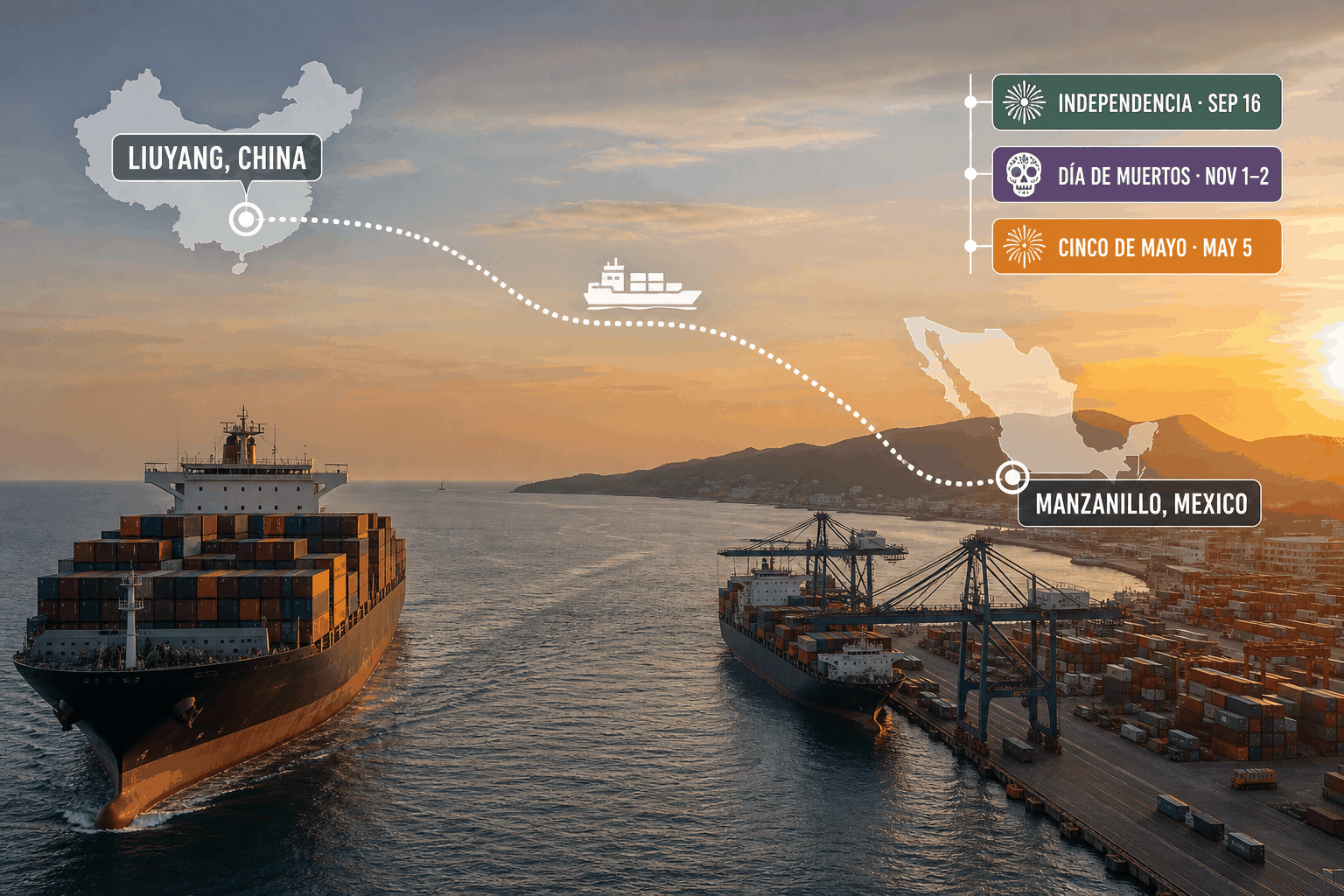
Few countries set off as many fireworks as Mexico. From the pyrotechnic town of Tultepec to the plazas that erupt for Independencia and Día de Muertos, demand is enormous and genuinely year-round. Yet the gate every imported container has to pass through is not a trade ministry or a civilian regulator — it is the Army. Explosives and pyrotechnics in Mexico are controlled by SEDENA, and the importer who understands that early wins the lane.
This guide sits inside our Latin America Import Hub and walks the Mexico lane step by step from the Liuyang side: how SEDENA regulates Class 1 goods, what the permiso general and the import permits actually cover, why Manzanillo is the working port, how the three selling seasons stack up, and a backward plan that lands a container ahead of September 16.
Why Mexico Is a Deeper Fireworks Market Than It Looks
Mexico is one of our established Latin American lanes, and what makes it attractive is the sheer depth of the culture behind the demand. This is the country of Tultepec, whose feria pirotécnica and bull-shaped toritos are world-famous; fireworks are woven into religious festivals, civic holidays and family celebrations in a way few markets match. For a distributor, that translates into repeat, multi-season demand rather than a single annual spike.
There is a strong domestic pyrotechnics industry too, but it does not remove the import opportunity — it shapes it. Imported product from China tends to fill the gaps the artisanal sector does not: consistent, certified, carton-level consumer assortments and the display-grade material that professional show companies and municipalities buy in volume. The buyer on this lane is a registered commercial importer, not a member of the public, and that distinction is the whole game.
For a Liuyang factory the implication is simple: Mexico is a permit-and-readiness market, not a closed one. The product moves; what decides whether a container clears cleanly is whether the Mexican importer holds the right SEDENA authorisation before the box is built. Get that right and Mexico is one of the more durable, multi-season fireworks markets in the Americas to supply.
The Gatekeeper Is the Army — How SEDENA Regulates Fireworks Imports
The single most important fact for a Mexico importer is who holds the keys. Explosives and pyrotechnic articles are regulated nationally under the Ley Federal de Armas de Fuego y Explosivos, and the authority that administers it is the Secretaría de la Defensa Nacional (SEDENA) — specifically its Dirección General del Registro Federal de Armas de Fuego y Control de Explosivos. This is military oversight of Class 1 goods, the same idea as the Army-registration system in Brazil or the DGMN in Chile, executed Mexican-style.
From the importer's side, SEDENA controls two things that decide your shipment. First, who may operate: a company handling explosives and pyrotechnics commercially registers and holds a standing authorisation. Second, the movement of cargo: bringing a Class 1 container into the country requires an import permit assessed against that standing status. The Chinese factory sits outside both processes — we can classify, label and document the cargo correctly, but the SEDENA status belongs to the importer of record in Mexico.
SEDENA Permits Step by Step — the Permiso General and the Import Permit
The permit chain is the long-lead item on a first Mexican shipment, so it pays to understand its shape. The detail below is the structure of what is required rather than a substitute for current SEDENA guidance — confirm the exact permit class, forms and steps with SEDENA or a Mexican customs broker, because the authority updates its requirements.
- The permiso general (standing status). A company in the explosives and pyrotechnics trade holds a general permit that establishes its legal standing to handle Class 1 goods. This is the licence to operate, and it is what the per-import paperwork is assessed against.
- The ordinary import permit (form SEDENA-02-019). For habitual, commercial imports a holder of a current permiso general uses the ordinary import permit to bring in explosive material and pyrotechnic articles.
- The extraordinary import permit (form SEDENA-02-018). For occasional or non-habitual imports there is a separate extraordinary permit route. Which one applies depends on your status and how regularly you import.
- Filed through VUCEM. Applications run through Mexico's single-window foreign-trade system (the Ventanilla Digital Mexicana de Comercio Exterior), with the permit attached to the customs entry. Storage of explosives and qualified handling sit alongside the import authorisation as part of being a credible registered operator.
- The permit describes a consignment, and the quantities are not a working draft. Mexican law provides that material imported under an ordinary or extraordinary permit must go to the use stated in the permit, and that changing that stated purpose requires a new permit; the provision allowing a single later amendment to certain extraordinary permits expressly carves out the quantities already authorised. In practice that means the SKU list, the calibres and the quantities have to be settled before the application goes in, not adjusted afterwards when a line comes out short.
Because this status takes time to establish and renew, the factory-side rule is the same one that applies across Latin America: confirm the importer's SEDENA permit is live and appropriate for the product class before the production run, not when the vessel is already at sea. The quantity point above is also what fixes the order of everything else in the season, which our Latin America sourcing calendar works through: the order freeze has to come before the permit application, because the application needs a list that has stopped moving.
Not sure your Mexican importer's permit covers the product mix? Send us the permit class and the SKU range you want to ship, and from the export-document side we will map the document set and classification against it before anything is built. Talk to the Liuyang team about your Mexico shipment.
Mexico's Three Selling Seasons — Independencia, Día de Muertos & Cinco de Mayo
What sets Mexico apart from a single-season market like Chile is that the calendar stacks up three recurring windows, two of them close together in the autumn. That changes how a container is planned: the SKU mix is broader, and a single shipment is often built to serve more than one window.
| Season | Date | Character | Product lean |
|---|---|---|---|
| Independencia | Sep 15–16 | National day — civic & municipal displays plus consumer celebration | Display shells + broad consumer assortments |
| Día de Muertos | Nov 1–2 | Cultural — community and family events, regional intensity | Consumer assortments, fountains, smaller cakes |
| Cinco de Mayo | May 5 | Regional — strongest in Puebla and US Mexican communities | Consumer packs + some display work |
Independencia on September 15–16 is the biggest national moment, mixing organised municipal displays with heavy consumer demand. Día de Muertos on November 1–2 follows barely six weeks later, which is why an autumn container is so often planned to cover both. Cinco de Mayo on May 5 is more regional — strongest in Puebla and among Mexican communities in the United States — and usually sits on a separate, earlier shipment rather than the autumn one. Year-end retail sits with the autumn pair in the buying plan; the assortment arithmetic for that run is in our Mexican assortment guide. Below is the SKU lean for the two autumn windows that drive the largest single planning decision.
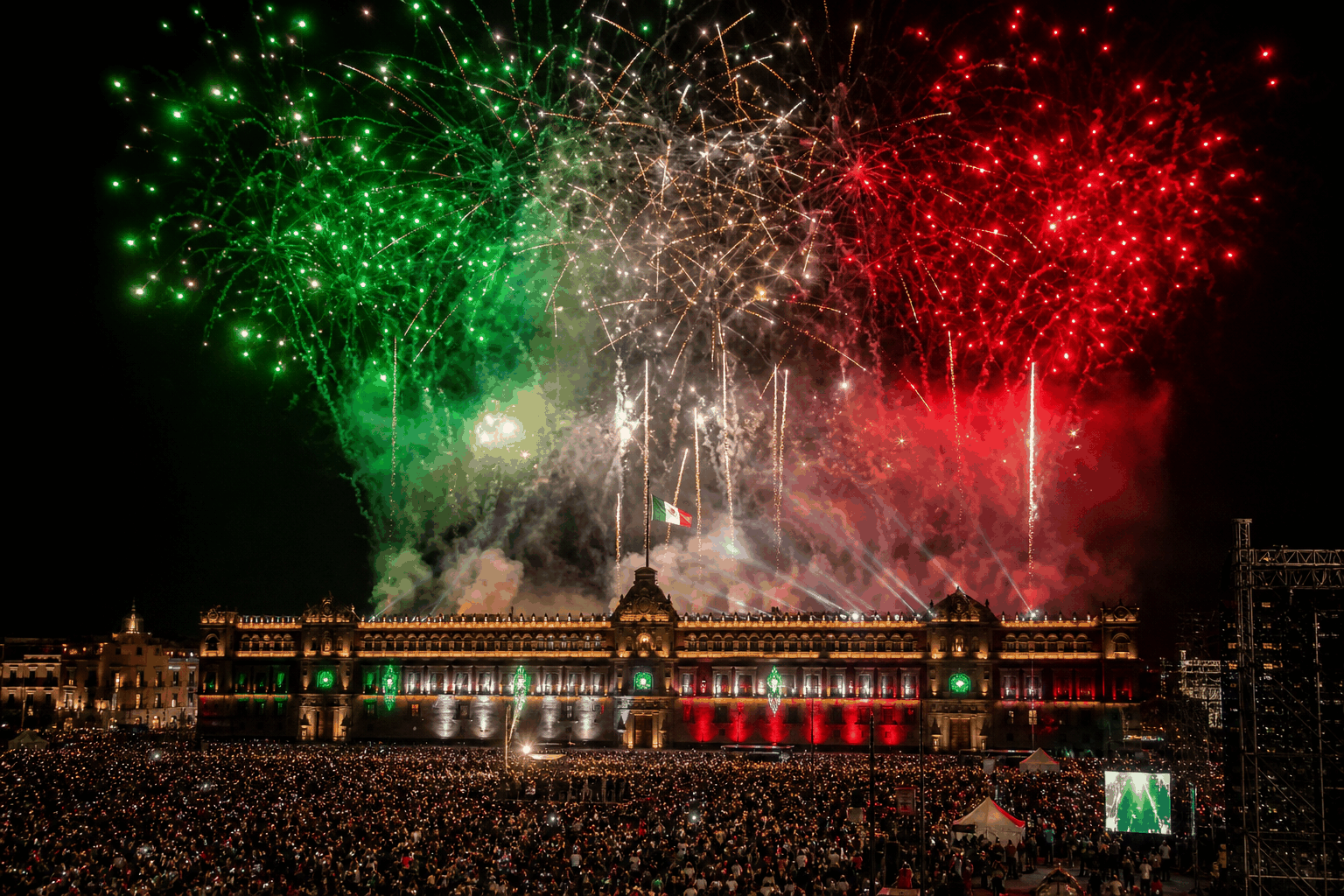
Independencia (Sep 16)
National day — municipal display + consumer
- Municipal and event display shells (1.3G, licensed operators)
- Multi-shot cakes and finale assortments
- Broad consumer assortment packs (1.4G)
- Roman candles, fountains and colour effects
Día de Muertos (Nov 1–2)
Community & family — consumer led
- Consumer assortment packs and family items (1.4G)
- Fountains, ground effects and novelties
- Smaller cakes for community events
- Regional display product where shows are organised
Turning those two columns into an actual load is a separate exercise, because Mexico already produces most of the fireworks it consumes and an imported container has to earn its place next to that industry. Which lines are worth importing, how the permit closes the line list, and why licensed storage caps a three-season buy are worked through in our Mexican mixed-container and assortment guide.
Manzanillo and Veracruz — DG Clearance and Demurrage Risk
Manzanillo, on Mexico's Pacific coast, is usually the default dangerous-goods-capable port for China-origin fireworks containers and runs among the most regular calls of the Latin American Pacific lanes. Veracruz, on the Gulf side, is the usual alternative and is chosen case by case depending on the importer's location and broker. For most Liuyang-to-Mexico sailings, Manzanillo is the port forwarders are set up for on the China lane. Because the entry customs office is one of the fields in the import permit application rather than a booking preference, the choice between the two is made before there is a vessel to book — worked through gate by gate in our Manzanillo vs Veracruz port decision guide.
As everywhere with Class 1 cargo, the decisive factor at the quay is readiness, not the port. A fireworks container sitting at a Mexican port without its SEDENA import permit and customs paperwork lined up is one of the most expensive forms of delay in the trade, because dangerous-goods storage is tightly limited and demurrage on Class 1 cargo runs faster than on general freight. The right UN classification and net explosive quantity on the paperwork is what clearance is assessed against, so the export documents and the import permit have to describe exactly the same cargo — for the classification side of that, see our explainer on UN numbers and shipping classifications.
Practical rule: Have the SEDENA permit confirmed and the import paperwork in motion before the factory loads the container. Under FOB Incoterms risk passes to the importer once the goods are on board the vessel at the named Chinese port — and Class 1 cargo stranded at Manzanillo without a clean clearance path is a demurrage bill that grows daily. Mexico also applies general import duty (IGI) and 16% IVA on landed goods at rates tied to the HS 3604.10 classification, so confirm the current duty position with your Mexican broker before pricing; see our shipping-cost breakdown for the freight and handling lines.
From Liuyang to a September 16 Delivery — a Backward Plan
Because Manzanillo is 25–40 days from China and production is another five to nine weeks, the only reliable way to hit September 16 is to work backward from it. The milestones below are anchored to an Independencia delivery; for Día de Muertos, shift the whole plan roughly six to seven weeks later, and for Cinco de Mayo run it on a separate earlier cycle.
Confirm SEDENA status & lock the SKU range Early May
Verify the importer's permit is current and covers the classes you intend to ship, and freeze the product list. This is the most schedule-critical step on a first shipment.
Confirm the import permit & place the PO Late May
Line up the SEDENA import permit for the consignment, then place the purchase order and book the Liuyang production slot before peak demand fills the line.
Production & Spanish labelling Late June
Production runs at Liuyang. Carton-level artwork and Spanish-language labelling are frozen now — including correct UN0336 1.4G / UN0335 1.3G classification and NEQ for the cargo.
Book the Class 1 DG vessel Mid-July
Reserve dangerous-goods vessel space to Manzanillo and assemble the full document set (commercial invoice, packing list, IMO DG declaration, B/L) so it matches the import permit exactly.
Sail from China Late July
Container sails trans-Pacific. With 25–40 days to Manzanillo, a late-July sailing targets a late-August to early-September arrival, ahead of the September 16 peak. This is the latest workable sailing rather than the comfortable one; sailing in late June, as our Latin America sourcing calendar plans it, buys a month of margin.
Manzanillo clearance & SEDENA release Early Sep
Customs clearance plus the SEDENA import permit. With status and paperwork already in hand, the box moves to the distributor or display operator for Independencia.
Add it up and a realistic plan from signed PO to goods-in-warehouse is roughly four months — longer on a first shipment because of the one-off permit work. For lane-by-lane transit detail that also applies to this route, see our shipping time guide, and for the end-to-end paperwork the dangerous-goods shipping process guide.
Shipping China to Manzanillo — a Trans-Pacific Lane, Clear of the Red Sea
Fireworks move by sea; airfreight of Class 1 explosives is effectively impossible outside tiny samples, and there is no overland option from China to Mexico. The geography works in the Mexican buyer's favour: the China–Mexico lane crosses the Pacific and never transits the Red Sea or Bab-el-Mandeb, so the Bab-el-Mandeb disruption that has stretched and inflated China–Gulf sailings has little direct effect on this route. Manzanillo sits on Mexico's Pacific coast and is reached on a direct trans-Pacific crossing rather than via Suez, which is part of why it runs the most regular China calls of the LatAm Pacific ports.
That leaves the Chinese Spring Festival production slowdown as the main calendar risk, not a shipping-route one. Factories pause for several weeks around Lunar New Year, so an order placed too late in the cycle loses its production slot before it loses its vessel. Booking the slot and the dangerous-goods space early is what protects an Independencia or Día de Muertos date.
Common Mexico Sourcing Mistakes
These are the errors we see most often from distributors new to the Mexico lane. Any one of them can cost more than the margin on a first container.
- Treating SEDENA as a customs formality. The permit is a military authorisation, not a routine import licence. It is the long-lead item, and chasing it after production is the classic schedule killer.
- Assuming the permiso general alone clears a container. The general permit is the standing status; a specific import still runs on the ordinary or extraordinary import permit. Confirm which applies to your importer before booking.
- Expecting the factory to hold the SEDENA status. The permit belongs to the Mexican importer of record. A Chinese exporter cannot hold it, so the registration has to be in place on the buyer side first.
- Forcing a Gulf or Brazilian document set onto Mexico. SABER, Civil Defence or Brazil's Army-registration templates do not map onto SEDENA requirements. Build the document set, and the Spanish labelling, for the Mexican regulator from the start — the Mexican field list comes from a general consumer standard rather than from the permit, and it is set out in our guide to Spanish and Portuguese fireworks labels.
- Planning one season when the container could serve two. Independencia and Día de Muertos are about six weeks apart; a single autumn container often covers both, so a one-season SKU list can leave volume on the table.
- Mismatching classification between the export docs and the import permit. The UN number and NEQ on the IMO DG declaration must match what the SEDENA permit and customs entry describe; a discrepancy is a clearance risk, not a paperwork detail.
Frequently Asked Questions
Do I need a SEDENA permit to import fireworks into Mexico?
Yes. Explosives and pyrotechnic articles are regulated nationally by the Army-affiliated SEDENA under the Ley Federal de Armas de Fuego y Explosivos. A commercial importer normally holds a permiso general and uses an ordinary import permit (the SEDENA-02-019 form) for habitual imports, with an extraordinary permit (SEDENA-02-018) for occasional ones, filed through Mexico's single-window VUCEM. Confirm the exact permit class and current forms with SEDENA or your Mexican broker before the production run.
Is Mexico's fireworks demand met by domestic makers like Tultepec, or is there room for imports?
Both, and they tend to serve different needs. Mexico has a large artisanal sector centred on Tultepec, but it does not close the import lane so much as shape it. Imported product from China usually fills the gaps the artisanal side does not: consistent, certified, carton-level consumer assortments and the display-grade material that show companies and municipalities buy in volume. Those two are separate consignments rather than one mixed load — imported material has to go to the use stated in the permit, and a box mixing divisions is treated as the more dangerous division throughout, as our Mexican assortment guide works through. The import opening sits in standardised, reliably supplied SKUs rather than in competing with artisanal craft.
Which Mexican port should my fireworks container land at?
Manzanillo, on the Pacific coast, runs the most regular China-origin calls and has mature DG handling, so it is usually the default for Class 1 fireworks; Veracruz on the Gulf side is the usual alternative, used case by case. Whichever you use, the real driver of demurrage is whether the SEDENA permit and Class 1 paperwork are in hand before the vessel arrives, because dangerous-goods storage is tightly limited and the clock runs fast.
How long does China-to-Mexico shipping take, and does the Red Sea affect it?
Plan on roughly 25 to 40 days from China to Manzanillo. The China–Mexico lane crosses the Pacific and never transits the Red Sea or Bab-el-Mandeb, so the disruption that has stretched China–Gulf transit has little direct effect here. The bigger calendar risk is the Chinese Spring Festival production slowdown, which is why the production slot and the Class 1 vessel space should be booked early.
When should I start sourcing for Independencia (September 16)?
Work back about four months from the event delivery date, and start earlier on a first shipment. Manzanillo transit is 25–40 days and production is another five to nine weeks, so a September 16 deadline means sailing by roughly late July at the latest. That is the last sailing that still lands in time; our Latin America sourcing calendar plans the same window to a late-June sailing, which is what leaves room for a rolled booking or a slow clearance. Lock the SKU range and confirm the SEDENA permit by around May — clear of the Chinese Spring Festival slowdown — for a clean Independencia delivery.
Can one container serve more than one Mexican season?
Often, yes. Independencia (Sep 16) and Día de Muertos (Nov 1–2) are only about six weeks apart, so a single autumn container is frequently planned to cover both, with Cinco de Mayo (May 5) served by a separate earlier shipment. That is why a Mexican order tends to carry a broader SKU mix than a single-season buy — and why the permit and labelling have to cover everything in the box.
Continue Reading by Market
- Region overview → Latin America Import Hub (Brazil, Chile & Mexico)
- Sister market → Brazil Réveillon & Carnaval Sourcing Guide
- Sister market → Chile DGMN & Polvorista Import Guide
- Port comparison → Manzanillo vs San Antonio vs Santos Clearance Guide
- Which Mexican port → Manzanillo or Veracruz: Choosing a Mexican Port of Entry
- Timing across the region → Latin America Fireworks Sourcing Calendar (three Mexican peaks off one production run)
- Distributor playbook → Distributor's Guide for ME & LATAM
Sourcing Fireworks for the Mexican Market?
Whether you need a SEDENA-aligned export document set, help matching your permit class to a product mix, or a container planned to land ahead of Independencia or Día de Muertos, our Liuyang team can prepare it before the box is sealed. We work with distributors across more than 30 countries.
WhatsApp Email