If you import fireworks for the Middle East or Latin America, the dangerous goods shipping process decides whether your containers arrive on time and in compliance — or sit at port for weeks.
Fireworks are not normal cargo. They are Class 1 explosives. Every step from the factory floor to your warehouse follows strict international rules. Miss one document or one label and the whole shipment can be delayed, fined or refused.
This guide is written for fireworks importers, wholesalers and distributors who already place orders from China and want a clear, practical view of the full fireworks shipping process. We cover the seven concrete steps from PO to delivery, the documents you must keep on file, and how to keep every container moving on schedule — the way experienced buyers handle how to ship dangerous goods from China.
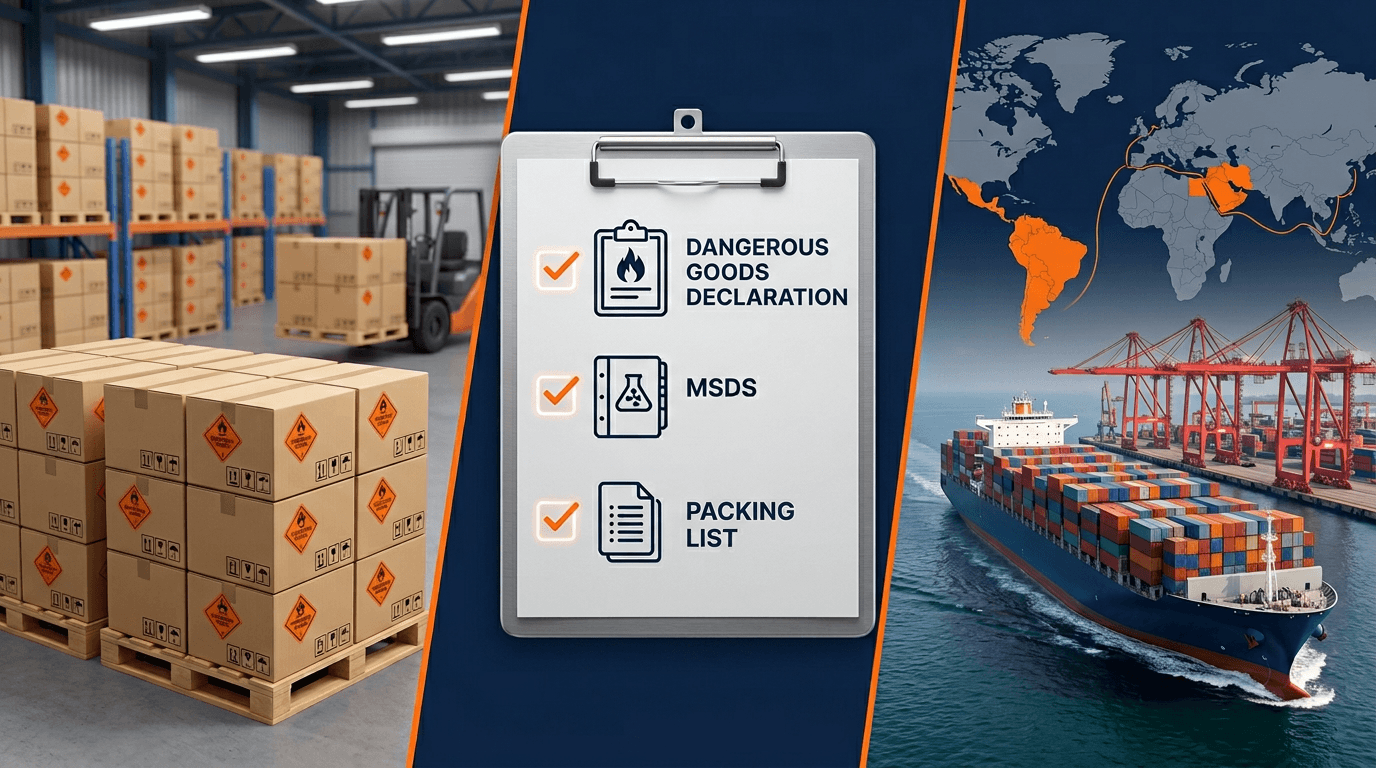
What Are Dangerous Goods in Fireworks Shipping
In international shipping, “dangerous goods” (DG) means any cargo that can pose a risk to people, ships, vehicles or the environment if it is not handled correctly. Fireworks fall squarely into this category.
Under the IMDG Code — the international rulebook for sea-going dangerous goods — fireworks are classified as Class 1 explosives. That classification triggers a full set of packaging, documentation, stowage and transport rules that do not apply to regular cargo.
For most importers, the key point is not to memorize every UN code. It is to make sure each SKU is shipped under the correct hazard division, such as 1.4G for many consumer fireworks or 1.3G for some professional display items. That classification affects every later step in the fireworks shipping process, and getting it right at the source is what our guide to UN numbers and shipping classifications walks through in detail.
For importers, the practical takeaway is simple. Whatever you buy from a Chinese factory will be marked, packed, documented and shipped as a Class 1 dangerous good. There is no fireworks shipping process that can skip the DG framework.
Overview of the Dangerous Goods Shipping Process
Before going step by step, it helps to see the responsibility chain. A DG shipment is not controlled by one party. The factory, exporter, forwarder, carrier, port, customs broker and importer each own a different part of the route.
- Factory: classify products, pack correctly, apply labels, prepare technical papers.
- Exporter / supplier: consolidate SKUs, arrange inspection, submit export papers.
- DG forwarder: confirm carrier acceptance, book space, check documents before port entry.
- Carrier and port: review DG declaration, assign stowage, handle the container under Class 1 rules.
- Importer and broker: secure local permits, clear customs and arrange licensed inland delivery.
That is the full DG logistics process China-style, end to end. The process works best when each party knows exactly what must be finished before the next handover.
Step-by-Step Dangerous Goods Shipping Process
These are the seven core hazardous goods shipping steps every fireworks container goes through. The order does not change.
Step 1: Product classification and documentation
Before anything ships, every product must be correctly classified. This means assigning the right UN number, hazard division, compatibility group and net explosive quantity (NEQ). The classification must come from official testing, not from a product name or catalog photo.
Classification is done by the factory based on test reports from Chinese authorities. Always request a copy of the report and certificate before booking. Wrong classification is the single most expensive mistake in the entire fireworks export procedure, because it can force rebooking, relabeling or re-export.
- Importer check: confirm the product list matches the certificate.
- Supplier check: confirm every SKU has a valid classification record.
- Forwarder check: confirm the carrier accepts that exact class on the planned route.
Step 2: Packaging and labeling requirements
Fireworks must be packed in UN-certified DG packaging. Inner packing protects each item; outer cartons are tested and marked with UN numbers, the explosive class diamond, the proper shipping name and the manufacturer information.
Pallets, shrink wrap and corner protectors are not decoration. They help the carton survive truck movement, port lifting and ocean vibration. Faded labels, loose cartons or mixed old packaging are common reasons for rejection during origin checks.
Step 3: Booking DG shipment with carrier
DG vessel space is limited and not every carrier accepts Class 1 cargo. The supplier or forwarder must book a sailing on a DG-approved vessel before the container is loaded. Booking is based on the DG declaration, classification papers and route approval.
For fireworks, late booking usually means a missed sailing. A practical buyer should ask three questions before production finishes: which carrier accepts the cargo, which port allows the class, and what document deadline applies before gate-in.
Step 4: Container loading and inspection
The DG container loading process is closely supervised. Containers are inspected for cleanliness, structural integrity and correct DG markings before loading begins.
During loading, cartons are stacked according to a pre-planned scheme — heavy items below, light items above, no mixed-class items in the same container without permission. Once loaded, the container is sealed with a numbered DG seal and photographed.
A loading certificate (often called a Container Packing Certificate or CTU Code Certificate) is issued. This document is required by every carrier in the world.
- Check container floor, door gasket, vents and inner walls before loading.
- Photograph empty container, half-loaded container, final load and seal number.
- Keep the loading record with the final packing list and DG declaration.
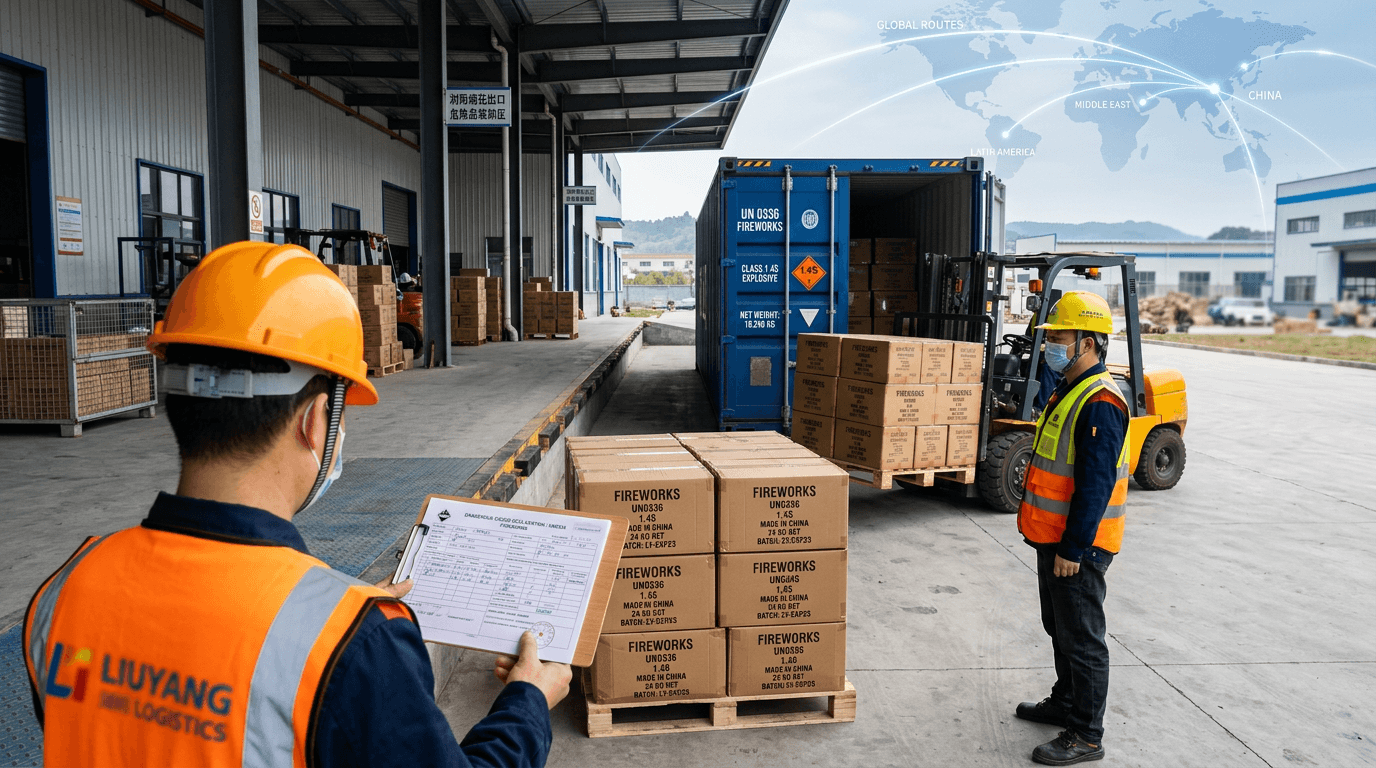
Step 5: Port handling and export customs
The sealed container is trucked to a DG-equipped export port. Port entry is not automatic. The port must accept the cargo class, the gate-in window and the vessel stowage plan.
At the port, the container moves to the DG yard, waits for the vessel and is inspected by customs. The export declaration, MSDS, packing list, commercial invoice and DG declaration are reviewed in detail. Any document mismatch stops the container until corrections arrive — usually a 2–5 day delay.
Step 6: Ocean transport
Once the vessel is loaded, the journey begins. Transit time depends on destination, routing and carrier acceptance. For detailed route timing by Middle East and Latin America port, see our separate guide on fireworks shipping time from China.
In this process guide, the important point is control. DG containers ride in approved stowage positions. The carrier monitors them under Class 1 rules, and any route change or transshipment must still comply with the original DG approval.
Step 7: Import customs clearance and delivery
When the vessel arrives, the real work for the importer begins. Local customs requires the import permit, original bill of lading, commercial invoice, packing list, DG declaration and often classification certificates from the manufacturer. Some markets also require civil defence, army or public security approval for explosive imports.
Once cleared, the container is trucked under DG-licensed transport to your bonded warehouse or approved storage site. The importer should confirm in advance who pays demurrage, who books the DG truck, and who can receive the container after working hours.
Key Documents Required for DG Shipping
Dangerous goods documentation is the backbone of any successful fireworks shipment. Missing or incorrect papers are the leading cause of preventable delays.
The standard document set for every fireworks container includes:
- MSDS (Material Safety Data Sheet) — Used by the carrier and port to understand cargo hazards and emergency response.
- DG Declaration — The main legal declaration for UN number, hazard class, compatibility group and NEQ.
- Packing List — Must match carton counts, gross weight, net weight and product names used in the DG papers.
- Commercial Invoice — Used for export and import customs value review.
- Bill of Lading — Must not conflict with the declared dangerous goods information.
- Container Packing Certificate — Confirms the container was loaded under DG rules.
- Classification Certificate / Test Report — Proves the declared class is supported by testing.
- Import Permit — Required before customs release in the destination market.
The best way to review dangerous goods documentation is not to ask, “Do we have all files?” Ask instead: do all files show the same product names, carton quantity, weight, UN information and consignee details? Most DG paperwork problems come from mismatch, not missing documents.
GCC Country Steps That Sit on Top of the DG Baseline
Everything above is the international DG baseline — it applies wherever the container is headed. But three Gulf markets add their own pre-shipment or arrival steps that decide whether a technically compliant container actually clears. If the Middle East is a regular destination for you, it helps to read these alongside our GCC fireworks import hub, which maps the same rules market by market.
Saudi SABER Conformity — the Step That Must Finish Before You Ship
Saudi Arabia is the one GCC market where a conformity step has to close before the vessel sails, not after it arrives. Retail-grade fireworks sit under a SASO technical regulation, and clearance runs through the SABER platform in two layers. The PCoC (Product Certificate of Conformity) certifies the product and is issued per product family — roughly USD 500–2,500 for each family and valid for a year, so a broad SKU range costs more than a single assortment. The SCoC (Shipment Certificate of Conformity) is then raised per shipment, usually USD 500–1,500, and references that PCoC plus the consignment’s invoice and HS code (3604.10).
The order matters: lock the SKU list early, have the factory test reports ready, let your conformity body issue the PCoC against each family, then raise the SCoC once the commercial invoice is final. Because the SCoC is tied to shipment data, a late SKU swap can invalidate it and strand the cargo at origin. The full Saudi picture — GDCD explosives permit, customs duty and VAT on top of SABER — is laid out in our Saudi SABER and SASO guide.
UAE Civil Defence Inspection When the Container Reaches Jebel Ali
Most China-origin Class 1 fireworks enter the UAE through Jebel Ali, where the practical lane is Indian Ocean to the Strait of Hormuz rather than a Red Sea call. Clearance is gated by the relevant Civil Defence authority — Dubai Civil Defence (DCD) for Dubai, with other emirates running their own equivalent — and the genuine prerequisite is the importer’s own explosives licence, which has to be valid before the cargo lands, not applied for afterwards.
The arrival check is less about the documents existing and more about the physical container agreeing with them: hazard labels and UN numbers still legible after palletising, the DG declaration and packing list matching on carton counts and NEQ, and the loading record matching the seal number. A spotless container with inconsistent paperwork still gets held. The step-by-step document chain and the DCD checklist are in our Jebel Ali clearance guide.
Qatar Hamad Port DG Clearance and the MOI Permit
Qatar routes explosive imports through Hamad Port, with approval led by the Ministry of Interior and Civil Defence. As elsewhere in the Gulf, the importer-side permit is the gate — it should be secured well ahead of arrival, because a Class 1 container waiting on a pending permit runs up demurrage fast. The document discipline is the familiar one: import permit, bill of lading, invoice, packing list and DG declaration all telling a single consistent story.
What buyers underestimate is the step after release. Gulf summer heat means cleared cargo belongs in a licensed, climate-aware magazine rather than a sun-baked yard — a point our GCC storage and magazine guide covers in detail. Kuwait, Bahrain and Oman follow broadly similar logic, which is why many buyers run them on a project basis rather than as standing programmes.
Special Requirements for Fireworks Shipping
Even within the broader DG framework, fireworks have their own special rules. Understanding them upfront prevents most surprises.
Strict Packaging Standards
Fireworks must be packed in UN-tested combination packaging. Inner cartons protect the items; outer cartons pass drop, stack and water tests. Substitutions — even cosmetic ones — are not allowed.
Mandatory Hazard Labels
Every carton carries the orange explosive diamond, the UN number, the proper shipping name and the net explosive quantity. Labels must be unfaded, undamaged and visible after palletizing.
Container Loading Rules
The DG container loading process bans mixing with incompatible products. Compatibility groups decide which items can travel together. If the buyer changes the SKU mix late, the loading plan may need to be checked again.
Container Condition and Trained Personnel
Containers must have intact floors, no holes, no oil residue and a valid CSC plate. Loaders, drivers, port handlers and ship crew all need DG training certifications — untrained workers cannot legally touch a Class 1 container.
Common Challenges in Dangerous Goods Shipping
A few problems show up over and over. Knowing them in advance is half the fix.
Booking Difficulty
DG vessel slots fill up early. Carriers may suspend Class 1 acceptance during high-risk weeks. New importers often discover this too late, when finished goods are ready but no approved sailing is available.
Documentation Errors
The DG declaration must match the packing list, commercial invoice and manufacturer’s test report. A wrong UN number, missing signature or mismatched NEQ can stop the container at any point in the chain.
Port Restrictions
Not every port accepts every fireworks class. Some limit total explosive quantity per vessel call. A container booked through the wrong port may need last-minute diversion, which means delay and extra fees.
Compliance Risk
Different countries enforce different national rules on top of IMDG. Some require civil defence, army or public security approval. Missing a national permit at the destination can lead to seizure, fines or forced re-export.
All four problems are preventable when DG shipping China operations start with route confirmation, document review and permit checks before production is completed.
How to Ensure Smooth DG Shipping
Smooth shipments are the result of preparation, not luck. The buyers who consistently land containers on time follow the same handful of habits.
Prepare Documents Early
Start the documentation pack as soon as the order is confirmed. Do not wait for production to finish. The MSDS, classification certificate and product list can usually be reviewed while goods are still being made.
Work with a DG-Specialist Forwarder
A generalist forwarder may handle one Class 1 container a year. A DG-specialist forwarder handles them every week. The difference shows up in carrier acceptance, paperwork accuracy and port turnaround time.
Confirm Classification in Writing
Ask your supplier for the official test report and the classification certificate before booking. Cross-check that every SKU on the packing list maps to a real UN number, real division and real NEQ. This single check prevents the costliest mistakes.
Choose Experienced Suppliers
Working with reliable fireworks suppliers in China is the most underrated advantage in DG shipping. Experienced DG handling on the factory side means clean labels, correct loading and clean documentation — every shipment, not occasionally. For new buyers, partnering with a supplier that offers full compliance support (classification, packaging, paperwork, booking and inspection) can save weeks of trial and error.
Plan a Buffer
Build a time buffer around document review, port entry and destination clearance. The buffer should sit before your selling window, not after it. This is especially important for buyers who sell around Eid, New Year, national holidays or local festival seasons.
The fireworks shipping process is not random. It is a controlled handover chain. When every party knows its task, DG shipping becomes repeatable instead of stressful.
Why Liuyang Has an Advantage in DG Shipping
Liuyang’s advantage is not only production volume. It is process memory. Factories, warehouses, truckers, inspection agents and DG forwarders here repeat the same Class 1 workflow every week.
Better Pre-Loading Control
Because many suppliers are close to each other, mixed-SKU orders can be checked before the container arrives. Carton marks, labels, weights and pallet plans can be aligned early instead of corrected at the port gate.
Faster Document Feedback
Local DG teams know which information carriers usually question. They can catch common problems before submission: unclear NEQ, inconsistent carton counts, missing signature, old MSDS version or wrong consignee format.
Clearer Export Procedure
The fireworks export procedure is repeated daily in Liuyang, so suppliers understand the order of actions: classify first, check packing, book DG space, load under supervision, then submit export papers. This order matters.
For importers in the Middle East and Latin America, this means fewer last-minute corrections and a cleaner handover to your destination broker. If you want to ship fireworks internationally with predictable control points and full compliance support, sourcing from a mature Liuyang supply chain is a practical advantage.
FAQ
What is the process for shipping dangerous goods?
The dangerous goods shipping process for fireworks runs through seven main steps: classification and documentation, packaging and labeling, DG-approved booking, container loading and inspection, port handling and export customs, ocean transport, and import customs clearance with delivery. Each step is governed by the IMDG Code and additional national rules at the destination country.
What documents are required for DG shipping?
At a minimum: MSDS, DG declaration, packing list, commercial invoice, bill of lading, container packing certificate, classification certificate and import permit. Some countries also require fumigation certificates, certificates of origin and civil defence or military approvals. Every document must match every other document, line by line.
Why is DG shipping more complicated?
Because the cargo is hazardous. Fireworks are Class 1 explosives. Special packaging, labeling, stowage, vessel routing, port handling and trained personnel are all required. Fewer carriers accept Class 1 cargo, fewer ports handle it well, and inspections are more frequent. All of this adds time, paperwork and supervision compared with normal containers.
Can I ship fireworks without a DG process?
No. Fireworks legally cannot move across international borders outside the dangerous goods framework. Any operator who claims otherwise is either mislabeling the cargo or violating international rules. The penalties — confiscation, fines, vessel detention, criminal charges — are far more expensive than the DG process itself. Always follow the DG process with experienced partners who handle Class 1 cargo every week.
Does Saudi Arabia require SABER certification before the fireworks ship?
Yes — Saudi Arabia is the one GCC market where conformity must close before the vessel sails, via the SABER platform. For DG planning the rule is simple: treat SABER as a pre-shipment task and lock the SKU list early so a late change cannot invalidate the shipment certificate. The full PCoC / SCoC workflow, costs and GDCD permit are in our Saudi SABER and SASO guide.
Who inspects a fireworks container when it arrives at Jebel Ali?
The relevant Civil Defence authority, such as Dubai Civil Defence (DCD), which checks that the physical container matches the paperwork before release; the importer’s explosives licence must already be valid when the cargo lands. The full DCD document chain and typical clearance timeline are in our Jebel Ali clearance guide.
Can one DG container clear customs for several GCC countries at once?
Not in one clearance. Each destination clears against its own import permit and national approvals. Buyers serving several Gulf markets usually clear into one entry hub, such as Jebel Ali, then arrange onward licensed movement — rather than expecting a single container to clear simultaneously for multiple countries.
How early should a GCC importer start the explosive import permit?
Before the cargo ships, not when it arrives. In the UAE, Qatar and the wider GCC the importer-side permit is the real gate, and a Class 1 container waiting on a pending permit accrues demurrage quickly. Treat the permit as a production-stage task that runs in parallel with manufacturing, not a port-arrival task.
Need a Reliable Partner for Your Next DG Shipment?
If you are looking for a reliable fireworks supplier with professional DG shipping experience, feel free to contact us for more details. We can walk you through the full export procedure for your route, prepare clean dangerous goods documentation, and help you book Class 1 vessel space ahead of peak season.
WhatsApp Email