In fireworks, quality isn't a slogan — it's what keeps effects predictable, cartons intact through four weeks at sea, labels clean for customs, and the end user's hand on the fuse. At our plant in Chengchong Town, Liuyang, we treat every production run as a batch contract between us, the importer, and whoever ends up lighting the product. This piece covers the fireworks factory quality control process we actually use — not a poster on the wall.
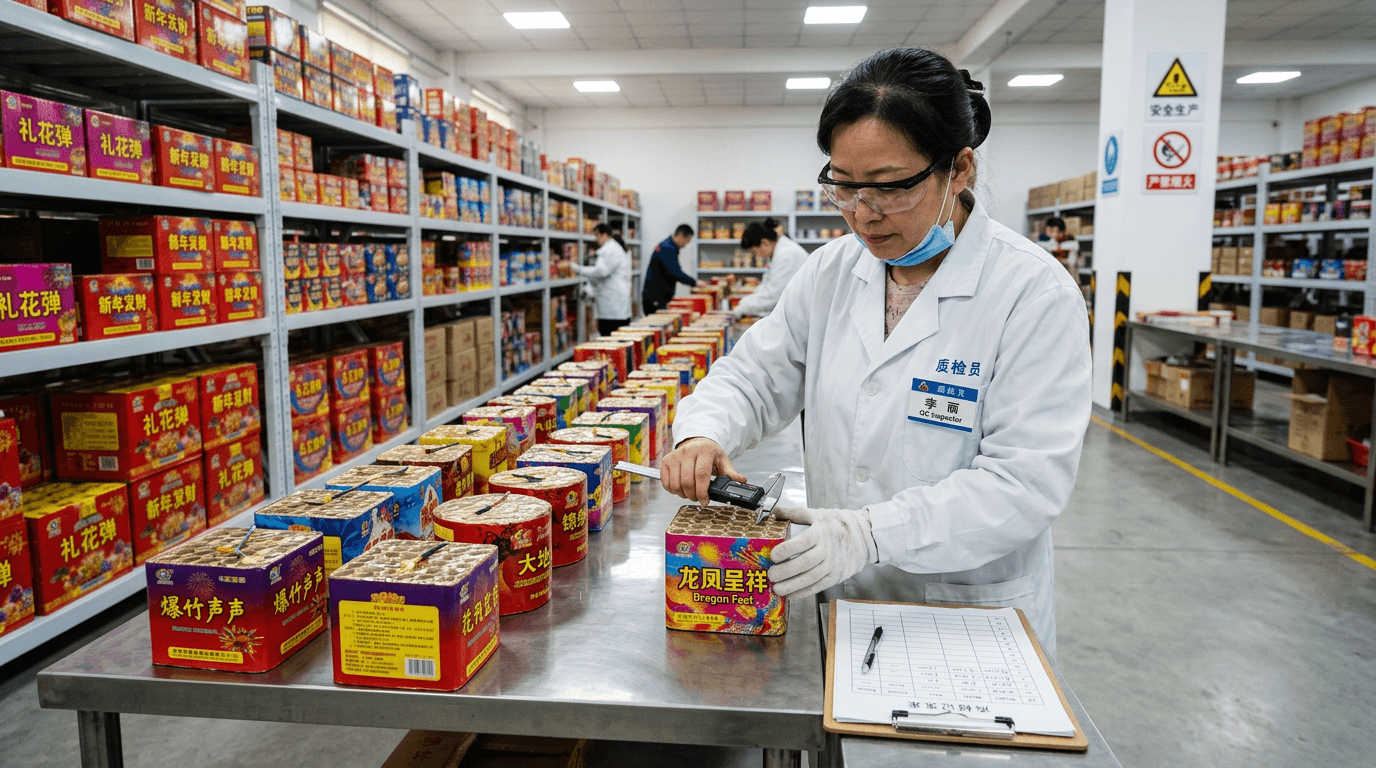
"Zero Defect" — What It Actually Means
Nobody reaches literal zero. What "zero defect" means on a real production line is that prevention is engineered into the workflow: clear specs, trained hands, controlled materials, measurable checkpoints, and fast correction when something drifts. You distinguish between random failures (rare, investigated) and system failures (unacceptable, fixed at the source). That's what lets a distributor scale orders without gambling on the next container.
A zero-defect batch is one that clears every agreed checkpoint — materials release, in-process, finished sampling, packaging, labels, export docs — with records that can be pulled by batch code. When something fails, it's contained. The line never moves forward on guesswork.
Stage 1 — Incoming Inspection (IQC)
Everything starts at the loading dock. Chemistry, paper, fuse, adhesives, hardware. Every lot is matched to its COA, lot number and packing marks. High-risk items (flash comp, fuse cord) get tighter sampling than bulk cardboard. Approved lots get labeled into the warehouse; rejected lots sit in quarantine until they leave. This single firewall is the difference between clean batches and expensive recalls.
- Certificate-to-lot identity check on receipt
- AQL sampling on bulk; tighter rules on the high-risk items
- Humidity- and static-controlled handling for sensitive compositions
- Supplier scorecard that triggers an audit when problems repeat
Stage 2 — In-Process Control
This is where the highest return on QC spend lives. Tube straightness, glue cure, lift charge weight, fuse delay spacing on cakes, clip and base integrity. Line leaders run a first-article check every time a setup changes, then patrol checks on fixed intervals. The aim is catching drift early — while a correction is cheap — not after 5,000 units are packed.
First-Article & Patrol Checks
When a SKU changes over, the first finished units are compared against the master sample and spec sheet — tube count, spacing, fuse routing, label position, gross weight. Patrol entries log time, operator and findings so engineering can spot patterns (a tooling wear trend on a specific shift, for example).
Stage 3 — Finished-Goods Inspection & Functional Testing
Finished product is measured against the approved master sample and the customer PO. Depending on category, that means visual, dimensional, weight, fuse pull, and real function tests in a licensed proving area. Every test ties back to a batch and carton range. This is where "looks fine in the warehouse" turns into "proven on the pad."
| QC gate | What we verify | Why it matters for buyers |
|---|---|---|
| Materials release | Lot identity, storage condition, critical parameters | Prevents silent composition drift across batches |
| In-process control | Assembly tolerances, fuse install, structural glue | Reduces misfires, tilt risks, and transport damage |
| Finished sampling | Effect, timing, height band vs. spec | Aligns retail reality with catalog promises |
| Packaging audit | Carton strength, inner braces, UN marks where required | Survives DG handling stacks and inland legs |
| Labeling & marks | CE trace codes, warnings, language packs | Smooth customs and retailer compliance checks |
Batch Traceability — The Spine of Export QC
Traceability is what turns QC from a filing cabinet into an operating asset. Every batch gets a production ID that links raw-material lots, line configuration, inspection sheets, rework notes if any, and the packing list. When something goes wrong in the field, we can pull the record in an afternoon instead of a week. If you're comparing suppliers, ask for a redacted batch record — a serious factory will send one. Batch records are one signal among several; the full sequence for vetting a supplier before you pay is in our sourcing and supplier-trust playbook.
How ISO 9001 and CE Play Out Day-to-Day
ISO 9001 isn't a sticker on the wall. It's the QMS that forces documented procedures, internal audits, corrective action logs, and management review. CE marking — for EU-bound product — ties your technical file, testing evidence and production consistency to the EU's Essential Safety Requirements. ISO answers "do we run quality as a habit?"; CE answers "does the evidence satisfy EU conformity?" Both lenses have to stay sharp for any factory that serves the destinations on our EU inquiry page and the product catalog.
Packaging, Labels, and DG Readiness
Perfect effects are worthless if the carton crushes or the marks are wrong. We audit export packaging for stacking strength, inner restraints on heavy cakes, and moisture protection. Labels get checked against destination rules and the PO. The last mile of QC is the label customs sees first.
Pre-Shipment Inspection
Internal QC is table stakes. PSI is what gives the buyer peace of mind. We welcome it — factory visits, third-party inspectors, random sampling against the master. Transparency correlates with lower dispute rates. The full mechanics — AQL sampling, what a proof-firing video must show, and the pre-balance document pack — are in our pre-shipment inspection & proof-firing guide. If this is your first direct order, our factory-direct sourcing guide shows where PSI fits in the timeline before the container seals.
Seven Rules the Line Never Breaks
1Controlled BOMs
Any material change requires engineering sign-off and a new revision. No improvising with whatever powder is on hand.
2Master Samples Locked Per SKU
Marketing videos are not the reference. The master sample is.
3Calibrated Tools, Tracked Tool Life
Fixtures on a schedule. Worn tooling replaced before tolerances stack up.
4Training & Authorization Matrix
Critical steps only get performed by trained operators. Cross-training is how we hold the line during peak season.
5CAPA Loop
Corrective and preventive actions get tickets — owners, dates, verification. Not hallway promises.
6Seasonal Surge Discipline
Peak demand never justifies a skipped gate. Surge headcount is pre-approved and competency-tested.
7Customer-Specific Addenda
Extra drop tests, language packs, unusual PSI steps — all attached to the work order as controlled appendices.
Category by Category — QC Isn't Generic
A 500g cake doesn't get inspected like a sparkler bundle or a display shell. Cakes live or die on tube alignment, fuse mapping, lift consistency, row timing. Shells are all about lift match, burst homogeneity and break height. Sparklers need straight wire, even coating and reliable tip ignition. Our checklists map to the product families directly — no team guesses which tests apply to which SKU.
Questions to Ask a Factory on the First Call
- Can we see a redacted batch record for a similar recent SKU?
- What's your AQL / sampling policy for finished goods?
- Who owns CAPA? Typical close time?
- How are master samples stored and versioned?
- Which PSI firms have you worked with in Liuyang?
- How do you handle rework without mixing lots?
Pair strong factory QC with your own PO-level acceptance criteria — effect names, duration bands, height class, decibel targets where regulated. Clear written criteria prevent 90% of the gray-area disputes that show up after a container lands.
Standards & References
The controls described above map to a specific set of published standards and regulations rather than a house style. The documents a serious fireworks QC system is built against:
- ISO 9001:2015 — the quality-management-system framework that governs document control, traceability and corrective action (CAPA).
- EN 15947 — the European standard for consumer fireworks (categories F1–F3) and the basis of CE marking; see our EU market page.
- APA 87-1 & CPSC 16 CFR 1507 — the American Pyrotechnics Association standard and the US Consumer Product Safety Commission rules for consumer fireworks.
- UN Model Regulations (UN 0336 / 0335 / 0431) — the classification and packaging framework for dangerous goods that drives DG documentation; our 1.3G vs. 1.4G guide explains how the class decides shipping and storage.
For how these controls translate into what a buyer actually sees in a sample, pair this guide with how to spot high-quality fireworks and the colour-chemistry benchmark in the science behind blue stars.
FAQ
What does "zero defects" actually mean in fireworks manufacturing?
A target operating model — not a literal promise. Specs, sampling, testing, containment and traceability are designed so defects are prevented where possible, and outliers are caught and contained before shipment, rather than relabeled "acceptable variance."
Which certifications matter for export?
ISO 9001 for repeatable process. CE for EU-bound product. Add national rules on top — always verify against the current import guidance for your destination.
How does QC differ across fireworks categories?
Each family uses its own checkpoint set. The control plan follows the hazard profile and the customer spec, not a generic checklist.
Why does batch traceability matter?
It connects material lot → production → testing → carton. When you need to investigate a field issue or deal with insurance, you can pull the full chain in an afternoon.
Should importers still run PSI if the factory has internal QC?
Yes. PSI validates what the factory already believes is true — counts, marks, assortment, random performance. It's one of the highest-ROI steps in international fireworks trade.
Batch-Consistent Fireworks, Documented End-to-End
Licensed Liuyang manufacturer with multi-stage documented QC, ISO 9001-aligned quality framework, and per-shipment compliance documentation prepared by destination market. Request specs, samples, a redacted batch record or an on-site visit — we'll walk through the full documentation with you.
WhatsApp Email