Ask what separates a $40 box off a supermarket shelf from a shell that opens 200 metres over a stadium, and you've found the single most important line in the whole fireworks trade. Everything else — price, freight, who can legally touch it, how it's sold — hangs off one distinction: consumer fireworks versus display (professional) fireworks.
This guide draws that line clearly for buyers and importers: what actually counts as consumer versus display, how the classes map across the US, EU and Canada, who is allowed to buy and fire each, what the freight and licensing really cost, and why the two categories run on completely different business models. The figures come from day-to-day export out of Liuyang, one of the world's largest production centres for both.
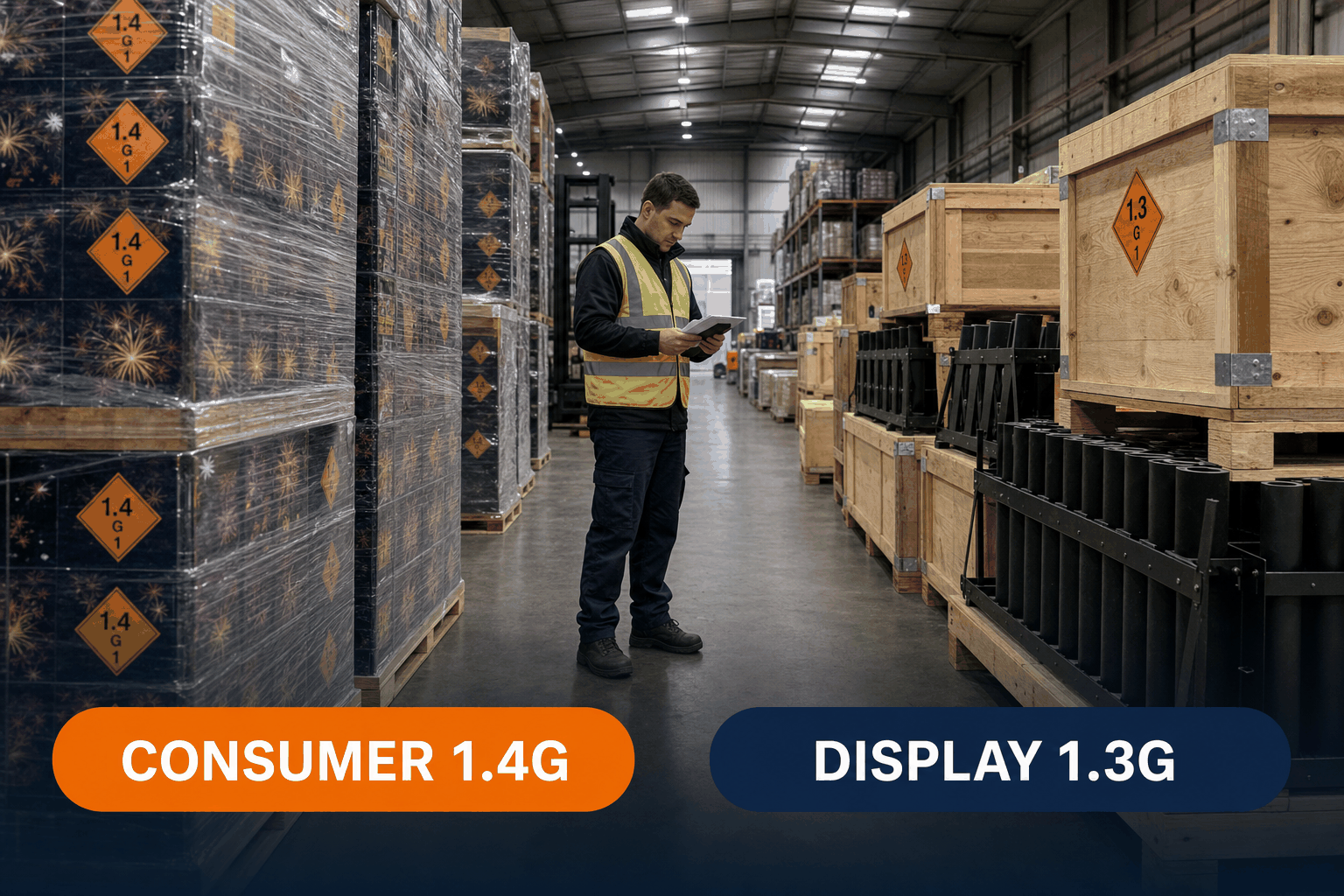
The Short Answer
Consumer fireworks are finished, self-contained products designed for the general public to buy and use where local law allows: cakes, fountains, roman candles, sparklers, small aerials, firecrackers and novelties. Display fireworks are professional ammunition — large aerial shells, oversized finale racks and the mortar-fired items that go with them — that only a licensed operator can buy, store and fire. In one line: consumer product is a packaged item for permitted public use; display product is choreographed by a licensed professional.
Consumer Fireworks
What it is: Finished, self-contained products with printed set-back distances.
Who buys it: The public, retailers, small event hosts.
Who fires it: Adult consumers, subject to local law; no licence needed in most markets.
Usual class: 1.4G (UN0336) / EU F1–F3.
Display (Professional) Fireworks
What it is: Large shells, finale racks and comet or mine banks fired from equipment.
Who buys it: Licensed display companies and pyrotechnicians.
Who fires it: Certified operators only, under a permit.
Usual class: 1.3G (UN0335) / EU F4.
Quick sourcing call: if you sell through retail, run a shop or supply small events, you are in the consumer market — 1.4G, broad legal reach, simple handling. If you serve licensed display companies, you are in the professional market — 1.3G, restricted buyers, specialist freight and storage. Most importers start with a consumer catalog to build volume, then add a display line only once they have licensed buyers and 1.3G logistics arranged. When you request a quote, state your destination market, target class (1.4G or 1.3G), required certificates (CE / CPSC) and MOQ up front.
What Counts as Consumer Fireworks
Consumer fireworks are engineered around one assumption: an untrained person will light them. That single design constraint shapes everything — capped powder loads, self-standing packaging, one external fuse, and set-back distances printed on the carton. The category is defined by a ceiling, not by a product type.
In practice that ceiling is 500 grams of pyrotechnic composition (NEC) per single item under US CPSC rules, while the EU works from the F1–F3 tiers of EN 15947 instead of a single mass figure. There is no one global number: most other markets adopt one of these two frameworks or a national variant, so the ceiling that governs your order is the destination's. Staying within it — plus the tube, effect and construction rules of the destination standard — is what keeps a product in the consumer class:
- Multi-shot cakes — the dominant seller; a whole mini show from one fuse. See the 200 g and 500 g cake guide.
- Fountains — ground effects that spray sparks upward, covered in our fountain fireworks guide.
- Roman candles — single tubes that fire stars in sequence.
- Small aerials — mines, single-shot tubes and reloadable 1.75" consumer shells (US only).
- Firecrackers — noise-only items; see the firecrackers guide.
- Sparklers, novelties and fountains — the low-hazard end of the shelf.
What ties them together isn't shape — it's that each ships as a complete, ready-to-fire unit at 1.4G, needs no separate launch equipment, and is permitted for general sale wherever consumer fireworks are legal. A buyer working this side of the line is running a retail or distribution business.
What Counts as Display Fireworks
Display fireworks pick up exactly where the consumer ceiling ends. Once an item exceeds the US consumer ceiling of 500 g NEC, or is an aerial shell 3 inches (75 mm) and larger, it crosses into professional territory: 1.3G in the UN system, F4 in the EU. These are not products in the retail sense — they're components a professional assembles into a show.
- Aerial display shells — 3" to 12"+ ball and cylinder shells fired from mortars; the backbone of every big show. Detailed in our professional aerial shells guide.
- Large finale racks and cakes — oversized multi-shot units above the consumer NEC limit.
- Comet and mine racks — heavy mid-air effects fired in banks.
One category sits across the line: close-proximity stage pyrotechnics. Indoor gerbs, stage fountains and set pieces are professional-use items by permit — NFPA 1126 in the US, a licensed operator and venue sign-off in most markets — yet by transport class most stage consumables are 1.4G or 1.4S (UN0431), so they ship inside a normal consumer container rather than as 1.3G display goods. Restricted use and restricted stowage are two different questions, and stage pyro is the clearest case where the answers differ. Our stage and close-proximity pyrotechnics guide works through what that means for sourcing.
Firing any of these requires equipment (mortars, racks, an electronic firing system), a credentialed operator, a permit for the specific event, and event liability insurance. The buyer here isn't a retailer — it's a display company selling a service. That is the real division: consumer is a product business; display is a service business. Where that service is sold to a city, the buying runs on a procurement calendar rather than a season — see our guide to municipal fireworks tenders.
Side-by-Side Specifications
The numbers every importer and buyer should have in front of them:
| Dimension | Consumer | Display (Professional) |
|---|---|---|
| UN hazard class | 1.4G (UN0336) | 1.3G (UN0335) |
| EU category | F1, F2, F3 | F4 |
| US classification | Consumer (CPSC, 16 CFR 1507) | Display (ATF-regulated) |
| Canada | Consumer Fireworks (CF) | Display Fireworks (DF) |
| Typical products | Cakes, fountains, roman candles, sparklers, small aerial | 3"+ shells, finale racks, comet and mine banks |
| Power limit | ≤ 500 g NEC per item (US); F1–F3 tiers in the EU | Above consumer limits — permit & licence |
| Who can buy | General public (subject to local law) | Licensed operators / companies only |
| Who can fire | Adult consumers, subject to local law | Certified pyrotechnician under permit |
| Equipment needed | None — self-contained | Mortars, racks, firing system |
| Insurance / permit | None for typical use | $1M–$5M policy + per-event permit |
| Business model | Retail & distribution (product) | Event contracting (service) |
| Liuyang supply form | Mixed 20ft/40ft, private-label, CE/CPSC | Per-caliber lots, proof-fired, 1.3G freight |
The Regulatory Line — 1.4G vs 1.3G
The gap between the two categories is written into transport law before it's anything else. Both classes share Class 1 (explosives) and compatibility group G, but the division digit is the whole story. The full framework is in our UN numbers and shipping classifications guide; here's what it means for the two markets.
UN classes
- 1.4G (UN0336) — consumer. A minor, package-level hazard. Ships at standard dangerous-goods rates and, in moderate quantities, stores without a specialty magazine. This is the class that makes seasonal retail viable.
- 1.3G (UN0335) — display. A mass-fire hazard with minor blast/projection. Needs licensed magazine storage, specialist DG freight (roughly a 30–60% premium over 1.4G) and licensed handling from factory gate to firing site.
For the exact cost and compliance impact of that one digit, our 1.3G vs. 1.4G fireworks guide works through it line by line.
How it maps region by region
- EU (EN 15947 / CE): consumer product is F1 (indoor/very low hazard), F2 (small outdoor) and F3 (larger outdoor) — available to the general public, subject to national age, sale and use restrictions. Display product is F4 — sold and fired by persons with specialist knowledge only. Our EU market page lists the F2/F3 consumer range. Snaps and poppers that sit in F1 are on the wholesale novelty fireworks page.
- US (CPSC / ATF): consumer fireworks fall under CPSC 16 CFR 1507 with the 500 g / 1.75" limits; display fireworks are ATF-regulated, needing a federal explosives licence to store and a state pyrotechnician licence to fire.
- Canada: the split is named directly — Consumer Fireworks (CF) versus Display Fireworks (DF), the latter requiring a Display Fireworks Supervisor.
Those three regimes all assume both markets exist side by side. Some do not, and that is worth planning for rather than discovering. Chile is the clearest case: sale to the public is prohibited and only the professional display group may be imported, with the lower groups excluded outright, so an assortment built for a consumer shelf has no legal buyer there at all. It is a useful reminder that the consumer/display line is not only a spec question — in some countries it decides whether you have a market. Our Latin America sourcing calendar works through what that means for a Chilean buying plan.
A 40ft container of 1.4G consumer product out of Liuyang lands at roughly $4,500–$6,500 ocean freight to the US West Coast. A comparable load of 1.3G display product runs roughly $6,000–$10,000 — about 30–60% more — because 1.3G demands compatible stowage, segregation and specialist handling at every port. That freight delta, plus storage and licensing, is why the two markets rarely share a warehouse. See our import guide for distributors for the full landed-cost picture.
Two Business Models
The consumer/display line isn't only technical — it separates two ways of making money that barely overlap.
Consumer — a product business
Revenue comes from moving volume: buy 1.4G product by the container, distribute to retailers or sell direct seasonally, earn a margin per box. Success rides on assortment, packaging, price and reliable resupply around peak dates. It's inventory-and-logistics work — closer to consumer packaged goods than to pyrotechnics. Barriers to entry are low, competition is on price and brand, and the calendar (New Year, 4th of July, Diwali, national days) drives everything.
Display — a service business
Revenue comes from selling a choreographed show, not a box. The 1.3G product is often a minority of the invoice; the value is in design, licensing, equipment, crew, insurance and safe execution. Margins per event are higher, but so are fixed costs and liability, and the barrier to entry — licences, magazines, track record — is steep. A display company competes on artistry and safety record, not shelf price.
An importer needs to decide which business they're actually in before choosing a catalog. Trying to serve both from one operation means carrying two freight profiles, two storage regimes and two very different customer types at once.
Where the Categories Live
Most product types sit cleanly on one side of the line, though a few straddle it depending on size and market:
- Usually consumer: fountains, sparklers, firecrackers, novelties, roman candles, and cakes up to the destination's consumer ceiling — 500 g NEC in the US, an F2 or F3 rating in the EU — though some markets restrict even these.
- Usually display: aerial shells 3" and larger, oversized finale racks, and comet or mine banks fired from equipment.
- Depends on size and market: reloadable aerial shells (consumer up to 1.75" in some US states, display above that) and large cakes (US-consumer under 500 g NEC, display above). This is where mislabeling and compliance errors most often happen.
- Restricted use, consumer stowage: close-proximity stage pyrotechnics — licensed-operator product that nonetheless ships 1.4G / 1.4S.
The cleanest example of the split within one product family is cakes versus shells — same city, same chemistry, opposite sides of the regulatory line. Our cake vs. shell comparison covers that pair in depth, and the full category guide maps every type to its class. If you are buying for a specific occasion rather than for stock, our guide to sourcing fireworks by event type works the other way round, starting from the clearance and permit reality of the venue and arriving at the class.
Sourcing Both from One Liuyang Factory
Liuyang is one of the world's largest production bases for both consumer fireworks and professional shells, so a single supply chain can serve both markets — as long as you keep the two streams distinct in your own operation.
Consumer line
MOQ is typically one mixed 20ft (~800–1,200 cartons). FOB runs $1–$15 per unit from small novelties to premium 500 g finale cakes. Private-label packaging is standard, with artwork usually included at MOQ — a custom print run adds a one-time plate and a per-SKU minimum (see our private-label & OEM guide). Qualified export factories can provide CE (EN 15947) marking and test consumer lines to CPSC 16 CFR 1507 requirements. Freight is standard 1.4G.
Display line
More specialised. MOQ 1,000–5,000 per caliber; lead time 8–16 weeks for hand-pasted large shells. FOB runs $3–5 for a 3" shell up to $30–50 for an 8". Freight is 1.3G — 30–60% above consumer — and needs licensed storage on arrival. Always insist on video proof-firing of the sample lot before the production order; shell quality varies far more between factories than consumer product does. Our guide to spotting high-quality fireworks covers what to check.
Buying both through one manufacturer means one chemistry, one QC system and one shipping schedule — but the compliance paperwork, storage and end-buyers stay separate on your side of the water.
FAQ
What is the difference between consumer and display fireworks?
Consumer fireworks are finished, self-contained products the general public can buy and use where local law allows — cakes, fountains, roman candles, sparklers and small aerials, all classed 1.4G (UN0336) and capped at 500 g of composition in the US, or rated F1 to F3 in the EU. Display fireworks are professional items — 3"+ aerial shells, finale racks and large finale cakes, classed 1.3G (UN0335) — that only a licensed pyrotechnician can buy, store and fire under a permit. Close-proximity stage pyrotechnics are the exception worth knowing: licensed-operator product that still ships as 1.4G or 1.4S.
Who can legally buy display (professional) fireworks?
In most markets, only licensed display companies or certified pyrotechnicians. Display product is 1.3G / F4, so buying it usually requires a federal explosives licence (ATF in the US), an F4 operator certificate (EU) or a Display Fireworks Supervisor credential (Canada), plus licensed magazine storage. It cannot be sold to the general public at retail.
What licence do I need to fire display fireworks?
It varies by country. In the US you typically need a state-issued display pyrotechnician licence plus a per-event permit from the local fire marshal, and an ATF licence to store. In the EU you need an F4 operator certificate under national rules; in Canada, a Display Fireworks Supervisor certificate. Every show also needs event liability insurance, commonly $1M–$5M.
Are cakes and roman candles always consumer fireworks?
Usually, but not always. Cakes and roman candles are consumer product as long as they stay within the destination's consumer ceiling — 500 g of composition per item in the US, an F2 or F3 rating in the EU — and within local size limits. A finale cake built above that ceiling becomes display product (1.3G / F4). Size and net explosive content decide the class — not the product name — so a large "cake" can legally be a display item.
How does consumer vs display map to EU F1–F4 categories?
Under EN 15947, F1 (indoor/very low hazard), F2 (small outdoor) and F3 (larger outdoor) are the consumer categories, available to the public subject to national age and use rules. F4 is display product for persons with specialist knowledge only. So EU F1–F3 lines up with 1.4G consumer, and F4 lines up with 1.3G display.
Is it cheaper to import consumer or display fireworks?
Consumer product is cheaper to move and hold. A 40ft of 1.4G lands at roughly $4,500–$6,500 ocean freight to the US West Coast; comparable 1.3G display product runs about $6,000–$10,000 — a 30–60% premium — plus licensed magazine storage on arrival. Individual display shells can be cheap per unit, but freight, storage and licensing make the total cost of a display line materially higher.
Can one Liuyang supplier provide both consumer and display lines?
Yes. Liuyang factories commonly produce both, so you can source consumer cakes and professional shells through one chemistry and QC system. What stays separate is on your side: the two lines ship under different classes (1.4G vs 1.3G), need different storage and go to different end-buyers. Tell us your destination market and target class and we prepare per-shipment compliance documentation for each.
Bottom Line
Consumer and display fireworks aren't grades of the same thing — they're two markets that happen to be made in the same city. Consumer product is a self-contained good for the public: 1.4G, retail-legal, simple to move, sold by the box. Display product is professional ammunition for licensed operators: 1.3G, restricted, expensive to freight and store, sold as part of a service. Wherever the destination draws the line — 500 g NEC and 3 inches in the US, the F-category tiers in the EU — that line decides freight, storage, buyer, business model and liability all at once.
For a buyer, the practical step is to know which side of that line you're operating on before you request a quote — because it dictates your certificates, your logistics and your customers. Whichever side you're on, both come out of Liuyang, and a supplier who can document the class and compliance of every shipment is the one worth building on.
Source Consumer or Display Fireworks from Liuyang
Manufacturer of both 1.4G consumer lines and 1.3G professional shells, with per-shipment compliance documentation prepared for your destination market. Tell us your market and target class for a quote and proof-firing sample.
WhatsApp Email