"What's the best type of firework?" is the wrong first question. There is no single best — there's the right product for your legal situation, your venue, your budget and the effect you're after. A backyard host, a retail buyer and a licensed display company are shopping for three completely different things, even when they all type the word "fireworks" into a search bar.
This is the map. It's the hub that connects every detailed fireworks comparison we've written — cake vs shell, peony vs chrysanthemum, 1.3G vs 1.4G and more — into one decision framework. Read this page to figure out which comparison actually matters for you, then follow the links into the deep dives. If the words themselves are the problem — brocade, kamuro, crossette, spider — start instead with our encyclopedia of fireworks effect names, which marks which terms the trade agrees on. The numbers throughout come from day-to-day manufacturing in Liuyang, the Chinese city that makes the majority of the world's fireworks.
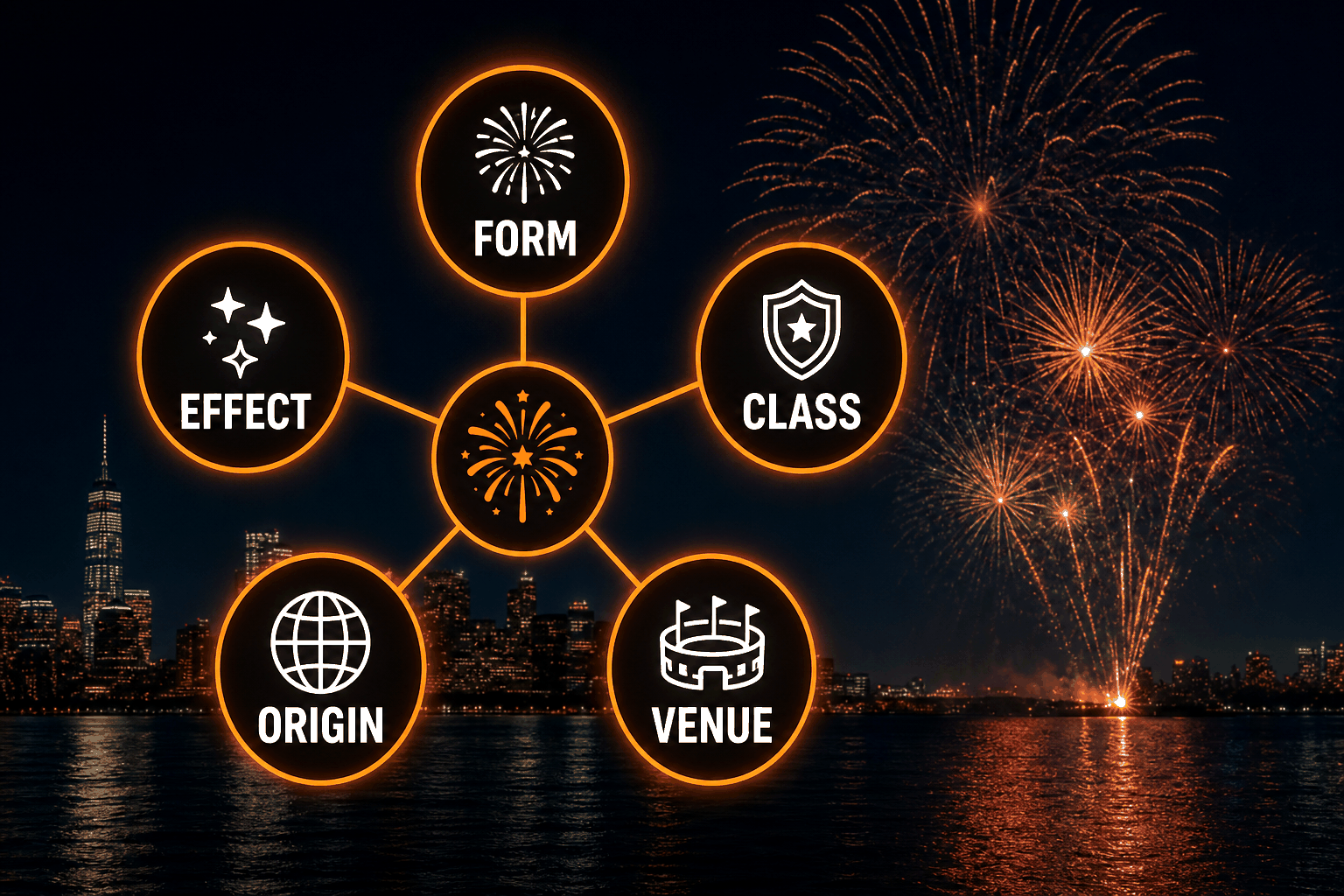
Start Here: The 5 Questions Before You Buy
Every fireworks purchase — one $30 cake or a container of mixed product — is answered by five questions. Work through them in order. The compliance question — use category, not just the UN digit — usually eliminates half your options before you ever look at effects.
- Form: Do you want a self-contained product that fires itself, or single shots a professional assembles into a show?
- Effect & build: What should it look like in the air — one clean sphere, a trailing willow, a slow rhythm of comets?
- Class & compliance: Are you legally allowed to buy, store and fire it? That is a use-category question (consumer vs display), which often tracks the 1.4G vs 1.3G freight label but is not the same thing.
- Origin & tradition: Does the job call for a specific style — Chinese, Italian or Japanese — and what does that mean for cost and lead time?
- Stage, chemistry & safety: Is the venue indoors or crowded, and does it need low-smoke or cold-spark effects?
The one-line map: use category decides what you're allowed to buy; the UN class decides how it ships; form and effect decide what you want; venue and origin decide the details. Each of the five dimensions below has its own head-to-head comparison — this page tells you which one to read.
Dimension 1 — Product Form
The most basic split in the whole industry: is it a finished product that fires a show from a single fuse, or a single projectile that needs equipment and an operator? A multi-shot cake is a box of pre-loaded tubes — light one fuse, step back, watch a 20–90 second sequence. An aerial shell is one paper-wrapped ball or cylinder that does nothing until a licensed operator drops it into a mortar. The roman candle sits between the two on the consumer shelf: a single tube that fires stars one at a time.
Form is where most first-time buyers go wrong, because it's invisible in a product photo — a "big aerial effect" listing might be a consumer cake or a professional shell, and the two are worlds apart in price, handling and legality. Nail form first.
Which form comparison do you need?
If you're deciding between a box that does everything and single shots for a pro show, that's cake vs shell. If you're a retailer choosing what to stack on the seasonal shelf, it's roman candle vs cake — two consumer products competing for the same aisle and the same dollar.
Dimension 2 — Aerial Shell Effect & Build
Once you're in shell territory, the choice moves to what the burst looks like and how the shell is built to produce it. Two shells the same size out of the same mortar can throw completely different pictures. A peony is a clean sphere of colour dots that appears and fades; a chrysanthemum is the same shape but with stars that leave glittering trails. Structurally, a ball shell opens in one symmetrical break — the Eastern, Japanese-perfected tradition — while a cylinder (canister) shell stacks charges to fire timed multi-break sequences, the Italian and Maltese approach.
For a display designer this is the heart of the art: effect and build decide the signature moments of a show, and they drive both the FOB price and how carefully you need to proof-fire a sample lot before committing to a production order.
Which shell comparison do you need?
If you're choosing the look of the burst — clean sphere or trailing rays — that's peony vs chrysanthemum. If you're choosing the construction and firing behaviour — one symmetrical break or a stacked multi-break — that's ball vs cylinder. Background on the whole category lives in our per-caliber aerial shell guide.
Dimension 3 — Class & Compliance
This is the dimension that decides what you can legally do, and it's the one buyers most often skip until it costs them at a port. Every firework carries a UN hazard class. 1.4G (UN0336) is the usual freight class for consumer product: cakes, fountains, roman candles, sparklers and small aerials — shipped at standard dangerous-goods rates, and sold to the public where local law allows. 1.3G (UN0335) is the usual freight class for display product: aerial shells 3 inches and larger and big finale racks — typically restricted to licensed operators, needing licensed magazines and specialist freight that runs 30–60% more. The class digit is a transport label, not a licence.
Which class comparison do you need?
For the market-side view — who can legally buy and fire each product, and the two business models behind them — that's consumer vs display. For the practical impact of the class digit on freight, storage and price, that's 1.3G vs 1.4G. For the full framework of UN numbers, hazard divisions and compatibility groups behind those labels, use our classifications guide.
Dimension 4 — Origin & Tradition
Fireworks carry regional fingerprints. The Chinese tradition — centred on Liuyang — dominates on scale, consistency and cost, and covers the full range from consumer cakes to large display shells. The European tradition, chiefly Italian and Maltese, is known for cylinder shells and hard, precise multi-break effects. The Japanese tradition is famous for perfectly symmetric ball shells with concentric colour rings. For most buyers the practical takeaway is simple: the style you associate with a country can often be manufactured in Liuyang to a comparable standard, usually at lower cost than a small European or Japanese workshop.
Origin matters most when a competition programme or a client specifically wants an "Italian" cylinder look or a "Japanese" hard-break sphere. Otherwise, it's a question of which factory holds the craft, not which country.
Where to read more
For the full sweep of what Liuyang produces across every category — and how the Chinese tradition compares to the European and Japanese schools — start with our complete category guide and the history of Liuyang as the world's fireworks capital.
Dimension 5 — Stage, Chemistry & Safety
The last dimension is about where and how the product burns. Indoor events, stages and crowded venues can't use traditional aerials — they need close-proximity effects. A cold-spark machine throws a cooler, lower-temperature spray that's often approved for indoor use when run at its rated clearance and signed off by the venue, where a traditional gerb or consumer fountain burns far hotter; stage gerbs and fountains still need controlled clearance and, in most markets, a permit. Underneath all of it is chemistry: the difference between black powder (a propellant and lift charge that pushes) and flash powder (an explosive that reports) explains why some products throw stars gently and others crack like a salute.
This dimension is where safety planning lives — smoke, fall-out, spectator distances and venue type. For any indoor or stage event, it's the first thing to sort out, not the last.
Where to read more
For indoor and stage effects, start with our close-proximity pyrotechnics guide and the fountain category. For the chemistry of why fireworks push, throw and bang differently, our science pieces on stars and firecrackers break it down.
Choose by Scenario
If you'd rather work backwards from your event, start here. Find the row that matches your situation, note the best-fit category, then jump to the comparison that settles the final choice. For the constraints that sit above the product choice — clear radius, who is licensed to fire, and how far out the date is — see our guide to sourcing fireworks by event type.
| Your Scenario | Best-Fit Category | Read Next |
|---|---|---|
| Backyard / small party | Consumer cakes + fountains | Cake vs. Shell |
| Outdoor wedding | Cakes, fountains & roman candles | Roman Candle vs. Cake |
| Indoor / stage event | Cold spark & low-smoke effects | Cold Spark vs. Gerb |
| Retail shelf / distribution | Consumer mix (cakes, candles, sparklers) | Shelf-Mix Guide |
| Professional choreographed display | Aerial shells (ball & cylinder) | Ball vs. Cylinder |
| Competition / signature aerial | Cylinder & specialty shells | Peony vs. Chrysanthemum |
| Import compliance planning | Class-driven catalog & freight | 1.3G vs. 1.4G |
Notice the pattern: consumer scenarios point to cakes, candles and fountains; professional scenarios point to shells; and everything is gated by class. That's the whole framework in one table.
Sourcing All of It From One Liuyang Factory
The reason this guide can cover every category is that nearly all of them are made in the same place. Liuyang produces around 60% of the world's fireworks because the entire supply chain — paper, chemicals, fuse cord, tubes, adhesives, packaging — is concentrated within a short radius of the city. That's why importers and display companies can consolidate most of a program — consumer cakes, roman candles, fountains, close-proximity pyrotechnics and professional shells — through a single Liuyang factory, under one QC standard and on one delivery schedule (electric cold-spark machines are the main exception, since they're SFX hardware rather than a pyrotechnic).
For a new importer, the normal starting point is a mixed 20ft container of consumer product — cakes, candles, fountains and sparklers — at MOQ, with private-label packaging available. Low-hazard wholesale novelty fireworks often ride the same 20ft. Display shells are added per caliber once licensed buyers and 1.3G logistics are in place. Whatever the mix, insist on video proof-firing of the sample lot before the production order; factory-to-factory quality varies far more than country-to-country. Our guide on how to spot high-quality fireworks covers what to check, and the shipping cost breakdown shows how class and lane drive landed cost.
FAQ
What are the main types of fireworks, and how do I choose between them?
There are roughly a dozen consumer and display categories, but almost every buying decision comes down to five questions: the product form (a self-contained cake or a single shot), the aerial effect you want, the legal use category you're allowed to handle (consumer vs display — often aligned with 1.4G vs 1.3G, but not the same label), origin and tradition, and your venue's smoke and safety limits. Start with the use category and the tested UN class — together they decide what you can buy, how it ships, and who can fire it.
What is the difference between consumer and professional (display) fireworks?
Consumer fireworks usually ship as 1.4G (UN0336) — cakes, fountains, roman candles and sparklers — and are sold to the public where local law allows. Professional display fireworks usually ship as 1.3G (UN0335) — aerial shells 3 inches and larger, plus big finale racks — restricted to licensed pyrotechnicians, with licensed storage and specialist dangerous-goods freight. The class digit is a transport label, not the licence that separates the two markets.
Which fireworks can I legally buy and set off myself?
In most markets the public-sale range is consumer product — typically multi-shot cakes, roman candles, fountains, sparklers and small aerials that ship as 1.4G. Large aerial shells (typically 1.3G / display) need a pyrotechnician licence to buy, store and fire. The UN class is not itself that licence, and a few markets are permit-only even for consumer products. Always check your local regulations first.
Should I buy cakes or shells?
Cakes for almost anything consumer — one fuse, no equipment, and legal in most markets. Shells only if you're a licensed operator running a real display with mortars, a firing system and insurance. Most professional shows use both: shells for the big high-altitude signatures and cakes for mid-air body work and the finale wall of fire.
What fireworks are safe for an indoor event or wedding?
Cold-spark machines and low-smoke close-proximity effects, not traditional aerials. A cold-spark fountain throws a cool, low-temperature spray used indoors and close to performers, while consumer gerbs and fountains are outdoor products and spec-grade stage gerbs can go indoors only under proximate-pyrotechnic permits. For any indoor, stage or first-dance moment, work from the close-proximity category and keep aerial shells strictly outdoors.
How much does it cost to import a container of fireworks from China?
As a rough guide, a 20ft FCL of 1.4G consumer fireworks ships for around $3,000–$6,500 in ocean freight to Middle East ports and $4,500–$9,500 to Latin America, plus product cost; exact figures depend on lane, season and carrier. 1.3G display shells run about 30–60% more because of specialist stowage, segregation and handling. Product FOB in Liuyang is roughly $1–15 per cake and $3–50 per shell depending on size. See our shipping cost breakdown for lane-by-lane ranges.
What is the minimum order to buy fireworks from a Liuyang factory?
For consumer cakes, MOQ is typically one mixed 20ft container (about 800–1,200 cartons), with private-label packaging available at MOQ. Display shells are ordered per caliber, commonly 1,000–5,000 units, with 8–16 week lead times for hand-pasted large calibers. Mixed containers of cakes, candles, fountains and sparklers are the normal starting point for new importers.
Bottom Line
Choosing fireworks isn't about finding the "best" one — it's about answering five questions in order: form, effect, class, origin, and venue. Class narrows the field to what you can legally handle; form and effect narrow it to what you actually want; origin and venue fill in the details. Every head-to-head comparison linked above sits inside that framework, so you never have to guess which one applies.
And because nearly every category is made in Liuyang, you can source the whole spread — consumer and professional — from a single factory whose quality you've verified with a proof-firing. Match the product to your legal situation and your venue, confirm quality before the production order, and the rest is logistics. If you're still sizing up the supplier itself, our sourcing and supplier-trust playbook covers verifying the factory and de-risking the order.
Source Every Category Direct from Liuyang
One Liuyang manufacturer for consumer cakes, roman candles, fountains, close-proximity effects and 3" to 12" display shells, with per-shipment compliance documents prepared for your destination market. Ask for the catalogue and a proof-firing sample to check quality before you commit.
WhatsApp Email